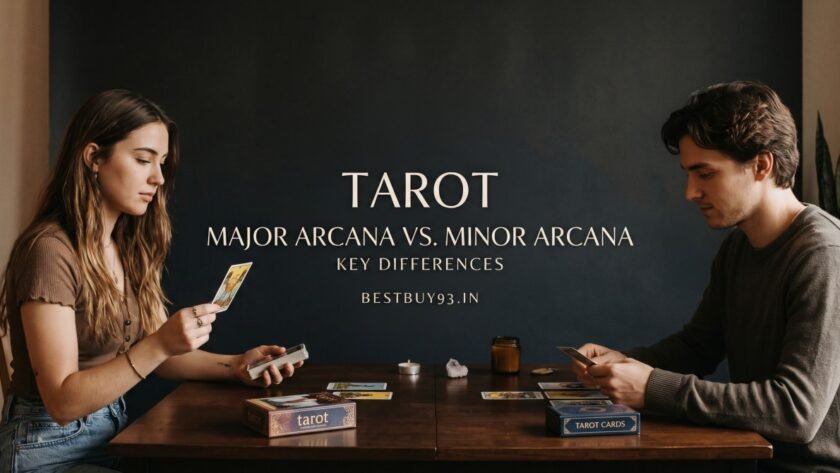

If you’ve ever explored Tarot cards, you’ve probably come across two terms: Major Arcana and Minor Arcana. At first, they might sound like complicated Tarot terminology, but understanding these two groups is actually one of the easiest ways to begin learning Tarot.
A traditional Tarot deck contains 78 cards, divided into two main groups: 22 Major Arcana cards and 56 Minor Arcana cards. Although both groups are important in a Tarot reading, they serve different purposes.
The Major Arcana generally represents significant life themes, personal transformation, spiritual lessons and important turning points. The Minor Arcana, on the other hand, focuses more on everyday experiences, relationships, emotions, decisions, challenges and practical situations.
Think of the Major Arcana as the bigger chapters of your life story and the Minor Arcana as the everyday moments that fill those chapters.
In this beginner-friendly guide, we’ll explore the differences between Major Arcana and Minor Arcana, understand all four Minor Arcana suits, look at important card examples and learn how these two groups work together during a Tarot reading.
Buy Tarot Cards on Amazon India
What Is Tarot?
Tarot is a system of cards traditionally used for symbolic interpretation, reflection and divination. A standard Tarot deck contains 78 cards, each featuring different illustrations, symbols and traditional interpretations.
These cards are divided into two categories:
- Major Arcana: 22 cards representing significant themes, archetypes and life lessons.
- Minor Arcana: 56 cards representing everyday situations, experiences and influences.
The word Arcana comes from the Latin word associated with secrets or mysteries. In Tarot terminology, the two groups are commonly understood as the major mysteries and the lesser mysteries.
One important thing to remember is that Tarot interpretations are not scientifically established predictions of the future. Many people use Tarot as a spiritual practice, a symbolic storytelling system or a tool for personal reflection.
What Is Major Arcana in Tarot?
The Major Arcana consists of 22 cards, usually numbered from 0 to 21. These cards represent significant archetypes, life experiences, personal development and broader spiritual themes.
Some familiar Major Arcana cards include:
- The Fool
- The Magician
- The High Priestess
- The Empress
- The Emperor
- The Lovers
- The Chariot
- Strength
- The Hermit
- Wheel of Fortune
- Death
- The Tower
- The Star
- The Moon
- The Sun
- The World
Major Arcana cards are often associated with important moments or themes in a person’s life. They may symbolise a new beginning, a major decision, an unexpected change, a period of self-discovery or the completion of an important chapter.
For example, The Fool traditionally represents beginnings, openness and taking a leap into the unknown. The World is commonly associated with completion, achievement and fulfilment.
When several Major Arcana cards appear in a reading, some Tarot readers interpret this as an indication that the reading is highlighting broader life themes rather than only small everyday matters.
The Fool’s Journey: Understanding the Major Arcana
A popular way of understanding the Major Arcana is through a concept known as The Fool’s Journey.
The Fool, numbered 0, represents the beginning of a journey. As the sequence progresses, the cards introduce different experiences, lessons, challenges and stages of development.
The journey concludes with The World, numbered 21, which traditionally represents completion and integration.
This is a widely used interpretive framework rather than a compulsory sequence that every Tarot reader must follow.
What Are the 22 Major Arcana Cards and Their Meanings?
Here is a beginner-friendly overview of all 22 Major Arcana cards.
| No. | Major Arcana Card | Common Traditional Associations |
|---|---|---|
| 0 | The Fool | New beginnings, freedom, adventure |
| I | The Magician | Initiative, skill, manifestation |
| II | The High Priestess | Intuition, mystery, inner knowledge |
| III | The Empress | Abundance, nurturing, creativity |
| IV | The Emperor | Structure, authority, stability |
| V | The Hierophant | Tradition, learning, spiritual guidance |
| VI | The Lovers | Relationships, values, important choices |
| VII | The Chariot | Determination, direction, control |
| VIII | Strength | Courage, patience, inner strength |
| IX | The Hermit | Reflection, solitude, wisdom |
| X | Wheel of Fortune | Cycles, change, turning points |
| XI | Justice | Fairness, accountability, truth |
| XII | The Hanged Man | Surrender, pause, new perspective |
| XIII | Death | Transformation, endings, renewal |
| XIV | Temperance | Balance, moderation, harmony |
| XV | The Devil | Attachment, temptation, limitations |
| XVI | The Tower | Disruption, sudden change, revelation |
| XVII | The Star | Hope, inspiration, renewal |
| XVIII | The Moon | Uncertainty, dreams, subconscious themes |
| XIX | The Sun | Joy, clarity, success |
| XX | Judgement | Awakening, reflection, evaluation |
| XXI | The World | Completion, fulfilment, achievement |
Note: These are common upright associations. Individual interpretations depend on the Tarot deck, the surrounding cards, the question and the reader’s interpretive tradition.
What Is Minor Arcana in Tarot?
The Minor Arcana contains 56 cards and represents everyday experiences, situations and influences.
Unlike the Major Arcana, which focuses on larger themes and archetypes, the Minor Arcana is often interpreted through more specific aspects of daily life.
For example:
- A relationship conversation.
- A financial decision.
- A new work opportunity.
- A personal disagreement.
- An emotional experience.
- A creative project.
- A practical challenge.
The Minor Arcana is divided into four suits:
- Wands
- Cups
- Swords
- Pentacles
Each suit contains 14 cards:
- Ace
- Two through Ten
- Page
- Knight
- Queen
- King
That gives us 56 Minor Arcana cards in total.
Understanding the Four Minor Arcana Suits
Each suit is traditionally associated with a particular element and area of human experience.
A. Suit of Wands – Fire Element
Common themes: Passion, creativity, ambition and action</text>
The Suit of Wands is associated with the element of Fire. It often represents motivation, enthusiasm, inspiration, personal ambition and creative energy.
These cards can appear in readings involving career plans, new projects, entrepreneurial ideas and personal goals.
Some common associations include:
- Ace of Wands: Inspiration and new creative opportunities.
- Three of Wands: Expansion and looking towards the future.
- Five of Wands: Competition and disagreements.
- Ten of Wands: Responsibility and feeling overburdened.
- Queen of Wands: Confidence, independence and charisma.
Example: If you’re considering starting a new business and the Ace of Wands appears, a Tarot reader might interpret it as a symbol of enthusiasm, inspiration or a promising creative beginning.
B. Suit of Cups – Water Element
Common themes: Emotions, relationships, intuition and connection</text>
The Suit of Cups is associated with Water and represents the emotional side of life.
These cards frequently appear in readings involving romantic relationships, friendships, family connections, emotional decisions and personal feelings.
Some common associations include:
- Ace of Cups: New emotional beginnings.
- Two of Cups: Partnership and mutual connection.
- Three of Cups: Friendship and celebration.
- Five of Cups: Disappointment and emotional loss.
- Ten of Cups: Emotional fulfilment and family harmony.
Example: If someone asks about a developing relationship and the Two of Cups appears, it may traditionally be interpreted as mutual affection, partnership or emotional connection.
C. Suit of Swords – Air Element
Common themes: Thoughts, communication, logic and challenges</text>
The Suit of Swords is associated with the element of Air. It represents the mind, communication, reasoning, decisions and conflicts.
These cards may appear in readings concerning difficult conversations, professional disagreements, mental challenges or important decisions.
Some common associations include:
- Ace of Swords: Clarity and new ideas.
- Three of Swords: Heartbreak and emotional pain.
- Six of Swords: Transition and moving forward.
- Eight of Swords: Feeling restricted or trapped.
- Queen of Swords: Independent thinking and clear communication.
Example: If someone is struggling to make an important decision, the Ace of Swords may be interpreted as a symbol of clarity, truth and a fresh perspective.
D. Suit of Pentacles – Earth Element
Common themes: Money, work, stability and material security</text>
The Suit of Pentacles is associated with Earth. It traditionally represents practical matters such as finances, career, resources, health routines and long-term stability.
These cards are particularly relevant in readings about work, business, savings, education and material goals.
Some common associations include:
- Ace of Pentacles: A new practical or financial opportunity.
- Three of Pentacles: Teamwork and skill development.
- Four of Pentacles: Saving and holding onto resources.
- Six of Pentacles: Generosity and giving.
- Ten of Pentacles: Long-term security and family legacy.
Example: If someone is considering a new job or business opportunity, the Ace of Pentacles may symbolise a practical beginning or an opportunity with long-term potential.
Major Arcana vs Minor Arcana: Key Differences
Now that we’ve explored both groups, let’s compare them directly.
| Feature | Major Arcana | Minor Arcana |
|---|---|---|
| Number of cards | 22 | 56 |
| Main focus | Major themes and life lessons | Everyday experiences |
| Card numbering | 0–21 | Ace–10 and court cards |
| Structure | One sequence of 22 cards | Four suits of 14 cards each |
| Common themes | Transformation, purpose, major choices | Relationships, work, emotions and practical matters |
| Examples | The Fool, The Lovers, The Tower | Two of Cups, Three of Swords, Ace of Pentacles |
| Reading emphasis | Broader life themes | Specific situations and influences |
The Simplest Way to Remember the Difference
Think of it this way:
- Major Arcana: The bigger picture of your life.
- Minor Arcana: The everyday experiences that contribute to that bigger picture.
For example, The Tower may symbolise a major disruption or a sudden change in a reading. The Five of Pentacles may highlight a more specific experience involving financial insecurity or feeling unsupported.
Both cards can be meaningful, but they operate at different interpretive levels.
How Do Major Arcana and Minor Arcana Work Together in a Tarot Reading?
Major and Minor Arcana cards are not meant to compete with one another. They work together to create a broader interpretation of a reading.
The Major Arcana may introduce the central theme, while the Minor Arcana provides additional context about how that theme is appearing in everyday life.
Consider these examples.
Example 1: Career Reading
Imagine a reading includes:
- The Chariot – Determination, direction and progress.
- Three of Pentacles – Collaboration and skill development.
- Eight of Pentacles – Practice, dedication and improvement.
A reader might interpret this combination as a period of professional development that requires focus, teamwork and consistent effort.
Example 2: Relationship Reading
Imagine the cards are:
- The Lovers – Relationship choices and values.
- Two of Cups – Emotional connection and partnership.
- Five of Swords – Conflict or communication difficulties.
A reader might interpret this combination as a relationship involving genuine connection but also a need to address disagreements or unhealthy communication patterns.
Example 3: Personal Growth Reading
Imagine the cards are:
- The Hermit – Self-reflection and inner wisdom.
- Ace of Wands – Fresh inspiration.
- Six of Swords – Transition and moving forward.
This combination might suggest a period of reflection followed by renewed motivation and gradual change.
These examples demonstrate symbolic interpretation, not guaranteed predictions or fixed outcomes.
How to Identify Major and Minor Arcana Cards
If you’re new to Tarot, here are a few easy ways to recognise the two groups.
Look at the Card Names
Major Arcana cards usually have distinctive names such as The Fool, The Empress, The Hermit, Death and The Sun.
Minor Arcana cards generally have a suit and rank, such as the Seven of Cups, King of Wands or Ace of Pentacles.
Look at the Card Numbering
Major Arcana cards are commonly numbered from 0 to XXI.
Minor Arcana cards follow a different structure: Ace through Ten, followed by Page, Knight, Queen and King.
Look at the Suit Symbol
Minor Arcana cards belong to one of four suits:
- Wands: Usually illustrated with wooden staffs.
- Cups: Usually illustrated with cups or goblets.
- Swords: Usually illustrated with swords.
- Pentacles: Usually illustrated with coins or pentacle symbols.
Learn Through Repetition
You don’t need to memorise all 78 cards in one day. Start with the four suits and a handful of familiar Major Arcana cards. Over time, you’ll begin recognising recurring themes and symbols.
In Case You Are Looking For –
- How Is Love Compatibility for Mulank 1?
- Which Gemstones Are Associated with Mulank 1?
- How Do Indian & Western Birthstone Traditions Differ?
Frequently Asked Questions
1. How many Major Arcana cards are there in Tarot?
A standard Tarot deck contains 22 Major Arcana cards, numbered from 0 to 21.
2. How many Minor Arcana cards are there?
There are 56 Minor Arcana cards divided into four suits: Wands, Cups, Swords and Pentacles.
3. Which is more important: Major Arcana or Minor Arcana?
Neither is universally more important. The Major Arcana often highlights broader life themes, while the Minor Arcana provides details about everyday situations and influences.
4. What does it mean when a Tarot reading has many Major Arcana cards?
Some readers interpret several Major Arcana cards as an indication that the reading is highlighting important themes, personal development or significant changes. The interpretation depends on the question and surrounding cards.
5. What are the four suits of Minor Arcana?
The four suits are Wands, Cups, Swords and Pentacles. They are traditionally associated with Fire, Water, Air and Earth respectively.
6. Are court cards part of the Minor Arcana?
Yes. Each Minor Arcana suit contains four court cards: Page, Knight, Queen and King.
7. Can Minor Arcana cards predict everyday events?
In Tarot traditions, Minor Arcana cards are often interpreted in relation to everyday situations, relationships, work and decisions. However, Tarot readings should not be treated as scientifically verified predictions.
8. What is The Fool’s Journey?
The Fool’s Journey is a popular interpretive framework that views the 22 Major Arcana cards as stages in a symbolic journey of experience, learning and personal development.
9. Can a Tarot reading contain only Minor Arcana cards?
Yes. A Tarot spread can contain only Minor Arcana cards. The interpretation will depend on the cards, their positions and the question being explored.
10. Can beginners learn Tarot using Major Arcana first?
Absolutely. Learning the 22 Major Arcana cards first is a popular approach because it introduces many of Tarot’s central archetypes and themes. You can then learn the four Minor Arcana suits.
Final Thoughts: Understanding the Two Sides of Tarot
The difference between Major Arcana and Minor Arcana becomes much easier to understand once you look at the purpose of each group.
The Major Arcana consists of 22 cards associated with significant themes, life lessons, personal transformation and broader experiences. The Minor Arcana consists of 56 cards that explore everyday situations through four suits: Wands, Cups, Swords and Pentacles.
Neither group should be studied in isolation. Together, they create a detailed symbolic language that Tarot readers use to interpret questions, experiences and different aspects of life.
If you’re just starting your Tarot journey, begin with the 22 Major Arcana cards, learn the four Minor Arcana suits and gradually explore how their meanings connect.
You don’t need to memorise all 78 cards overnight. Take your time, observe the illustrations, understand the traditional symbolism and enjoy discovering the stories behind each card.