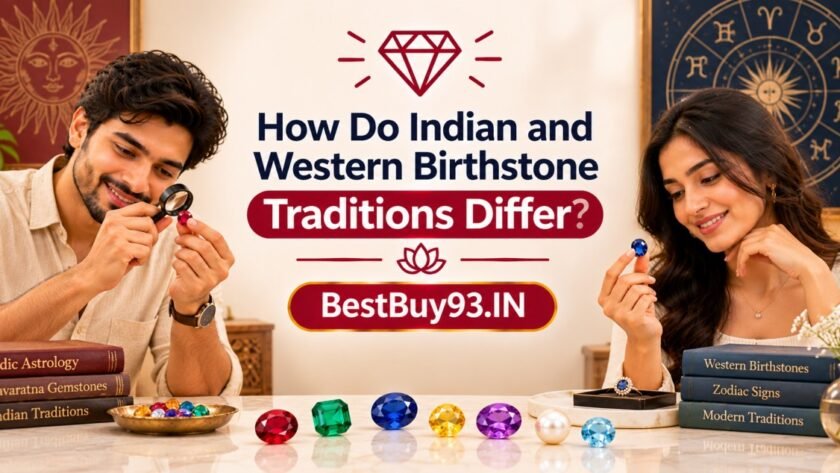

Have you ever wondered why someone born in January is associated with Garnet in a Western birthstone chart, while an Indian astrologer might recommend an entirely different gemstone based on their birth chart?
That’s because Indian and Western birthstone traditions follow different systems of gemstone selection.
In Western jewellery traditions, birthstones are generally associated with the month of birth. January has Garnet, February has Amethyst, March has Aquamarine and so on. These gemstones are commonly worn as personalised jewellery, birthday gifts and symbolic accessories.
Indian traditions, particularly Vedic astrology (Jyotish), approach gemstones differently. Instead of simply selecting a stone based on the month someone was born, astrologers traditionally consider planetary positions, the birth chart, the ascendant (Lagna), and other astrological factors. The Navaratna system, which features nine gemstones associated with celestial bodies, is another important part of Indian gemstone heritage.
So, are Indian birthstones and Western birthstones the same? Can someone wear both? And which tradition should you follow when buying a gemstone?
In this guide, we’ll explore the history, differences, gemstone associations, cultural meanings and jewellery choices behind both traditions.
Buy Latest Gemstones from Amazon India
What Are Birthstones?
Birthstones are gemstones traditionally associated with a person’s birth month, zodiac sign or other cultural and astrological systems.
People wear birthstone jewellery for several reasons:
- Personal symbolism and identity.
- Birthday gifts and meaningful jewellery.
- Cultural and religious traditions.
- Traditional beliefs about protection and prosperity.
- A personal connection with a particular gemstone or colour.
For example, Garnet is commonly associated with January, Amethyst with February and Emerald with May in modern Western birthstone charts.
However, not every birthstone tradition follows the same rules.
Some systems assign gemstones according to the month of birth, while others connect them with zodiac signs, planets or astrological calculations.
Important distinction: A birthstone is a cultural or traditional association, not a scientifically established method of influencing someone’s health, personality, wealth or future.
What Are Western Birthstone Traditions?
Western birthstone traditions are most commonly recognised through the twelve-month birthstone chart used by jewellery retailers.
The historical background is more complicated than a simple list of twelve gemstones.
One frequently discussed historical connection is the twelve gemstones described on the Breastplate of Aaron in the biblical Book of Exodus. Later writers connected these twelve stones with the twelve months and zodiac signs.
The modern custom of wearing one gemstone according to your birth month developed in Europe over several centuries, particularly during the 16th to 18th centuries.
A major development came in 1912, when the National Association of Jewelers in the United States standardised a birthstone list. The list has subsequently been updated with additional gemstone options.
Today, Jewelers of America publishes a recognised version of the modern monthly birthstone list. <a href=”https://www.jewelers.org/find-a-jeweler/buying-guides/birthstones”>Explore the Jewelers of America birthstone guide</a>.
How Does the Western System Work?
The Western system is relatively straightforward:
- Identify your birth month.
- Find the gemstone traditionally assigned to that month.
- Choose jewellery featuring that gemstone.
- Wear it as a personal accessory or meaningful gift.
For example, someone born in May can choose Emerald jewellery because Emerald is traditionally associated with that month.
The system is generally used for jewellery, gifting and personal symbolism rather than individual astrological chart calculations.
Western Birthstones by Month: January to December
Here’s a quick reference chart of commonly recognised modern Western birthstones.
| Birth Month | Western Birthstone | Common Traditional Associations |
|---|---|---|
| January | Garnet | Friendship, commitment and protection |
| February | Amethyst | Peace, sincerity and clarity |
| March | Aquamarine | Courage, calmness and communication |
| April | Diamond | Strength, love and purity |
| May | Emerald | Renewal, love and prosperity |
| June | Pearl, Moonstone, Alexandrite | Wisdom, intuition and transformation |
| July | Ruby | Passion, vitality and confidence |
| August | Peridot, Spinel | Renewal, positivity and strength |
| September | Sapphire | Wisdom, loyalty and sincerity |
| October | Opal, Tourmaline | Creativity, hope and individuality |
| November | Topaz, Citrine | Warmth, abundance and friendship |
| December | Turquoise, Tanzanite, Blue Zircon | Good fortune, protection and wisdom |
Note: Birthstone associations and alternative stones can vary between jewellery organisations and traditional charts. The meanings listed are popular symbolic interpretations, not scientific properties.
Why Do Some Months Have Multiple Birthstones?
You may notice that June, August, October, November and December have multiple gemstone options.
This is because birthstone charts have evolved over time. Additional stones have been recognised as alternatives, reflecting changing jewellery preferences, gemstone availability and industry standards.
For example:
- June includes Pearl, Moonstone and Alexandrite.
- August includes Peridot and Spinel.
- October includes Opal and Tourmaline.
- November includes Topaz and Citrine.
- December includes Turquoise, Tanzanite and Blue Zircon.
This gives jewellery buyers more choices in terms of colour, design and budget.
What Are Indian Birthstone Traditions?
Indian gemstone traditions have a different foundation.
In India, gemstones have long been associated with religious symbolism, traditional beliefs, astrology and royal jewellery.
One particularly important system is Vedic astrology, also known as Jyotish.
Unlike the Western monthly birthstone chart, Vedic astrology does not generally assign one universal gemstone to everyone born in a particular month.
Instead, gemstone recommendations are traditionally connected with planetary influences and an individual’s horoscope.
An astrologer may examine:
- Date of birth.
- Exact time of birth.
- Place of birth.
- Ascendant or Lagna.
- Planetary positions.
- Planetary strength and house ownership.
- The overall birth chart.
Depending on the astrological tradition and chart interpretation, a particular gemstone may be recommended.
Common Gemstones Associated with Indian Astrology
| Gemstone | Traditional Indian Name | Associated Planet |
|---|---|---|
| Ruby | Manik | Sun (Surya) |
| Pearl | Moti | Moon (Chandra) |
| Red Coral | Moonga | Mars (Mangal) |
| Emerald | Panna | Mercury (Budh) |
| Yellow Sapphire | Pukhraj | Jupiter (Guru) |
| Diamond | Heera | Venus (Shukra) |
| Blue Sapphire | Neelam | Saturn (Shani) |
| Hessonite Garnet | Gomed | Rahu |
| Cat’s Eye Chrysoberyl | Lehsunia | Ketu |
These nine gemstone associations form the foundation of the traditional Navaratna system.
It is important to understand that this is not a universal Indian birthstone chart. Individual gemstone recommendations in Jyotish are traditionally made through horoscope interpretation, not simply by matching a birth month to a gemstone.
Understanding the Navaratna Gemstone System
Navaratna is a Sanskrit term meaning “nine gems.”
It refers to a traditional arrangement of nine gemstones associated with the nine celestial influences used in Indian astrology.
The Navaratna system is an important part of Indian jewellery heritage. These gemstones have appeared in traditional ornaments, royal jewellery and decorative objects.
According to the traditional planetary associations:
| Planetary Influence | Gemstone | Traditional Indian Name |
|---|---|---|
| Sun | Ruby | Manik |
| Moon | Pearl | Moti |
| Mars | Red Coral | Moonga |
| Mercury | Emerald | Panna |
| Jupiter | Yellow Sapphire | Pukhraj |
| Venus | Diamond | Heera |
| Saturn | Blue Sapphire | Neelam |
| Rahu | Hessonite Garnet | Gomed |
| Ketu | Cat’s Eye | Lehsunia |
Why Is Navaratna Jewellery Special?
Traditional Navaratna jewellery brings all nine gemstones together in a prescribed arrangement.
The stones represent different planetary influences, making the jewellery culturally and symbolically significant.
One traditional arrangement places Ruby, representing the Sun, in the centre, with the other gemstones arranged around it.
Navaratna jewellery is also an important part of India’s historical gem and jewellery traditions. The Gemological Institute of America documents historical Indian Navaratna jewellery and its nine gemstone associations. <a href=”https://www.gia.edu/jewels-of-india”>Explore GIA’s Jewels of India collection</a>.
Is Navaratna the Same as Wearing Your Birthstone?
No.
A Western birthstone is generally selected according to the month of birth.
Navaratna jewellery combines nine gemstones in one traditional arrangement.
An individual Vedic gemstone recommendation, meanwhile, may involve selecting one particular stone based on a horoscope.
These are three related but different concepts.
Indian vs Western Birthstone Traditions: Key Differences
Now let’s compare the two systems side by side.
| Comparison | Western Birthstone Tradition | Indian Vedic Gemstone Tradition |
|---|---|---|
| Main basis | Birth month | Birth chart and planetary associations |
| Selection method | Month of birth | Astrological interpretation |
| Number of gemstones | Usually one or more per month | Nine principal planetary gemstones in Navaratna |
| Zodiac connection | Historical associations with months and zodiac traditions | Uses Jyotish planetary and horoscope frameworks |
| Popular examples | Garnet, Amethyst, Emerald, Ruby | Manik, Moti, Panna, Pukhraj |
| Common purpose | Jewellery, gifts and personal symbolism | Traditional astrological and cultural use |
| Personalisation | Generally based on birth month | Traditionally based on individual horoscope |
| Jewellery styles | Rings, pendants, bracelets and necklaces | Rings, pendants, Navaratna ornaments and other traditional jewellery |
The Biggest Difference
The most important difference is the method of selection.
Western birthstones are primarily month-based, whereas Vedic astrological gemstones are traditionally chart-based.
For example, someone born in September may choose Sapphire as their Western birthstone.
However, a Vedic astrologer would not automatically recommend Blue Sapphire simply because that person was born in September.
The recommendation would traditionally depend on the person’s horoscope and the astrological interpretation being followed.
Why the Same Gemstone Can Have Different Meanings
Here’s where things get particularly interesting!
The same gemstone can appear in both Indian and Western traditions, but its cultural and symbolic associations may differ.
Let’s look at some examples.
Ruby: Manik
Ruby is traditionally associated with July in the Western monthly birthstone chart.
In Indian Vedic astrology, Ruby is associated with Surya, the Sun.
It is traditionally connected with leadership, authority, vitality and confidence in astrological symbolism.
Ruby also has a long history in Indian royal jewellery and ornamental traditions.
Emerald: Panna
Emerald is the Western birthstone for May.
In Indian astrology, Emerald is associated with Budh, or Mercury.
Traditional interpretations connect Mercury with communication, learning, intellect and analytical abilities.
The gemstone therefore has different selection contexts in the two systems.
Pearl: Moti
Pearl is one of the traditional birthstone options for June in modern Western charts.
In Indian astrology, Pearl is associated with Chandra, the Moon.
It is traditionally linked with calmness, emotional balance and the Moon’s symbolic qualities.
Blue Sapphire: Neelam
Blue Sapphire is the commonly recognised Western birthstone for September.
In Indian astrology, it is associated with Shani, or Saturn.
It has an important place in traditional Jyotish gemstone discussions. Some astrologers recommend it only after carefully examining the horoscope.
It should not be purchased as an astrological remedy simply because someone was born in September.
Amethyst
Amethyst is February’s Western birthstone.
It is often associated with peace, sincerity and spiritual symbolism in Western jewellery traditions.
Although Amethyst is used in contemporary Indian jewellery and crystal practices, it should not automatically be treated as an equivalent replacement for a classical Vedic planetary gemstone.
Can You Wear Indian and Western Birthstones Together?
Yes!
There is no general jewellery rule that prevents someone from wearing both a Western birthstone and an Indian traditional gemstone.
For many people, the choice is simply about personal preference, design and cultural connection.
For example:
- Someone born in February may wear Amethyst jewellery as their Western birthstone.
- Someone born in May may choose Emerald jewellery as a personalised birthday accessory.
- Someone interested in Indian heritage may prefer traditional Navaratna jewellery.
- Someone following Vedic astrology may seek an individual gemstone recommendation from a qualified practitioner.
However, if you are wearing gemstones specifically for astrological reasons, don’t assume that combining different stones will automatically produce a particular result.
Traditional astrological recommendations depend on the system and horoscope interpretation being followed.
Jewellery Ideas for Combining Both Traditions
You can explore these designs:
- Birthstone pendant: Wear your Western birthstone as a simple everyday accessory.
- Traditional gemstone ring: Choose an Indian-inspired gemstone design.
- Navaratna pendant: Explore traditional nine-gem jewellery.
- Birthstone bracelet: Combine gemstones that have personal or family significance.
- Custom jewellery: Create a design featuring gemstones connected with your birth month and cultural background.
The best combination is one that you genuinely enjoy wearing.
Which Birthstone Tradition Should You Follow?
There isn’t one universally correct answer. It depends on why you want the gemstone.
Here’s a simple guide:
| Your Purpose | Tradition to Explore |
|---|---|
| Birthday jewellery | Western birthstone tradition |
| Personalised birthday gift | Western birthstone tradition |
| Traditional Indian gemstone jewellery | Indian gemstone heritage |
| Nine-gem traditional jewellery | Navaratna |
| Astrological gemstone recommendation | Vedic astrology |
| Jewellery based on favourite colours | Personal preference |
| Family or cultural significance | Your preferred cultural tradition |
If You’re Buying a Gemstone for Jewellery
You can choose your gemstone based on:
- Colour preference.
- Jewellery design.
- Budget.
- Gemstone durability.
- Personal significance.
- Whether the stone is natural, treated or synthetic.
If You’re Buying a Gemstone for Astrological Reasons
Do not rely solely on a generic birthstone chart.
Consult a knowledgeable practitioner who can explain the astrological reasoning behind the recommendation.
Also remember that traditional gemstone beliefs have not been scientifically established as methods of changing planetary influences or guaranteeing life outcomes.
What to Consider Before Buying a Birthstone
Whether you prefer Western birthstones or Indian gemstone jewellery, buying the right stone requires more than choosing an attractive colour.
Here are some important things to check.
A. Natural vs Synthetic Gemstones
A natural gemstone forms through geological processes.
A synthetic gemstone is manufactured and has essentially the same chemical composition and crystal structure as its natural counterpart, although it is laboratory-created.
Both can be used in jewellery, but their market value and disclosure requirements differ.
Ask the seller whether the stone is natural, laboratory-grown or an imitation.
B. Check for Treatments
Many gemstones undergo treatments to improve their appearance.
Common examples include:
- Heat treatment.
- Fracture filling.
- Dyeing.
- Irradiation.
- Surface coatings.
Treatments are not necessarily a reason to reject a gemstone, but they should be disclosed because they can affect price, durability and care requirements.
C. Ask for a Gemstone Identification Report
For an expensive gemstone purchase, consider obtaining an independent gemological report from a recognised laboratory.
A report may help identify:
- Gemstone species and variety.
- Natural or laboratory-grown origin.
- Detectable treatments.
- Relevant gemological characteristics.
Do not assume that every certificate guarantees the gemstone’s market value or astrological suitability.
D. Consider Durability
Some gemstones are more suitable for everyday rings than others.
For example, Diamond, Ruby and Sapphire are relatively hard gemstones, while Pearls and Opals require more careful handling.
Consider the Mohs hardness scale, toughness and sensitivity to heat, chemicals and sudden temperature changes.
E. Compare Prices Carefully
Gemstone prices can vary significantly depending on:
- Colour.
- Clarity.
- Cut.
- Carat weight.
- Origin.
- Treatment.
- Natural or synthetic status.
- Certification.
A larger gemstone is not automatically a better-quality gemstone.
Compare stones based on their actual characteristics rather than carat weight alone.
Also Read | How Is Love Compatibility for Mulank 1? | Which Gemstones Are Associated with Mulank 1?
Frequently Asked Questions
1. What is the main difference between Indian and Western birthstones?
Western birthstones are generally associated with a person’s birth month. Indian Vedic astrological gemstones are traditionally selected based on planetary associations and an individual’s horoscope.
2. Does India have an official birthstone chart?
There is no single universally accepted Indian birthstone chart that applies across all Indian gemstone traditions. Vedic astrology uses planetary gemstone associations, while other Indian cultural and regional traditions may have their own practices.
3. Is Navaratna an Indian birthstone system?
Navaratna is a traditional nine-gem system associated with nine celestial influences in Indian astrology. It is not simply a month-by-month birthstone chart.
4. Is Ruby a birthstone in both Indian and Western traditions?
Yes, but the associations differ. Ruby is July’s modern Western birthstone and is traditionally associated with the Sun (Surya) in Indian Vedic astrology.
5. Is Emerald a Western or Indian birthstone?
Emerald appears in both traditions. It is May’s Western birthstone and is associated with Mercury (Budh) in Vedic astrology.
6. Is Blue Sapphire the birthstone for September?
Yes. Blue Sapphire is commonly recognised as September’s Western birthstone. In Indian astrology, it is associated with Saturn (Shani), but an astrological recommendation should not be based on birth month alone.
7. Can I wear my Western birthstone according to Indian traditions?
Yes, you can wear it as jewellery or for personal symbolism. However, a Western birthstone should not automatically be considered a Vedic astrological remedy.
8. Are birthstones scientifically proven to bring good luck?
No. Birthstone meanings and astrological gemstone beliefs are part of cultural, spiritual and historical traditions. There is no reliable scientific evidence that wearing a particular gemstone guarantees luck, wealth, health or success.
9. Which gemstone should I buy for my birthday?
You can choose the gemstone traditionally associated with your birth month, your favourite colour or a design that has personal significance. If your intention is astrological, seek an individual recommendation rather than relying on a generic chart.
10. Are Indian gemstones more powerful than Western birthstones?
There is no scientific basis for ranking gemstones by astrological power. Both traditions have their own cultural histories and symbolic meanings. The choice depends on personal interest and the purpose of wearing the jewellery.
Final Verdict: Two Traditions, Different Stories, One Love for Gemstones
Indian and Western birthstone traditions may use some of the same gemstones, but they approach gemstone selection from different perspectives.
Western birthstones are primarily connected with the month of birth and are widely used in personalised jewellery and gifting.
Indian gemstone traditions, particularly Vedic astrology, focus on planetary associations, horoscope interpretation and the Navaratna system.
Neither tradition needs to replace the other. You can appreciate Western birthstone jewellery while also exploring India’s rich gemstone heritage.
Whether you love the deep red beauty of Ruby, the refreshing green of Emerald, the royal blue of Sapphire or the timeless elegance of Pearl, every gemstone has its own story.
Choose a gemstone that reflects your style, interests and cultural connection and always buy from a trustworthy seller.
Because sometimes, the most meaningful gemstone is simply the one you love wearing. 💎