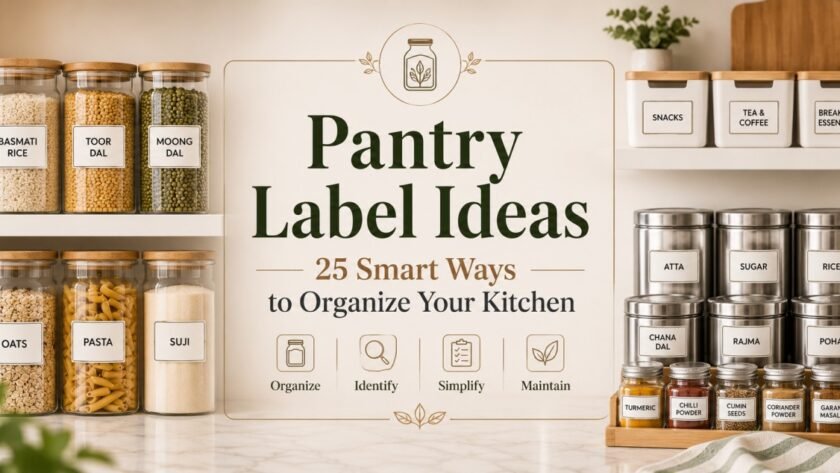

A well-organized pantry can make everyday cooking feel much easier. You know where everything is, you can quickly see what you have, and you don’t have to pull out five different containers just to find one ingredient. But there is one small detail that can take a pantry from “organized” to actually easy to use”: labels.
That’s where these Pantry Label Ideas come in.
Whether you’re using glass storage jars, steel containers, plastic bins or a combination of all three, the right labels can make your kitchen storage system much easier to understand. And no, pantry labels don’t have to look like they came straight out of a luxury kitchen showroom. A simple, readable label can work just as well. 😄
In this guide, we’re looking at practical Pantry Label Ideas for everything from rice and dal to spices, baking ingredients, snacks and breakfast foods. We’ll also cover different label styles, where to place them, which materials work best, and how to create a labeling system that remains useful rather than becoming another kitchen project you forget about after two weeks.
Also Read | Glass vs Steel Storage Jars Which Should You Choose?
🏷️ Why Pantry Labels Matter
You might be wondering:
“If I can see what’s inside the container, why do I need a label?”
Fair question.
Transparent containers definitely make pantry organization easier because you can see the contents. But labels still provide an extra layer of organization.
For example, imagine five glass jars containing different types of dal.
You can see that they’re different, but identifying each one immediately may not always be obvious.
A label changes that.
Instead of:
“Is this moong dal or masoor dal?”
you get:
MOONG DAL
Simple. Done. No detective work required. 😂
Good pantry labels can help with:
- Quick ingredient identification
- Better pantry organization
- Easier grocery planning
- Consistent storage
- Faster cooking
- Cleaner-looking shelves
- Easier restocking
- Better food rotation
And if multiple people use your kitchen, labels become even more useful because everyone can understand where things belong.
🫙 1. Pantry Label Ideas for Glass Storage Jars
Glass storage jars are probably one of the easiest places to start.
Because the jars are transparent, you already have visibility. Adding a label simply makes identification faster.
You can label jars containing:
- Rice
- Toor Dal
- Moong Dal
- Masoor Dal
- Chana Dal
- Sugar
- Flour
- Suji
- Poha
- Oats
For a clean appearance, use the same label size and font across all your jars.
Simple Example
BASMATI RICE
TOOR DAL
MOONG DAL
SUGAR
ATTA
POHA
You don’t need elaborate graphics.
Sometimes the simplest Pantry Label Ideas are the ones that work best.
🥫 2. Pantry Label Ideas for Steel Containers
Steel containers are incredibly practical, but they have one obvious disadvantage:
You can’t see through them.
That’s where labels become particularly important.
If you use steel storage jars for rice, flour, dal or other pantry staples, clear labels can prevent confusion.
For example:
| Container | Suggested Label |
|---|---|
| Rice container | RICE |
| Flour container | ATTA |
| Sugar container | SUGAR |
| Semolina container | SUJI |
| Flattened rice | POHA |
| Lentils | DAL |
| Chickpeas | CHANA |
| Kidney beans | RAJMA |
For steel containers, place the label somewhere that’s clearly visible when the container is sitting on the shelf.
A label hidden underneath the container is technically present.
It is also completely useless. 😂
🌶️ 3. Spice Jar Label Ideas
Spices are one of the best categories for pantry labels.
Most spice jars are small, and several spices can look surprisingly similar.
A consistent labeling system can make your spice collection much easier to navigate.
Everyday Spice Labels
- TURMERIC
- CHILLI POWDER
- CORIANDER
- CUMIN
- GARAM MASALA
- BLACK PEPPER
- MUSTARD SEEDS
- FENNEL
- CLOVE
- CARDAMOM
Whole Spice Labels
You can also create a separate category for whole spices:
- Cinnamon
- Bay Leaf
- Star Anise
- Cloves
- Cardamom
- Black Pepper
- Nutmeg
If you have a dedicated spice drawer, placing labels on the top of the jars can be more useful than placing them on the side.
Why?
Because when the jars are sitting inside a drawer, you’re looking down at them rather than directly at the sides.
This is one of those tiny Pantry Label Ideas that makes a surprisingly big difference.
🍚 4. Pantry Label Ideas for Rice and Grains
If your kitchen stores multiple varieties of rice, labels can save you a lot of guesswork.
Consider labels such as:
- BASMATI RICE
- SONAMASURI RICE
- BROWN RICE
- WHITE RICE
- POHA
- QUINOA
- MILLET
- DALIA
- OATS
You can also include the type of grain on the label if you regularly keep several varieties.
For example:
BASMATI RICE
is more useful than simply:
RICE
if you have multiple types.
The rule is simple:
Label according to how you actually identify the ingredient.
🌾 5. Pantry Label Ideas for Dal and Pulses
Indian kitchens can have quite a collection of dals and pulses.
And when several containers are sitting next to each other, labels become extremely helpful.
Try:
TOOR DAL
MOONG DAL
MASOOR DAL
URAD DAL
CHANA DAL
WHOLE MOONG
KABULI CHANA
RAJMA
BLACK CHANA
If you frequently buy the same ingredients in bulk, consistent labels can make restocking much easier.
🧁 6. Pantry Labels for Baking Ingredients
If you have a baking section, give it its own labeling system.
Useful labels include:
- ALL-PURPOSE FLOUR
- WHOLE WHEAT FLOUR
- SUGAR
- COCOA POWDER
- BAKING POWDER
- BAKING SODA
- CORNSTARCH
- CHOCOLATE CHIPS
- SPRINKLES
- DRY FRUITS
You can organize these containers together in one section so you don’t have to search the entire pantry whenever you decide to bake.
💡 Tip
Use slightly smaller labels for small containers.
A giant label saying BAKING SODA on a tiny jar can look a little dramatic. 😂
🥣 7. Breakfast Pantry Label Ideas
Breakfast ingredients can easily become scattered throughout a pantry.
Instead, create a dedicated breakfast section.
Useful labels include:
- OATS
- CORNFLAKES
- MUESLI
- GRANOLA
- POHA
- UPMA
- CHIA SEEDS
- FLAX SEEDS
- CEREAL
- DRY FRUITS
This makes mornings quicker because everything you need is in one area.
And let’s be real—anything that makes mornings less chaotic deserves a medal. 🏅
🍪 8. Snack Storage Labels
Not everything in the pantry needs to go into a beautiful glass jar.
For packaged snacks and loose items, pantry bins can be more practical.
You could label bins:
SNACKS
BISCUITS
CHIPS
CHOCOLATES
KIDS’ SNACKS
TEA-TIME
READY TO EAT
If you’re using pantry bins, large labels are usually easier to read than tiny decorative ones.
For more storage inspiration, see our guide to Best Pantry Storage Bins.
🥜 9. Dry Fruit and Seed Labels
Small glass jars are perfect for creating a dedicated dry-fruit and seed section.
Try labels such as:
- ALMONDS
- CASHEWS
- WALNUTS
- RAISINS
- PISTACHIOS
- CHIA SEEDS
- FLAX SEEDS
- PUMPKIN SEEDS
- SUNFLOWER SEEDS
If you buy these ingredients in smaller quantities, don’t use unnecessarily large containers.
A smaller jar is easier to handle and takes up less shelf space.
🍝 10. Pasta and Noodle Labels
Transparent jars containing pasta already look organized, but labels can make the system even clearer.
Try:
PENNE
MACARONI
FUSILLI
SPAGHETTI
NOODLES
VERMICELLI
If you’re using tall jars for spaghetti, put the label near the middle or upper portion where it’s easy to see.
For shorter pasta, center the label on the front.
☕ 11. Tea and Coffee Labels
A dedicated beverage station can make your kitchen feel much more organized.
Create labels such as:
- TEA
- COFFEE
- GREEN TEA
- HERBAL TEA
- HOT CHOCOLATE
- COFFEE BEANS
- SUGAR
You can also use matching containers for coffee and tea if they’re stored on an open shelf.
This is where decorative Pantry Label Ideas can work particularly well because these containers are often visible.
🧂 12. Salt and Sugar Labels
Salt and sugar can look very similar in transparent containers.
So yes, please label them. 😂
Use:
SALT
SUGAR
If you use different varieties, you can be more specific:
ROCK SALT
BLACK SALT
POWDERED SUGAR
BROWN SUGAR
This is especially useful when several containers are kept together.
🏷️ 13. Minimalist Pantry Label Ideas
You don’t need fancy fonts, illustrations and twelve decorative borders to make your pantry look good.
Minimalist labels can actually look more polished.
Think:
BLACK TEXT
WHITE BACKGROUND
SIMPLE FONT
CONSISTENT SIZE
For example:
RICE
TOOR DAL
SUGAR
FLOUR
That’s it.
The cleaner the label design, the easier it is to read.
And because kitchen organization is about functionality first, readability should always beat decoration.
🌿 14. Modern Pantry Label Ideas
If you want something slightly more decorative, you can use a modern style.
Try:
- Neutral colors
- Minimal borders
- Simple serif fonts
- Clean sans-serif fonts
- Small botanical elements
- Rounded labels
- Consistent typography
A modern label system can work particularly well with:
- Glass jars
- Wooden shelves
- Bamboo lids
- White cabinets
- Neutral kitchen décor
Just don’t make the text so fancy that “Coriander” starts looking like an ancient royal decree. 😭
🎨 15. Color-Coded Pantry Labels
Color coding can be useful if you have a large pantry.
For example:
🟢 Green
Healthy foods and seeds
🟡 Yellow
Grains and cereals
🔵 Blue
Baking ingredients
🟠 Orange
Snacks
🟣 Purple
Spices
You don’t necessarily need five different label colors, though.
Even two or three categories can make a noticeable difference.
For a smaller pantry, one consistent label style may actually look cleaner.
🌐 16. English Pantry Labels
English labels are simple and widely understood.
Examples:
RICE
DAL
SUGAR
FLOUR
SPICES
SNACKS
PASTA
CEREALS
These are particularly useful if multiple people in your household speak different languages.
🇮🇳 17. Hindi and English Pantry Labels
If you want your kitchen labels to feel more familiar, you can use bilingual labels.
For example:
RICE | चावल
SUGAR | चीनी
FLOUR | आटा
SALT | नमक
LENTILS | दाल
This can be particularly useful in family kitchens where different people prefer different languages.
You can also use regional language labels if that makes more sense for your household.
The important thing is that everyone can understand the system.
✍️ 18. Handwritten Pantry Labels
You don’t need a label printer to create an organized pantry.
A permanent marker and blank stickers can get the job done.
Handwritten labels can actually be useful when:
- You’re experimenting with your storage system
- You frequently change ingredients
- You don’t want to spend money on a printer
- You need temporary labels
Once you know what works, you can upgrade to printed labels.
This is one of the most budget-friendly Pantry Label Ideas.
🖨️ 19. Printable Pantry Labels
Printable labels are useful if you want consistency.
You can create one template and print labels for your entire pantry.
Advantages include:
✔ Consistent font
✔ Consistent size
✔ Clean appearance
✔ Easy duplication
✔ Professional-looking result
You can also keep a few blank labels ready for ingredients you purchase occasionally.
💧 20. Waterproof Pantry Labels
If your kitchen gets humid or the containers are washed frequently, waterproof labels can be worth considering.
This is particularly important for:
- Spice jars
- Containers handled daily
- Containers stored near the sink
- Refrigerator storage
- Frequently washed jars
Before buying labels, check whether they are actually designed to resist water.
A label that starts peeling after two washes isn’t exactly winning the organization Olympics. 😂
🔄 21. Reusable Pantry Labels
Reusable labels are useful if you frequently change what goes into a container.
They can be particularly helpful for:
- Temporary food storage
- Bulk ingredients
- Seasonal ingredients
- Baking supplies
- Containers used for different foods
Chalkboard-style labels are one option, although the writing surface should still be easy to clean and maintain.
📍 22. Where Should You Put Pantry Labels?
Label placement depends on the container.
Glass Jar
Front of the jar.
Steel Container
Front or lid.
Deep Pantry Bin
Front edge.
Spice Jar in Drawer
Top of the lid.
Tall Container
Upper-middle section.
Stackable Container
Front-facing side.
The goal is simple:
You should be able to read the label without moving the container.
If you have to pick up six containers just to read the seventh label, your label placement needs work.
🧠 23. What Should You Actually Write on a Pantry Label?
Keep it simple.
The label should answer:
“What is this?”
Not:
“What is this, where did I buy it, what was the price, what day did I transfer it and what recipe do I plan to make next Tuesday?” 😂
Good examples:
BASMATI RICE
TOOR DAL
COCOA POWDER
CHIA SEEDS
PASTA
For ingredients with multiple varieties, include the variety.
That’s enough.
📦 24. Pantry Labels for Storage Bins
Storage bins often contain multiple smaller packets.
Instead of labeling every packet, label the bin.
For example:
Bin 1
BREAKFAST
Bin 2
SNACKS
Bin 3
BAKING
Bin 4
TEA & COFFEE
Bin 5
BACKUP STOCK
This can save time and prevent your pantry from becoming a graveyard of half-open packets.
For larger pantry systems, category labels are often more useful than labeling every single item.
🏠 25. Create a Consistent Pantry Label System
The final and perhaps most important of these Pantry Label Ideas is consistency.
Don’t use:
Elegant gold labels
on one shelf,
handwritten stickers
on another,
and
random printed labels
somewhere else.
Unless that’s genuinely your aesthetic, of course. 😂
Instead, choose:
- One font
- One label shape
- One or two colors
- One text format
- One placement style
Then apply it across your pantry.
This creates visual consistency and makes the entire kitchen easier to navigate.
🧠 Pantry Labels Should Make Life Easier
The best Pantry Label Ideas aren’t necessarily the most decorative ones.
They’re the ones that help you:
Find ingredients faster.
Know what you’re running low on.
Return things to the correct place.
Keep similar ingredients separate.
Maintain a cleaner pantry.
That’s the real purpose of labeling.
You don’t need a professional pantry designer.
You don’t need expensive equipment.
And you definitely don’t need to buy 50 decorative labels before figuring out whether you even like using them.
Start small.
Label your most-used containers.
See what works.
Then expand your system.
A few clear labels can genuinely make a surprisingly big difference in how your kitchen functions every day. 🏠✨
🏷️ How to Create a Pantry Labeling System That Actually Works
Before you start sticking labels everywhere, take a quick look at your pantry.
You don’t need to label every item immediately.
Instead, divide your storage into a few broad categories.
For example:
🌾 Pantry Staples
Rice, dal, flour, sugar, suji and poha.
🌶️ Spices
Powders, whole spices and spice blends.
🥣 Breakfast
Oats, cereals, granola and muesli.
🥜 Dry Fruits & Seeds
Almonds, cashews, raisins and seeds.
🍪 Snacks
Biscuits, chips and packaged snacks.
🧁 Baking
Cocoa, baking ingredients, chocolate chips and decorating supplies.
Once these zones are established, your Pantry Label Ideas become much easier to implement.
📍 Label Placement Matters More Than You Think
You can have the most beautiful label in the world, but if it’s facing the wall, it’s not doing much. 😂
The correct placement depends on the container.
Glass Jars
Place labels on the front.
Steel Containers
Place labels on the front or lid.
Pantry Bins
Place large labels on the front.
Spice Jars in Drawers
Place labels on the lid.
Spice Jars on Shelves
Place labels on the front.
Stackable Containers
Use front-facing labels so you don’t have to move the containers.
The golden rule is:
Place the label where you naturally look when reaching for the container.
🫙 Labeling Glass Storage Jars
Glass jars already give you excellent visibility, so you don’t need oversized labels.
A small, clean label can be enough.
For example:
BASMATI RICE
TOOR DAL
SUGAR
OATS
PASTA
If you’re using jars with bamboo or wooden lids, neutral labels can complement the natural look.
If you’re using completely clear glass jars, dark text on a light label usually provides excellent contrast.
For more ideas on choosing containers, see our Best Glass Storage Jars guide.
🥫 Labeling Steel Storage Jars
Steel containers need more attention because you can’t see their contents.
If you have several identical containers, labels should be easy to spot.
A good system might look like:
RICE
ATTA
DAL
SUGAR
SUJI
POHA
If the containers are stored in a drawer, put the labels on the lids.
If they’re on open shelves, put the labels on the front.
This is one area where Pantry Label Ideas aren’t simply decorative—they make opaque storage considerably more functional.
For a deeper comparison of these materials, check out Glass vs Steel Storage Jars.
🌶️ Create a Dedicated Spice Label System
Spices deserve their own labeling system because they’re usually stored in small containers and often look similar.
You can organize them into:
Everyday Spices
- Turmeric
- Chilli Powder
- Coriander Powder
- Cumin
- Garam Masala
Whole Spices
- Cardamom
- Cloves
- Cinnamon
- Black Pepper
- Bay Leaf
Specialty Spices
- Chaat Masala
- Sambar Masala
- Kitchen King
- Pav Bhaji Masala
Keep frequently used spices in the easiest-to-reach location.
And if you’re storing them in a drawer, top labels are a must.
🧂 Label Similar-Looking Ingredients
Some ingredients are particularly easy to confuse.
These deserve clear labels.
For example:
SUGAR
SALT
SUJI
ATTA
MAIDA
RICE FLOUR
CORN FLOUR
BAKING POWDER
BAKING SODA
When several similar ingredients sit together, clear labels eliminate unnecessary guesswork.
This is especially useful for anyone who cooks or bakes frequently.
🏷️ Use Large Labels for Large Containers
A common mistake is using the same label size for every container.
That’s not necessary.
A large rice container can handle a larger label.
A tiny spice jar cannot.
Suggested Approach
Small jar → Small label
Medium jar → Medium label
Large jar → Large label
This keeps the proportions visually balanced.
It also means you don’t end up with a label covering half your jar.
🔤 Should Pantry Labels Be Uppercase?
Uppercase labels can be very easy to scan.
For example:
BASMATI RICE
MOONG DAL
SUGAR
FLOUR
They’re especially useful when containers are lined up next to each other.
However, title case can also look more relaxed:
Basmati Rice
Moong Dal
Sugar
Flour
Our Recommendation
Choose whichever style you prefer—but use it consistently.
Consistency matters more than whether you choose uppercase or title case.
🎨 Should You Color-Code Pantry Labels?
Color coding can be useful, but don’t overcomplicate it.
A simple system could be:
🟢 Green → Grains
🟡 Yellow → Baking
🟠 Orange → Snacks
🔵 Blue → Breakfast
🟣 Purple → Spices
But there’s a catch.
If your pantry is small, color coding may be unnecessary.
One consistent label design may actually look cleaner.
Use Color Coding If:
- You have a large pantry
- Several people use the kitchen
- You have many storage categories
- You want faster visual navigation
Skip It If:
- Your pantry is small
- You prefer minimalist design
- You only have a few categories
🌿 Pantry Label Ideas for a Minimalist Kitchen
For a minimalist kitchen, less is definitely more.
Try:
Cream labels
Black text
Simple font
No unnecessary graphics
Consistent spacing
For example:
RICE
DAL
FLOUR
SUGAR
OATS
Simple.
Clean.
Easy to read.
That’s enough.
A pantry doesn’t need to look like a stationery shop exploded inside it. 😂
🏠 Pantry Label Ideas for a Traditional Indian Kitchen
If you prefer a more traditional kitchen setup, you can still use labels without making everything look ultra-modern.
Use simple labels for:
- Rice
- Dal
- Atta
- Suji
- Poha
- Sugar
- Salt
- Spices
You can also use bilingual labels such as:
ATTA | आटा
RICE | चावल
SUGAR | चीनी
DAL | दाल
This can be particularly practical in family kitchens.
🌐 English vs Bilingual Labels
There isn’t one correct answer.
English Labels
Best if:
- Everyone understands English
- You prefer a minimalist appearance
- You want shorter labels
Bilingual Labels
Best if:
- Multiple generations use the kitchen
- You prefer regional-language names
- Some ingredients are easier to identify by local names
Example
CHICKPEAS | CHANA
LENTILS | DAL
FLOUR | ATTA
This can make the pantry more intuitive for everyone.
🧺 Label Pantry Bins by Category
When you’re storing packaged food, category labels are often better than individual labels.
For example:
SNACKS
Contains:
- Chips
- Biscuits
- Crackers
- Namkeen
BREAKFAST
Contains:
- Cereals
- Oats
- Granola
BAKING
Contains:
- Chocolate
- Sprinkles
- Baking ingredients
BACKUP STOCK
Contains unopened packets.
This approach reduces the number of labels you need while still keeping everything organized.
📦 Create a “Back Stock” Area
If you shop in bulk, this is one of the most useful Pantry Label Ideas to adopt.
Create a bin or shelf labeled:
BACKUP STOCK
Use it for unopened packets of:
- Rice
- Dal
- Flour
- Pasta
- Sugar
- Cereals
- Snacks
Then your everyday containers remain neat and easy to access.
When a jar becomes empty, refill it from the backup stock.
Simple.
🔄 Use FIFO With Your Pantry Labels
Labels can also help with food rotation.
FIFO stands for:
First In, First Out.
When you purchase a new ingredient, use older stock first whenever practical.
You can organize your pantry so newer purchases go behind older ones.
This is especially useful for:
- Cereals
- Pasta
- Flour
- Snacks
- Dry mixes
- Baking ingredients
The label tells you what the ingredient is.
Your storage arrangement helps you manage when to use it.
📅 Should You Put Dates on Pantry Labels?
Usually, you don’t need a permanent date on your main ingredient label.
For example:
RICE
is a permanent label.
But temporary date labels can be useful for:
- Homemade mixes
- Opened specialty ingredients
- Prepared dry mixes
- Baking mixtures
- Items with specific storage instructions
If you use dates, choose a format that’s easy to update.
🛒 Pantry Labels Can Make Grocery Shopping Easier
Here’s an underrated benefit.
When your pantry containers are clearly labeled, you can quickly see what you’re running low on.
You might notice:
RICE — LOW
SUGAR — HALF FULL
DAL — LOW
OATS — EMPTY
This can make creating your grocery list much faster.
You don’t need an elaborate inventory spreadsheet unless you’re into that kind of thing.
For most households, a quick pantry check is enough.
🧠 Create a “Low Stock” System
If you want to take your organization one step further, you can create a simple low-stock indicator.
For example:
Full
No action needed.
Half Full
Check during your next grocery trip.
Nearly Empty
Add to the shopping list.
You can also use small removable stickers or markers if you want a visual system.
But don’t overengineer this.
You’re organizing a pantry, not running NASA mission control. 🚀😂
🧽 How to Apply Labels Properly
If you’re using adhesive labels, preparation matters.
Step 1: Clean the Surface
Remove dust and grease.
Step 2: Dry Completely
Moisture can interfere with adhesion.
Step 3: Position Carefully
Don’t stick it immediately.
Check the alignment first.
Step 4: Apply From One Side
Smooth the label gradually.
Step 5: Press Firmly
Make sure the edges are properly attached.
Step 6: Let It Set
Avoid washing the container immediately if the label manufacturer recommends waiting.
This simple process can help prevent peeling and air bubbles.
💧 How to Keep Pantry Labels From Peeling
If your labels are constantly peeling, check three things:
1. Surface
Was it clean?
2. Moisture
Was the container completely dry?
3. Label Material
Is the label actually designed for kitchen use?
For containers exposed to moisture, choose labels specifically designed to handle those conditions.
And don’t assume a label is waterproof just because the product photo shows it sitting beside a sink.
Check the specifications.
🖨️ Printable vs Ready-Made Pantry Labels
You have two main options.
Printable Labels
Pros
✔ Customizable
✔ Easy to duplicate
✔ Consistent
✔ Can match your kitchen
Cons
❌ Requires printing
❌ May need suitable label paper
❌ You need to create the design
Ready-Made Labels
Pros
✔ Convenient
✔ Quick
✔ No design work
✔ Available in many styles
Cons
❌ Less customizable
❌ May not include every ingredient
❌ Replacement labels may not match perfectly
🏆 Our Pick
For a complete pantry makeover, printable labels offer more flexibility.
For a quick organization project, ready-made labels are perfectly fine.
✍️ Are Handwritten Pantry Labels Good Enough?
Absolutely.
If your priority is function rather than aesthetics, handwritten labels can do the job perfectly well.
They’re especially useful while testing your system.
Try handwritten labels for a few weeks.
If you like the organization, upgrade to printed labels later.
This is actually a smart way to avoid spending money before you know what you need.
🏷️ Permanent vs Removable Labels
| Type | Best For |
|---|---|
| Permanent Labels | Rice, flour, sugar |
| Removable Labels | Multi-purpose containers |
| Writable Labels | Frequently changing contents |
| Waterproof Labels | Frequently washed containers |
| Chalkboard Labels | Decorative storage |
| Printed Labels | Full pantry systems |
Choose based on how permanent the storage purpose is.
📐 Label Placement for Different Storage Types
| Storage Type | Best Label Location |
|---|---|
| Glass Jar | Front |
| Steel Container | Front |
| Drawer Spice Jar | Lid |
| Spice Rack Jar | Front |
| Pantry Bin | Front |
| Stackable Container | Front |
| Deep Storage Box | Front or top edge |
| Countertop Jar | Front |
| Tall Container | Upper-middle front |
This small detail can dramatically improve usability.
🧩 Match Pantry Labels With Your Containers
You don’t necessarily need matching containers.
You need matching labels.
For example, your pantry might contain:
🫙 Glass jars
🥫 Steel containers
📦 Plastic bins
🧺 Wire baskets
That’s perfectly fine.
If all the labels use the same:
- Font
- Color
- Shape
- Placement
the entire system can still look cohesive.
This is especially useful if you’re organizing your kitchen gradually.
🚫 Pantry Label Mistakes to Avoid
Let’s quickly go over the big ones.
❌ Using Tiny Text
If you need to squint, it’s too small.
❌ Overdecorating
Don’t let design hide the ingredient name.
❌ Ignoring Moisture
Choose suitable labels for wet environments.
❌ Labeling the Wrong Side
Put labels where you naturally look.
❌ Using Too Many Colors
A little consistency goes a long way.
❌ Labeling Every Packet
Use category bins for packaged foods.
❌ Creating Too Many Categories
Keep the system simple.
❌ Never Updating Labels
If the contents change, update the label.
📊 Pantry Label Ideas: Pros and Cons
| What We Like | What We Don’t Like |
|---|---|
| Makes ingredients easier to identify | Requires initial setup |
| Creates visual consistency | Labels can peel |
| Helps organize opaque containers | Some labels cost more |
| Useful for multiple household members | Too many labels can create clutter |
| Makes pantry bins easier to navigate | Permanent labels aren’t ideal for changing contents |
| Helps with grocery planning | Requires occasional maintenance |
| Can improve pantry appearance | Poor placement reduces usefulness |
🛒 What to Look for When Buying Pantry Labels
If you’re purchasing labels instead of making them yourself, check:
Material
Is it paper, vinyl, plastic or another material?
Adhesive
Is it designed for the surface you’re using?
Water Resistance
Important for frequently washed containers.
Size
Will the label fit your jars and bins?
Font
Is it actually readable?
Customization
Can you add your own ingredients?
Removability
Can you change it later?
Quantity
Do you get enough labels for your pantry?
Compatibility
Will they work on glass, steel or plastic?
Don’t buy a giant label pack just because it contains 200 stickers.
If you only need 30, you’ll have enough labels left to organize the pantry of your imaginary second home. 😂
🔬 Our Research Methodology
For this Pantry Label Ideas guide, we focused on practical organization rather than decorative trends alone.
We evaluated pantry labeling approaches based on:
- Readability
- Label size
- Placement
- Container compatibility
- Water resistance
- Removability
- Ease of customization
- Category organization
- Long-term usability
- Kitchen practicality
We also considered how labels work with different storage solutions, including glass jars, steel containers, pantry bins, spice jars and stackable containers.
The goal was to identify Pantry Label Ideas that can work in real kitchens rather than systems that only look good in staged pantry photographs.
🏆 Best Pantry Label Ideas for Different Kitchens
| Kitchen Type | Best Label Approach |
|---|---|
| Small Kitchen | Simple front labels |
| Large Pantry | Category + container labels |
| Minimalist Kitchen | Black-and-white labels |
| Traditional Kitchen | English + regional language |
| Open Pantry | Decorative but readable labels |
| Spice Drawer | Top labels |
| Steel Containers | Large front labels |
| Glass Jars | Small front labels |
| Pantry Bins | Large category labels |
| Family Kitchen | Simple bilingual labels |
| Frequently Washed Containers | Water-resistant labels |
| Multi-Purpose Storage | Removable labels |
🏠 How to Build Your Pantry Label System Step by Step
If you’re starting from zero, don’t try to label everything in one afternoon.
Step 1: Empty One Shelf
Start small.
Step 2: Group Similar Items
Put grains together, spices together, snacks together and so on.
Step 3: Choose Containers
Decide whether each category needs jars, bins or steel containers.
Step 4: Choose Your Label Style
Pick one font, color and shape.
Step 5: Label Everyday Ingredients First
Start with the things you use most.
Step 6: Label the Containers
Place labels where they’re easiest to read.
Step 7: Create Category Labels
Add labels to larger bins or shelves.
Step 8: Test the System
Use the pantry for a couple of weeks.
Step 9: Fix What Doesn’t Work
Move labels or change categories if necessary.
Step 10: Expand Gradually
Only label additional areas when you actually need them.
This approach keeps the process manageable.
🧠 The 80/20 Rule of Pantry Labels
You don’t need to label 100% of your pantry to get most of the benefits.
Focus on the 20% of items you use 80% of the time.
For example:
Rice
Dal
Flour
Sugar
Salt
Spices
Tea
Coffee
Oats
Pasta
Start there.
Once these are organized, the rest of the pantry becomes much easier to manage.
🏆 Final Verdict
The best Pantry Label Ideas are the ones that make your kitchen easier to use, not simply prettier to photograph.
For glass jars, use clean front labels.
For steel containers, use larger labels that are easy to spot.
For spice drawers, put labels on the lids.
For pantry bins, use category labels.
For frequently washed containers, choose suitable water-resistant options.
For family kitchens, consider bilingual labels.
And if you’re not sure whether you need permanent labels, start with removable or handwritten ones.
Most importantly, keep your system simple and consistent.
You don’t need ten fonts.
You don’t need twelve colors.
You don’t need a label for every single snack packet.
You just need a clear system that answers one question quickly:
“Where is the thing I need?”
If your pantry can answer that without making you dig through three shelves, congratulations—you’ve already won. 🏠✨
❓ Frequently Asked Questions
1. Are pantry labels really necessary?
They’re not essential, but they can make an organized pantry much easier to use. Labels are especially useful for opaque containers, similar-looking ingredients and pantry bins.
2. What should I label first?
Start with frequently used staples such as rice, dal, flour, sugar, salt, spices, oats and pasta.
3. What labels are best for glass jars?
Simple front-facing adhesive labels work well. Choose a readable font and a size appropriate for the jar.
4. Where should labels go on steel containers?
Front-facing labels generally work best. If the containers are stored inside drawers, labels on the lids may be easier to see.
5. Should spice jar labels go on the top or front?
Use top labels for spice drawers and front labels for spice racks.
6. Are waterproof pantry labels worth it?
They can be useful for containers that are regularly exposed to moisture or washed frequently. For dry pantry shelves, regular labels may be sufficient.
7. Can I make pantry labels myself?
Yes. You can create them with a printer, sticker paper, marker or even simple handwritten labels.
8. What font is best for pantry labels?
Choose a clean, readable font. Avoid extremely decorative or thin fonts that are difficult to read quickly.
9. Should pantry labels be permanent?
Not always. Use permanent labels for dedicated containers and removable or writable labels for containers whose contents change.
10. Should I use different colors for different pantry categories?
You can, especially in a large pantry. But a single consistent label style often looks cleaner in smaller kitchens.
11. Should pantry labels include dates?
Permanent ingredient labels generally don’t need dates. Temporary date labels can be useful for homemade mixes or ingredients where tracking the preparation or opening date is relevant.
12. Can I use bilingual pantry labels?
Absolutely. English plus Hindi or another regional language can be especially practical for family kitchens.