

If someone asks, “What’s your zodiac sign?”, you probably know the answer.
Aries. Taurus. Gemini. Scorpio. Pisces.
That familiar sign is usually your Sun sign, and it is the basis of most short horoscopes you see in newspapers, magazines, apps and social-media posts.
But then you open a birth-chart calculator and suddenly there are planets, houses, degrees, coloured lines, an Ascendant, a Moon sign, Venus, Mars and enough symbols to make you wonder whether you accidentally opened an astronomy exam. 😭
The difference is actually fairly simple.
A Sun-sign horoscope primarily groups people according to the zodiac sign occupied by the Sun at birth. A birth chart, or natal chart, maps the positions of the Sun, Moon, planets and important astrological points for a specific date, time and place of birth.
Astrodienst describes a birth chart as a diagram representing planetary positions at the moment of birth, while its chart system also incorporates houses, the Ascendant and angular relationships known as aspects.
So if Sun-sign astrology is one chapter, a birth chart is closer to the whole book.
That does not mean a birth chart has been scientifically proven to describe personality or predict life events. Astrology remains a traditional interpretive belief system rather than an established scientific method. Controlled scientific testing has not demonstrated reliable personality predictions from natal charts.
With that distinction clear, let’s understand exactly what each system contains.
Quick Answer: Birth Chart vs Sun-Sign Horoscope
| Feature | Sun-Sign Horoscope | Birth Chart |
|---|---|---|
| Main information used | Sun’s zodiac sign | Full birth date, time and location |
| Number of broad categories | 12 zodiac signs | Highly individualised chart |
| Sun included? | Yes | Yes |
| Moon included? | Usually not in simple horoscope | Yes |
| Rising sign included? | Usually no | Yes, when birth time is known |
| Planetary placements | Usually no | Yes |
| Houses | No | Usually yes |
| Aspects | No | Yes |
| Birth time needed? | Usually no | Ideally yes |
| Birth place needed? | Usually no | Yes for accurate angles/houses |
| Level of detail | Broad | Much more complex |
| Typical use | General daily/weekly horoscope | Natal interpretation |
The easiest way to remember it is:
Sun sign = one placement.
Birth chart = the full astrological map used by that tradition.
What Is a Sun Sign?
Your Sun sign refers to the zodiac sign in which the Sun was positioned when you were born.
In Western astrology, this is usually what people mean when they say:
“I’m a Leo.”
or:
“She’s a Capricorn.”
Astrology.com describes the zodiac or Sun sign as the sign occupied by the Sun at the moment of birth, with the Sun spending roughly four weeks in each of the twelve zodiac signs.
That is why your birthday alone is usually enough to identify your general Sun sign.
For example, under the commonly used tropical Western zodiac:
- Aries: around March 21–April 19
- Taurus: around April 20–May 20
- Gemini: around May 21–June 20
- Cancer: around June 21–July 22
- Leo: around July 23–August 22
…and so on.
Exact transition dates can vary slightly by year and time, particularly for people born close to the moment the Sun changes signs.
What Is a Sun-Sign Horoscope?
A Sun-sign horoscope takes those twelve Sun-sign categories and gives each group an interpretation or forecast.
That is the familiar format:
Aries
Today may be a good time to…
Taurus
Relationships could require…
Gemini
Pay attention to…
And so on.
The great advantage is obvious:
It is simple.
A publication does not need your exact birth time, coordinates or complete natal chart.
It can write twelve short forecasts and potentially address millions of readers.
The trade-off is that everyone with the same Sun sign receives essentially the same broad interpretation.
That means two Aries readers born:
- in different countries
- in different years
- at different times
- with different Moon signs
- different Ascendants
- different planetary positions
may still be reading the same basic Aries horoscope.
This is why Sun-sign horoscopes are best understood as the simplified popular version of astrology rather than the full natal-chart method.
What Is a Birth Chart?
A birth chart, also called a natal chart, is an astrological diagram calculated for a person’s birth.
Astrodienst defines it as a representation of planetary positions at the moment a person was born and notes that natal charts generally require the birth date and location, with an exact birth time ideally included.
A typical Western natal chart can show:
- Sun
- Moon
- Mercury
- Venus
- Mars
- Jupiter
- Saturn
- Uranus
- Neptune
- Pluto
- Ascendant
- Midheaven
- 12 houses
- zodiac signs
- planetary degrees
- aspects between planets
So your Sun sign is still there.
It simply becomes one part of a larger system.
The Biggest Difference: One Sign vs an Entire Chart
This is where beginners often get confused.
Suppose two people are both Virgo Sun signs.
A simple Virgo horoscope groups them together.
But their birth charts could look dramatically different.
One might have:
Virgo Sun + Aries Moon + Scorpio Rising
while another might have:
Virgo Sun + Pisces Moon + Gemini Rising
Their Venus, Mars, Jupiter, Saturn and house placements may also differ.
Within astrology, those differences are then interpreted as adding layers that cannot be captured by the Sun sign alone.
So the birth chart is not really competing with your Sun sign.
It contains it.
Think of it this way:
Your Sun sign is like knowing someone’s city.
Their birth chart is more like seeing the entire map.
Why Does a Birth Chart Need Your Exact Birth Time?
This is one of the most important differences.
For a basic Sun-sign horoscope, your birthday is usually enough.
For a detailed natal chart, birth time can significantly affect the Ascendant and house structure.
Astrodienst notes that the Ascendant moves on average about one degree every four minutes, meaning even a difference of around 15 minutes can affect chart interpretation.
That sounds tiny until you realise how quickly the eastern horizon changes because Earth is rotating.
Your exact birth time is especially important for calculating:
- Rising sign or Ascendant
- house cusps
- Midheaven
- planetary house placement
That is why proper birth-chart calculators normally ask for:
Date + Time + Location
rather than just your birthday.
What Is the Rising Sign or Ascendant?
The Ascendant, commonly called the Rising sign, is the zodiac sign rising on the eastern horizon at the relevant birth time and location.
Astrodienst explains that because Earth continually rotates, there is always a zodiac sign rising in the east, and that point becomes the Ascendant in the chart.
In many Western astrological traditions, the Ascendant is considered one of the most important chart factors.
It also establishes the beginning of the house system.
So someone might say:
“I’m a Taurus Sun, Sagittarius Moon and Libra Rising.”
This is where the popular idea of the “Big Three” comes from:
- Sun sign
- Moon sign
- Rising sign
A normal Sun-sign horoscope uses only the first of those.
What Is the Moon Sign?
Your Moon sign represents where the Moon was positioned in the zodiac at your birth.
Astrological traditions generally interpret the Moon differently from the Sun.
The Sun is commonly associated with themes such as identity or conscious self-expression, while the Moon is traditionally associated with emotional responses, habits and internal needs. Astrology.com describes the Moon sign as representing aspects of the emotional or internal self.
Whether someone personally identifies with those interpretations is another matter.
The important structural difference is:
A full natal chart includes both Sun and Moon placements.
A basic Sun-sign horoscope generally does not.
What Are the 12 Houses in a Birth Chart?
The houses are another major feature missing from simple Sun-sign horoscopes.
A typical astrological birth chart divides the wheel into 12 houses.
Astrodienst explains that houses represent different spheres or areas of life and that their division depends on the exact birth time and geographic location.
Traditional Western interpretations commonly associate houses with themes such as:
| House | Common Traditional Theme |
|---|---|
| 1st | Self, identity, appearance |
| 2nd | Money, possessions, values |
| 3rd | Communication, siblings, learning |
| 4th | Home, roots, family |
| 5th | Creativity, romance, children |
| 6th | Routine, work, health |
| 7th | Partnerships |
| 8th | Shared resources, transformation |
| 9th | Higher learning, beliefs, travel |
| 10th | Career, public life |
| 11th | Friends, communities, aspirations |
| 12th | Inner life, retreat, hidden matters |
Astrological schools may vary in exactly how these themes are interpreted.
But structurally, houses allow astrologers to ask not only:
“Which sign is Venus in?”
but also:
“Which house is Venus in?”
That adds another interpretive layer unavailable in basic Sun-sign horoscopes.
What Are Planetary Aspects?
If the planets are the actors in a birth chart, aspects are the relationships between them.
Astrodienst describes aspects as special angular relationships between planets that can be represented by lines inside the chart.
Common major aspects include:
- conjunction
- opposition
- trine
- square
- sextile
For example, a birth-chart interpretation might discuss a relationship between:
Sun and Saturn
or:
Venus and Mars
A Sun-sign horoscope generally does not calculate these individual planetary relationships for every reader.
Again, that is why the natal chart becomes considerably more complex.
What Do the Other Planets Represent in Astrology?
Traditional Western astrology assigns symbolic themes to different planets.
A simplified overview looks like this:
| Planet | Common Astrological Association |
|---|---|
| Sun | Identity, vitality |
| Moon | Emotions, habits |
| Mercury | Communication, thinking |
| Venus | Relationships, aesthetics, attraction |
| Mars | Drive, action, assertion |
| Jupiter | Expansion, beliefs, growth |
| Saturn | Structure, limits, responsibility |
| Uranus | Change, independence |
| Neptune | Imagination, ideals |
| Pluto | Transformation, power |
These are traditional astrological interpretations, not scientifically established psychological categories.
A full natal reading attempts to combine these planetary symbols with their:
sign + house + degree + aspects
That is where birth-chart interpretation can become extremely detailed.
Why Can Two People with the Same Sun Sign Seem So Different?
This is probably the question that pushes many people from basic horoscope reading toward birth charts.
You meet someone who shares your zodiac sign and think:
“We have absolutely nothing in common.”
Astrologically, that is not considered surprising.
Two people with the same Sun sign may still have different:
- Moon signs
- Ascendants
- Mercury signs
- Venus signs
- Mars signs
- houses
- aspects
- chart patterns
Even their Sun may occupy different houses.
So within the astrological framework, sharing one Sun sign does not mean sharing an identical chart.
Outside astrology, of course, there is an even simpler explanation:
Human personalities are shaped by genetics, upbringing, experiences, environment, culture and many other factors.
A zodiac sign was never going to make millions of people clones of one another.
Birth Chart vs Daily Horoscope: Are They the Same Thing?
No.
A birth chart is fixed to your birth data.
The planetary positions shown in your natal chart represent the astrological configuration calculated for that birth moment.
A daily horoscope, meanwhile, tries to interpret current planetary movements.
More advanced astrology may compare the moving planets called transits with the natal chart.
Astrodienst describes a transit chart as placing current planetary movements against the natal positions and considering their relationships with natal planets, axes and houses.
That is substantially more personalised than a simple:
“Leo: expect exciting news today.”
Do Western and Vedic Birth Charts Work the Same Way?
Not exactly.
This is an important distinction, especially for Indian readers.
Both Western astrology and Vedic astrology can use detailed birth charts, but their calculation and interpretation systems differ.
Western astrology commonly uses the tropical zodiac, while Jyotish or Vedic astrology generally uses a sidereal zodiac.
As a result, your Western Sun, Moon or Ascendant sign may differ from the signs appearing in a Vedic chart.
Astrology.com notes that Indian astrology often gives significant attention to the Moon and lunar mansions or nakshatras, whereas popular Western astrology commonly defaults to the Sun sign when someone asks, “What’s your sign?”
Chart layouts also differ.
North Indian and South Indian horoscope charts may look visually very different from a circular Western birth chart even though they are representing astrological positions.
So if one app says:
“Libra Sun”
and a Vedic calculator says:
“Virgo Sun”
it may not mean that one calculator is broken.
They may be using different zodiac frameworks.
Is a Birth Chart More Accurate Than a Sun-Sign Horoscope?
It is more detailed within astrology, but “more detailed” should not automatically be confused with “scientifically more accurate.”
A natal chart uses considerably more information:
- exact birth date
- time
- location
- several planets
- houses
- aspects
So from an astrological perspective, it is far more personalised than a generic horoscope based on one Sun sign.
However, astrology has not been scientifically validated as a reliable method of predicting personality or future events.
A well-known double-blind test published in Nature examined astrologers’ ability to match natal charts with personality information and did not establish the predictive claims being tested.
So the safest distinction is:
Birth charts are more individualised astrological interpretations not scientifically proven personality tests.
Can You Make a Birth Chart Without Knowing Your Birth Time?
You can calculate some planetary positions without an exact birth time, but the chart becomes less reliable for time-sensitive elements.
The biggest problems are usually:
- Ascendant
- houses
- Midheaven
- sometimes the Moon’s precise degree/sign near a transition
Astrodienst allows charts with unknown birth times but omits houses rather than pretending a guessed time is exact.
If possible, look for your birth time in:
- birth certificate
- hospital record
- family documentation
- official birth registration
Avoid inventing something like:
“Mummy thinks maybe around lunchtime, so I’ll enter 12:07.”
That level of precision is fake precision.
Sun Sign vs Moon Sign vs Rising Sign
Here is the beginner version:
| Placement | What It Is | Depends Mainly On |
|---|---|---|
| Sun Sign | Zodiac position of Sun at birth | Date and precise solar position |
| Moon Sign | Zodiac position of Moon | Date and time |
| Rising Sign | Sign rising on eastern horizon | Exact time + location |
The Sun sign changes relatively slowly.
The Moon moves much faster.
The Ascendant changes even more rapidly through the day.
That is one reason birth time becomes increasingly important once you move beyond simple Sun-sign astrology. Birth Charts vs Sun-Sign Horoscopes
Why Are Sun-Sign Horoscopes Still So Popular?
Because they are easy.
You do not need to know:
- your exact birth time
- coordinates
- houses
- aspects
- chart rulers
You only need to know your birthday and approximate zodiac-date range.
They also work perfectly for newspapers, social posts and apps because twelve categories are easy to publish.
Imagine opening your Sunday newspaper and finding:
“Please submit your exact birthplace, birth time and planetary aspect table before reading page 12.”
Not quite as convenient with chai. 😂
Sun-sign horoscopes are essentially astrology made scalable. Birth Charts vs Sun-Sign Horoscopes
Common Mistakes Beginners Make
Assuming Your Sun Sign Is Your Entire Birth Chart
It isn’t.
Your Sun is one placement among many in natal astrology.
Thinking Everyone Born Under One Sign Has the Same Chart
Two Capricorn Suns may have completely different planetary and house arrangements.
Ignoring Birth Time
For detailed natal interpretation, birth time is especially important for the Ascendant and houses.
Using a Random Approximate Birth Time as Exact
If you genuinely do not know your time, be transparent about that rather than inventing precision.
Mixing Western and Vedic Signs Without Realising It
A sidereal Vedic chart and tropical Western chart can place planets in different signs.
Know which system your calculator uses.
Treating Astrology as Scientific Diagnosis
A natal chart should not replace psychological, medical, financial or professional advice.
Use astrology as a traditional or reflective framework if you enjoy it not as evidence-based diagnosis. Birth Charts vs Sun-Sign Horoscopes
In Case You Are Looking For –
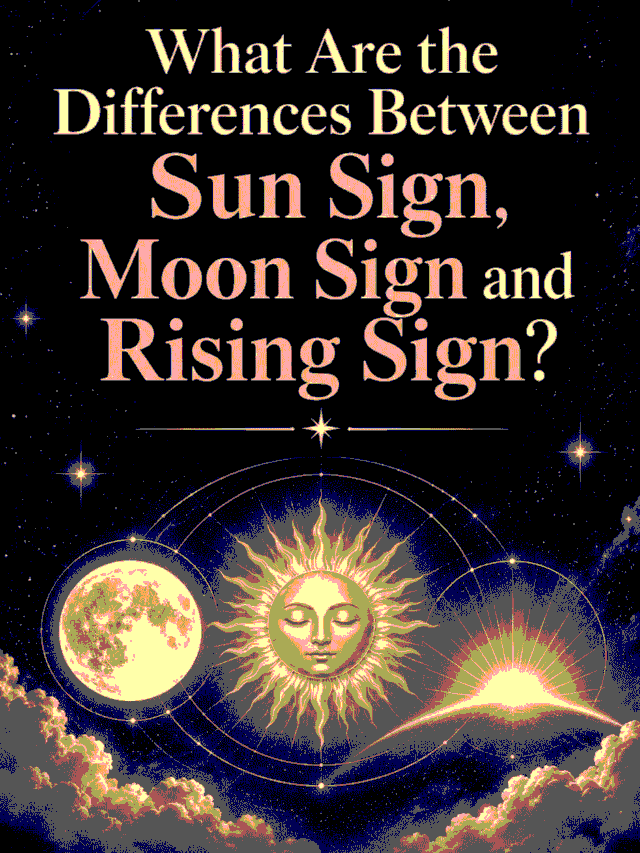
- What Are the Differences Between Sun Sign, Moon Sign and Rising Sign?
- How Do Beginners Choose Their First Tarot Deck?
- What Do the Four Suits in Tarot Traditionally Represent?
- How Are Lucky Colours and Numbers Traditionally Linked to Mulank 1?
- What Should You Know Before Choosing a Gemstone Based on Mulank 2?
- Which Gemstones Are Traditionally Associated with Mulank 2?
Frequently Asked Questions
What is the main difference between a birth chart and a Sun-sign horoscope?
A Sun-sign horoscope primarily uses your Sun’s zodiac sign, while a birth chart includes a wider set of planetary positions, the Moon, Ascendant, houses and aspects calculated for your birth date, time and location. Birth Charts vs Sun-Sign Horoscopes
Is my zodiac sign the same as my Sun sign?
In popular Western astrology, yes. When someone asks your zodiac sign, they usually mean the sign occupied by the Sun when you were born. Birth Charts vs Sun-Sign Horoscopes
Does a birth chart include your Sun sign?
Yes.
A birth chart does not replace your Sun sign it includes it alongside the other planetary placements. Birth Charts vs Sun-Sign Horoscopes
Do you need an exact birth time for a birth chart?
Ideally, yes.
Birth time is especially important for calculating the Ascendant and houses. Astrodienst notes that the Ascendant moves approximately one degree every four minutes on average. Birth Charts vs Sun-Sign Horoscopes
Can two people with the same Sun sign have different Rising signs?
Absolutely.
Because the Ascendant changes through the day and depends on geographic location, two people sharing a Sun sign can easily have different Rising signs. Birth Charts vs Sun-Sign Horoscopes
Is a Moon sign different from a Sun sign?
Yes.
The Sun sign comes from the Sun’s zodiac position at birth, while the Moon sign comes from the Moon’s position. Birth Charts vs Sun-Sign Horoscopes
Is a birth chart scientifically proven?
No.
Birth charts belong to astrology, which has not been scientifically established as a reliable method for predicting personality or future events. Controlled studies have tested astrological claims without establishing the proposed predictive ability. Birth Charts vs Sun-Sign Horoscopes
Is a Vedic birth chart the same as a Western birth chart?
Not exactly.
They use different zodiac frameworks and interpretive traditions. Western astrology generally uses the tropical zodiac, whereas Vedic astrology commonly uses a sidereal zodiac and gives substantial importance to the Moon and nakshatras. Birth Charts vs Sun-Sign Horoscopes
Key Takeaways
The easiest distinction is this:
A Sun-sign horoscope gives you one broad astrological category.
A birth chart gives astrology a much larger set of information to interpret.
A simple horoscope generally starts with your Sun sign.
A natal chart can include your:
Sun + Moon + Rising sign + planets + houses + aspects + degrees
and relies on your birth date, exact birth time and birthplace for its most detailed calculations.
This is why two people who both say, “I’m a Libra” can end up with very different-looking natal charts. Birth Charts vs Sun-Sign Horoscopes
Final Thoughts
So, how do birth charts differ from simple Sun-sign horoscopes?
A Sun-sign horoscope is essentially astrology in its most simplified and widely accessible form. It places you into one of twelve broad categories based primarily on the Sun’s position at birth.
A birth chart goes much further.
It attempts to map the complete astrological sky for your specific birth moment and location, including the Sun, Moon, planets, Ascendant, houses and planetary aspects. Astrodienst describes the natal chart as the central diagram used in natal astrology and calculates its detailed structure from the birth data supplied.
That makes birth charts far more personalised within the astrological system, but it does not make their interpretations scientifically proven.
If astrology interests you, think of your Sun sign as the starting point not the entire story.
The moment you start exploring your Moon sign, Rising sign, houses and planets, you have moved from the newspaper-horoscope version of astrology into the much more complex world of natal charts. 🌙✨
Explore more astrology, numerology, Mulank and traditional belief guides on BestBuy93.IN.