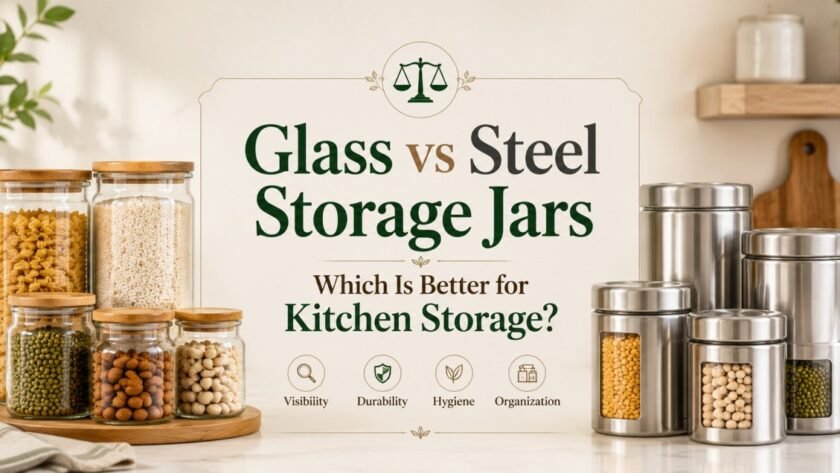

When it comes to organizing a kitchen, the humble storage jar doesn’t get nearly enough attention. We spend plenty of time choosing cabinets, shelves and countertops, but the containers sitting inside those cabinets are what we actually use every single day. And when you’re deciding between glass and steel, the choice isn’t as simple as picking whichever one looks nicer.
Glass vs Steel Storage Jars is a comparison worth considering if you’re planning a pantry makeover, replacing old containers or trying to build a more organized kitchen in 2026.
Both materials have been kitchen staples for years. Glass gives you excellent visibility, a clean appearance and an easy way to see exactly what’s inside. Steel, particularly stainless steel, brings durability, lighter handling in many designs and excellent resistance to everyday knocks and bumps.
But which one is actually better?
Well… it depends on what you’re storing, where you’re storing it and how you use your kitchen. 😄
In this Glass vs Steel Storage Jars comparison, we’ll look at durability, weight, cleaning, visibility, storage, moisture protection, pantry organization and everyday convenience. We’ll also look at which material makes more sense for common Indian kitchen staples such as rice, dal, flour, sugar, spices and dry fruits.
Because a container isn’t useful just because it looks beautiful on a shelf.
It needs to survive actual kitchen life.
Also Read | Best Glass Storage Jars 10 Smart Kitchen Picks
🫙 Glass vs Steel Storage Jars at a Glance
Before getting into all the details, here’s a quick overview.
| Feature | Glass Storage Jars | Steel Storage Jars |
|---|---|---|
| Visibility | Excellent | None |
| Durability | Good but breakable | Excellent |
| Weight | Generally heavier | Generally lighter |
| Odor Resistance | Excellent | Excellent |
| Stain Resistance | Excellent | Excellent |
| Cleaning | Easy | Easy |
| Appearance | Clear and modern | Classic and practical |
| Pantry Visibility | Excellent | Limited |
| Handling | Can be heavy | Usually easier |
| Breakage Risk | Higher | Very low |
| Stackability | Depends on design | Often practical |
| Spices | Excellent | Good |
| Rice & Dal | Excellent | Excellent |
| Dry Fruits | Excellent | Excellent |
| Everyday Accessibility | Excellent visibility | Depends on labeling |
| Best For | Visibility + organization | Durability + practicality |
The comparison already tells us something important: neither material wins every category.
That’s exactly why the Glass vs Steel Storage Jars debate is more interesting than it first appears.
🏠 What Are Glass Storage Jars?
Glass storage jars are containers made primarily from glass and designed to store food or pantry ingredients.
They come in a huge variety of shapes and capacities, from tiny spice jars to large containers designed for rice, flour and other staples.
You can find them with:
- Screw-top lids
- Clip or clamp closures
- Silicone seals
- Plastic lids
- Bamboo lids
- Wooden lids
- Metal lids
The biggest advantage of glass is incredibly simple:
You Can See What’s Inside.
That sounds basic, but it’s genuinely useful.
Imagine having five containers sitting in front of you.
With glass, you can immediately identify:
Rice
Moong Dal
Masoor Dal
Sugar
Pasta
With opaque storage, you may need labels or a memory that is considerably better than most of ours. 😂
👀 Why Glass Is Popular for Pantry Organization
One of the biggest reasons glass works well in a pantry is visibility.
You can quickly see:
- How much food remains
- Which ingredient you’re looking for
- Whether a container is empty
- Whether you’re running low
- Whether you already have a particular ingredient
This can make grocery shopping easier too.
Instead of buying another packet of pasta because you’re convinced you’re out, you can simply look at the jar.
That makes glass particularly attractive for people who want a visually organized pantry.
In the Glass vs Steel Storage Jars comparison, this is one area where glass has a very clear advantage.
🥫 What Are Steel Storage Jars?
Steel storage jars are traditionally used in many Indian kitchens and remain popular because of their durability and practical design.
When shopping for steel storage containers, you’ll commonly encounter stainless steel products.
They’re available in:
- Small spice containers
- Medium pantry jars
- Large storage canisters
- Multi-container sets
- Stackable designs
- Containers with separate lids
- Containers with airtight-style closures
Unlike glass, steel is opaque.
You can’t see what’s inside without opening the container or checking a label.
But that isn’t necessarily a disadvantage.
A simple label can solve the visibility issue, while the strength of steel can make it a very practical choice for everyday kitchen use.
💪 Steel’s Biggest Advantage: Durability
Let’s be honest.
Glass can break.
You can have the most beautiful glass storage jar in the kitchen, but if it slips from your hand onto a hard floor, there is a very real possibility that your beautiful pantry organization project is about to become a cleaning project. 😭
Steel doesn’t have that same problem.
A good stainless steel storage jar can withstand the kind of everyday knocks that would make you nervous with glass.
This makes steel particularly useful for:
- Busy kitchens
- Large families
- Frequently handled containers
- Lower kitchen cabinets
- Bulk storage
- Homes where containers are moved regularly
In the Glass vs Steel Storage Jars debate, steel takes the lead when durability is the priority.
⚖️ Glass vs Steel Storage Jars: Which Is Heavier?
Weight is another important factor.
At first, an empty glass jar might not seem particularly heavy.
But fill it with:
- Rice
- Flour
- Dal
- Sugar
and suddenly you’re lifting considerably more weight.
Steel containers can also become heavy when filled, of course, but many steel storage designs are relatively practical to handle because they don’t combine the weight of a thick glass body with the food inside.
Why This Matters
Think about where you’ll keep the container.
If you’re storing a large quantity of rice in a container placed on an upper shelf, weight becomes much more important.
For heavy pantry staples, keeping containers on lower shelves is generally more practical regardless of material.
Still, in a Glass vs Steel Storage Jars comparison, steel often makes more sense if easy handling is one of your biggest priorities.
🧼 Glass vs Steel Storage Jars: Which Is Easier to Clean?
Both materials can be easy to clean.
But there are some differences worth considering.
Glass
Glass has a smooth surface and is generally straightforward to wash.
It also lets you see the inside clearly, making it easier to spot leftover food residue.
This is particularly useful for:
- Flour
- Sugar
- Spices
- Sticky ingredients
- Dry fruits
Steel
Stainless steel is also relatively easy to clean and doesn’t have the same breakage concern.
However, because it’s opaque, you can’t see the inside until you open it.
Our Verdict
Both are easy to clean.
The actual difference may come down more to the lid and seal design than the container material itself.
A complicated lid with grooves and seals can require more cleaning attention regardless of whether the body is glass or steel.
🌶️ Glass vs Steel Storage Jars for Spices
Spices are one area where glass has a particularly strong advantage.
Why?
Because visibility matters.
Imagine you’re cooking and need:
Turmeric
You can immediately identify it in a glass jar.
With steel, you’d need:
- A label
- A memory test
- Or a little peek inside.
😂
For frequently used spices, small glass jars can therefore be extremely convenient.
However, steel spice containers have their own advantage: they’re durable and practical, particularly in busy cooking environments.
Best Choice for Spices
Glass: Better for visibility.
Steel: Better for durability.
If you’re someone who wants a neat spice rack where every spice is immediately visible, glass has the edge.
🍚 Glass vs Steel Storage Jars for Rice
Rice is one of the most commonly stored pantry staples in Indian kitchens, so it’s worth looking at separately.
Glass
Advantages:
- You can see the rice
- Easy to check quantity
- Looks organized
- Easy to clean
- Works well with pantry labeling
Disadvantages:
- Large jars can become heavy
- Breakage is possible
- Moving a full jar requires care
Steel
Advantages:
- Durable
- Suitable for frequent handling
- No breakage concern
- Practical for bulk storage
Disadvantages:
- Contents aren’t visible
- Labels become more important
Verdict
For rice, both can work well.
If you prioritize visibility and pantry aesthetics, choose glass.
If durability and everyday handling matter more, steel may be the better choice.
That’s one of the clearest examples of why there’s no universal winner in the Glass vs Steel Storage Jars debate.
🌾 Glass vs Steel Storage Jars for Dal
Dal creates a similar comparison.
With glass, you can immediately identify different varieties:
- Toor dal
- Moong dal
- Masoor dal
- Chana dal
- Urad dal
That can be incredibly convenient if you keep multiple varieties at home.
With steel, labeling becomes much more important.
However, steel offers excellent durability and is particularly useful if containers are frequently moved in and out of cabinets.
Our Pick
Glass for visibility.
Steel for durability.
And honestly, either can work beautifully when the container is the right size and has a secure lid.
🍚 Glass vs Steel Storage Jars for Flour and Sugar
Flour and sugar benefit from containers that are:
- Easy to open
- Easy to scoop
- Easy to clean
- Properly sealed
- Comfortable to lift
A wide-mouth container is particularly useful because you can easily insert a measuring cup or spoon.
Glass
Excellent visibility and easy cleaning.
Steel
Excellent durability and practical handling.
For both materials, the lid design matters enormously.
If the container is supposed to protect dry ingredients from humidity, make sure the product has a secure closure appropriate for that purpose.
🥜 Glass vs Steel Storage Jars for Dry Fruits
Dry fruits are another category where glass looks particularly appealing.
You can instantly see:
- Almonds
- Cashews
- Raisins
- Walnuts
- Pistachios
This makes portion management and inventory checks easier.
Steel can also store dry fruits effectively, but because it’s opaque, labeling is more useful.
Best Choice
For countertop or open-shelf storage:
Glass
For durability and everyday cabinet storage:
Steel
🧠 Does Glass Keep Food Fresher Than Steel?
This is where we need to avoid oversimplifying things.
The material itself isn’t the only factor determining how well food is stored.
The lid and seal matter enormously.
A properly sealed container can help limit exposure to:
- Air
- Humidity
- Dust
- Kitchen odors
Whether the body is glass or steel, you should look at the actual closure mechanism.
Look For:
- Secure-fitting lids
- Silicone seals
- Rubber gaskets
- Clamp closures
- Properly designed screw-top lids
Don’t assume that every glass jar or steel container is automatically airtight.
In the Glass vs Steel Storage Jars comparison, the quality of the seal can matter more than the material itself.
👃 Glass vs Steel Storage Jars for Odor and Stains
Both materials can be excellent choices when it comes to resisting food odors.
Glass has a smooth surface and generally doesn’t retain food smells easily.
Stainless steel is also widely used for food storage and is resistant to many common kitchen stains and odors.
This makes both suitable for a variety of pantry ingredients.
Where Glass Has an Advantage
You can see whether the jar has any residue or staining.
Where Steel Has an Advantage
You don’t have to worry about shattering if the container gets knocked around.
So once again, it’s fairly even.
🏡 Glass vs Steel Storage Jars for Small Kitchens
Small kitchens require a slightly different approach.
Every inch of cabinet space matters.
If you have a compact kitchen, think about:
- Container dimensions
- Stackability
- Weight
- Shelf height
- Shelf depth
- Frequency of use
Glass can look beautiful in a small pantry because its transparency reduces visual clutter.
Steel can be practical if you frequently move containers around and want something more resistant to accidental knocks.
For Small Kitchens
Glass: Great for visual organization.
Steel: Great for durability.
The best choice depends on which problem you’re trying to solve.
📦 The Best Strategy May Be Using Both
Here’s a thought that often gets overlooked.
You don’t have to choose only glass or only steel.
Your kitchen can use both.
For example:
Glass
Use for:
- Spices
- Dry fruits
- Cereals
- Pasta
- Frequently used dal
- Countertop storage
Steel
Use for:
- Bulk rice
- Flour
- Backup supplies
- Frequently moved containers
- Heavy pantry staples
This hybrid approach can give you the advantages of both materials without forcing one material to do every job.
And honestly, that’s probably the most practical approach for many kitchens.
📊 Glass vs Steel Storage Jars: First Verdict
At this stage, here’s how the comparison looks:
| Category | Winner |
|---|---|
| Visibility | 🏆 Glass |
| Pantry Aesthetics | 🏆 Glass |
| Durability | 🏆 Steel |
| Breakage Resistance | 🏆 Steel |
| Easy Identification | 🏆 Glass |
| Heavy-Duty Use | 🏆 Steel |
| Spices | 🏆 Glass |
| Rice | Tie |
| Dal | Tie |
| Flour | Tie |
| Dry Fruits | 🏆 Glass |
| Cleaning | Tie |
| Odor Resistance | Tie |
| Small Kitchen | Depends |
| Everyday Handling | 🏆 Steel |
| Open Shelf Storage | 🏆 Glass |
There’s no runaway winner.
And that’s exactly what makes Glass vs Steel Storage Jars a useful comparison rather than a simple yes-or-no question.
The right choice depends on whether you value visibility and organization more or durability and practical handling more.
Choosing between glass and steel becomes more interesting once you move beyond the basic question of appearance. A kitchen container needs to survive repeated opening, closing, washing, filling, lifting and storing. That’s why this Glass vs Steel Storage Jars comparison focuses on the things you’ll actually notice after using the containers for months—not just how they look on day one.
⚖️ Glass vs Steel Storage Jars: Detailed Comparison
Let’s break down the most important differences before deciding which material deserves a permanent place in your kitchen.
💪 1. Durability
If durability is your number-one priority, steel has the advantage.
A good stainless steel storage jar can handle everyday bumps, knocks and frequent handling without the same breakage concerns associated with glass.
Glass is durable enough for normal kitchen use, but it needs more care.
Glass
✔ Strong and long-lasting when handled carefully
✔ Doesn’t easily develop scratches from ordinary use
✔ Suitable for pantry shelves and countertops
❌ Can crack or shatter if dropped
Steel
✔ Highly durable
✔ Handles everyday knocks well
✔ Better suited to busy kitchens
✔ Practical for frequent handling
🏆 Winner: Steel
For families where containers are constantly being moved around, steel is the safer practical choice.
👀 2. Visibility
This one isn’t even close.
Glass wins.
You can see exactly what’s inside without opening the container.
That’s particularly useful when you’re storing several similar ingredients.
For example:
- Moong dal
- Masoor dal
- Toor dal
- Chana dal
- Urad dal
A transparent glass jar lets you identify them immediately.
With steel, you’ll need a label or you’ll have to open the container.
🏆 Winner: Glass
If you want a pantry where you can see everything at a glance, glass is hard to beat.
🧼 3. Ease of Cleaning
Both glass and stainless steel can be relatively easy to clean.
The bigger factor is the lid design.
A simple lid with fewer grooves and components is generally easier to maintain than a complicated closure mechanism.
Glass
The transparent body makes it easy to spot residue.
Steel
The material is sturdy and practical for frequent washing.
🏆 Winner: Tie
For both Glass vs Steel Storage Jars, choose a design that’s easy to open, wash and dry.
💧 4. Protection From Moisture
If you’re storing dry pantry ingredients, moisture protection matters.
However, don’t make the mistake of thinking that the container material automatically determines whether your food stays protected.
The seal is crucial.
A glass jar with a poor-fitting lid isn’t necessarily better than a steel container with a well-designed seal.
When comparing Glass vs Steel Storage Jars, check for:
- Silicone gaskets
- Rubber seals
- Secure lids
- Clamp closures
- Tight-fitting screw lids
🏆 Winner: Tie
The better-sealed container wins, regardless of whether it’s glass or steel.
🌶️ 5. Best Material for Spices
Spices are frequently opened and accessed, so convenience matters.
Glass has a major advantage because you can see the spice immediately.
A collection of small glass jars can also make a spice drawer or rack look much more organized.
Steel containers are durable and practical, but you’ll generally need labels.
🏆 Winner: Glass
For everyday spices, glass storage jars are usually more convenient.
🍚 6. Best Material for Rice
Rice is commonly purchased and stored in larger quantities, so capacity and weight matter.
Glass
A large transparent jar lets you instantly see how much rice remains.
Steel
A large steel container is durable and practical, especially if the rice is frequently accessed.
The downside of glass is that a large glass jar filled with rice can become quite heavy.
🏆 Winner: Depends
Glass for visibility.
Steel for heavy-duty everyday handling.
🌾 7. Best Material for Dal
Dal is another category where both materials perform well.
If you keep multiple varieties, glass is especially convenient.
You can quickly distinguish between different dals without opening every container.
Steel works beautifully if durability matters more and you use clear labels.
🏆 Winner: Glass for visibility, Steel for durability
This is one of those categories where your kitchen habits should determine the winner.
🧂 8. Best Material for Sugar and Flour
For flour and sugar, look for:
- Wide openings
- Secure lids
- Suitable capacity
- Easy cleaning
- Comfortable handling
A wide-mouth design is particularly helpful because it allows you to use a measuring cup or spoon without making a mess.
Glass
Excellent visibility and easy monitoring.
Steel
Excellent durability and practical handling.
🏆 Winner: Tie
The lid and size matter more than the material here.
🥜 9. Best Material for Dry Fruits
Glass gets another point here.
Dry fruits look great in transparent jars, and you can easily check your stock.
For example, you can immediately see whether you’re running low on:
- Almonds
- Cashews
- Raisins
- Walnuts
- Pistachios
Steel works perfectly well for storage but doesn’t give you that instant visual check.
🏆 Winner: Glass
🏠 10. Best Material for Open Shelves
If your pantry has open shelves, appearance becomes more important.
Glass jars create a clean and consistent visual effect, particularly when you use matching containers and simple labels.
Steel containers can look neat too, but they naturally create a more opaque appearance.
🏆 Winner: Glass
For open shelving and countertop organization, glass usually has the aesthetic edge.
🧺 11. Best Material for Closed Cabinets
Inside a closed cabinet, appearance matters less.
This is where steel’s durability can become more valuable.
If the containers are regularly moved around, stacked or pulled from the back of a cabinet, steel can be more forgiving.
🏆 Winner: Steel
Especially for busy kitchens where practicality comes before aesthetics.
🪜 12. Glass vs Steel Storage Jars for High Shelves
This is an important consideration that often gets ignored.
Large glass jars filled with rice, flour or dal can become very heavy.
Putting them on a high shelf isn’t ideal because lifting a heavy glass container from above shoulder height can be awkward.
Steel containers may also become heavy when filled, but their lower breakage risk gives them an advantage in this situation.
Our Recommendation
Keep:
Small glass jars → higher shelves
Large heavy containers → lower shelves
This is a better storage strategy regardless of material.
📦 13. Stackability
If you’re working with a small kitchen, stackability can make a huge difference.
But don’t assume that every glass or steel container can be stacked safely.
Look for containers specifically designed for stacking.
Glass
Some modern glass storage systems are designed around stackable shapes.
Steel
Steel containers are also commonly available in stackable designs.
🏆 Winner: Tie
The design matters more than the material.
🧽 14. Odor and Stain Resistance
Both glass and stainless steel are good options when you’re concerned about lingering food smells.
Glass is particularly convenient because its smooth surface makes it easy to clean.
Stainless steel also performs well for everyday kitchen storage.
🏆 Winner: Tie
Both are practical choices.
🪶 15. Handling and Everyday Convenience
This is where steel starts pulling ahead.
Imagine taking a container out of the cabinet several times a day.
You want something that’s:
- Comfortable to lift
- Easy to hold
- Durable
- Simple to open
- Not unnecessarily heavy
Large glass containers can become cumbersome once filled.
Steel can often feel more practical for heavy-duty storage.
🏆 Winner: Steel
Especially for large quantities.
💰 16. Which Is More Budget-Friendly?
There’s no universal answer because both glass and steel storage jars come in a wide price range.
Basic containers can be affordable in either material, while premium designs with specialized lids, seals or finishes can cost considerably more.
Instead of asking:
“Which material is cheaper?”
ask:
“Which container gives me the features I actually need?”
A cheap container that doesn’t fit your shelf or doesn’t seal properly isn’t really a bargain.
🧠 Glass vs Steel Storage Jars: Which One Is Better for Your Lifestyle?
This is probably the most useful way to make the decision.
👩🍳 If You Cook Every Day
Steel can be practical for frequently handled bulk ingredients.
Use glass for spices and smaller ingredients you need to identify quickly.
Best Setup:
Steel + Glass
🏢 If You Live in a Small Apartment
Glass can help you visually organize your pantry, while stackable steel containers can handle heavier storage.
Best Setup:
A mix of compact glass and steel
🌶️ If You Love a Well-Organized Spice Rack
Go with glass.
Being able to see your spices instantly is incredibly convenient.
Best Choice:
Glass
🛒 If You Buy Groceries in Bulk
Steel may be more practical for heavy ingredients that are moved frequently.
Best Choice:
Steel for bulk storage
✨ If You Want an Aesthetic Pantry
Glass wins.
Matching transparent jars with simple labels can make even an ordinary pantry look significantly more organized.
Best Choice:
Glass
🆚 Glass vs Steel Storage Jars: Pros and Cons
| 🫙 Glass | 🥫 Steel | |
|---|---|---|
| Visibility | Excellent | Poor without labels |
| Durability | Good | Excellent |
| Breakage | Possible | Very low |
| Weight | Can be heavy | Usually practical |
| Cleaning | Easy | Easy |
| Odor Resistance | Excellent | Excellent |
| Pantry Aesthetics | Excellent | Good |
| Spice Storage | Excellent | Good |
| Bulk Storage | Good | Excellent |
| Open Shelves | Excellent | Good |
| Heavy Handling | Moderate | Excellent |
| Ingredient Identification | Excellent | Requires labels |
| Stacking | Depends on design | Depends on design |
| Moisture Protection | Depends on lid | Depends on lid |
| Long-Term Use | Excellent with care | Excellent |
🏆 Glass vs Steel Storage Jars: Best Choice by Category
| Kitchen Need | Better Choice |
|---|---|
| Spices | 🏆 Glass |
| Dry fruits | 🏆 Glass |
| Open shelves | 🏆 Glass |
| Pantry visibility | 🏆 Glass |
| Rice | Tie |
| Dal | Tie |
| Flour | Tie |
| Sugar | Tie |
| Bulk storage | 🏆 Steel |
| Heavy ingredients | 🏆 Steel |
| Frequent handling | 🏆 Steel |
| Durability | 🏆 Steel |
| Small labelled containers | 🏆 Glass |
| Heavy-duty kitchen | 🏆 Steel |
| Aesthetic pantry | 🏆 Glass |
| Mixed kitchen storage | 🏆 Both |
🧩 Why a Combination Can Be Better Than Choosing One
Here’s where the Glass vs Steel Storage Jars debate gets interesting.
You don’t actually have to choose one material for your entire kitchen.
A hybrid storage system can make much more sense.
For example:
Glass Storage Jars
Use them for:
- Spices
- Dry fruits
- Seeds
- Pasta
- Cereals
- Frequently used dals
Steel Storage Jars
Use them for:
- Rice
- Atta
- Bulk dal
- Backup supplies
- Heavy ingredients
This gives you the visibility of glass where it matters and the durability of steel where it matters.
It’s basically the kitchen-storage equivalent of not putting all your eggs in one basket. 🥚😂
🏷️ Labels Make Steel Containers Easier to Use
One of the biggest complaints about steel containers is that you can’t see the contents.
Fortunately, there’s a very simple solution:
Labels.
You can use:
RICE
TOOR DAL
MOONG DAL
SUGAR
FLOUR
SUJI
POHA
Even simple handwritten labels can work.
If you want a more polished pantry, use matching printed labels.
The point isn’t to make your pantry look like a luxury showroom.
The point is to make finding ingredients fast.
📏 Choosing the Right Size
Whether you’re buying glass or steel, capacity should be based on what you actually store.
Small: 100–300ml
Best for:
- Spices
- Seeds
- Small dry fruits
Medium: 500ml–1L
Best for:
- Sugar
- Smaller quantities of dal
- Cereals
- Pasta
Large: 1–2L
Best for:
- Dal
- Flour
- Sugar
- Larger pantry staples
Extra Large: 2L+
Best for:
- Rice
- Atta
- Bulk ingredients
Don’t buy huge containers just because you shop in bulk.
If a container becomes too heavy to comfortably move, its large capacity stops being an advantage.
🧺 How to Organize Glass and Steel Jars Together
If you’re using both materials, don’t arrange them randomly.
Instead, organize by function.
For example:
Eye-Level Shelf
Glass jars containing everyday ingredients.
Middle Shelf
Steel containers for frequently used bulk staples.
Lower Shelf
Large steel or glass containers containing heavy ingredients.
Spice Section
Small glass jars.
Backup Zone
Steel containers for unopened bulk supplies.
This creates a practical flow throughout the pantry.
🔄 Follow FIFO With Both Materials
The First In, First Out method isn’t limited to glass.
It works equally well with steel containers.
When adding fresh ingredients:
- Check the existing stock.
- Use older stock first.
- Refill the container when appropriate.
- Keep newer purchases separate if needed.
- Avoid blindly mixing old and new ingredients.
This can make your pantry easier to manage and reduce forgotten supplies.
⚠️ Common Mistakes to Avoid
Even the best container material won’t save a badly organized pantry.
Here are some mistakes to avoid when choosing between Glass vs Steel Storage Jars.
❌ Buying Only Based on Appearance
A pretty jar isn’t automatically practical.
❌ Ignoring Weight
A huge glass jar filled with rice can become difficult to handle.
❌ Forgetting the Lid
The body material isn’t enough.
❌ Buying Containers Before Measuring Shelves
Always measure first.
❌ Overfilling
Leave enough room for comfortable access.
❌ Storing Heavy Glass Jars Up High
Keep heavy containers lower whenever practical.
❌ Assuming Every Container Is Airtight
Check the actual closure mechanism.
❌ Buying Too Many
You don’t need 30 containers because one Instagram reel convinced you that your pantry is currently a personal failure. 😂
🔬 Our Research Methodology
For this Glass vs Steel Storage Jars comparison, we evaluated both materials based on practical kitchen-storage considerations rather than appearance alone.
Our comparison considers:
- Durability
- Weight
- Visibility
- Cleaning
- Odor resistance
- Stain resistance
- Lid and seal design
- Storage capacity
- Stackability
- Accessibility
- Pantry organization
- Everyday handling
- Suitability for common Indian pantry ingredients
We also considered how the materials perform in different kitchen environments, including compact kitchens, open shelving, closed cabinets and bulk-storage setups.
The aim is to help you choose the material that fits your actual kitchen habits, rather than simply declaring one material the winner.
🛒 What to Look for Before Buying
Whether you choose glass or steel, use this checklist before purchasing.
1. Material Quality
For steel, look for clearly specified stainless steel construction where applicable.
For glass, check the intended food-storage use and product specifications.
2. Capacity
Match the container to the quantity you normally store.
3. Lid
Check how securely it closes.
4. Seal
If you need airtight storage, look for an appropriate gasket or sealing mechanism.
5. Opening
Wide openings are usually easier for filling, scooping and cleaning.
6. Dimensions
Measure your pantry shelves before buying.
7. Stackability
Only stack containers designed for stacking.
8. Weight
Think about the filled weight, not just the empty container.
9. Maintenance
Check how the jar, lid and seal should be cleaned.
10. Replacement Parts
If the lid or seal is replaceable, that’s a useful bonus for long-term use.
💡 One Simple Rule for Choosing
If you’re still confused between the two, use this simple rule:
Choose Glass If You Want:
Visibility + aesthetics + easy identification
Choose Steel If You Want:
Durability + practical handling + heavy-duty storage
Choose Both If You Want:
The best of each material.
And honestly, that last option is probably the most sensible for many Indian kitchens.
🏠 Glass vs Steel Storage Jars for Indian Kitchens
Indian kitchens often have a unique combination of storage requirements.
You may need separate containers for:
- Rice
- Multiple varieties of dal
- Atta
- Suji
- Poha
- Sugar
- Salt
- Spices
- Dry fruits
- Snacks
- Tea
- Coffee
That means there isn’t necessarily one perfect container size or material.
For smaller ingredients and frequently accessed products, glass can make identification easier.
For larger quantities and heavy staples, steel can provide practical durability.
This is why a mixed approach can be particularly effective.
🧹 Maintenance Tips for Both Materials
A good storage system only works if you maintain it.
For Glass
- Handle carefully
- Check for chips or cracks
- Wash thoroughly
- Dry completely
- Inspect the lid seal
For Steel
- Wash according to manufacturer instructions
- Dry properly
- Keep lids clean
- Check for dents or damaged closures
- Inspect seals when applicable
And regardless of material:
Never refill a container without checking what’s already inside.
Your pantry deserves better than mystery food. 😂
Choosing the right storage material becomes much easier once you stop thinking about it as a simple glass versus steel competition and start thinking about what your kitchen actually needs.
A busy kitchen may benefit from both.
Glass can make your pantry easier to see and organize, while steel can handle heavier ingredients and everyday knocks with less worry. The best solution isn’t necessarily to replace every container you own. Instead, choose the material that makes the most sense for each storage job.
This final section of our Glass vs Steel Storage Jars guide brings everything together, including the best use cases, buying checklist, maintenance tips, pros and cons, final verdict and frequently asked questions.
🏆 Glass vs Steel Storage Jars: Which One Should You Choose?
If you want the shortest possible answer:
Choose Glass For:
- Spices
- Dry fruits
- Seeds
- Pasta
- Cereals
- Frequently used ingredients
- Open shelves
- Aesthetic pantry organization
- Easy ingredient identification
Choose Steel For:
- Rice
- Atta
- Bulk dal
- Heavy ingredients
- Backup pantry supplies
- Frequently handled containers
- Busy family kitchens
- Storage where durability matters most
Choose Both For:
- A complete pantry organization system
- Kitchens with different storage requirements
- Families that want both visibility and durability
That’s why our overall answer to Glass vs Steel Storage Jars is:
🥇 There Is No Universal Winner
Glass wins for visibility and organization.
Steel wins for durability and heavy-duty practicality.
A combination of both is the most versatile solution.
🫙 When Glass Storage Jars Make More Sense
Glass is an excellent option when you want to see what you’re storing.
This is especially useful for ingredients you reach for regularly.
Imagine opening your pantry and immediately seeing:
Turmeric → Cumin → Chilli Powder → Garam Masala
No opening.
No guessing.
No “Where did I keep that?” kitchen treasure hunt. 😂
Glass also works particularly well if you like a neat, coordinated pantry with matching containers and simple labels.
🥫 When Steel Storage Jars Make More Sense
Steel becomes particularly attractive when durability is your biggest concern.
For example, imagine a large container of atta that gets moved several times a week.
You may not care whether you can see the flour through the container.
You care that the container:
- Is sturdy
- Is easy to handle
- Doesn’t break
- Has a secure lid
- Can withstand everyday kitchen use
That’s where steel shines.
In the Glass vs Steel Storage Jars comparison, steel is the practical workhorse.
It may not give you the Instagram-worthy transparency of glass, but it can take the daily kitchen grind without demanding quite as much attention.
🌶️ Best Material for a Spice Collection
For spices, we’d lean toward glass.
Small transparent jars make it easy to identify ingredients quickly.
You can organize them alphabetically, by frequency of use or according to your cooking routine.
Everyday Section
- Turmeric
- Chilli powder
- Coriander powder
- Cumin
- Garam masala
Whole Spices
- Cardamom
- Cloves
- Cinnamon
- Black pepper
- Star anise
Specialty Blends
- Chaat masala
- Kitchen king
- Sambar masala
- Other spice blends
A dedicated spice organizer combined with small glass jars can create a very efficient setup.
For more inspiration, see our Spice Organization Ideas guide.
🍚 Best Material for Rice and Grains
Rice is one of those ingredients where both materials can work well.
Choose Glass If:
You want to see how much rice remains.
Choose Steel If:
You store large quantities and frequently move the container.
Choose Both If:
You keep a large backup supply in steel while storing your everyday quantity in a smaller glass container.
That last approach can be surprisingly practical.
For example:
Bulk rice → Steel
Everyday rice → Glass
This gives you durability where you need it and visibility where you use it.
🌾 Best Material for Dal
If you regularly use multiple types of dal, glass can be particularly convenient.
You can easily distinguish:
- Toor dal
- Moong dal
- Masoor dal
- Chana dal
- Urad dal
However, if you prefer traditional storage and durability, steel remains an excellent option.
Our Pick:
Glass for identification
Steel for durability
And if you’re already using steel containers, simply add clear labels.
Problem solved. 👍
🥜 Best Material for Dry Fruits and Seeds
Glass is particularly useful for dry fruits and seeds because these ingredients are often stored in smaller quantities.
A row of small glass jars can make it easy to monitor:
- Almonds
- Cashews
- Walnuts
- Raisins
- Chia seeds
- Flax seeds
- Pumpkin seeds
- Sunflower seeds
You can also quickly see when something needs to be added to your grocery list.
For these smaller ingredients, glass generally makes more sense than oversized steel containers.
🍝 Best Material for Pasta and Cereals
Glass jars can be excellent for pasta because you can see the contents immediately.
A tall glass jar can work particularly well for:
- Spaghetti
- Long pasta
- Vermicelli
Medium jars can be useful for:
- Macaroni
- Penne
- Fusilli
- Cereals
- Oats
Steel can certainly store these foods too, but the visibility advantage of glass makes it easier to identify different varieties.
🧁 Best Material for Baking Ingredients
If you’re creating a dedicated baking zone, glass can be particularly convenient.
You can use appropriately sized jars for suitable dry ingredients such as:
- Sugar
- Cocoa powder
- Baking ingredients
- Nuts
- Seeds
- Sprinkles
Transparent jars make it easier to see what you have before starting a recipe.
And if you’ve ever started baking only to discover you’re out of cocoa powder halfway through, you already understand why visibility matters. 😂
🏠 Glass vs Steel Storage Jars for Small Kitchens
Small kitchens require smarter storage because there isn’t much room for mistakes.
Before choosing your containers, measure:
Width
Depth
Height
Shelf clearance
Cabinet opening
Then think about how the containers will actually be used.
For Small Shelves
Compact glass jars can provide excellent visibility.
For Deep Cabinets
Steel containers or handled storage bins can make frequent access easier.
For Vertical Storage
Choose containers specifically designed to stack.
For High Shelves
Avoid placing heavy filled containers where they’re difficult to lift.
The best Glass vs Steel Storage Jars setup for a small kitchen is often a combination rather than one material.
🧺 Glass vs Steel Storage Jars and Pantry Bins
Another useful idea is to combine jars with pantry bins.
You don’t need to put every product inside a jar.
Glass Jars
Use for:
- Rice
- Dal
- Flour
- Sugar
- Pasta
- Dry fruits
- Spices
Steel Jars
Use for:
- Bulk ingredients
- Backup stock
- Heavy staples
Pantry Bins
Use for:
- Biscuits
- Snack packets
- Chips
- Sachets
- Small boxes
- Packaged foods
This gives every storage solution a clear purpose.
For more help with packaged food storage, see our Best Pantry Storage Bins guide.
🧩 Combine Storage Materials With Modular Organization
If you’re building a complete pantry from scratch, modular storage can make things easier.
You could have:
Large Containers
For rice and flour.
Medium Containers
For dal, sugar and cereals.
Small Containers
For spices and seeds.
Pantry Bins
For packaged foods.
The goal is to create a system where each container has a purpose.
This is more useful than simply buying a giant matching set.
For more on this approach, check out our Modular vs Stackable Storage guide.
🔄 Use FIFO Regardless of Material
Whether you choose glass or steel, food rotation still matters.
Use the First In, First Out (FIFO) method.
That means:
Older stock → Front
Newer stock → Back
When you buy another packet of rice or dal, don’t blindly mix it with whatever is already in the container.
Check the existing stock first.
This can help prevent old ingredients from being forgotten at the back of the pantry.
🧹 Maintenance Tips for Glass Storage Jars
Glass storage is relatively easy to maintain, but you still need to treat it properly.
1. Wash Regularly
Clean jars when changing ingredients or when residue builds up.
2. Dry Completely
Never add dry food to a damp jar.
3. Check for Damage
Look for chips, cracks or damaged edges.
4. Clean the Lid
Don’t focus only on the glass body.
5. Inspect the Seal
If the jar has a gasket, check that it remains clean and properly seated.
6. Avoid Sudden Temperature Changes
Follow the manufacturer’s instructions regarding temperature and intended use.
A container designed specifically for food storage isn’t automatically suitable for every cooking or heating application.
🧼 Maintenance Tips for Steel Storage Jars
Steel is generally very practical, but it also benefits from regular care.
Keep It Dry
Dry the container after washing.
Clean the Lid
Food residue can collect around closures.
Check for Dents
Small cosmetic dents aren’t necessarily a problem, but damaged closures may affect usability.
Inspect Seals
If the container has a gasket, check it periodically.
Follow Manufacturer Instructions
Different finishes and lid materials can have different cleaning requirements.
⚠️ When You Shouldn’t Choose Glass
Glass isn’t automatically the best choice.
Consider steel or another suitable storage material if:
- You frequently drop containers
- You need large heavy-duty storage
- Children frequently handle the containers
- Containers need to be moved constantly
- Breakage is a major concern
- You store very large quantities
In these situations, the durability advantage of steel can outweigh the visibility advantage of glass.
⚠️ When You Shouldn’t Choose Steel
Steel also isn’t perfect for every situation.
Consider glass if:
- You frequently forget what’s inside containers
- You use many similar-looking ingredients
- You want transparent pantry organization
- You like open shelving
- You need easy visual inventory
- You’re organizing spices
- You want to see how much food remains
If you hate opening five containers just to find the right dal, glass might make your life considerably easier. 😄
💰 How to Shop Without Overspending
You don’t need to replace every kitchen container immediately.
Start with the categories that cause the most trouble.
Step 1
Identify your five most frequently used pantry ingredients.
Step 2
Choose the appropriate material.
Step 3
Measure the storage area.
Step 4
Buy only the required sizes.
Step 5
Use them for a few weeks.
Step 6
Expand your system only if necessary.
This approach is much better than buying an enormous container set and then discovering that half of the jars don’t fit your kitchen.
🛍️ Buying Checklist for Glass and Steel Storage Jars
Before purchasing, ask yourself:
Material
Is the material appropriate for your intended use?
Capacity
Does the jar hold the quantity you actually store?
Lid
Does it close securely?
Seal
Does it provide the type of seal you need?
Opening
Is it wide enough for easy filling and scooping?
Dimensions
Does it fit your shelves?
Weight
Will you be comfortable lifting it when full?
Stackability
Is it designed to stack?
Cleaning
Can the container and lid be cleaned easily?
Replacement Parts
Can you replace the lid or seal if necessary?
Quantity
Do you actually need the number of containers in the set?
This checklist works equally well when comparing Glass vs Steel Storage Jars.
🏆 Pros and Cons: Glass vs Steel Storage Jars
| 🫙 Glass Storage Jars | 🥫 Steel Storage Jars | |
|---|---|---|
| Visibility | Excellent | Low |
| Durability | Good | Excellent |
| Breakage Risk | Higher | Very low |
| Cleaning | Easy | Easy |
| Odor Resistance | Excellent | Excellent |
| Stain Resistance | Excellent | Excellent |
| Aesthetic Appeal | Excellent | Good |
| Spice Storage | Excellent | Good |
| Bulk Storage | Good | Excellent |
| Heavy-Duty Use | Moderate | Excellent |
| Open Shelving | Excellent | Good |
| Ingredient Identification | Excellent | Requires labels |
| Weight When Filled | Can be high | Depends on design |
| Stackability | Design dependent | Design dependent |
| Long-Term Use | Excellent with care | Excellent |
| Best Feature | Visibility | Durability |
🏆 Final Verdict: Glass vs Steel Storage Jars
After comparing the two materials across everyday kitchen requirements, our verdict is pretty straightforward.
🥇 Glass Wins for Visibility and Organization
If your priority is a pantry where you can instantly see your ingredients, glass is the better option.
It’s particularly useful for:
- Spices
- Dry fruits
- Seeds
- Pasta
- Cereals
- Dal
- Open shelves
Glass also works beautifully when you’re creating a coordinated pantry with labels and different container sizes.
🥇 Steel Wins for Durability
If your priority is a container that can handle everyday knocks, frequent movement and heavier ingredients, steel is the stronger choice.
It’s particularly useful for:
- Rice
- Atta
- Bulk dal
- Backup supplies
- Large quantities
- Busy kitchens
Steel is less visually informative, but labels can solve that problem easily.
🏆 Best Overall: A Combination of Both
For most kitchens, we’d choose both.
Use glass where visibility matters.
Use steel where durability matters.
That gives you a practical storage system without forcing one material to solve every problem.
And that’s the real answer to Glass vs Steel Storage Jars:
The best material is the one that matches the ingredient, storage location and way you use your kitchen.
There is no need to turn your pantry into a glass-only or steel-only zone.
Your rice container doesn’t need to have the same material as your spice jar.
Your kitchen isn’t a laboratory. It’s a kitchen. 😄
📊 Glass vs Steel Storage Jars: Quick Decision Guide
| If You Want… | Choose |
|---|---|
| Maximum visibility | 🫙 Glass |
| Easy ingredient identification | 🫙 Glass |
| Aesthetic pantry | 🫙 Glass |
| Spice organization | 🫙 Glass |
| Open-shelf storage | 🫙 Glass |
| Maximum durability | 🥫 Steel |
| Heavy-duty storage | 🥫 Steel |
| Bulk pantry ingredients | 🥫 Steel |
| Frequent handling | 🥫 Steel |
| Less breakage concern | 🥫 Steel |
| Best of both worlds | 🏆 Both |
🔬 Our Research Methodology
For this Glass vs Steel Storage Jars comparison, we evaluated both materials based on practical kitchen-storage requirements rather than appearance alone.
Our assessment considered durability, weight, visibility, cleaning, odor and stain resistance, lid design, sealing, capacity, stackability, accessibility and pantry compatibility.
We also considered how each material performs with common kitchen ingredients such as rice, dal, flour, sugar, spices, dry fruits, pasta and cereals.
Rather than selecting a single material as universally superior, we evaluated where each option makes the most practical sense in an everyday kitchen.
❓ Frequently Asked Questions
1. Are glass or steel storage jars better?
Neither material is universally better.
Glass is better for visibility, organization and ingredient identification, while steel is better for durability, heavy-duty storage and frequent handling.
For many kitchens, using both is the most practical solution.
2. Which is better for storing rice, glass or steel?
Both can work well.
Glass allows you to see the remaining rice, while steel is more durable for frequent handling and bulk storage.
If you store large quantities, consider the filled weight before choosing a very large glass jar.
3. Are glass jars better for spices?
Yes, glass can be particularly convenient for spices because you can immediately see the contents.
Small glass jars combined with labels or a spice rack can create a very practical spice-storage system.
4. Are steel containers good for Indian kitchens?
Yes.
Steel storage containers have long been popular for kitchen storage because they are durable and practical for everyday use.
They’re particularly useful for bulk ingredients and frequently handled pantry staples.
5. Which is easier to clean, glass or steel?
Both can be easy to clean.
The lid and seal design often matters more than the container material.
Choose containers with simple, accessible components that can be washed and dried properly.
6. Do glass jars keep food fresher?
The material alone doesn’t determine freshness.
The quality of the seal and storage conditions are important factors.
If you’re storing dry ingredients, choose an appropriately sealed container and keep it clean and completely dry.
7. Are glass storage jars too heavy?
Large glass jars can become heavy when filled with rice, flour or other dense ingredients.
That’s why large filled glass jars are usually better placed on lower shelves.
8. Can steel storage jars be airtight?
Some steel storage containers have airtight-style or sealed lids, while others do not.
Always check the product specifications rather than assuming every steel container is airtight.
9. Can glass and steel jars be stacked?
Some designs are specifically made for stacking.
Don’t stack containers simply because they appear to fit together. Check the product design and stability first.
10. Should I replace all my plastic containers with glass or steel?
Not necessarily.
Replace containers based on actual needs.
If your current containers are clean, safe, functional and suitable for your storage requirements, there’s no need to replace everything simply for the sake of having a matching pantry.
11. Which is better for a small kitchen?
It depends on the storage problem.
Glass is excellent for visibility and compact ingredient organization, while steel can be useful for durable storage of heavier ingredients.
A combination can work particularly well.
12. Which material is better for a modern pantry?
Glass generally creates a more transparent and coordinated appearance, especially with matching jars and labels.
However, steel can look equally neat when used as part of a consistent storage system.
🏁 Final Thoughts
The Glass vs Steel Storage Jars debate doesn’t really need a dramatic winner.
Both materials have strengths.
Glass gives you:
Visibility.
Organization.
Easy identification.
A clean pantry appearance.
Steel gives you:
Durability.
Practicality.
Heavy-duty performance.
Resistance to everyday knocks.
For a kitchen that uses a variety of ingredients, the smartest approach is often to combine the two.
Use glass for spices, dry fruits, seeds and frequently accessed pantry ingredients.
Use steel for rice, atta, bulk dal and other heavier or frequently handled supplies.
And most importantly, don’t buy containers simply because they look good in someone else’s pantry.
Measure your shelves.
Think about your ingredients.
Consider the filled weight.
Check the lid.
Look at the seal.
Then buy only what you actually need.
Because the perfect kitchen-storage system isn’t the one that looks amazing for a single Instagram photo.
It’s the one that still works beautifully six months later. 🏠✨