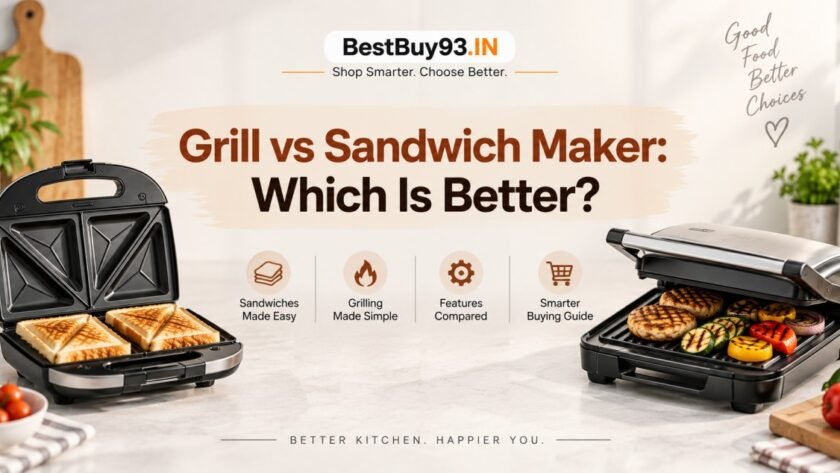

🥪🔥A sandwich maker and a grill can look almost identical on a kitchen counter.
Both have heated plates.
Both can toast bread.
Both can make crispy snacks.
Both can make your kitchen smell absolutely amazing. 😂
So naturally, the question is:
Do you actually need a sandwich maker, or would a grill be better?
The answer depends on what you cook most often.
If your idea of a perfect sandwich is:
🍞 Bread + chutney + aloo + cheese → Sandwich maker
If you’re thinking:
🧀 Paneer + vegetables + grilled sandwich + toasted bun → Grill
then a flat grill may be the better choice.
And here’s where things get interesting:
A sandwich maker and a grill are not always completely different appliances.
Some modern sandwich makers use flat grill plates and can open completely flat, effectively giving you a small contact grill. Others use triangular or pocket plates specifically designed to seal sandwiches.
So let’s break down the difference properly.
🥪 Grill vs Sandwich Maker: Quick Comparison
| Feature | Sandwich Maker | Electric Grill |
|---|---|---|
| Best for | Stuffed sandwiches | Grilling + sandwiches |
| Plate design | Triangle/pocket or grill | Flat/ribbed grill |
| Stuffed sandwiches | ⭐⭐⭐⭐⭐ | ⭐⭐⭐⭐ |
| Paneer | ⭐⭐⭐ | ⭐⭐⭐⭐⭐ |
| Vegetables | ⭐⭐⭐ | ⭐⭐⭐⭐⭐ |
| Classic triangle sandwiches | ⭐⭐⭐⭐⭐ | ⭐⭐ |
| Panini-style sandwiches | ⭐⭐⭐ | ⭐⭐⭐⭐⭐ |
| Flatbread/buns | ⭐⭐⭐ | ⭐⭐⭐⭐⭐ |
| Versatility | Medium | High |
| Cleaning | Depends on plates | Depends on plates |
| Kitchen space | Usually compact | Can be larger |
| Best for | Sandwich-focused users | Multi-purpose users |
The biggest difference isn’t necessarily the motor or wattage.
It’s the plate design and what you want to cook.
🔺 What Is a Sandwich Maker?
A traditional sandwich maker uses two heated plates that close over your sandwich.
Many models have:
Triangle or pocket-shaped plates
These plates press the bread together and can create a sealed edge around the filling.
That makes them particularly useful for:
🥔 Aloo sandwiches
🧀 Cheese sandwiches
🌽 Corn sandwiches
🫑 Vegetable sandwiches
🥪 Chutney sandwiches
👧 Kids’ tiffin sandwiches
The result is usually a crisp outer layer with a hot filling inside.
🔥 What Is an Electric Grill?
An electric grill, often called a contact grill, usually uses flatter or ribbed cooking plates.
Instead of shaping your sandwich into sealed triangles, it presses the food between grill surfaces.
This makes it useful for much more than sandwiches.
Depending on the specific appliance and manufacturer instructions, you may be able to grill:
🧀 Paneer
🥦 Vegetables
🍞 Buns
🥪 Sandwiches
🌯 Flatbreads
🍢 Other suitable foods
Some models can also open 180°, turning the two plates into a larger flat grilling surface.
🥪 1. Which Is Better for Stuffed Sandwiches?
Winner: Sandwich Maker
If you’re the person who believes a sandwich isn’t a sandwich unless it’s stuffed properly, a traditional sandwich maker has an advantage.
Think:
Bread
⬇️
Green chutney
⬇️
Aloo masala
⬇️
Cheese
⬇️
Capsicum + onion
⬇️
More cheese because why not? 😂
Pocket-style plates are designed specifically for this type of sandwich.
They can press and seal the edges while creating the classic triangular shape.
Best for:
🥔 Aloo sandwiches
🧀 Cheese-filled sandwiches
🌽 Corn & cheese
🥬 Vegetable sandwiches
🥪 Sealed toasties
🔥 2. Which Is Better for Paneer?
Winner: Electric Grill
This is where a flat grill pulls ahead.
Paneer doesn’t need to be trapped inside bread.
You want a cooking surface where the pieces can sit directly against the hot plates.
A flat grill can be much more practical for:
🧀 Paneer tikka
🔥 Grilled paneer
🥦 Vegetables
🍄 Mushrooms
🌽 Corn
The ability to open some models flat can also give you more usable cooking area.
🥬 3. What About Grilled Vegetables?
Again:
Winner: Electric Grill
A flat surface is simply more convenient.
You can spread vegetables across the plate rather than trying to fit them inside a sandwich pocket.
Depending on the model, suitable foods may include:
🥦 Broccoli
🫑 Capsicum
🌽 Corn
🍄 Mushrooms
🥒 Zucchini
🍅 Tomatoes
Always check the manufacturer’s instructions before using an appliance for foods beyond its intended applications.
🧀 4. What About Cheese Sandwiches?
This one is closer.
For classic sealed cheese sandwiches:
Sandwich Maker wins.
For panini-style grilled cheese:
Flat Grill wins.
Both can produce delicious results.
The difference is the texture.
Sandwich maker:
Crispy + sealed + triangular
Grill:
Pressed + browned + grilled
So this comes down to your preferred sandwich style.
🔺 5. Triangle Sandwich vs Grilled Sandwich
This is probably the easiest way to understand the difference.
Triangle Sandwich
Made using pocket/triangle plates.
You get:
🔺 Crispy edges
🔺 Sealed filling
🔺 Defined portions
🔺 Classic Indian sandwich-shop style
Grilled Sandwich
Made using flat or ribbed grill plates.
You get:
🔥 Grill marks
🔥 Crisp exterior
🔥 Flatter sandwich
🔥 Panini-style result
Neither is automatically better.
They’re simply different styles.
🥖 6. Which Is Better for Thick Bread?
Usually: Flat Grill with a floating hinge
A floating hinge allows the upper plate to adjust better to different food thicknesses.
That’s useful for:
🍞 Thick bread
🧀 Heavy cheese fillings
🥪 Stuffed sandwiches
🥖 Panini-style bread
A rigid sandwich maker may compress a very thick sandwich more aggressively.
So if you love oversized sandwiches:
Look for a floating hinge.
🥯 7. What About Buns and Burgers?
Winner: Electric Grill
A flat contact grill is generally more practical for:
🍔 Burger buns
🥯 Bagels
🥖 Bread rolls
🥪 Panini-style bread
You have more flexibility in how you position the food.
A traditional triangle sandwich maker isn’t really designed for this.
🧀 8. What About Paneer Tikka?
This is one of the biggest reasons to choose a grill.
A suitable electric grill can turn your kitchen into a mini grilling station.
You can place marinated paneer directly onto the hot surface and grill it according to the appliance’s instructions.
Some 180° opening models are specifically positioned for grilling paneer, vegetables and other snacks.
If you regularly make paneer:
Grill > Traditional Sandwich Maker
🥪 9. What About Kids’ Sandwiches?
Winner: Sandwich Maker
For kids, sealed sandwiches can be incredibly convenient.
You can make:
🧀 Cheese
🥔 Potato
🌽 Corn
🥪 Vegetable
sandwiches quickly.
The sealed edges can also help keep fillings contained.
And the triangle shape?
Kids generally approve. 😂
👨👩👧👦 10. What About Family Breakfast?
This depends on your family.
If everyone wants:
Different stuffed sandwiches
→ Sandwich maker.
If you want:
Sandwich + grilled vegetables + paneer + buns
→ Grill.
And if you’re feeding several people, look at the cooking surface area and number of portions per batch, not just the wattage.
🏠 11. Which Takes Less Kitchen Space?
Usually: Sandwich Maker
Basic sandwich makers are often compact and designed specifically for two sandwiches at a time.
A larger contact grill can have:
- Larger plates
- Bigger footprint
- More storage requirements
If you have a small kitchen or limited cabinet space, a compact sandwich maker can make more sense.
🧼 12. Which Is Easier to Clean?
There’s no universal winner.
It depends heavily on the plate design.
Fixed sandwich plates:
You usually need to wipe them in place.
Removable grill plates:
Much easier to clean.
Flat grill:
May be easier to access, but food residue can still collect around edges and hinges.
The real question is:
Are the plates removable?
That’s often more important than whether the appliance is called a grill or sandwich maker.
🔄 13. What About a 3-in-1 Sandwich Maker?
Now we reach the interesting middle ground.
A 3-in-1 sandwich maker can come with interchangeable plates for different cooking functions.
For example:
🥪 Sandwich plates
🔥 Grill plates
🧇 Waffle plates
This can be useful if you want multiple appliances in one.
The advantage:
One appliance.
Multiple cooking options.
The disadvantage:
More parts.
More storage.
Usually higher cost.
And you have to actually use those functions.
If you’re only going to make sandwiches, don’t buy a 3-in-1 just because it sounds impressive.
🔓 14. What Does 180° Opening Actually Do?
This is one of the most useful features on a grill-style appliance.
Normally:
Top plate
⬇️
Food
⬇️
Bottom plate
But when opened 180°:
Plate + Plate
You effectively get a larger flat cooking area.
This can make it easier to grill:
🧀 Paneer
🥦 Vegetables
🍞 Buns
🥪 Open sandwiches
Depending on the appliance, it can also make cooking for multiple portions easier.
⚡ 15. Grill vs Sandwich Maker: Which Uses More Electricity?
Don’t assume the grill automatically costs much more.
What matters is:
Power × cooking time
For example, a 1000W appliance used for a short period may consume less energy than a lower-powered appliance running for significantly longer.
Current comparisons also note that wattage alone isn’t a good measure of running cost; actual cooking time matters.
So don’t choose purely based on:
“This one is only 750W, so it must be cheaper.”
Look at how long you actually use it.
💰 16. Grill vs Sandwich Maker: Which Is More Expensive?
Basic sandwich makers can be relatively affordable.
Flat grills and more versatile models tend to cost more as you add:
✔️ Larger plates
✔️ Removable plates
✔️ 180° opening
✔️ Better hinges
✔️ Multiple functions
✔️ Premium cooking surfaces
Current 2026 Indian comparisons place mainstream sandwich makers around roughly ₹800–₹3,700, while flat-plate grills can extend toward around ₹4,500, depending on features and brand.
So:
Sandwich maker = usually cheaper entry point
Grill = usually more versatile
🥪 17. Which Is Better for Indian-Style Sandwiches?
Sandwich Maker wins if you love:
🥔 Aloo masala sandwiches
🧀 Cheese sandwiches
🌽 Corn sandwiches
🥪 Chutney sandwiches
🥬 Vegetable sandwiches
Grill wins if you love:
🧀 Paneer
🔥 Grilled vegetables
🥖 Panini-style sandwiches
🍞 Buns
🍢 Grilled snacks
🧠 18. Which One Should You Buy?
Let’s make the decision ridiculously simple.
Buy a Sandwich Maker if:
✔️ You mainly make stuffed sandwiches
✔️ You like triangular sealed sandwiches
✔️ You want a compact appliance
✔️ You’re on a budget
✔️ You don’t need extensive grilling
Buy an Electric Grill if:
✔️ You want to grill paneer
✔️ You cook vegetables frequently
✔️ You want panini-style sandwiches
✔️ You want a larger cooking surface
✔️ You want more versatility
✔️ You like 180° flat-opening designs
Buy a 3-in-1 if:
✔️ You want multiple cooking functions
✔️ You have limited kitchen space
✔️ You’ll actually use the extra plates
✔️ You don’t mind paying more
🏆 19. BestBuy93.IN Decision Table
| If Your Priority Is… | Choose |
|---|---|
| Classic sandwich | 🥪 Sandwich Maker |
| Stuffed aloo sandwich | 🥪 Sandwich Maker |
| Cheese toastie | 🥪 Sandwich Maker / Grill |
| Paneer tikka | 🔥 Grill |
| Grilled vegetables | 🔥 Grill |
| Panini | 🔥 Grill |
| Kids’ sandwiches | 🥪 Sandwich Maker |
| Multiple snack types | 🔥 Grill |
| Small kitchen | 🥪 Compact Sandwich Maker |
| Maximum versatility | 🔥 Grill / 3-in-1 |
| Lowest initial cost | 🥪 Sandwich Maker |
| Larger cooking surface | 🔥 Grill |
Features, Performance & Real-World Use 🥪🔥
We established the basic difference between a sandwich maker and an electric grill:
Sandwich maker = better for sandwiches
Grill = better for grilling
3-in-1 grill/sandwich maker = better if you want both
But here’s where things get interesting.
Two appliances may both say “Grill Sandwich Maker” on the box, yet their actual performance can be completely different. One may handle thick aloo-paneer sandwiches beautifully, while another struggles to close properly. One may work great for vegetables and paneer, while another is basically designed for toast.
So before buying one, let’s look at the features that actually make a difference. 👇
🔥 1. Plate Design Matters More Than the Name
Don’t get too impressed by labels like “Sandwich Grill,” “Panini Maker,” “Contact Grill” or “Multi Grill.”
The plate design tells you much more about what the appliance can actually do.
🥪 Triangle/Pocket Plates
These plates divide the sandwich into triangular sections and are designed mainly for:
- Bread sandwiches
- Cheese sandwiches
- Potato sandwiches
- Vegetable sandwiches
- Stuffed sandwiches
- Kids’ breakfast
They seal the edges and create that classic Indian-style toasted sandwich.
Best for: Someone who mainly wants sandwiches.
🔥 Flat or Ribbed Grill Plates
These are much more versatile.
You can use them for:
- Paninis
- Grilled bread
- Paneer
- Capsicum
- Onion
- Corn
- Vegetables
- Burger patties
- Kebabs
- Buns
- Wraps
A 180° opening makes them even more useful because both plates can become a larger open grilling surface. Current models from brands such as Wipro, Glen and Bajaj specifically use this design for indoor grilling.
Best for: People who want more than just sandwiches.
⚙️ 2. Floating Hinge — The Feature You Shouldn’t Ignore
If you regularly make thick stuffed sandwiches, look for a floating hinge.
A normal fixed hinge basically moves through a limited range.
So imagine this:
🍞 Bread
🥔 Aloo
🧀 Cheese
🫑 Vegetables
🍞 Another bread slice
You close the lid…
CRUSH. 😭
A floating hinge allows the upper plate to adjust to the thickness of the food instead of forcing everything into one fixed height.
This is particularly useful for:
- Club sandwiches
- Thick cheese sandwiches
- Aloo sandwiches
- Paneer sandwiches
- Multi-layer sandwiches
- Paninis
Current grill models such as the Borosil Jumbo and several 180° grill makers specifically use floating-hinge designs for thicker food.
👉 My recommendation
If your sandwiches are usually simple bread + chutney + cheese, you don’t necessarily need to pay extra for a floating hinge.
But if you love properly stuffed sandwiches, it’s absolutely worth considering.
🔄 3. What Does 180° Opening Actually Do?
You’ll see “180° opening” mentioned everywhere.
But why does it matter?
Because when the appliance opens completely flat, it can work more like an open contact grill.
Instead of:
Top plate ↓
🥪
Bottom plate ↑
you get:
[ Grill Plate ] [ Grill Plate ]
That gives you a much larger cooking area.
You can grill things such as:
- Paneer tikka
- Vegetables
- Burger patties
- Kebabs
- Buns
- Toast
- Panini
- Sandwiches
Some current 180° models even include oil-collection trays for grilling foods that release fat or moisture.
Is 180° opening necessary?
For basic sandwiches: ❌ Not really.
For multipurpose grilling: ✅ Very useful.
⚡ 4. 750W vs 800W vs 1000W vs 1500W+
This is where people sometimes make the mistake of thinking:
“Higher wattage = automatically better.”
Not exactly.
Wattage mainly tells you about the electrical power available to the heating system. Actual performance also depends on plate design, heating element distribution, thermostat/control and how well the appliance recovers heat between batches.
🟢 750W
Good for:
- Occasional sandwiches
- Toasting
- Small households
- Basic breakfast use
If you’re only making 1–2 sandwiches occasionally, 750W can be perfectly adequate.
🟢 800W
This is a very practical middle ground.
Good for:
- Everyday sandwiches
- Cheese sandwiches
- Stuffed sandwiches
- Small families
- Regular breakfast use
Many mainstream sandwich makers sit around the 750–800W range.
🟡 1000W
Worth considering if you want:
- Faster heating
- More frequent batches
- Better performance with thicker food
- Sandwich + grill functionality
For example, Wipro’s current 1000W grill model combines ceramic plates, temperature control, auto cut-off and 180° grilling.
🔴 1500W–2000W+
This category starts making more sense when you’re buying a proper grill-style appliance.
These models are designed for:
- Larger plates
- Multiple sandwiches
- Heavy grilling
- Paneer
- Vegetables
- Patties
- Frequent back-to-back cooking
Current examples include 1500W, 1700W and 2000W grill models with 180° opening and larger cooking surfaces.
⚠️ One important point
Before buying a very high-wattage appliance, check your kitchen’s socket and electrical setup and follow the manufacturer’s requirements.
Don’t buy a 2000W appliance and then discover your favourite extension board isn’t appropriate for it. 😅
🧀 5. Thick Stuffed Sandwiches: Grill vs Sandwich Maker
This is one of the biggest real-world differences.
Sandwich Maker
A traditional sandwich maker is usually better at sealing and pressing the sandwich.
Great for:
- Bread
- Cheese
- Potato
- Corn
- Onion
- Capsicum
- Chutney
- Simple Indian fillings
Grill
A flat grill is better when you don’t necessarily want the sandwich compressed into a sealed pocket.
For example:
Bread + cheese + vegetables + paneer
You can grill it more like a café-style panini.
🏆 Winner?
Classic stuffed Indian sandwich → Sandwich maker
Thick café-style sandwich/panini → Grill with floating hinge
🧀 6. What About Cheese?
Cheese is where appliance design suddenly becomes very important. 😂
If cheese melts and escapes onto the plates, cleaning becomes annoying.
A good non-stick surface helps release food more easily, while a flat-open design can make access to the plates easier during cleaning.
Tip:
Don’t overload the sandwich with cheese right up to the edge.
Leave a little space around the perimeter.
Otherwise:
Cheese: “I’m free!” 🧀🏃♂️
And suddenly your sandwich maker needs a cleaning session.
🥘 7. Can You Grill Paneer and Vegetables?
Yes but plate design matters.
For paneer, vegetables and similar foods, a flat/ribbed grill is generally more practical than triangular pocket plates.
Look for:
- Ribbed grilling surface
- Larger plate area
- Temperature control
- Floating hinge
- 180° opening
- Easy-clean surface
- Drip/oil collection where applicable
Some current grill models are specifically designed around these features.
Best combination:
Flat ribbed plates + floating hinge + temperature control + 180° opening
That’s basically the “I want to grill everything” configuration. 🔥
🧽 8. Fixed Plates vs Removable Plates
This is a feature people often ignore until the first cheese explosion.
Fixed Plates
Pros:
- Usually simpler construction
- Often more compact
- Fewer removable components
- Easy for basic sandwich use
Cons:
- Cleaning corners can be annoying
- You can’t remove the plates and wash them separately
Removable Plates
Pros:
- Easier cleaning
- More convenient after messy grilling
- Some models allow different plate types
Cons:
- Can increase cost
- Adds another component to store
- Plate locking/removal mechanism needs to be reasonably well designed
My take:
If you’re buying a basic sandwich maker, fixed plates are perfectly fine.
If you’re buying a premium multipurpose grill, removable plates become much more attractive.
🥞 9. Ceramic vs Traditional Non-Stick Plates
This is another area where marketing can make things confusing.
Traditional Non-Stick
Usually:
- Easy to clean
- Common
- Affordable
- Good for everyday sandwich making
But you should avoid:
❌ Metal utensils
❌ Abrasive scrubbers
❌ Aggressive scraping
Ceramic-Coated Plates
Ceramic-coated models are increasingly available, including current grill makers marketed as PTFE/PFOA-free.
Potential advantages include:
- Easy food release
- Easy cleaning
- Different coating chemistry
- Good option for buyers specifically looking for ceramic surfaces
But don’t assume ceramic automatically means better cooking performance.
The heating system, plate design and temperature control still matter.
Best approach:
Don’t choose purely based on the word “ceramic.”
Choose based on the complete appliance.
🌡️ 10. Temperature Control — Is It Worth Paying For?
For a basic sandwich maker:
Not essential.
For a multipurpose grill:
Very useful.
Why?
Because different foods need different levels of heat.
Lower heat
Good for:
- Melting cheese
- Reheating
- Gentle toasting
Medium heat
Good for:
- Sandwiches
- Bread
- Buns
- Vegetables
Higher heat
Useful for:
- Paneer
- Grilled vegetables
- Patties
- Faster browning
Some current grill models combine adjustable temperature controls with 180° opening and larger grilling surfaces.
💧 11. Oil Drip Tray — Small Feature, Big Convenience
If you’re only making sandwiches, you may never need one.
But if you’re grilling:
- Paneer
- Patties
- Kebabs
- Vegetables
- Fatty foods
an oil collector/drip tray can make cleanup considerably easier.
Current contact grills such as Glen’s 2000W model include a removable oil collector tray.
Verdict:
Sandwich-only user: Optional
Regular grilling: Highly useful
🧼 12. Cleaning: Don’t Underestimate This
A grill can have all the fancy features in the world.
But if cleaning it is irritating, eventually it’ll live inside your kitchen cabinet.
Look for:
✅ Non-stick/ceramic cooking surface
✅ Easy access to corners
✅ 180° opening
✅ Removable drip tray where applicable
✅ No unnecessary grooves that trap food
And remember:
Never immerse the electrical appliance in water.
Let it cool completely, unplug it and clean according to the manufacturer’s instructions.
⚡ 13. Electricity: Will a Grill Increase Your Bill?
Higher wattage means higher maximum power consumption while the heating element is operating.
For example:
- 800W appliance → 0.8 kWh per hour if continuously drawing full rated power
- 1500W appliance → 1.5 kWh per hour
- 2000W appliance → 2 kWh per hour
But a sandwich maker normally operates for only a few minutes at a time, and thermostatic controls can cycle the heating element.
So don’t compare appliances only by their wattage.
Real question:
How long will you actually use it?
For a 5–10 minute breakfast session, even a higher-wattage grill doesn’t automatically mean a huge electricity expense.
👨👩👧👦 14. Which One Makes More Sense for Your Household?
| Your Usage | Better Choice |
|---|---|
| 1–2 people, occasional sandwiches | 🥪 Basic sandwich maker |
| Daily breakfast sandwiches | 🥪 750–1000W sandwich maker |
| Thick stuffed sandwiches | 🔥 Floating-hinge grill |
| Panini-style sandwiches | 🔥 Flat grill |
| Paneer & vegetables | 🔥 Grill |
| Burgers & patties | 🔥 Openable grill |
| Family of 4+ | 🔥 Large 4-slice grill |
| Sandwiches + grilling | 🔥 3-in-1 / 180° grill |
| Only occasional toast | 🥪 Basic sandwich maker |
| Maximum versatility | 🔥 Grill with 180° opening |
💰 15. Which Features Are Actually Worth Paying Extra For?
Here’s the part I’d personally use while shopping.
| Feature | Worth Paying Extra? |
|---|---|
| 750W → 800W | ⭐ Sometimes |
| 800W → 1000W | ⭐⭐ Yes for frequent use |
| 1000W → 1500W+ | ⭐⭐ Mainly for grilling |
| Floating hinge | ⭐⭐⭐ Yes for thick sandwiches |
| 180° opening | ⭐⭐⭐ Yes for grilling |
| Temperature control | ⭐⭐⭐ Yes for multipurpose use |
| Removable plates | ⭐⭐ Useful |
| Oil drip tray | ⭐⭐ Useful for grilling |
| Ceramic coating | ⭐⭐ Preference-based |
| 4-slice capacity | ⭐⭐⭐ Great for families |
| Fancy presets | ⭐ Usually unnecessary |
| Premium exterior | ⭐ Not important |
🚫 Common Buying Mistakes
❌ Mistake 1: Buying based only on wattage
A 1500W grill isn’t automatically better for making sandwiches than a well-designed 800W sandwich maker.
❌ Mistake 2: Ignoring plate shape
If you want paneer and vegetables, don’t buy a triangle-pocket sandwich maker just because it looks attractive.
❌ Mistake 3: Ignoring hinge design
If you love thick fillings, a fixed hinge can become frustrating very quickly.
❌ Mistake 4: Paying for features you won’t use
If you’re only making two sandwiches every Sunday, you probably don’t need a giant 2000W commercial-style grill.
❌ Mistake 5: Forgetting kitchen storage
A large 180° grill can be significantly bigger than a compact sandwich maker.
Measure your storage space before buying.
🧠 The Best Feature Combination for Different Users
🥪 Basic Sandwich Lover
Look for:
750–800W + non-stick plates + indicator lights + compact design
🧀 Stuffed Sandwich Lover
Look for:
800–1000W + floating hinge + non-stick/ceramic plates
🔥 Grill Lover
Look for:
1000W+ + ribbed plates + temperature control + 180° opening
👨👩👧👦 Family User
Look for:
Large plates + 4-slice capacity + 1000W+ + easy cleaning
🏠 Small Kitchen User
Look for:
Compact 2-slice model + vertical storage/cord management + simple controls
🏆 Grill vs Sandwich Maker: Verdict
After looking beyond the basic definitions, the decision becomes much clearer.
Choose a Sandwich Maker if:
🥪 Sandwiches are your primary use
💰 You want to spend less
🏠 You have limited counter/storage space
🍞 You mostly make regular bread sandwiches
⚡ You don’t need extensive grilling
Choose a Grill if:
🔥 You want to grill paneer and vegetables
🥩 You want to cook patties or kebabs
🥪 You make thick sandwiches or paninis
🔄 You want 180° opening
🌡️ You want temperature control
👨👩👧👦 You cook multiple portions
Choose a 3-in-1 / 180° Grill Sandwich Maker if:
You basically want to say:
“I don’t want another appliance for every single thing.” 😂
This is probably the most interesting option for someone who wants sandwiches and grilling without buying two separate appliances.
Budget, Maintenance & Final Buying Checklist 💰🔥
By now, we know the basic difference:
🥪 Sandwich Maker → sandwiches first
🔥 Grill → grilling first
🔄 3-in-1 Grill/Sandwich Maker → both
We went deeper into plate design, wattage, floating hinges, 180° opening, temperature control, removable plates and other features.
But there’s one question left:
How much should you actually spend and which option makes the most sense for your kitchen?
Because honestly, you don’t need to spend ₹3,000+ just to make two cheese sandwiches on a Sunday. 😂
On the other hand, buying the cheapest sandwich maker and expecting it to handle paneer, vegetables, thick sandwiches and back-to-back cooking can also leave you disappointed.
So let’s look at the money, maintenance and long-term value side of the decision. 👇
💰 1. How Much Should You Spend?
The current Indian market has everything from basic sandwich makers under ₹1,000 to larger, higher-powered grills costing several thousand rupees.
A useful way to think about the budget is by how you actually plan to use the appliance.
🟢 Under ₹1,000 — Basic Sandwich Making
Best for:
- Students
- Singles
- Occasional users
- Simple breakfast sandwiches
- Toasted bread
- Small kitchens
At this price, focus on:
✅ Around 750W
✅ Non-stick plates
✅ Auto temperature control
✅ Power/heating indicators
✅ Basic safety features
Don’t expect premium grilling performance.
Best for: “Mujhe bas sandwich banana hai.” 🥪
🟡 ₹1,000–₹2,000 — The Sweet Spot
This is where things become much more interesting.
You can find models offering:
- 750–1000W power
- Better plate design
- Larger cooking surfaces
- Floating hinges on some models
- Better build quality
- Grill functionality
- 180° opening on selected models
- Ceramic-coated options
For many households, this is the most sensible price range.
If you’re going to use the appliance regularly, I’d rather spend around this range on a well-designed model than buy the cheapest available option.
🏆 Best for:
Everyday home use + reasonable versatility
🟠 ₹2,000–₹3,500 — Premium Home Use
At this level, you’re usually paying for a combination of:
🔥 Better construction
🔥 Larger plates
🔥 Higher power
🔥 Better hinge mechanism
🔥 Temperature control
🔥 More versatile grilling
🔥 Better coating
🔥 Additional features
This makes sense if you genuinely use the appliance several times a week.
If you only make sandwiches occasionally, however, you probably don’t need to go this high.
🔴 ₹3,500+ — Buy Only If You Need the Extra Capability
Higher-priced grills can make sense for:
- Frequent grilling
- Large families
- Large sandwiches
- Multiple batches
- Heavy cooking
- Larger cooking surfaces
- More advanced controls
But don’t fall into the trap of:
“Expensive = automatically better.”
A ₹4,000 grill isn’t automatically a better sandwich maker than a ₹1,500 sandwich maker.
It may simply be better suited to a different type of cooking.
⚡ 2. Don’t Buy Based Only on Wattage
This point is worth repeating because it causes a lot of confusion.
You might see:
Model A — 800W
Model B — 1500W
and assume Model B is automatically superior.
Not necessarily.
Actual cooking performance depends on:
- Heating-element design
- Plate size
- Heat distribution
- Thermostat/control
- Heat recovery
- Plate material
- Hinge design
- Food thickness
Example:
If you’re making two normal cheese sandwiches, an 800W sandwich maker can be completely adequate.
If you’re grilling several batches of paneer and vegetables, a larger high-powered grill can make much more sense.
Match wattage to workload not ego. 😂
🧽 3. Maintenance: The Part Nobody Thinks About Before Buying
Everyone gets excited about:
“180° opening!”
“1000W!”
“Ceramic coating!”
“3-in-1!”
But six months later…
“Yaar isko clean kaise karun?” 😭
A sandwich maker/grill should ideally be easy to clean because food residue, cheese and oil can build up quickly.
🧀 After Making Sandwiches
Allow the appliance to cool.
Then:
- Unplug it.
- Remove loose crumbs.
- Wipe the plates with a soft damp cloth.
- Use a soft sponge for stubborn residue.
- Dry completely before storing.
Avoid:
❌ Steel scrubbers
❌ Metal knives
❌ Sharp objects
❌ Abrasive cleaners
❌ Pouring water directly onto the appliance
These can damage the cooking surface.
🫕 4. What If Cheese Gets Stuck?
Don’t immediately start scraping it with a spoon.
That can damage the coating.
Instead:
Step 1
Unplug the appliance and allow it to cool.
Step 2
Use a soft damp cloth or sponge.
Step 3
For stubborn residue, follow the manufacturer’s cleaning instructions.
Step 4
Wipe the plates dry.
A little patience is much cheaper than replacing damaged plates. 😅
🛢️ 5. Do You Need Oil or Butter?
Usually, you don’t need to flood the plates with oil.
Depending on the bread and recipe, you may use:
- A light layer of butter
- A small amount of oil
- No additional oil
For grilling paneer or vegetables, a light coating may help with browning and food release.
But more oil doesn’t automatically mean better grilling.
Best approach:
Use only what the recipe actually needs.
🔄 6. Removable Plates: Worth Paying Extra?
If you’re comparing two otherwise similar appliances, removable plates can be a meaningful convenience feature.
Fixed plates
Better when:
- You want simplicity
- You mostly make sandwiches
- Cleaning requirements are minimal
- You want a compact appliance
Removable plates
Better when:
- You grill frequently
- You make messy foods
- You want easier cleaning
- You want interchangeable plate options
For a 3-in-1 appliance, removable plates become considerably more useful.
🧱 7. Don’t Ignore Build Quality
A cheap appliance can look perfectly fine in an online photograph.
But check:
- Hinge strength
- Lid movement
- Handle quality
- Plate alignment
- Locking mechanism
- Cord quality
- Base stability
- Overall finish
Especially check the hinge.
If the hinge feels flimsy from day one, imagine opening and closing it hundreds of times.
That’s one reason a floating hinge can be useful on models intended for thick sandwiches.
🏠 8. Small Kitchen? Think About Storage
This is an underrated factor.
A large 180° grill can be significantly bigger than a compact two-slice sandwich maker.
Before buying, check:
📏 Width
📏 Depth
📏 Height
📦 Storage position
🔌 Cord storage
🗄️ Cabinet space
If your kitchen counter is already packed with a mixer grinder, rice cooker, kettle and other appliances, a giant grill may spend most of its life inside a cupboard.
And an appliance that is difficult to access is an appliance you eventually stop using.
👨👩👧👦 9. Two-Slice vs Four-Slice
This decision is simple.
2-Slice
Good for:
- Singles
- Couples
- Small kitchens
- Occasional use
- One or two servings
4-Slice / Large Grill
Better for:
- Families
- Multiple children
- Breakfast for several people
- Batch cooking
- Frequent entertaining
If you’re regularly making four sandwiches, having a larger cooking surface can save considerable time.
⚡ 10. Electricity Cost: Keep It in Perspective
Let’s use a simple example.
Suppose an appliance is rated at 1000W.
That’s 1 kW.
If you use it for 10 minutes:
1 kW × 10/60 hour = approximately 0.167 kWh
So even if your electricity tariff were ₹10 per unit, that would be roughly:
₹1.67 for 10 minutes of full-rated consumption.
Actual consumption can be lower because the heating element doesn’t necessarily draw full power continuously once the desired temperature is reached.
The important point is:
Don’t obsess over wattage alone.
A faster, more powerful grill used for a short period can still be perfectly reasonable for everyday cooking.
🛠️ 11. Warranty & Service Matter More Than Fancy Features
Before purchasing, check:
✅ Warranty period
✅ Brand service availability
✅ Customer support
✅ Whether the model has an identifiable model number
✅ Replacement availability
✅ Plate/coating warranty, if specified
✅ Terms for electrical components
A slightly more expensive appliance from a brand with better support can be a better long-term purchase than a cheaper model with questionable after-sales service.
🚩 12. Online Buying: Watch Out for These Red Flags
Before clicking Buy Now, don’t just read the headline.
Check the actual specifications.
🚩 Red Flag #1
“Multi-purpose grill” but no clear information about the plates.
🚩 Red Flag #2
Huge wattage claim but tiny cooking surface.
🚩 Red Flag #3
“Non-stick” mentioned repeatedly without clear information about the plate construction.
🚩 Red Flag #4
No clear warranty information.
🚩 Red Flag #5
No proper model number.
🚩 Red Flag #6
Reviews complaining repeatedly about:
- Uneven heating
- Plate coating
- Weak hinge
- Difficult cleaning
- Burning bread
- Appliance stopping after short use
One negative review doesn’t mean a product is bad.
But the same complaint appearing repeatedly deserves attention.
💸 13. Where Should You Spend More?
If you have a limited budget, prioritize features in this order:
🥇 1. Heating consistency
Food should cook reasonably evenly.
🥈 2. Plate quality
The cooking surface directly affects usability and cleaning.
🥉 3. Hinge design
Especially important for thick sandwiches.
4️⃣ Safety
Auto shut-off, stable construction and appropriate electrical protection matter.
5️⃣ Cleaning
A practical design is easier to live with.
6️⃣ Versatility
Worth paying for only if you’ll actually use it.
7️⃣ Fancy extras
Only after everything above is sorted.
🥪 14. Which Appliance Should Different People Buy?
| User | Recommended Choice | Ideal Features |
|---|---|---|
| Student | Basic Sandwich Maker | 750W, compact |
| Single | Sandwich Maker | 750–800W |
| Couple | Sandwich Maker/Grill | 800–1000W |
| Sandwich lover | Sandwich Maker | Triangle/pocket plates |
| Stuffed sandwich lover | Grill | Floating hinge |
| Paneer lover | Grill | Ribbed plates |
| Vegetable grilling | Grill | Flat/ribbed + temp control |
| Family | Large Grill | 1000W+, larger plates |
| Small kitchen | Compact Sandwich Maker | 2-slice, easy storage |
| Multi-purpose user | 3-in-1 | 180° + interchangeable plates |
🧠 15. The 5-Question Final Decision Test
Still confused?
Forget the marketing.
Answer these five questions:
1. What will I make most often?
Sandwiches → Sandwich Maker
Paneer/vegetables/panini → Grill
2. Do I make thick sandwiches?
Yes → Floating hinge
No → Standard hinge is fine
3. Do I want to grill food directly?
Yes → Flat/ribbed plates + 180° opening
No → Sandwich-focused plates
4. How many people am I cooking for?
1–2 → 2-slice
3–4+ → Larger grill / 4-slice
5. How often will I use it?
Occasionally → ₹800–₹1,500 range can be enough
Several times a week → ₹1,000–₹2,500 sweet spot
Heavy/frequent grilling → Consider a larger premium grill
🏆 Grill vs Sandwich Maker: Verdict
After going through all three parts, there’s actually no universal winner.
The better appliance depends entirely on what you cook most often.
🥪 Choose a Sandwich Maker
If your main goal is:
- Toasted sandwiches
- Cheese sandwiches
- Stuffed Indian sandwiches
- Quick breakfasts
- Simple operation
- Lower price
- Compact storage
This is the smarter choice.
🔥 Choose a Grill
If you want:
- Paneer
- Vegetables
- Paninis
- Buns
- Patties
- Kebabs
- Larger sandwiches
- More cooking flexibility
Go for a proper grill.
🔄 Choose a 3-in-1 Grill/Sandwich Maker
If you want:
- Sandwiches
- Grilling
- Multiple plate styles
- Maximum versatility
- One appliance instead of several
This is the best compromise.
💡 BestBuy93.IN Final Recommendation
If I had to simplify the entire decision into one line:
Don’t buy the appliance with the highest wattage buy the appliance whose plate design, size and features match the food you actually make.
For a regular Indian household, an 800–1000W sandwich maker/grill with a good non-stick or ceramic cooking surface is often a practical starting point.
If you mainly make sandwiches, stick with a sandwich-focused model.
If paneer, vegetables, paninis and grilling are equally important, spend a little more on a floating-hinge 180° grill.
And if you genuinely want everything in one appliance, look at a 3-in-1 model with interchangeable plates.
That’s where the extra money can actually make sense. 🔥
📋 Final Grill vs Sandwich Maker Buying Checklist
Before purchasing, save this checklist:
☐ Correct plate type
☐ Suitable wattage
☐ Good heating consistency
☐ Floating hinge if needed
☐ 180° opening if grilling
☐ Non-stick/ceramic cooking surface
☐ Removable plates if cleaning is important
☐ Large enough cooking area
☐ Appropriate 2/4-slice capacity
☐ Auto temperature control
☐ Safety features
☐ Easy cleaning
☐ Stable base
☐ Strong hinge
☐ Suitable cord and plug
☐ Warranty
☐ Service availability
☐ Genuine model number
☐ Reviews checked
☐ Fits your kitchen storage space
☐ Price matches your actual usage
❓ FAQs
Is a grill better than a sandwich maker?
Not necessarily. A grill is more versatile for foods such as paneer and vegetables, while a sandwich maker is usually better optimized for making sealed toasted sandwiches.
Can a sandwich maker grill paneer?
Some can, but flat/ribbed grill plates are generally more practical for paneer than triangular sandwich plates.
Is 800W enough for a sandwich maker?
Yes. Around 750–800W can be perfectly adequate for everyday sandwich making.
Is 1000W better than 800W?
Not automatically. A 1000W model may provide more heating power, but plate design and heating consistency also matter.
Is a 180° grill worth buying?
If you want to grill paneer, vegetables, patties or larger foods, the 180° opening can be very useful. For basic sandwiches, it isn’t essential.
Are removable plates better?
They’re mainly better for convenience and cleaning. They’re particularly useful if you’re buying a multipurpose grill.
Should I buy ceramic or non-stick?
Either can work well. Don’t choose based only on the coating name look at the overall plate construction, heating performance, cleaning requirements and manufacturer instructions.
What is the best wattage for home use?
For basic sandwich making, 750–800W is a practical range. For more demanding grilling and frequent use, 1000W or higher can make more sense.
Is a 3-in-1 sandwich maker worth it?
It can be, provided you’ll actually use the extra functions. If you only want sandwiches, a simpler model may offer better value.
🎯 Final Takeaway
The Grill vs Sandwich Maker debate isn’t really about which appliance is better.
It’s about which appliance is better for you.
🥪 Sandwiches → Sandwich Maker
🔥 Grilling → Grill
🔄 Both → 3-in-1 Grill/Sandwich Maker
And remember:
More watts ≠ automatically better.
More features ≠ automatically better.
Higher price ≠ automatically better.
The smartest purchase is the one that fits your food habits, family size, kitchen space, cleaning expectations and budget.
That’s the kind of appliance buying decision we aim for here at BestBuy93.IN less marketing noise, more practical value. ❤️