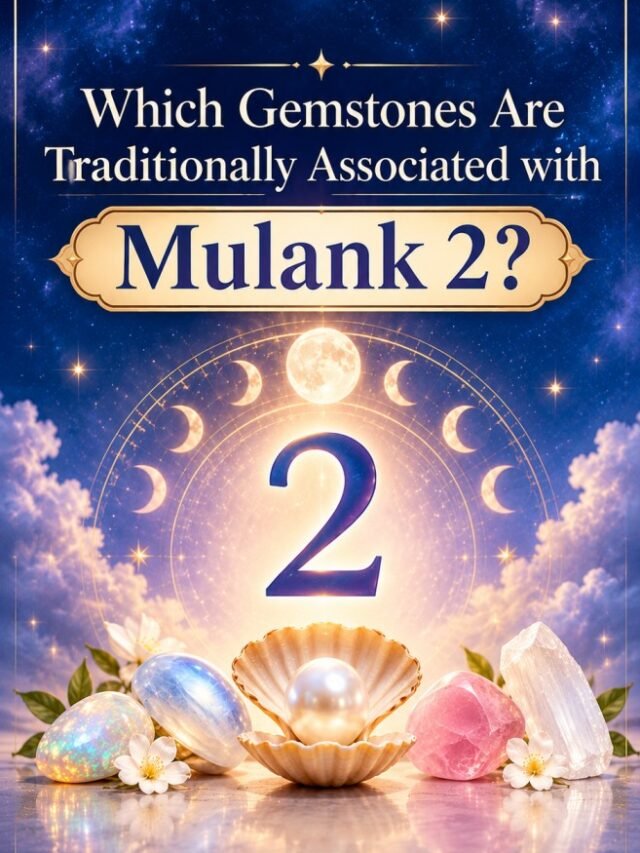
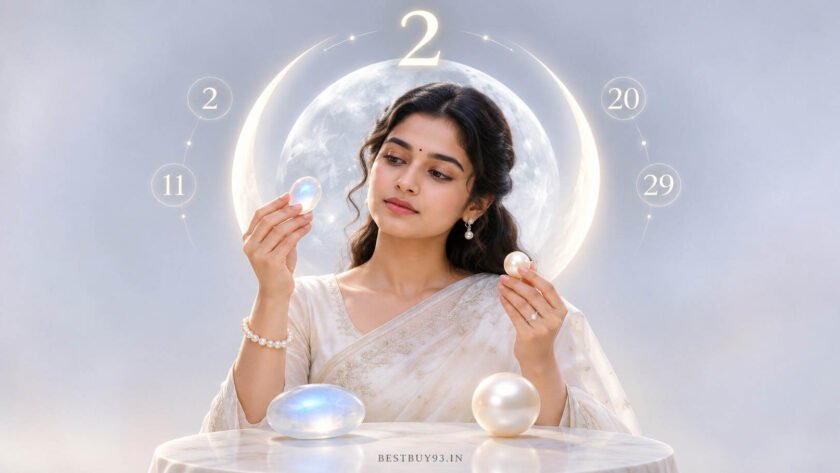

If you were born on the 2nd, 11th, 20th or 29th of any month, your Mulank is traditionally considered Mulank 2. In Indian numerology, number 2 is commonly associated with Chandra or the Moon, and Pearl (Moti) is the gemstone most consistently linked with it. Moonstone is also commonly suggested as a lunar alternative.
Sounds simple enough: Mulank 2 → Moon → Pearl → buy a pearl ring.
Except… that is exactly where you should slow down.
Choosing a gemstone based only on a single numerology number can be an oversimplification. Your Mulank is calculated only from the day of your birth; it does not include your complete birth date, birth time, planetary placements, ascendant or Moon sign. Even practitioners who work within numerology and astrology often caution that a gemstone intended as a planetary remedy should not automatically be prescribed from Mulank alone.
And then there is the practical side: natural pearl vs cultured pearl, real vs imitation, moonstone quality, gemstone treatment, jewellery durability, certification and budget.
So before spending thousands of rupees because someone on Instagram said, “Mulank 2 ho? Pearl pehno!”, here is what you actually need to know. 😄
Important: Numerology and gemstone remedies are traditional belief systems. There is no scientific evidence that wearing a pearl or moonstone can guarantee emotional balance, wealth, relationships, health or future outcomes. Treat these associations as cultural or spiritual traditions rather than proven medical or financial advice.
Quick Answer: Gemstones Traditionally Associated with Mulank 2
| Mulank 2 Association | Traditional Interpretation |
|---|---|
| Birth Dates | 2, 11, 20 and 29 |
| Ruling Planet | Moon / Chandra |
| Primary Traditional Gemstone | Pearl / Moti |
| Common Alternative | Moonstone |
| Traditional Colour Family | White, cream, silver |
| Traditional Day | Monday |
| Most Important Buying Advice | Do not choose solely from Mulank if using the stone as an astrological remedy |
| Practical Pearl Advice | Cultured pearls are real pearls; imitation pearls are not |
| Practical Moonstone Advice | Check adularescence, clarity, cut and durability |
Traditional numerology sources consistently connect Mulank 2 with the Moon and pearl, although secondary crystal recommendations vary considerably between practitioners.
What Is Mulank 2?
Mulank is calculated using only the day of the month on which you were born.
So:
- Born on the 2nd → Mulank 2
- Born on the 11th → 1 + 1 = 2
- Born on the 20th → 2 + 0 = 2
- Born on the 29th → 2 + 9 = 11 → 1 + 1 = 2
The birth month and year do not enter the Mulank calculation.
This is different from Bhagyank, which is generally calculated using the complete date of birth.
That distinction matters because numerology systems may consider Mulank and Bhagyank together rather than treating one number as a complete personal reading.
Why Is Mulank 2 Traditionally Linked with the Moon?
In a commonly used Indian numerology system, numbers 1 to 9 are associated with planetary influences.
Within this framework:
1 → Sun
2 → Moon
3 → Jupiter
…and so on.
Mulank 2 is therefore connected with Chandra the Moon.
Traditional Mulank 2 interpretations consequently use lunar symbolism: sensitivity, adaptability, receptivity, intuition, partnership and emotionality.
This is also why you often see associated colours such as:
- white
- cream
- silver
- soft or pale shades
and why Monday is frequently listed as the traditional day associated with Mulank 2.
But these are symbolic associations within numerology not scientifically established personality rules.
Not everyone born on the 20th suddenly becomes a poetic moonchild staring wistfully out of a window at 2 a.m. 😭
Human personality is far more complicated than a birth number.
Which Gemstone Is Traditionally Recommended for Mulank 2?
Pearl or Moti
Pearl is the gemstone most consistently associated with Mulank 2 in Indian numerology and related astrological traditions.
The logic is straightforward:
Mulank 2 → Moon → Pearl
Several contemporary numerology references list pearl as the primary gemstone associated with number 2.
Traditionally, pearl is symbolically connected with qualities such as:
- calmness
- softness
- emotional steadiness
- receptivity
- lunar energy
These are belief-based associations rather than medically demonstrated effects.
Is Moonstone Also Suitable for Mulank 2?
Moonstone is commonly suggested as an alternative lunar gemstone, particularly in modern numerology and crystal traditions.
From a gemological perspective, moonstone is a feldspar gemstone famous for a floating optical glow called adularescence.
GIA explains that this glow is caused by light scattering between microscopic layers within the feldspar structure.
That moon-like glow is one reason the stone has accumulated strong lunar symbolism historically.
So from a traditional-belief perspective, you will commonly encounter:
Primary traditional option
Pearl
Common alternative
Moonstone
Other crystals such as rose quartz or selenite sometimes appear in modern crystal-numerology lists, but those recommendations are far less universal.
Do not assume every “Mulank 2 crystal bracelet” online belongs to one ancient, standardised system. It probably doesn’t.
Pearl vs Moonstone: Which One Should You Choose?
This depends on what you mean by “choose.”
If you’re simply selecting jewellery that symbolically represents your Mulank, either can work beautifully.
If you’re using the stone specifically as an astrological planetary remedy, the decision becomes more complicated and should ideally consider the complete chart rather than Mulank alone.
Practically, the stones are also very different.
| Factor | Pearl | Moonstone |
|---|---|---|
| Traditional Mulank 2 association | Strongest | Common alternative |
| Origin | Organic gem formed in molluscs | Feldspar mineral |
| Appearance | Lustrous, usually spherical/baroque | Glowing adularescence |
| Mohs hardness | About 2.5 | 6–6.5 |
| Scratch resistance | Low | Moderate |
| Toughness concerns | Scratches/chemicals | Cleavage/chipping |
| Common jewellery | Rings, earrings, pendants, strands | Rings, pendants, earrings |
| Maintenance | High | Moderate |
| Budget range | Extremely broad | Extremely broad |
Pearls are much softer than moonstone. GIA gives pearl a Mohs hardness of around 2.5, which means it scratches relatively easily.
Moonstone is harder at around 6 to 6.5, although GIA notes that it has cleavage and poor toughness, so a sharp impact can still chip or break it.
So “harder” does not mean “indestructible.”
Should You Choose a Gemstone Based Only on Mulank 2?
This is probably the most important section in this entire guide.
If you’re choosing a gemstone purely as symbolic jewellery, Mulank 2 can be a perfectly reasonable inspiration.
If you’re choosing the gemstone as a serious astrological remedy intended to strengthen a planet, relying only on Mulank is much less sensible.
Why?
Because Mulank tells you only one thing:
the reduced number of your birth date.
A full Vedic birth chart may consider:
- complete date of birth
- exact birth time
- birth location
- ascendant
- Moon sign
- planetary houses
- planetary strengths
- aspects
- dashas
- other chart relationships
Numerology does not calculate those positions.
Two people born on the 11th can both be Mulank 2 while having completely different birth charts.
So the statement:
“You’re Mulank 2, therefore you must wear pearl”
is much stronger than the information actually supports.
A better statement is:
“Pearl is traditionally associated with Mulank 2 and the Moon; suitability as an astrological remedy may require a fuller assessment.”
Much less dramatic. Much more responsible.
Natural Pearl vs Cultured Pearl vs Imitation Pearl
This area causes enormous confusion.
Natural Pearl
A natural pearl develops inside a mollusc without deliberate human initiation.
Natural pearls are uncommon, and fine examples can be extremely expensive. GIA notes that large natural pearls with desirable round or drop shapes are particularly rare.
Cultured Pearl
A cultured pearl also grows inside a real mollusc but human intervention initiates the process.
And yes:
cultured pearls are real pearls.
GIA explicitly distinguishes cultured pearls from imitation pearls and confirms that cultured pearls are genuine pearls formed through human-assisted cultivation.
This is important because some sellers use language that makes shoppers feel that “cultured” means “fake.”
It doesn’t.
Imitation Pearl
An imitation pearl is made from another material designed to look like pearl.
Examples can include:
- glass
- plastic
- shell-based material
- coated beads
These are not genuine pearls.
Do You Need an Expensive Natural Pearl for Mulank 2?
Not necessarily.
From a jewellery perspective, cultured pearls are genuine pearls and are far more accessible than rare natural pearls.
If a specific astrologer insists that a remedy requires a particular pearl type, origin, weight or untreated status, ask them to explain why that particular specification matters within the tradition they follow.
Do not assume an expensive natural pearl automatically produces more “luck.”
Gemological rarity and traditional spiritual claims are two entirely different things.
A ₹1 lakh gem can be genuinely rare.
That does not scientifically establish that it will change someone’s life more than a ₹5,000 gem.
How Do You Judge Pearl Quality?
If you’re paying real money for a pearl, stop looking only at whether it is “white.”
GIA evaluates pearls using several important quality factors.
1. Luster
This is one of the most important pearl quality characteristics.
A good pearl should show bright, sharp reflections rather than looking dull or chalky.
A beautiful pearl almost seems to glow from within.
2. Surface Quality
Some surface characteristics are natural.
But severe blemishes can affect both beauty and durability.
Do not automatically expect a genuine pearl to look like a perfectly smooth plastic marble.
3. Nacre Quality
Nacre affects both appearance and durability.
GIA notes that thin nacre can produce a dull appearance and may compromise durability.
4. Shape
Pearls come in many forms:
- round
- semi-round
- oval
- drop
- button
- baroque
- circled
Perfect roundness tends to command higher prices, but baroque pearls can be beautiful and completely genuine.
5. Size
Larger pearls generally cost more when other quality factors are comparable.
But bigger does not automatically mean better quality.
6. Colour
White is traditionally associated with lunar symbolism, but pearls naturally occur in a range of colours depending on type.
If you specifically want a pearl for traditional Mulank 2 symbolism, white or creamy tones are usually the most obvious aesthetic choice.
How Do You Choose a Good Moonstone?
Moonstone requires a totally different checklist.
According to GIA, its main value factors include body colour, sheen, clarity, cut and carat weight.
Look for Strong Adularescence
Adularescence is that moving glow visible across the stone.
The more attractive and well-centred the sheen, the more visually impressive the moonstone usually appears.
Fine material may show a vivid blue sheen over a nearly colourless body.
Check Transparency and Clarity
High-quality moonstone is often semi-transparent to nearly transparent with relatively few distracting inclusions.
Too many inclusions can interfere with the optical glow.
Check the Cut
Moonstone is commonly cut as a cabochon a smooth, rounded shape because this displays adularescence particularly well.
Do Not Buy Solely by Carat Weight
A large cloudy stone with weak sheen may be less attractive than a smaller moonstone with beautiful adularescence.
As always, giant numbers are very good at convincing shoppers to stop asking useful questions. 😅
Is Rainbow Moonstone Actually Moonstone?
Here’s a fun little gemstone plot twist.
Rainbow moonstone is technically not traditional moonstone.
GIA describes rainbow moonstone as transparent labradorite, a closely related feldspar material that can display colourful iridescent sheen. The trade nevertheless widely accepts the name “rainbow moonstone.”
So if you’re buying specifically because a numerologist told you to wear “moonstone,” ask what they mean:
- traditional orthoclase moonstone?
- rainbow moonstone/labradorite?
- any lunar-associated feldspar?
Those are not automatically identical from a gemological perspective.
Should You Buy a Certified Gemstone?
For inexpensive fashion jewellery, extensive laboratory paperwork may be overkill.
But certification becomes more useful when:
- the stone is expensive
- the seller claims it is natural
- treatment status matters
- you’re paying a premium for origin
- you’re buying a valuable natural pearl
- authenticity is central to the purchase
A report should come from a credible gemological laboratory.
For natural pearls in particular, specialised testing can differentiate natural from cultured material by examining internal growth structures. GIA offers pearl identification services that can report characteristics such as natural/cultured identity and detectable treatments.
Also remember:
A certificate identifies a gemstone. It does not certify spiritual results.
Huge distinction.
Which Jewellery Type Is Better for Pearl or Moonstone?
From a practical durability perspective, jewellery type matters.
Pearl
Pearls are soft, so earrings and pendants can sometimes be easier to maintain than rings that constantly hit desks, taps and door handles.
A pearl ring can still be worn just treat it carefully.
Moonstone
Moonstone is harder than pearl, but GIA specifically notes that it can chip or cleave from impact. Because rings receive frequent knocks, pendants, earrings and pins can offer greater protection.
If your lifestyle includes gym sessions, cooking, constant typing, housework or frequent travel, consider whether a delicate ring is realistic.
Your gemstone should suit your actual life not the Pinterest version of your life.
What About Gemstone Weight, Metal, Finger and Wearing Day?
This is where online advice becomes wildly inconsistent.
You may see recommendations involving:
- specific carat or ratti weights
- silver settings
- particular fingers
- Monday morning
- Moon mantras
- milk or water cleansing rituals
- specific lunar timings
These belong to particular astrological or spiritual traditions and are not universal gemological requirements.
If you’re following a specific astrologer’s recommendation, follow the system they use consistently instead of mixing instructions from seven YouTube Shorts.
For example:
One creator says 5 ratti.
Another says 7.
A third says “minimum 8.25.”
By the time you’re finished, your ring could qualify as gym equipment. 😭
Before spending money, ask the practitioner:
Why this gemstone? Why this weight? Why this metal? Why this finger?
A credible practitioner should be able to explain the reasoning within their tradition.
Can Mulank 2 People Wear Other Gemstones?
Yes being Mulank 2 does not mean you are banned from every other gemstone on Earth.
You can wear:
- diamond
- emerald
- sapphire
- amethyst
- garnet
- quartz
- topaz
- turquoise
- or anything else
simply because you like the jewellery.
The distinction is between:
wearing a gem for beauty
and
wearing a gem as a prescribed planetary remedy.
Those are different decisions.
If you love an emerald necklace, Mulank 2 does not send numerology police to confiscate it. 😂
How to Care for a Pearl
Pearls need more care than many people realise.
GIA warns that pearls can be damaged by heat, acids, perfume, cosmetics, hairspray and even perspiration.
A few practical habits help:
- Put pearl jewellery on after perfume and cosmetics.
- Wipe it gently with a soft cloth after wearing.
- Store pearls separately from harder gemstones.
- Avoid ultrasonic cleaners.
- Avoid steam cleaning.
- Use warm, mild soapy water only when appropriate.
- Let strung pearls dry completely before wearing.
Think of pearls as elegant but slightly high-maintenance.
Basically the diva of the jewellery box. 😂
How to Care for Moonstone
Moonstone should also be handled thoughtfully.
GIA recommends warm soapy water and specifically advises against steam and ultrasonic cleaning.
Avoid:
- hard knocks
- gym workouts while wearing a moonstone ring
- sudden temperature changes
- harsh cleaning systems
Moonstone may be harder than pearl, but its cleavage makes impact damage a real concern.
Common Mistakes to Avoid Before Choosing a Mulank 2 Gemstone
1. Buying a Pearl Immediately Because Your Birth Date Reduces to 2
Mulank gives you a traditional association not necessarily a personalised astrological prescription.
2. Assuming Cultured Pearl Means Fake Pearl
It doesn’t.
Cultured pearls are real pearls.
3. Paying “Natural Pearl” Prices Without Verification
Natural pearls can command significant premiums.
If a seller makes an expensive natural-pearl claim, credible identification becomes much more important.
4. Buying Moonstone Without Checking Its Sheen
A moonstone’s visual appeal depends heavily on adularescence.
Do not judge it solely by size.
5. Assuming Rainbow Moonstone and Traditional Moonstone Are Identical
Rainbow moonstone is generally labradorite rather than traditional orthoclase moonstone.
6. Believing a Gemstone Guarantees a Result
No gemstone guarantees:
- marriage
- wealth
- pregnancy
- promotion
- mental-health improvement
- physical healing
- exam success
Treat numerological associations as tradition, not a contract with the universe.
7. Ignoring Durability
Pearls scratch easily.
Moonstones can chip.
Choose jewellery based partly on how you actually intend to wear it.
8. Spending Beyond Your Budget
Spiritual anxiety is a terrible reason to overspend.
If someone tells you disaster will occur unless you immediately buy an expensive stone from their shop, that’s a reason to become more cautious, not less.
Pearl vs Moonstone for Mulank 2: Simple Decision Guide
Choose Pearl if:
- you want the most traditional Mulank 2 association
- you love classic jewellery
- you don’t mind careful maintenance
- you understand the difference between cultured and imitation pearls
Choose Moonstone if:
- you like the lunar symbolism but prefer a mineral gemstone
- you enjoy visible sheen and iridescence
- you prefer pendants or earrings
- you want an alternative commonly linked with the Moon
Choose neither as a remedy yet if:
- you have been told you need a planetary gemstone but haven’t had a complete assessment
- the seller is using fear to rush you
- you’re unsure whether the stone is genuine
- you’re being asked to spend far beyond your budget
- you’re expecting guaranteed life changes
Sometimes the best gemstone-buying decision is simply:
“I need more information first.”
In Case You Are Looking For –
- Which Gemstones Are Traditionally Associated with Mulank 2?
- How Are Lucky Colours and Numbers Traditionally Linked to Mulank 1?
- What Should You Know Before Choosing a Gemstone Based on Mulank 1?
- Which Gemstones Are Traditionally Associated with Mulank 1?
- Which Birth Numbers Are Traditionally Considered Compatible with Mulank 1?
- What Do Numerology Traditions Say About Friendship for Mulank 1?
Frequently Asked Questions
Which gemstone is traditionally linked with Mulank 2?
Pearl or Moti is the gemstone most consistently linked with Mulank 2 because number 2 is traditionally associated with the Moon or Chandra. Moonstone is also commonly suggested as a lunar alternative.
Which birth dates come under Mulank 2?
People born on the 2nd, 11th, 20th or 29th of a month have Mulank 2 because those dates reduce numerologically to the number 2.
Is cultured pearl suitable if I want a real pearl?
From a gemological standpoint, yes cultured pearls are real pearls. They form inside molluscs after human intervention initiates pearl growth. Imitation pearls made from materials such as plastic or coated glass are not genuine pearls.
Is moonstone better than pearl for Mulank 2?
There is no objective “better.” Pearl is the more consistently cited traditional Mulank 2 gemstone, while moonstone is a commonly used lunar alternative. Practical differences in appearance, durability, budget and maintenance may help you decide.
Can I wear pearl every day?
You can, but pearls require care because they are quite soft around 2.5 on the Mohs hardness scale and can be damaged by scratches, cosmetics, perfume, acids and heat.
Can moonstone be worn in a ring?
Yes, but it needs care. Moonstone has a hardness of approximately 6–6.5, yet its cleavage makes it vulnerable to chipping or breaking when hit. GIA recommends avoiding activities such as sports or gym workouts while wearing a moonstone ring.
Is rainbow moonstone the same as normal moonstone?
Not technically. Rainbow moonstone is generally transparent labradorite, a related feldspar material. The jewellery trade nevertheless commonly uses the term “rainbow moonstone.”
Should everyone with Mulank 2 wear pearl?
Not necessarily. Mulank 2 provides a traditional connection with the Moon and pearl, but it is only one numerological factor. If the gemstone is being used as an astrological remedy rather than decorative jewellery, a fuller birth-chart assessment may be appropriate.
Final Verdict
So, what should you know before choosing a gemstone based on Mulank 2?
Start with the tradition:
People born on the 2nd, 11th, 20th or 29th are considered Mulank 2, which Indian numerology commonly associates with Chandra the Moon. Pearl is the most consistently recommended traditional gemstone, while moonstone is a popular alternative.
But do not let that simple association become an automatic purchase decision.
If you want a gemstone merely as symbolic Mulank jewellery, choose whichever genuine pearl or attractive moonstone suits your style and budget.
If you want to use it as a serious astrological remedy, remember that Mulank alone does not describe your entire birth chart. Seek a personalised interpretation before spending heavily.
And whichever stone you choose, shop like a gemstone buyer not just a numerology believer.
Understand what “cultured pearl” actually means. Check luster and nacre quality. Look at moonstone’s adularescence. Ask about treatments. Consider durability. Request credible laboratory documentation when the purchase value justifies it.
The traditional symbolism can be meaningful.
But knowledge should come before jewellery and certainly before a giant credit-card bill. 🌙🤍
Explore more Mulank, numerology, gemstones, astrology and traditional lifestyle guides on BestBuy93.IN.