
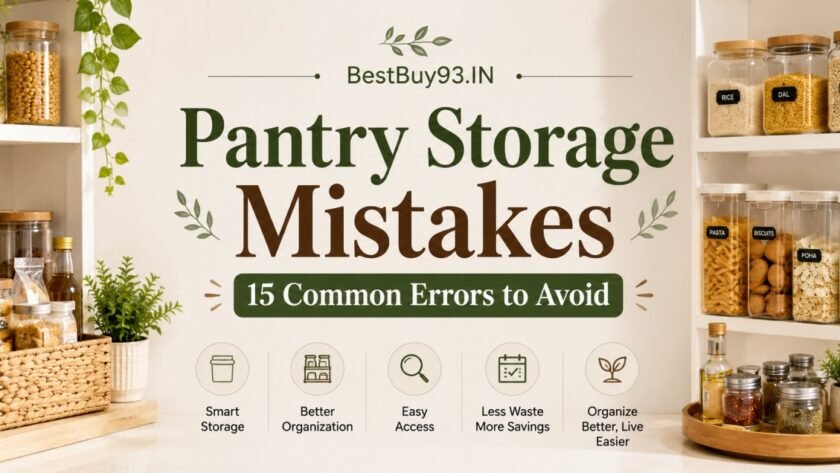

A well-organized pantry can make everyday cooking so much easier. You can quickly find your rice, flour, spices or snacks, see what needs to be restocked and avoid buying things you already have sitting at the back of a shelf.
But here’s the funny part: a pantry can look organized and still be badly organized. 😅
You can have matching containers, pretty labels and perfectly arranged shelves, yet still struggle to find ingredients or end up wasting food. That’s because good pantry organization isn’t only about appearance. It’s about accessibility, visibility, food safety and making the available storage space work efficiently.
In this guide, we’re looking at the most common Pantry Storage Mistakes and, more importantly, what you can do instead.
Also Read | Bamboo vs Plastic Lazy Susan Which Is Better?
🏠 Why Do Pantry Storage Mistakes Happen?
Most pantry problems happen for a few simple reasons.
You may buy storage containers before measuring your shelves. You may place frequently used ingredients at the back because they fit there nicely. Or you may keep adding organizers without removing things you no longer use.
Another common issue is trying to make the pantry look like a perfectly styled social-media pantry.
Real kitchens are different.
You cook.
You open packets.
You refill containers.
You buy groceries.
Things move around.
So your pantry organization system needs to work with your daily routine, not against it.
❌ 1. Buying Storage Containers Before Measuring
This is probably one of the most common Pantry Storage Mistakes.
You see a gorgeous set of glass jars online, order them immediately and then discover that they’re either too tall for the shelf or too wide to fit properly.
Before buying containers, measure:
- Shelf width
- Shelf depth
- Available height
- Cabinet opening
- Space between shelves
Then check the actual dimensions of the containers.
What to Do Instead
Measure first, shop second.
If you’re working with a small kitchen, this becomes even more important because every centimetre matters.
❌ 2. Overcrowding Every Shelf
More storage doesn’t necessarily mean better storage.
One of the biggest Pantry Storage Mistakes is trying to squeeze every possible item into every available corner.
When shelves are overcrowded:
- Ingredients become difficult to reach
- Older products get forgotten
- Containers become difficult to remove
- Spills become harder to clean
- You lose visibility
A pantry should have some breathing room.
What to Do Instead
Leave enough space to comfortably remove an item without moving five others.
If a shelf is constantly overflowing, consider whether you have too many products rather than immediately buying another organizer.
❌ 3. Keeping Frequently Used Items at the Back
Imagine reaching for sugar every morning but storing it behind three large containers.
That’s unnecessary work.
Frequently used ingredients should be placed where they’re easiest to access.
Keep Everyday Items Within Easy Reach
- Rice
- Flour
- Sugar
- Salt
- Tea
- Coffee
- Common spices
- Cooking essentials
Less frequently used ingredients can go toward the back or higher shelves.
What to Do Instead
Organize your pantry based on frequency of use, not simply by how attractive the arrangement looks.
❌ 4. Ignoring Vertical Space
Another common mistake is using only the shelf surface while completely ignoring the space above it.
If your pantry has tall shelves, you may be wasting a lot of vertical storage potential.
You can use:
- Stackable containers
- Shelf risers
- Two-tier organizers
- Under-shelf baskets
- Vertical dividers
However, don’t automatically add organizers everywhere.
The goal is to make the space more usable—not turn every shelf into an obstacle course.
❌ 5. Mixing Everything Together
Rice, snacks, baking supplies, spices and breakfast foods shouldn’t all live in one giant chaotic zone.
One of the easiest Pantry Storage Mistakes to fix is poor categorization.
Try creating simple zones such as:
🌾 Grains & Staples
Rice, flour, dal and poha.
🌶️ Spices
Powders, whole spices and masalas.
🥣 Breakfast
Oats, cereals and spreads.
🍪 Snacks
Biscuits, crackers and packaged snacks.
🧁 Baking
Cocoa, baking ingredients and decorating supplies.
📦 Backup Stock
Unopened packets and extra supplies.
You don’t need twenty categories.
A few logical groups are usually enough.
❌ 6. Storing Heavy Items Too High
Large containers filled with rice, flour or other heavy ingredients shouldn’t normally be stored on the highest shelf where they’re difficult to lift down safely.
This is both inconvenient and potentially risky.
What to Do Instead
Keep heavier pantry items on:
- Lower shelves
- Waist-level shelves
- Easy-to-reach areas
Use higher shelves for lighter products that you don’t need every day.
This simple change can make your pantry much easier to use.
❌ 7. Using Containers That Are Too Large
Bigger containers aren’t always better.
A huge container may take up valuable shelf space while leaving awkward gaps around it.
This is especially problematic in small kitchens.
Instead of buying one enormous container, consider whether two appropriately sized containers would make the space easier to organize.
The right container should fit both:
The quantity you normally store
and
The shelf where you’re storing it.
❌ 8. Forgetting to Label Containers
Clear containers may seem self-explanatory, but once you have several similar-looking jars, things can get confusing.
For example:
Moong Dal
Masoor Dal
Chana Dal
Toor Dal
They can look surprisingly similar when stored in identical containers.
Labels make identification faster.
You can use simple labels with:
- Ingredient name
- Bilingual names
- Category names
- Temporary dates where useful
For more ideas, check out our Pantry Label Ideas guide.
❌ 9. Putting New Groceries in Front of Older Stock
This is a classic pantry organization problem.
You buy a new packet of pasta and place it directly in front of the older packet.
Then the older one gets forgotten.
This can contribute to unnecessary food waste.
What to Do Instead
Use a simple First In, First Out (FIFO) approach where practical.
Put newer products behind older ones so that the older stock gets used first.
This is especially useful for:
- Packaged foods
- Cereals
- Pasta
- Flour
- Baking ingredients
- Snacks
❌ 10. Treating Every Pantry Item the Same
Not everything needs the same storage method.
Some ingredients work beautifully in airtight containers.
Others are better kept in their original packaging until they’re needed.
Some items need to stay dry.
Some need protection from heat or moisture.
Some are used daily, while others may sit untouched for weeks.
One of the biggest Pantry Storage Mistakes is creating a one-size-fits-all system.
What to Do Instead
Choose storage based on:
- Ingredient type
- Usage frequency
- Packaging
- Shelf life
- Moisture sensitivity
- Available space
Your pantry should be organized around how you actually use food, not simply how the containers look together.
❌ 11. Buying Too Many Organizers
This sounds strange, but yes—too many organizers can create more clutter.
You buy bins for the bins, containers for the containers and then another set because the first set doesn’t quite fit.
Suddenly, organizing the pantry has become a hobby instead of a solution. 😄
What to Do Instead
Start by identifying the actual problem.
Do you need:
- A bin for snack packets?
- A turntable for sauces?
- Containers for loose grains?
- A shelf riser?
- Labels?
Buy only what solves a specific storage problem.
A simple pantry with a few well-chosen organizers can be much more functional than one packed with storage accessories.
❌ 12. Ignoring Visibility
A pantry may technically be organized while still being difficult to use.
If containers are hidden behind other containers, you may forget what you own.
This is especially common with deep shelves.
What to Do Instead
Prioritize visibility.
You can use:
- Clear containers
- Open-front bins
- Shelf risers
- Lazy Susans
- Pull-out baskets
- Labels
For deep shelves, a lazy Susan can be particularly useful for bottles, jars and condiments.
Instead of reaching into the back, simply rotate the organizer.
For more ideas, see our guide to the Best Lazy Susans.
❌ 13. Storing Everything in Matching Containers
Matching containers look beautiful.
But you don’t necessarily need to transfer every single pantry item into an identical jar.
This is one of those Pantry Storage Mistakes that happens when aesthetics take over functionality.
Some foods are easier to store in their original packaging.
For example:
- Sealed snack packets
- Biscuits
- Specialty ingredients
- Frequently replaced products
- Foods with useful cooking instructions on the package
What to Do Instead
Use containers selectively.
Transfer items that genuinely benefit from airtight or organized storage, while keeping practical packaging where it makes sense.
Your pantry doesn’t need to look like a catalogue photo.
❌ 14. Forgetting About Expiry Dates
A beautiful pantry isn’t useful if expired products are hiding behind the pretty containers.
When transferring food into containers, make sure you don’t lose important information such as:
- Expiry date
- Best-before date
- Cooking instructions
- Allergen information
- Product details
What to Do Instead
If you transfer an item into another container, consider keeping track of the relevant date.
You can add a small label or write the date where appropriate.
And every few weeks, quickly check older products.
This can help reduce unnecessary food waste.
❌ 15. Not Cleaning the Pantry Regularly
Another common mistake is organizing the pantry once and assuming the job is finished forever.
Unfortunately, kitchens don’t work that way. 😂
Crumbs appear.
Packets leak.
Flour gets everywhere.
Spice powder somehow ends up three shelves away from the spice container.
Regular maintenance keeps the pantry functional.
What to Do Instead
Do a quick clean regularly and a more thorough pantry reset occasionally.
Check:
- Spills
- Crumbs
- Expired products
- Damaged packaging
- Empty containers
- Pest activity
- Dust
A clean pantry is much easier to maintain than one that has been ignored for months.
🌡️ 16. Ignoring Heat and Moisture
Where you store your pantry items matters.
Some areas of the kitchen can become warmer or more humid, particularly around cooking appliances or sinks.
Excess heat and moisture can affect certain foods and packaging.
What to Do Instead
Keep pantry staples in a cool, dry and suitable storage area according to the food’s packaging or storage instructions.
Avoid placing sensitive ingredients directly beside:
- Ovens
- Stoves
- Dishwashers
- Areas with frequent steam
- Leaky plumbing
This is especially important for ingredients that can absorb moisture easily.
❌ 17. Storing Heavy Items on Small or Weak Bins
Storage bins aren’t automatically suitable for heavy products.
A small decorative basket may look great but may not be designed to hold several kilograms of pantry staples.
What to Do Instead
For heavy items, choose sturdy storage solutions and keep them on appropriate shelves.
Consider:
- Container strength
- Shelf capacity
- Handle strength
- Base stability
- Ease of lifting
Don’t sacrifice safety just to make the pantry look neat.
❌ 18. Not Using Lazy Susans for Awkward Areas
Deep corners are often wasted storage zones.
You can technically place items there, but reaching them becomes annoying.
A lazy Susan can solve this problem by making products accessible from different angles.
It’s particularly useful for:
- Sauces
- Oils
- Spices
- Condiments
- Small jars
However, don’t force one into every cabinet.
Measure first and make sure there is enough clearance for the tray to rotate.
❌ 19. Keeping Backup Stock With Everyday Items
Another common Pantry Storage Mistake is mixing unopened backup products with the items you use every day.
Imagine having six packets of pasta in one drawer.
You use one regularly, while five unopened packets sit behind it.
That makes it harder to see what you’re actually running low on.
What to Do Instead
Create a separate backup-stock zone.
For example:
Everyday Zone
The items currently in use.
Backup Zone
Unopened extras.
This makes grocery planning easier and prevents accidental overbuying.
❌ 20. Not Creating a System You Can Maintain
This might be the biggest mistake of all.
You spend an entire Sunday reorganizing the pantry.
Everything looks perfect.
Then two weeks later, you’re back to randomly throwing packets onto the nearest shelf.
Why?
Because the system wasn’t practical.
What to Do Instead
Create a system that takes seconds—not minutes—to maintain.
If you use something every day, it should have an obvious home.
If you buy a new product, you should know where it belongs.
If a container becomes empty, you should know whether it needs refilling or replacing.
Good organization should reduce work.
It shouldn’t create more of it.
🧠 How to Fix Pantry Storage Mistakes
Now that we’ve covered the common problems, let’s turn them into a simple pantry reset.
Step 1: Empty One Shelf at a Time
Don’t necessarily empty the entire pantry if that feels overwhelming.
Start with one section.
Step 2: Check Everything
Look for:
- Expired products
- Empty packets
- Duplicate products
- Damaged packaging
- Items you no longer use
Step 3: Create Categories
Group similar products together.
For example:
Staples
Spices
Breakfast
Snacks
Baking
Tea & Coffee
Backup Stock
Step 4: Decide What Needs Containers
Not every product needs one.
Prioritize containers for products where they genuinely improve:
- Freshness
- Visibility
- Organization
- Accessibility
Step 5: Measure Before Buying Organizers
Check shelf dimensions before purchasing bins, jars, risers or turntables.
Step 6: Place Heavy Items Lower
Keep heavier containers somewhere comfortable and safe to lift.
Step 7: Put Frequently Used Items Within Reach
Your daily staples shouldn’t require a treasure hunt.
📦 How to Choose Pantry Containers
The right container can make a big difference, but don’t buy based solely on aesthetics.
Look for:
Airtight seals where appropriate
Suitable capacity
Stackability
Easy-to-clean surfaces
Useful shapes
Clear visibility
Durable construction
For dry pantry staples, airtight storage may help protect against moisture and pests when appropriate for the food.
For other products, the original packaging may be more practical.
🫙 Glass vs Plastic Pantry Containers
Both have advantages.
| Feature | Glass | Plastic |
|---|---|---|
| Visibility | Excellent | Excellent if clear |
| Weight | Heavy | Lightweight |
| Durability | Can break | Generally impact-resistant |
| Cleaning | Easy | Easy |
| Stackability | Depends on design | Often excellent |
| Everyday Handling | Less convenient | Very convenient |
| Appearance | Premium | Practical |
| Best For | Countertops & staples | Everyday pantry use |
Your choice should depend on your storage needs rather than simply following a trend.
For a deeper comparison, you can also read our Best Glass Storage Jars guide and Glass vs Steel Storage Jars comparison.
🧺 When Should You Use Pantry Bins?
Bins work especially well for products that don’t stack neatly.
They’re useful for:
- Snack packets
- Small food packets
- Baking supplies
- Tea sachets
- Packaged foods
- Backup stock
Instead of having several loose packets spread across a shelf, one bin can keep them together.
But remember:
Don’t fill the bin so much that you can’t see what’s inside.
📐 Make Use of Vertical Space
If your shelves have unused height, consider adding:
- Shelf risers
- Stackable bins
- Stackable containers
- Under-shelf baskets
But don’t stack so high that removing the bottom container becomes difficult.
Accessibility still matters.
🔄 Use the FIFO Method
For products where it makes sense, use First In, First Out organization.
When you purchase a new packet:
➡️ Put the older one toward the front.
➡️ Put the newer one behind it.
This makes it easier to use older stock first.
It can be particularly useful for packaged pantry foods.
🏷️ Why Labels Matter
Labels aren’t only about aesthetics.
They help you:
- Identify ingredients quickly
- Keep categories consistent
- Find things faster
- Maintain the organization
- Avoid confusion between similar ingredients
Keep labels simple.
You don’t need a fancy typography project on every jar.
Name + optional date/category = enough.
🧹 Create a 10-Minute Pantry Reset
You don’t need to reorganize your entire kitchen every weekend.
Instead, create a quick maintenance routine.
Every Few Days
Put items back where they belong.
Weekly
Check for spills and misplaced products.
Monthly
Check older products and reorganize problem areas.
Occasionally
Take everything out of a section and give it a proper clean.
This small routine can prevent most Pantry Storage Mistakes from returning.
🏆 The Golden Rule of Pantry Organization
If you remember only one thing from this guide, remember this:
Your pantry should be organized around how you use it.
Not around matching containers.
Not around social-media trends.
Not around having the maximum number of storage bins.
Your pantry should make everyday life easier.
If you cook every day, your most-used ingredients should be easy to reach.
If you bake occasionally, baking supplies can occupy a less accessible section.
If you buy groceries in bulk, create a backup-stock zone.
If your kitchen is tiny, prioritize vertical and accessible storage.
That’s how you avoid repeating the same Pantry Storage Mistakes over and over again.
🏠 How to Create a Better Pantry Storage System
Fixing pantry organization doesn’t mean you need to throw everything away and start over.
Instead, work through your pantry in sections.
1. Start With a Pantry Declutter
Take everything out of one shelf or section.
Separate the products into:
- Keep
- Use soon
- Refill
- Donate where appropriate
- Discard if expired or unsuitable
Check packaging and storage information before deciding whether a food item is still suitable to use.
The goal is to remove things that are simply taking up valuable space.
📦 2. Create Simple Pantry Zones
Once you’ve decluttered, create broad categories.
A practical pantry might have:
| Zone | Examples |
|---|---|
| Everyday Staples | Rice, flour, dal |
| Spices | Masalas, whole spices |
| Breakfast | Cereal, oats, spreads |
| Snacks | Biscuits, crackers |
| Baking | Cocoa, baking ingredients |
| Tea & Coffee | Tea, coffee, sugar |
| Cooking | Sauces, vinegar, oils |
| Backup Stock | Unopened extras |
Don’t create too many categories.
If you need a map to remember where the biscuits live, the organization has gone slightly too far. 😂
👀 3. Prioritize Visibility
One of the easiest ways to prevent Pantry Storage Mistakes is to make everything visible.
For deep shelves, consider:
- Clear containers
- Open-front bins
- Shelf risers
- Lazy Susans
- Pull-out baskets
A container doesn’t need to be transparent for everything, but you should have a quick way to identify what’s inside.
Visibility also helps you notice when you’re running low on frequently used ingredients.
🔄 4. Use Lazy Susans Strategically
Lazy Susans are particularly useful for awkward areas.
Use them for:
- Sauces
- Oils
- Condiments
- Spices
- Small jars
A rotating tray can bring products from the back toward you without requiring you to remove everything in front.
However, don’t put a lazy Susan everywhere just because you can.
Measure first and make sure there’s enough room for it to rotate properly.
Our Best Lazy Susans guide covers the different types and uses in more detail.
🫙 5. Choose Containers Based on the Food
Not every pantry item needs to be transferred into a beautiful matching jar.
Use containers when they genuinely improve storage.
Good Candidates
- Rice
- Dal
- Flour
- Sugar
- Pasta
- Dry grains
- Cereals
For packaged foods, keeping the original packaging may sometimes be more practical.
Before transferring anything, make sure you don’t lose important information such as expiry dates, preparation instructions or allergen details.
🏷️ 6. Label Only Where It Helps
Labels are useful, but you don’t have to label every single object in your kitchen.
They’re especially helpful for:
- Similar-looking ingredients
- Opaque containers
- Multiple varieties of grains
- Spice collections
- Baking ingredients
Keep labels simple.
For example:
TOOR DAL
MOONG DAL
BASMATI RICE
SUGAR
FLOUR
If you want more ideas, our Pantry Label Ideas guide covers practical ways to label and organize pantry storage.
📐 7. Use Vertical Space Carefully
Look upward.
Many pantries have unused space between shelves.
You can improve vertical storage with:
- Shelf risers
- Stackable containers
- Stackable bins
- Under-shelf baskets
But don’t turn every shelf into a tower.
You should still be able to remove the item you need without dismantling the entire stack.
⚖️ 8. Store Heavy Items Lower
Large containers of rice, flour and other heavy pantry staples are easier to handle when stored on lower or middle shelves.
Keep lightweight products higher up.
This makes the pantry easier and safer to use.
A simple arrangement could be:
Lower Shelf
Heavy staples and larger containers.
Middle Shelf
Everyday ingredients.
Upper Shelf
Lightweight and occasional-use products.
🔁 9. Create a First-In, First-Out Routine
FIFO—First In, First Out—is a simple way to prevent older products from being forgotten.
When you purchase a new product:
Older stock → Front
Newer stock → Back
This is particularly useful for packaged foods and pantry staples.
It also makes grocery shopping easier because you can see what you’re actually using.
🛒 10. Don’t Overbuy Just Because There’s Space
A large pantry can create the illusion that you need to fill every shelf.
You don’t.
Bulk buying only makes sense when:
- You regularly use the product
- You have suitable storage space
- The product can be stored appropriately
- Buying larger quantities is genuinely useful
Otherwise, you may end up with a pantry full of products you forgot you purchased.
🧹 Pantry Cleaning Checklist
A good organization system needs regular maintenance.
Weekly
✔ Put products back in their zones
✔ Wipe obvious spills
✔ Check for misplaced items
Monthly
✔ Check older products
✔ Clean problem areas
✔ Review backup stock
✔ Reorganize overcrowded shelves
Occasionally
✔ Remove everything from a section
✔ Clean shelves thoroughly
✔ Check containers and lids
✔ Review whether your organization system still works
This is much easier than waiting until the pantry becomes a complete disaster.
🚫 Pantry Storage Mistakes to Stop Making
Here’s the quick checklist:
| Mistake | Better Approach |
|---|---|
| Buying containers first | Measure shelves first |
| Overcrowding | Leave breathing room |
| Hiding everyday items | Keep them accessible |
| Ignoring vertical space | Use risers carefully |
| Mixing categories | Create simple zones |
| Heavy items up high | Store them lower |
| No labels | Label confusing containers |
| New stock in front | Use FIFO |
| Too many organizers | Buy only what solves a problem |
| Ignoring expiry dates | Check older products regularly |
| Ignoring moisture | Choose suitable storage areas |
| Overloading bins | Respect their capacity |
| Wasting deep corners | Consider rotating storage |
| Mixing backup stock | Create a backup zone |
| No maintenance | Schedule quick pantry resets |
🏆 Pros and Cons of an Organized Pantry
| What You Gain | Possible Downsides |
|---|---|
| Easier access | Initial setup takes time |
| Better visibility | Containers can cost money |
| Less everyday clutter | Labels need maintenance |
| Easier grocery planning | Organization can change over time |
| Better use of shelf space | Too many organizers can create clutter |
| Easier cleaning | Requires occasional resets |
| Less forgotten stock | Needs a system everyone follows |
The important thing is not to chase perfection.
A pantry that stays 80% organized all the time is far more useful than one that looks perfect for one weekend and becomes chaotic again.
🧠 How to Keep Your Pantry Organized Long-Term
The easiest organization system is one that requires very little effort.
Try these simple habits:
Put Things Back Immediately
Don’t create a “I’ll organize it later” pile.
We all know how that story ends. 😄
Keep Categories Consistent
If snacks have their own bin, keep using that bin.
Don’t Overfill Containers
Leave enough room to see and remove the contents.
Review Before Grocery Shopping
Check your pantry before buying duplicates.
Reset Problem Areas
If one shelf repeatedly becomes messy, change the storage system rather than repeatedly cleaning it.
That’s an important point.
If the same area keeps becoming disorganized, the problem may be the system—not you.
🔬 Our Research Methodology
For this Pantry Storage Mistakes guide, we focused on the practical issues that affect everyday pantry organization rather than simply styling a pantry for appearance.
We considered:
- Accessibility
- Visibility
- Shelf capacity
- Container selection
- Food rotation
- Labeling
- Vertical storage
- Weight distribution
- Moisture considerations
- Cleaning
- Backup-stock management
- Long-term maintenance
We also connected these recommendations with common kitchen-storage solutions such as pantry bins, glass storage jars, labels and lazy Susans.
The goal is to create a pantry system that’s functional, realistic and easy to maintain.
🏆 Final Verdict
The biggest Pantry Storage Mistakes usually aren’t caused by having a small pantry.
They’re caused by making storage decisions without considering how the kitchen is actually used.
Buying too many containers won’t automatically organize your pantry.
Matching jars won’t solve poor accessibility.
Adding more bins won’t fix overcrowding.
And a beautiful pantry isn’t necessarily a functional pantry.
Instead, focus on the basics:
📏 Measure Before Buying
Know the dimensions of your shelves.
🗂️ Create Simple Categories
Group similar products together.
👀 Keep Things Visible
Don’t hide everyday ingredients behind unnecessary layers.
🔄 Rotate Older Stock Forward
Use FIFO where practical.
🏷️ Label Where Useful
Especially similar-looking ingredients.
⚖️ Store Heavy Items Sensibly
Keep them lower and easy to handle.
🧹 Maintain the System
A quick reset is easier than a complete pantry makeover.
Most importantly, don’t organize your pantry for Instagram—organize it for yourself. ❤️
Your pantry should make cooking, grocery shopping and everyday life easier.
If you can open the door, immediately find what you need and put it back without creating chaos, congratulations—you’ve already beaten most of the common Pantry Storage Mistakes.
❓ Frequently Asked Questions
What is the biggest pantry storage mistake?
Overcrowding is one of the biggest problems because it reduces visibility and makes everyday items difficult to access.
Should I use containers for everything in my pantry?
No. Use containers where they genuinely improve organization, freshness, visibility or accessibility. Some products are perfectly fine in their original packaging.
Should pantry containers be airtight?
Airtight containers can be useful for suitable dry ingredients, but storage requirements vary by food. Always follow the product’s storage instructions.
How often should I clean my pantry?
Do small maintenance checks regularly and perform a more thorough clean periodically. The exact frequency depends on how often the pantry is used.
Are lazy Susans good for pantry organization?
Yes. They’re particularly useful for bottles, sauces, spices and other products stored in deep areas where visibility is poor.
Should heavy pantry items go on the top shelf?
Generally, no. Heavy containers are easier and safer to handle when stored on lower or middle shelves.
Do I need pantry labels?
Not necessarily. Labels are most useful when you have similar-looking containers, opaque storage bins or several varieties of similar ingredients.
How can I stop my pantry from becoming messy again?
Create simple categories, give frequently used products obvious homes and avoid overcrowding. A quick regular reset is easier than repeatedly reorganizing the entire pantry.
Should I buy pantry organizers before measuring?
No. Measure first and buy second. This prevents containers and bins from being too large, too small or incompatible with your shelves.




















[…] Also Read | Pantry Storage Mistakes 15 Common Errors to Avoid […]