
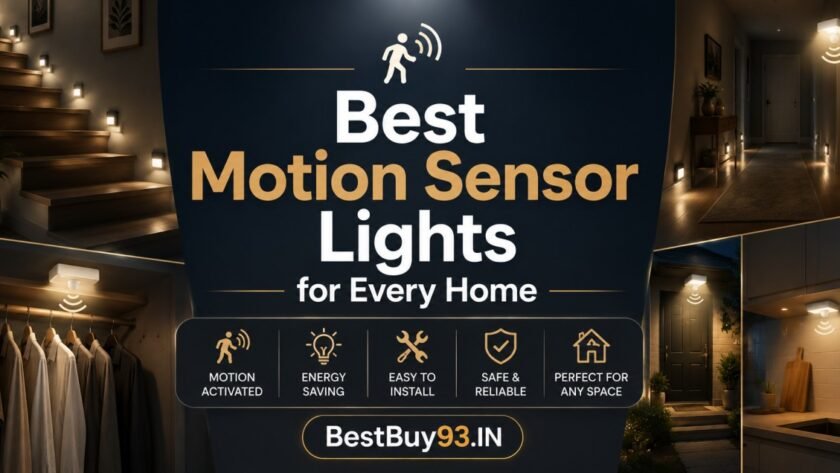

Walking into a dark hallway, opening a wardrobe at night, or climbing the stairs with your hands full these are exactly the little moments when motion sensor lights make life easier. Instead of reaching for a switch, the light turns on automatically when it detects movement and switches off again after a set period.
And honestly, that sounds like a tiny upgrade until you actually start using one. Then suddenly you’re wondering why every dark corner in the house doesn’t have one. 😄
In this guide, we’ll look at the best motion sensor lights for different parts of your home, including wardrobes, bedrooms, stairs, bathrooms, corridors, cabinets and outdoor areas. We’ll also cover the important specifications to check before buying, such as sensor type, detection range, brightness, power source, battery life and weather resistance.
💡 Best Motion Sensor Lights at a Glance
If you want a quick idea of what we’ll be covering, here are the categories we’ll focus on:
| Category | Best For |
|---|---|
| 🏆 Best Overall | Everyday home use |
| 💰 Best Budget | Affordable lighting upgrades |
| 🚪 Best for Wardrobes | Cabinets & closets |
| 🪜 Best for Stairs | Staircases & passages |
| 🛏️ Best for Bedroom | Night-time illumination |
| 🍳 Best for Kitchen | Cabinets & counters |
| 🚿 Best for Bathroom | Hands-free night lighting |
| 🌳 Best Outdoor | Gates, balconies & entrances |
| 🔋 Best Rechargeable | Wireless installation |
| 🏠 Best Value | Multiple areas around the home |
The right option isn’t necessarily the brightest or most expensive one. A small rechargeable light can be perfect inside a wardrobe, while an outdoor entrance needs something considerably more powerful and weather-resistant.
🔦 What Are Motion Sensor Lights?
Motion sensor lights are automatic lighting fixtures that use a motion or occupancy sensor to detect movement and turn the light on. Once movement stops, the light generally remains on for a preset period before switching itself off.
Most residential models combine an LED light source with a sensor in the same unit. That makes them particularly convenient for places where you don’t want to install complicated wiring or constantly reach for a switch.
There are also motion sensor switches, which are slightly different. A sensor light has the light and sensor integrated into one product, whereas a sensor switch controls an existing wired light fixture.
For this article, we’re focusing specifically on motion sensor lights.
⚙️ How Do Motion Sensor Lights Work?
The basic idea is surprisingly simple.
A sensor continuously monitors the area around the light. When it detects movement, it sends a signal to the lighting circuit, which turns the LED on. After movement stops, a timer keeps the light illuminated for a predetermined period before switching it off.
Many models also include a daylight or LUX sensor. This prevents the light from activating when the surrounding area is already bright, which can help reduce unnecessary battery or electricity consumption.
The most common sensor technologies
PIR (Passive Infrared) is one of the most common technologies used in home motion sensor lights. It detects changes in infrared radiation associated with moving people or animals.
Microwave or radar sensors use radio waves to detect movement and can offer different coverage characteristics from PIR sensors. They’re more commonly seen in certain outdoor, commercial or larger-area applications.
For a simple wardrobe, cabinet or bedroom light, you usually don’t need to overcomplicate things. A reliable PIR-based rechargeable light can be perfectly adequate. Motion Sensor Lights
🏠 Why Use Motion Sensor Lights at Home?
The biggest advantage is convenience.
Imagine opening your wardrobe late at night and having the interior light turn on automatically. Or walking down a staircase without having to find a switch in complete darkness. That’s where these lights really earn their place.
Some of the most useful applications include:
- 👕 Wardrobes and closets — automatically illuminate the inside when you open or approach them.
- 🪜 Staircases — provide hands-free illumination while moving between floors.
- 🚶 Hallways and corridors — useful for short trips at night.
- 🛏️ Bedrooms — provide gentle night-time illumination without turning on the main ceiling light.
- 🍳 Kitchen cabinets — illuminate darker work areas and storage spaces.
- 🚿 Bathrooms — useful for nighttime visits when you don’t want harsh overhead lighting.
- 🚪 Entrances — automatically light up when someone approaches.
- 🌳 Balconies and outdoor areas — improve visibility around the home.
- 🚗 Garage and parking areas — provide automatic illumination when you arrive.
Rechargeable stick-on models are particularly useful for wardrobes, cabinets and other locations where you don’t want to deal with electrical wiring.
🔍 What to Look for When Buying Motion Sensor Lights
Not all motion sensor lights are created equal. Some are excellent little helpers; others are basically decorative gadgets with a sensor slapped on top. 😅
Before buying, pay attention to these specifications.
1. Sensor Detection Range
The detection range determines how far away movement can be detected.
For a wardrobe or cabinet, you don’t need a huge range. For a staircase, corridor or outdoor entrance, a wider detection area can be more useful.
Current products can vary considerably in their stated detection distances, so don’t assume that every “motion sensor” light will cover the same area.
2. Detection Angle
The detection angle tells you how wide an area the sensor can monitor.
A wider angle is helpful when the light is installed in a corner or where people approach from different directions.
3. Brightness
Look beyond wattage and check the lumen output when the manufacturer provides it.
A small wardrobe light doesn’t need the same brightness as an outdoor entrance light. Choosing the right brightness for the application can make the light more comfortable and practical.
4. Power Source 🔋
You’ll generally find:
- USB-rechargeable models
- Replaceable battery models
- Plug-in lights
- Mains-powered fixtures
- Solar-powered outdoor lights
Rechargeable models are particularly convenient when you want a wireless, no-electrician installation.
5. Auto-Off Timer
Look for a light with a sensible shut-off delay.
If it switches off almost immediately, you’ll be waving your hand around like you’re trying to summon a genie. 🧞♂️
If it stays on for several minutes after you’ve left, you lose some of the convenience and energy-saving advantage.
6. Daylight/LUX Sensor
A daylight sensor can prevent the light from activating when there is already enough ambient light.
This is particularly useful for battery-powered products because unnecessary activations can mean more frequent charging.
7. Mounting Method
For cabinets and wardrobes, magnetic or adhesive mounting can be extremely convenient.
For permanent outdoor or mains-powered installations, screw mounting is generally more appropriate.
8. IP Rating for Outdoor Use
If you’re buying a motion sensor light for a balcony, gate, driveway or other exposed location, check its IP rating.
Outdoor lights need protection against dust and moisture, particularly in India’s monsoon conditions. An indoor-only light isn’t suddenly an outdoor light because the product listing says “perfect for outside.” 😄 Motion Sensor Lights
🧪 How We Selected the Best Motion Sensor Lights
For this roundup, we would evaluate products across the factors that actually matter in everyday use rather than ranking them purely by price or popularity.
Our evaluation framework includes:
- Sensor performance — detection reliability and response
- Detection range and angle — how effectively the light covers its intended area
- Brightness — whether the illumination matches the intended application
- Power source — rechargeable, battery, plug-in or mains-powered
- Battery performance — particularly important for wireless models
- Build quality — materials, mounting and overall construction
- Outdoor suitability — weather resistance and IP rating where applicable
- Ease of installation — especially for DIY-friendly products
- Value for money — features and performance relative to price
Current Indian motion-sensor-light roundups similarly place considerable emphasis on detection, range, brightness, build quality and value when comparing products.
🥇 1. Best Overall Motion Sensor Light
Best for: Everyday indoor use
If you want one versatile motion sensor light for general household use, look for a rechargeable LED model with PIR detection, magnetic mounting and adjustable brightness.
This combination makes the light useful in wardrobes, corridors, cabinets, bedrooms and staircases without requiring permanent wiring.
Why we like it
- 🔋 Rechargeable battery
- 💡 Adjustable brightness
- 👋 Automatic motion detection
- 🧲 Magnetic mounting
- 🚫 No complicated wiring
- 🌙 Useful for nighttime illumination
Best suited for: Homes that want one multipurpose sensor light rather than separate lights for every application. Motion Sensor Lights
💰 2. Best Budget Motion Sensor Light
Best for: Small spaces and occasional use
You don’t have to spend a fortune to automate a dark corner. Affordable USB-rechargeable or battery-powered LED sensor lights can work particularly well in cupboards, bedside areas and small corridors.
The key is not to chase the cheapest possible model. Look for a decent sensor, adequate brightness and a mounting system that won’t fall off after three days.
Why we like it
- 💵 Affordable
- 🔋 Usually battery or USB powered
- 📦 Compact design
- 🧲 Easy installation
- 💡 Good for small areas
Best suited for: Buyers who want basic automatic lighting without spending much. Motion Sensor Lights
👕 3. Best Motion Sensor Light for Wardrobes
Best for: Closets, wardrobes and cabinets
This is arguably one of the best uses for motion sensor lighting.
A slim LED bar installed inside a wardrobe can automatically illuminate the shelves whenever you open the door or move nearby. Look for a model with a slim profile and magnetic mounting, because you don’t want a chunky light stealing precious wardrobe space.
What to look for
- Slimline construction
- PIR sensor
- Magnetic installation
- Rechargeable battery
- Warm or neutral white illumination
- Good battery life
Best suited for: Wardrobes, kitchen cabinets, shoe cabinets and storage cupboards. Motion Sensor Lights
🪜 4. Best Motion Sensor Light for Stairs
Best for: Staircases and hallways
Stairs and darkness are not exactly a dream team. A motion sensor light can provide enough illumination to safely see the steps without forcing you to switch on the entire house.
For staircases, prioritize wide detection coverage and reliable triggering over ultra-compact size.
Why it works
- 👣 Detects movement automatically
- 💡 Provides immediate illumination
- 🌙 Useful during nighttime
- 🔌 Can eliminate the need to reach for a switch
- 🏠 Works well in multi-level homes
For larger staircases, you may also want to use multiple sensor lights rather than expecting one tiny LED bar to illuminate the entire staircase. Motion Sensor Lights
🛏️ 5. Best Motion Sensor Light for Bedrooms
Best for: Nighttime movement
A bedroom needs softer lighting than a garage or outdoor entrance.
For this space, a warm white or adjustable-colour-temperature sensor light can be a better choice than an extremely bright cool-white model.
Place it near the bed, under a bedside table, near the wardrobe or along the floor.
Look for:
- 🌙 Soft illumination
- 🔋 Rechargeable operation
- 👋 Reliable motion detection
- 🔅 Adjustable brightness
- 🤫 Quiet operation
- 🧲 Easy mounting
Best suited for: Midnight trips to the bathroom, wardrobes and subtle pathway lighting. Motion Sensor Lights
🍳 6. Best Motion Sensor Light for Kitchen Cabinets
Best for: Countertops and cabinets
Kitchen counters can develop surprisingly dramatic shadows, especially underneath overhead cabinets.
A slim sensor light installed beneath the cabinet can automatically illuminate the workspace when you approach.
For this application, pay particular attention to brightness and colour temperature.
A neutral-white light can make the work surface easier to see without creating the overly harsh feel that some cool-white lights can produce. Motion Sensor Lights
Why we like sensor lights here
- 💡 Lights the workspace automatically
- 👋 Hands-free operation
- 🔋 Wireless models avoid extra wiring
- 🧲 Easy installation
- ✨ Keeps counters looking cleaner
🚿 7. Best Motion Sensor Light for Bathrooms
Best for: Nighttime bathroom visits
Nobody wants to blast their eyes with a ceiling light at 3 a.m. 😵💫
A low-level motion sensor light can provide enough illumination to navigate the bathroom without turning on the main light.
However, safety should come before convenience here.
If you’re placing a light inside or near a wet area, check the manufacturer’s installation instructions and the product’s IP rating. Don’t install a product in a location where its electrical rating isn’t suitable for moisture exposure. Motion Sensor Lights
Look for:
- 💧 Appropriate water/moisture protection
- 🌙 Low or adjustable brightness
- 👋 Reliable motion detection
- 🔋 Rechargeable operation
- 🧲 Secure mounting
🌳 8. Best Outdoor Motion Sensor Light
Best for: Entrances, balconies, gates and driveways
Outdoor lighting has completely different requirements from a wardrobe light.
Here, you need to think about weather resistance, detection distance, brightness and mounting security.
A good outdoor sensor light should be able to handle environmental exposure while detecting people approaching the entrance or moving around the property. Motion Sensor Lights
Key features
- ☔ Weather-resistant construction
- 🌧️ Appropriate IP rating
- 💡 Higher brightness
- 📡 Wider detection coverage
- 🔋 Rechargeable or solar power
- 🏠 Secure wall mounting
For completely exposed locations, don’t buy an indoor sensor light simply because it has a motion sensor. The sensor isn’t the problem the housing and electrical protection are.
🔋 9. Best Rechargeable Motion Sensor Light
Best for: Wireless installation
Rechargeable sensor lights are among the easiest options to install because you don’t necessarily need an electrician.
Most can be mounted using magnets, adhesive strips or screws, depending on the model. Motion Sensor Lights
Advantages
- 🔋 No disposable batteries
- 🔌 USB charging
- 🧲 Easy removal for charging
- 🏠 Flexible placement
- 💰 Can reduce recurring battery costs
They’re particularly useful when you want lighting somewhere that doesn’t already have an electrical connection.
🏠 10. Best Value Motion Sensor Light
Best for: Multiple areas around the home
If you’re planning to install sensor lights throughout your home, value matters more than having the fanciest individual unit.
A reliable mid-range model that works well in several locations can be a smarter purchase than an expensive specialist light for every room. Motion Sensor Lights
Consider buying several matching units for:
- Wardrobes
- Bedside areas
- Staircases
- Hallways
- Kitchen cabinets
- Storage areas
That gives your home a more consistent lighting setup while keeping installation and maintenance simple.
📊 Motion Sensor Lights: Quick Comparison
| Pick | Best For | Power | Key Feature to Prioritise |
|---|---|---|---|
| 🥇 Best Overall | Everyday use | Rechargeable | Versatility |
| 💰 Budget Pick | Small spaces | Battery/USB | Value |
| 👕 Wardrobe Pick | Closets | Rechargeable | Slim design |
| 🪜 Staircase Pick | Stairs | Rechargeable/Mains | Detection coverage |
| 🛏️ Bedroom Pick | Night lighting | Rechargeable | Soft illumination |
| 🍳 Kitchen Pick | Cabinets | Rechargeable/Mains | Brightness |
| 🚿 Bathroom Pick | Night use | Rechargeable | Moisture suitability |
| 🌳 Outdoor Pick | Entrances | Solar/Mains | Weather resistance |
| 🔋 Rechargeable Pick | Wireless setups | USB | Battery life |
| 🏠 Value Pick | Multiple rooms | Rechargeable | Overall value |
⚖️ Pros & Cons of Motion Sensor Lights
| Pros | Cons |
|---|---|
| ✅ Automatic operation | ❌ Sensors can occasionally trigger unnecessarily |
| ✅ Convenient at night | ❌ Battery models need periodic charging |
| ✅ Useful in hard-to-reach areas | ❌ Detection can vary by placement |
| ✅ Great for wardrobes and cabinets | ❌ Cheap models may have weaker sensors |
| ✅ Can reduce unnecessary lighting | ❌ Outdoor models need suitable weather protection |
| ✅ Many models are easy to install | ❌ Some require careful positioning |
🏆 What Makes a Motion Sensor Light Worth Buying?
The best motion sensor light isn’t necessarily the brightest one.
For indoor spaces, I’d prioritize reliable motion detection, comfortable brightness, rechargeable power and easy mounting.
For outdoor spaces, move weather resistance and detection range much higher up your checklist.
And for wardrobes or cabinets, size and mounting convenience can matter more than raw brightness.
In other words, buy according to where you’re going to use it, not simply according to whichever product listing has the biggest number in bold. 😄 Motion Sensor Lights
👕 1. Wardrobes & Closets
This is one of the easiest places to start.
Install a slim sensor light inside a wardrobe, and it can illuminate your clothes, shelves and drawers whenever you open the door or move in front of the sensor.
Best choice:
Slim rechargeable LED + PIR sensor + magnetic mounting
It’s especially useful for deep wardrobes where the ceiling light doesn’t reach properly.
🪜 2. Staircases
Staircases are another excellent application.
A sensor light can illuminate the steps when you approach, reducing the need to search for a switch in the dark.
For longer staircases, consider using multiple low-level lights rather than one extremely bright fixture.
💡 Tip: Positioning matters here. Test the detection area before permanently mounting the lights.
🚶 3. Hallways & Corridors
Hallways often don’t need lighting continuously throughout the night.
A motion sensor light can turn on when someone walks through and switch off automatically after they’ve passed.
This is particularly convenient for homes where people frequently move between bedrooms and bathrooms at night.
🛏️ 4. Bedrooms
For bedrooms, the goal isn’t maximum brightness. It’s comfortable visibility.
A warm or dimmable sensor light under the bed, near a wardrobe or beside the pathway can provide enough illumination without turning the room into a stadium.
🌙 Warm white lighting is usually a more comfortable choice for nighttime use.
🍳 5. Kitchen Cabinets
Install sensor lights underneath cabinets or inside pantry areas to illuminate darker sections.
They’re particularly handy when your hands are full or covered in atta. 😭
A rechargeable magnetic light can also make installation much easier when you don’t want to add permanent wiring.
🚿 6. Bathrooms
A low-level sensor light can be useful for nighttime visits.
However, this is one place where you need to be particularly careful about water and electrical safety.
Always follow the manufacturer’s installation instructions and make sure the product is rated appropriately for the location where it will be installed.
🚪 7. Main Entrance
An outdoor motion sensor light can automatically illuminate your entrance when someone approaches.
Besides convenience, this can also improve visibility around the doorway when arriving home after dark.
For outdoor installations, prioritize:
- ☔ Weather resistance
- 💡 Adequate brightness
- 📡 Good detection range
- 🔒 Secure mounting
- ⚡ Appropriate electrical protection
🌳 8. Balcony, Garage & Outdoor Areas
Motion sensor lights can also be useful around balconies, garages, driveways and side passages.
For these locations, weather resistance is not optional.
Look for an appropriate IP rating and make sure the product is designed for outdoor installation. Motion Sensor Lights
💡 Motion Sensor Lights vs Regular Lights
Still wondering whether you actually need one?
Here’s the simple comparison:
| Feature | Motion Sensor Light | Regular Light |
|---|---|---|
| Automatic operation | ✅ Yes | ❌ No |
| Manual switch required | Usually no | Yes |
| Convenient at night | ⭐⭐⭐⭐⭐ | ⭐⭐⭐ |
| Installation | Varies | Usually simple |
| Energy efficiency | Potentially better | Depends on usage |
| Ideal for wardrobes | ✅ Excellent | ❌ Less convenient |
| Ideal for corridors | ✅ Excellent | ✅ Good |
| Outdoor convenience | ✅ Excellent | ✅ Good |
| Battery options | ✅ Available | Usually no |
| Hands-free operation | ✅ | ❌ |
So which one is better?
Neither is universally better.
Regular lights are still the better choice when you need continuous illumination, such as reading, cooking or working.
Motion sensor lights shine when you need short bursts of automatic illumination.
Think of them as a convenience upgrade not a replacement for every light in your home.
🔧 Motion Sensor Light Installation Tips
One of the biggest mistakes people make is installing a sensor light without thinking about where the sensor is actually looking.
Before fixing it permanently, test the detection area.
Follow these tips:
1. Position the sensor where movement crosses its detection area
Don’t automatically point it toward a wall.
2. Avoid unnecessary obstacles
Large furniture, doors or other objects can interfere with the sensor’s ability to detect movement.
3. Don’t place it too close to a heat source
PIR sensors respond to changes in infrared radiation, so unusual heat sources can sometimes affect detection.
4. Check the activation direction
A person walking across a sensor’s detection zone may be detected differently from someone walking directly toward it.
5. Test before final installation
This sounds obvious, but it’s much easier to move a sensor before you’ve permanently mounted it. Motion Sensor Lights
🔋 How to Get Better Battery Life
If you’ve chosen a rechargeable motion sensor light, battery life becomes an important consideration.
Fortunately, a few simple changes can reduce unnecessary activations.
🌙 Use the daylight sensor
If your model has a light-sensitive mode, enable it so the light doesn’t activate when the room is already bright.
💡 Don’t use maximum brightness unnecessarily
If the light has multiple brightness settings, choose the lowest setting that provides enough illumination.
⏱️ Keep the auto-off time reasonable
A sensor light doesn’t need to remain on for five minutes if you’re only walking through a hallway for ten seconds.
📍 Improve placement
If the sensor keeps detecting movement from people passing outside the intended area, repositioning it can reduce unnecessary activations.
💰 Are Motion Sensor Lights Worth It?
Yes if you use them in the right places.
They’re particularly worthwhile for areas where you frequently need temporary lighting:
- Wardrobes
- Stairs
- Corridors
- Cabinets
- Bathrooms
- Entrances
- Garages
- Storage rooms
The biggest benefit isn’t necessarily saving a huge amount on your electricity bill.
It’s convenience.
You don’t have to hunt for switches, you don’t have to remember to turn the light off, and you can illuminate areas that don’t have convenient electrical connections.
For renters, rechargeable magnetic models are particularly attractive because they can often be installed without permanent electrical modifications.
🛒 Final Buying Advice
Before purchasing a motion sensor light, ask yourself five simple questions:
1. Where will I install it?
Indoor and outdoor requirements are very different.
2. How much brightness do I actually need?
A wardrobe doesn’t need the same brightness as a driveway.
3. Do I want rechargeable or wired?
Rechargeable models offer flexibility, while wired options can make more sense for permanent installations.
4. How much area needs to be covered?
Check detection range and angle rather than assuming every sensor works the same way.
5. Is the mounting method suitable?
Magnetic and adhesive mounting is convenient for lightweight indoor models, while outdoor fixtures may need secure screw mounting.
The smartest purchase is the one that matches the job. That’s the whole game.
❓ Frequently Asked Questions About Motion Sensor Lights
Are motion sensor lights worth buying?
Yes. They’re especially useful in wardrobes, staircases, hallways, bathrooms, cabinets and outdoor entrances where automatic illumination is convenient.
Do motion sensor lights use a lot of electricity?
Most sensor lights only operate when movement is detected, so they don’t remain illuminated continuously. Actual energy consumption depends on the light’s power rating, activation frequency and how long it stays on.
Are rechargeable motion sensor lights good?
Yes. They’re particularly useful where you don’t have an existing electrical connection. They’re also convenient for wardrobes, cabinets and other locations where permanent wiring isn’t desirable.
Can motion sensor lights be used outdoors?
Yes, but only if the specific product is designed and rated for outdoor use. Check its IP rating and installation instructions before exposing it to rain or moisture.
How long do motion sensor lights stay on?
It depends on the model. Many products allow the auto-off duration to be adjusted, while simpler models use a fixed timer.
Can I install a motion sensor light myself?
Many battery-powered or rechargeable indoor models are designed for relatively simple installation. However, mains-powered electrical installations should be handled according to local electrical-safety requirements and, where appropriate, by a qualified electrician.
Do motion sensor lights work during the daytime?
Some models include a daylight/LUX sensor that prevents activation when sufficient ambient light is present. Others may activate whenever movement is detected.
What is better: PIR or microwave motion sensing?
For many basic home applications, PIR sensors are perfectly adequate and widely used. Microwave/radar sensing can have different detection characteristics and may be useful for particular applications. The best choice depends on the installation environment.
🔗 Related Articles
If you’re upgrading your home’s lighting, these guides on BestBuy93.IN can help you choose the right lighting for different rooms and situations:
- 💡 Best Table Lamps: 10 Stylish Picks for Every Home
- 🌡️ Warm White vs Cool White Lighting: Which Is Better?
- 🛏️ Bedroom Lighting Ideas: 15 Ways to Create a Cozy & Stylish Space
- 🏠 Best Wall Clocks: 10 Stylish Picks for Every Home
- ⏰ Analog vs Digital: Which Wall Clock Is Better?
🏁 Final Verdict
Motion sensor lights are one of those small home upgrades that can make everyday life noticeably easier. They’re not meant to replace every conventional light in your home, but they’re fantastic for areas where you only need illumination temporarily.
For wardrobes and cabinets, choose a compact rechargeable model.
For bedrooms and hallways, look for soft, comfortable illumination.
For staircases, prioritize reliable detection and coverage.
And for entrances, balconies and other outdoor areas, put weather resistance and IP rating near the top of your checklist.
Most importantly, don’t buy based solely on the brightest lumen figure or the fanciest product photo. 😄 Choose the motion sensor light according to where you’re actually going to use it.
A well-placed sensor light should feel almost invisible in daily life you simply walk in, the light comes on, you walk away, and it goes off. That’s exactly the kind of smart-home convenience worth having. 💡🏠