
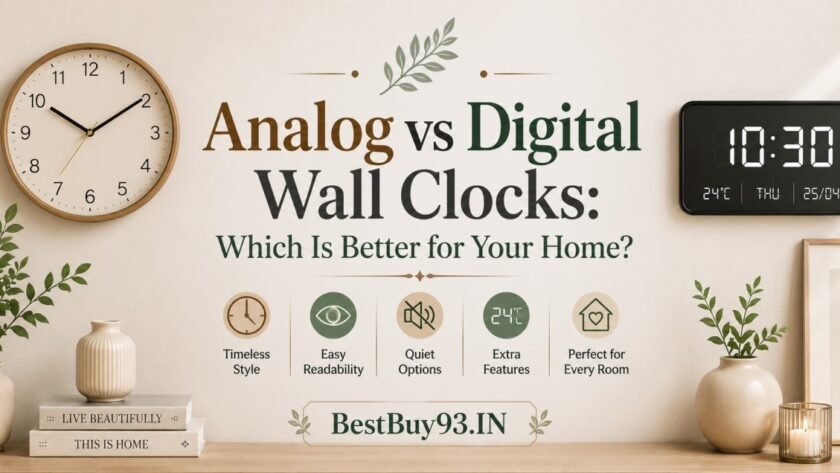

Choosing a wall clock used to be pretty straightforward: find one that looks good, make sure it tells the time, and hang it on the wall. 🕐😄
Today, though, you have another decision to make: analog or digital?
Analog wall clocks bring the familiar look of a traditional clock face, complete with hands, numbers and that classic home décor appeal. Digital wall clocks, on the other hand, offer an instantly readable numerical display and can come with useful extras such as date, temperature or other information.
So which one is actually better?
The answer depends on where you’re placing the clock, how quickly you want to read the time, your interior style and whether you prefer decoration or additional functionality. 🏡✨
In this guide, we’ll compare analog vs digital wall clocks across design, readability, functionality, placement, maintenance, noise, power requirements and overall practicality. We’ll also look at which type works best for living rooms, bedrooms, kitchens, home offices and other spaces. Wall Clock
Also Read | Best Wall Clocks: 10 Stylish Picks for Every Home
🕐 Analog vs Digital Wall Clocks at a Glance
| Feature | 🕐 Analog Wall Clock | 🔢 Digital Wall Clock |
|---|---|---|
| Time display | Hands and dial | Numerical display |
| Decorative appeal | ⭐⭐⭐⭐⭐ | ⭐⭐⭐ |
| Readability | Excellent once familiar | Excellent at a glance |
| Traditional look | Excellent | Limited |
| Modern look | Excellent | Excellent |
| Additional information | Usually limited | Often available |
| Bedroom use | Excellent with silent movement | Excellent |
| Living room use | Excellent | Good |
| Kitchen use | Excellent | Excellent |
| Home office | Excellent | Excellent |
| Ticking | Possible | Usually electronic |
| Battery use | Common | Common |
| Maintenance | Generally simple | Generally simple |
| Styling flexibility | Very high | Moderate to high |
| Best for | Décor + timekeeping | Quick reading + features |
🕐 What Is an Analog Wall Clock?
An analog wall clock displays time using moving hands positioned around a numbered or marked dial.
It’s the classic clock design most people grew up seeing.
You may find:
- 🕐 Traditional numbered dials
- 🔢 Arabic numerals
- 🏛️ Roman numerals
- 🖤 Minimal hour markers
- 🌳 Wooden frames
- ✨ Decorative metallic frames
- 🤍 Minimalist designs
- 🕰️ Vintage-inspired clocks
Why Analog Clocks Remain Popular
Analog clocks aren’t just functional objects.
They’re also a form of wall décor.
A beautifully designed analog clock can work almost like artwork, particularly when placed above a sofa, console or sideboard.
That makes analog clocks especially attractive for homeowners who want their clock to contribute to the overall aesthetic of a room. Wall Clock
🔢 What Is a Digital Wall Clock?
A digital wall clock displays time using numerical digits, usually through an LED or LCD-style display.
Instead of interpreting the position of clock hands, you simply look at the numbers.
For example:
10:35
Done. No decoding required. 😂
Depending on the model, digital wall clocks may also include features such as:
- 📅 Date
- 🌡️ Temperature
- 💧 Humidity
- ⏰ Alarm
- 🔆 Display brightness adjustment
- 📆 Day/date information
Some designs are extremely simple, while others are more like multifunctional information displays.
Why Choose Digital?
Digital clocks are particularly useful when quick readability and additional information matter more than traditional decorative styling. Wall Clock
⚖️ Analog vs Digital Wall Clocks: Key Differences
The biggest difference isn’t simply how they display the time.
It’s what each type prioritizes.
Analog → Traditional design + visual character
Digital → Immediate readability + functionality
That distinction becomes especially important depending on where you plan to use the clock. Wall Clock
🎨 1. Design and Appearance
This is probably the biggest advantage analog clocks have.
🕐 Analog
Analog wall clocks are available in an enormous range of decorative designs.
You can find:
- Minimalist
- Rustic
- Industrial
- Scandinavian
- Vintage
- Traditional
- Contemporary
- Luxury-inspired
- Wooden
- Metallic
This makes them incredibly flexible for interior design.
🔢 Digital
Digital clocks tend to have a more technological appearance.
They’re excellent for modern, minimalist or functional spaces, but they generally don’t provide the same traditional decorative character as an ornate analog clock.
🏆 Winner: Analog
If your priority is wall décor, analog wins comfortably.
👀 2. Readability
This is where digital clocks fight back.
🔢 Digital
You see:
08:45
And you instantly know the time.
There’s no interpretation required.
This can be particularly useful for:
- Kitchens
- Offices
- Workshops
- Classrooms
- Utility rooms
🕐 Analog
Analog clocks require you to interpret the position of the hour and minute hands.
For most adults, this happens almost automatically.
However, readability can vary significantly depending on:
- Number size
- Hand design
- Dial contrast
- Lighting
- Clock size
🏆 Winner: Digital
For instant numerical readability, digital has the edge.
🎯 3. Accuracy
Both analog and digital clocks can be accurate when they use reliable mechanisms.
Analog
Quartz analog clocks are commonly battery-powered and generally provide dependable everyday timekeeping.
Digital
Digital clocks may use quartz-based timekeeping as well, depending on the design.
Accuracy therefore depends more on the specific movement, mechanism and product quality than simply whether the display is analog or digital.
🏆 Winner: Tie
Don’t assume digital automatically means more accurate.
Look at the actual clock mechanism and specifications.
⚙️ 4. Features and Functionality
This is where digital clocks usually pull ahead.
Analog
Most analog clocks focus primarily on:
Timekeeping + decoration
Some may include additional features, but they’re usually not the main selling point.
Digital
Digital wall clocks can potentially offer:
- 📅 Calendar
- 🌡️ Temperature
- 💧 Humidity
- ⏰ Alarm
- 🔆 Adjustable brightness
- 📆 Day/date display
If you want a clock that provides more information at a glance, digital is usually the better option.
🏆 Winner: Digital
For additional features, digital wins.
🤫 5. Noise
This one matters more than people think.
Traditional analog clocks can produce a ticking sound depending on their movement.
For some people, it’s harmless background noise.
For others?
Absolutely unbearable at 2 a.m. 😂
Analog
Look for:
Silent sweep movement / non-ticking movement
if the clock is going into a bedroom or quiet workspace.
Digital
Digital clocks generally don’t have the traditional ticking mechanism associated with analog clocks.
However, electronic clocks can still have alarms or other sounds depending on the model.
🏆 Winner: Digital
For avoiding traditional ticking, digital generally has the advantage.
🔋 6. Power Requirements
Both analog and digital wall clocks can be battery-powered.
Analog
Many standard analog clocks use replaceable batteries.
Digital
Digital clocks may use:
- 🔋 Batteries
- 🔌 AC power
- 🔋 Battery backup + mains power
The exact setup depends on the model.
Which Is Better?
If you want a completely cordless installation, a battery-powered clock is convenient.
If you want a large digital display with multiple features, a mains-powered model may be more practical.
🏆 Winner: Tie
It depends entirely on the specific clock.
🏠 7. Placement and Room Suitability
Where you plan to place the clock can make the decision much easier.
🛋️ Living Room
Analog wins
A decorative analog clock can function as wall art.
🛏️ Bedroom
Tie
Choose a silent analog clock if you like traditional décor.
Choose digital if you want instant readability and additional information.
🍳 Kitchen
Digital slightly wins for functionality
A clear digital display can be easy to read while cooking.
But an easy-to-read analog clock works perfectly well too.
💻 Home Office
Digital for functionality, analog for décor
Your choice depends on whether you prefer information or visual simplicity.
🚪 Entryway
Analog wins
A decorative analog clock can add personality without looking overly technical.
🕐 8. Ease of Use
Analog
Once you’re familiar with reading an analog clock, checking the time is quick.
The main challenge comes from decorative clocks with tiny markers or unusual hands.
Digital
There’s virtually no interpretation.
You look at the numbers and you’re done.
🏆 Winner: Digital
For instant, straightforward time reading, digital is easier.
🧹 9. Maintenance
Both types are relatively easy to maintain.
Analog Maintenance
You may need to:
- Replace batteries
- Dust the frame
- Clean the glass
- Occasionally check the movement
Digital Maintenance
You may need to:
- Replace batteries
- Clean the display
- Check power connections
- Replace backup batteries where applicable
Digital displays may require slightly more care if they have additional electronic features.
🏆 Winner: Tie
Neither requires complicated maintenance for ordinary household use.
🎨 10. Interior Style
This is where personal taste becomes important.
🖤 Modern Interior
Both can work.
A minimalist analog clock can look surprisingly contemporary.
🌳 Rustic Interior
Analog wins
Wooden and vintage-style clocks complement rustic décor naturally.
🤍 Scandinavian Interior
Analog wins slightly
Simple wooden or neutral clocks work beautifully.
🏭 Industrial Interior
Both work.
Black metal analog clocks are classic, while sleek digital displays can suit a more contemporary industrial space.
💻 Tech-Inspired Interior
Digital wins
A digital display naturally complements technology-focused spaces.
🛋️ Which Is Better for the Living Room?
🥇 Winner: Analog
For most living rooms, an analog wall clock is the more versatile choice.
Why?
Because your living room isn’t just a place where you check the time.
It’s also a space where you entertain, relax and display your personal style.
A decorative analog clock can become part of the room’s design.
Best Choices
- Large wooden clock 🌳
- Minimalist black clock 🖤
- Decorative metal clock ✨
- Vintage clock 🕰️
- Oversized statement clock 📏
Digital Alternative
Choose digital if your living room has a very modern, technology-focused aesthetic.
🛏️ Which Is Better for the Bedroom?
🥇 Winner: Depends
If you’re decorating a traditional or minimalist bedroom, a silent analog clock can be beautiful.
If you want immediate readability and additional information, a digital clock may be more practical.
Choose Analog If:
- You prefer traditional décor
- You want a decorative clock
- You don’t mind interpreting the hands
- You choose a silent movement
Choose Digital If:
- You want instant readability
- You prefer modern technology
- You want date or temperature information
- You dislike ticking sounds
🍳 Which Is Better for the Kitchen?
🥇 Winner: Digital for Functionality
The kitchen is a place where you often need to check time quickly.
A digital clock can be particularly convenient when you’re:
- Cooking
- Baking
- Preparing meals
- Timing food
- Working through recipes
However, a large analog clock with clear numbers can be equally practical.
💡 Kitchen Tip
Whichever style you choose, prioritize visibility and easy cleaning.
A beautiful clock hidden behind a cabinet isn’t helping anyone.
💻 Which Is Better for a Home Office?
🥇 Winner: Digital for Functionality
Digital clocks can provide an easy-to-read display without requiring you to interpret hands while working.
Some models also provide additional information.
However, a silent minimalist analog clock is an excellent option if you want your office to feel more like a calm interior space rather than a tech dashboard.
🚪 Which Is Better for an Entryway?
🥇 Winner: Analog
Entryways benefit from decorative pieces.
A stylish analog clock can complement:
- Console tables
- Mirrors
- Plants
- Artwork
- Decorative trays
A digital clock can work, but it tends to feel more functional than decorative.
❤️ Pros and Cons of Analog Wall Clocks
| Pros | Cons |
|---|---|
| Excellent decorative appeal | May produce ticking noise |
| Huge variety of styles | Requires interpreting the dial |
| Works with traditional interiors | Usually fewer extra features |
| Great as wall art | Decorative designs may compromise readability |
| Available in many materials | Hands can be difficult to see in low light |
| Excellent for living rooms | Requires battery replacement |
| Can be silent with the right movement | Large designs can be heavy |
🔢 Pros and Cons of Digital Wall Clocks
| Pros | Cons |
|---|---|
| Instant numerical readability | Less decorative variety |
| Often includes extra features | Can look more functional |
| Usually no traditional ticking | May require mains power |
| Excellent for offices and kitchens | Display may be distracting |
| Useful for date/temperature information | Some designs feel technologically dated |
| Easy to read from a distance | Bright displays can be unsuitable for bedrooms |
| Modern appearance | May not suit traditional interiors |
🏆 Analog vs Digital: Quick Winner Guide
| Category | Winner |
|---|---|
| 🎨 Decorative appeal | 🕐 Analog |
| 👀 Instant readability | 🔢 Digital |
| 🏠 Traditional interiors | 🕐 Analog |
| 💻 Tech-focused spaces | 🔢 Digital |
| 🛋️ Living room | 🕐 Analog |
| 🛏️ Bedroom | 🤝 Tie |
| 🍳 Kitchen | 🔢 Digital |
| 🚪 Entryway | 🕐 Analog |
| 💻 Home office | 🔢 Digital |
| 🤫 Avoiding ticking | 🔢 Digital |
| ✨ Statement décor | 🕐 Analog |
| 📅 Extra features | 🔢 Digital |
| 🌳 Rustic décor | 🕐 Analog |
| 🤍 Minimalist décor | 🤝 Tie |
🏠 Which Is Better for Different Rooms?
The easiest way to decide between analog vs digital wall clocks is to stop thinking about the clock in isolation and look at the room around it.
A clock in your living room has a very different job from one sitting above your kitchen counter or beside your work desk. 🕐✨
🛋️ Analog vs Digital Wall Clock for the Living Room
🥇 Best Overall: Analog
For most living rooms, an analog wall clock is the more natural choice.
Why? Because the living room is usually one of the most decorative areas of the home. A wall clock doesn’t have to simply tell time—it can become part of the room’s visual identity.
Choose Analog for:
- 🌳 Wooden furniture
- 🪴 Indoor plants
- 🖼️ Gallery walls
- 🛋️ Neutral sofas
- ✨ Decorative interiors
- 🏡 Traditional or contemporary homes
A large wooden clock can add warmth, while a black metal clock can create a stronger modern or industrial look.
When Digital Makes Sense
A digital clock can work well if your living room has a distinctly modern or technology-focused aesthetic.
It can also be useful if you want:
- Large numbers
- Date display
- Temperature information
- Easy readability from a distance
💡 Living Room Tip
If the clock is going above your sofa or console, analog usually looks more decorative.
If it’s going on a wall where functionality is the main priority, digital can make more sense.
🛏️ Analog vs Digital Wall Clock for the Bedroom
🥇 Best Overall: Tie
The bedroom is where this comparison gets interesting.
You need to consider both appearance and noise.
Choose a Silent Analog Clock If:
- You love traditional clock designs
- You want the clock to complement bedroom décor
- You prefer a softer visual appearance
- You choose a silent movement
A minimalist round clock or wooden clock can look beautiful above a dresser.
Choose Digital If:
- You want instant readability
- You prefer a modern aesthetic
- You want date or temperature information
- You don’t want traditional ticking
⚠️ Watch Out for Bright Displays
A digital clock with a very bright display may not be ideal for everyone in a dark bedroom.
If you’re buying one specifically for the bedroom, look for features such as:
- Adjustable brightness
- Dim mode
- Night mode
- Automatic display adjustment
💡 Bedroom Tip
If your priority is peaceful décor, choose a silent analog clock.
If your priority is quick time checking, digital may be more practical.
🍳 Analog vs Digital Wall Clock for the Kitchen
🥇 Best for Functionality: Digital
The kitchen is one place where quick readability really matters.
You might be:
- 🍪 Baking
- 🍳 Cooking
- ⏱️ Timing food
- 🥘 Preparing multiple dishes
- 🧼 Cleaning
- ☕ Making breakfast
Being able to glance at a large numerical display can be extremely convenient.
Why Digital Works Well
You don’t need to interpret the clock hands.
You simply see:
08:20
and carry on with whatever culinary chaos is happening on the counter. 😂
But Analog Still Works
A large analog clock with:
- Clear numbers
- High contrast
- Large hands
- Easy-to-clean frame
can be just as practical.
💡 Kitchen Tip
Don’t choose a clock with an overly complicated decorative face.
In the kitchen, readability beats fancy design.
💻 Analog vs Digital Wall Clock for a Home Office
🥇 Best for Functionality: Digital
A home office is another space where digital clocks have a natural advantage.
You can glance at the display without interrupting your workflow.
Digital Is Great For:
- ⏰ Time tracking
- 📅 Date checking
- 💻 Workspaces
- 📚 Study areas
- 📝 Productivity setups
If you choose a model with additional information, you may also be able to check the date or temperature at a glance.
Why Choose Analog?
A minimalist analog clock can make a home office feel less clinical.
Instead of another glowing screen, you get a simple decorative object that quietly does its job.
💡 Office Tip
If your desk already has multiple screens, a simple analog clock can actually make the room feel calmer.
You probably don’t need another glowing rectangle staring at you. 😂
🚪 Analog vs Digital Wall Clock for the Entryway
🥇 Best Overall: Analog
Entryways benefit from decorative objects because they’re usually the first part of your home guests see.
A stylish analog clock can work beautifully above:
- 🪵 Console tables
- 🪴 Plants
- 🪞 Decorative mirrors
- 🏺 Vases
- 🧺 Storage baskets
Best Analog Styles
- Round wooden clock
- Minimalist black clock
- Vintage clock
- Decorative metal clock
- Oversized statement clock
Digital Alternative
Digital works if your entryway has a modern, minimalist design and you want functionality to take priority.
But visually, analog generally has more personality.
🍽️ Analog vs Digital Wall Clock for the Dining Room
🥇 Best Overall: Analog
A dining room is another space where décor matters.
A decorative analog clock can become a focal point above a sideboard or on a feature wall.
Try:
Large clock + sideboard + lamp + vase ✨
or
Wooden clock + dining table + indoor plant 🌿
Digital Option
A digital clock can work in a modern dining space, but it may feel more functional than decorative.
If the dining room already has a contemporary, technology-inspired aesthetic, that’s not necessarily a problem.
🚶 Analog vs Digital Wall Clock for a Hallway
🥇 Best Overall: Analog
Hallways generally don’t need complicated functionality.
Instead, the clock can provide a decorative element while filling an otherwise empty wall.
Good Choices
- Small round analog clock
- Slim rectangular clock
- Minimalist clock
- Wooden clock
Digital Option
Digital can work if the hallway connects to a home office or utility area where functionality matters.
But for purely decorative hallway styling, analog is usually more appealing.
🏡 Analog vs Digital Wall Clocks for Small Homes
Small homes require a little more thought because every decorative object contributes to the visual balance of the room.
Analog Advantage
An analog clock can double as wall décor + timekeeping.
That means you don’t necessarily need another artwork or decorative object on the same wall.
Digital Advantage
Digital clocks can provide more information without requiring additional objects.
For example, one clock might display:
Time + Date + Temperature
instead of having separate devices.
💡 Small-Space Tip
If you’re trying to keep your home visually calm, choose one multifunctional piece instead of several smaller ones.
🎨 Which Clock Is Easier to Match With Home Décor?
🥇 Winner: Analog
This isn’t even particularly close.
Analog clocks come in a huge range of:
- Shapes
- Materials
- Colours
- Frames
- Dial styles
- Finishes
That makes them easier to integrate into different decorating styles.
🌳 Rustic
Wooden analog clock.
🖤 Industrial
Black metal analog clock.
🤍 Scandinavian
Minimal wooden or white analog clock.
🏛️ Traditional
Roman numeral or vintage analog clock.
✨ Contemporary
Minimalist or geometric analog clock.
💻 Tech-Inspired
Digital wall clock.
🕐 Analog vs Digital for Minimalist Interiors
This one is surprisingly close.
Minimalist Analog
A simple analog clock with:
- Thin frame
- Minimal markers
- Neutral colours
- Clean hands
can look incredibly sophisticated.
Minimalist Digital
A clean digital display can also work beautifully.
It provides information without visual clutter.
🏆 Verdict
Analog = minimalist décor
Digital = minimalist functionality
Choose based on what you want the clock to contribute to the room.
🌳 Analog vs Digital for Rustic Interiors
🥇 Winner: Analog
Rustic interiors naturally work better with materials and designs that have warmth and character.
Think:
- 🌳 Wood
- 🕰️ Vintage finishes
- 🤎 Earthy colours
- ⚙️ Aged metal
- 🪵 Natural textures
A digital clock can feel a little too technological in this setting.
🏭 Analog vs Digital for Industrial Interiors
🥇 Winner: Tie
Industrial décor gives you more freedom.
Analog Industrial
Think:
Black metal + exposed details + oversized dial
Classic industrial clock styling.
Digital Industrial
A simple digital display can work if the rest of the room has a contemporary, urban feel.
💡 Styling Tip
If your industrial room already has lots of metal and exposed elements, a minimalist digital clock can provide contrast.
🤍 Analog vs Digital for Scandinavian Interiors
🥇 Winner: Analog
Scandinavian décor usually relies on:
- Natural materials
- Neutral colours
- Simplicity
- Light wood
- Clean lines
A simple wooden analog clock fits naturally into that aesthetic.
Digital can work too, but it tends to feel more technological.
🏛️ Analog vs Digital for Traditional Interiors
🥇 Winner: Analog
This is an easy one.
Traditional rooms naturally complement:
- Roman numerals
- Wooden frames
- Decorative details
- Vintage-inspired clock faces
- Brass or antique finishes
A digital display may feel visually disconnected from the rest of the room.
📊 Analog vs Digital: Detailed Comparison
| Factor | Analog | Digital | Winner |
|---|---|---|---|
| Decorative appeal | Excellent | Good | 🕐 Analog |
| Instant reading | Good | Excellent | 🔢 Digital |
| Traditional interiors | Excellent | Limited | 🕐 Analog |
| Modern interiors | Excellent | Excellent | 🤝 Tie |
| Extra features | Limited | Excellent | 🔢 Digital |
| Silent operation | Available | Usually quiet | 🔢 Digital |
| Design variety | Excellent | Moderate | 🕐 Analog |
| Living room | Excellent | Good | 🕐 Analog |
| Bedroom | Excellent with silent movement | Excellent | 🤝 Tie |
| Kitchen | Excellent | Excellent | 🤝 Tie |
| Home office | Excellent | Excellent | 🤝 Tie |
| Entryway | Excellent | Good | 🕐 Analog |
| Rustic décor | Excellent | Limited | 🕐 Analog |
| Tech décor | Good | Excellent | 🔢 Digital |
| Maintenance | Easy | Easy | 🤝 Tie |
| Battery options | Excellent | Excellent | 🤝 Tie |
🪞 Analog vs Digital: Which Looks More Like Wall Art?
🥇 Analog
If your main goal is to make the clock part of your décor, analog is the obvious choice.
A decorative analog clock can fill the role of:
- 🖼️ Wall art
- 🎯 Focal point
- 🏡 Decorative accent
- 🕐 Functional timepiece
This is especially useful when decorating a large empty wall.
Digital
Digital clocks tend to feel more like functional technology.
That’s not a criticism.
In the right space, that can actually be exactly what you want.
🔢 Which Is Easier to Read From Far Away?
🥇 Digital
If the display is large enough, digital clocks can be extremely easy to read from across a room.
You simply recognize the numbers.
Analog clocks can also be highly visible if they’re large and have strong contrast, but decorative designs sometimes sacrifice readability.
💡 If Readability Matters
Look for:
Large display + high contrast + uncluttered design
regardless of the type you choose.
🤫 Which Is Better for Quiet Spaces?
🥇 Digital
Digital clocks generally avoid the traditional ticking associated with many analog movements.
However, if you love analog styling, you don’t necessarily have to sacrifice peace and quiet.
Look for:
Silent sweep
Non-ticking
Quiet movement
A silent analog clock can be an excellent compromise for bedrooms and study spaces.
🔋 Which Is Easier to Install?
🥇 Analog
Most simple battery-powered analog wall clocks are very straightforward.
Hang the clock, insert the battery and set the time.
Digital clocks can also be simple, particularly when battery-powered, but models with mains power may require positioning near an outlet.
💡 Before Buying
Always check:
- Power source
- Cable length, if applicable
- Battery type
- Mounting system
- Clock weight
A beautiful clock that needs a cable running awkwardly across your wall isn’t exactly a décor victory. 😂
🧹 Which Is Easier to Maintain?
🏆 Winner: Tie
Both are relatively low-maintenance.
Analog
Keep the dial and frame clean and replace the battery when necessary.
Digital
Keep the display clean and maintain the power source.
Feature-rich digital clocks may require slightly more attention because there are simply more functions involved.
For most households, however, the difference is minimal.
💰 Does One Cost More Than the Other?
Not necessarily.
Both analog and digital clocks are available across a broad range of prices.
Budget Analog
You can find simple clocks with basic quartz movements.
Premium Analog
You may pay more for:
- Solid wood
- Decorative metal
- Larger dimensions
- Specialty designs
- Craftsmanship
Budget Digital
Basic digital displays can be relatively affordable.
Premium Digital
Higher-priced models may include:
- Larger displays
- Multiple sensors
- Temperature/humidity information
- Better display technology
- Additional controls
- Backup power
💡 Buying Tip
Don’t assume that digital is automatically more expensive—or that an expensive analog clock is automatically better.
Compare the materials, movement, display quality, dimensions and features.
🛒 What to Look for Before Buying an Analog Wall Clock
📏 1. Clock Size
Measure the wall before buying.
👀 2. Dial Readability
Check the numbers, hands and contrast.
⚙️ 3. Movement
Look for quartz or silent movement depending on your needs.
🤫 4. Noise
Especially important for bedrooms.
🖼️ 5. Frame Material
Wood, metal, plastic and other materials have different visual and durability characteristics.
🔋 6. Battery
Check the required battery type.
🧱 7. Mounting
Check the clock weight and mounting mechanism.
🎨 8. Design
Make sure it complements the rest of your room.
🛒 What to Look for Before Buying a Digital Wall Clock
🔢 1. Display Size
Make sure the digits are visible from the intended viewing distance.
💡 2. Brightness
If you’re using it in a bedroom, adjustable brightness can be useful.
📅 3. Extra Features
Decide whether you actually need date, temperature or humidity information.
🔋 4. Power Source
Check whether it uses batteries, mains power or both.
⏰ 5. Alarm
If included, check whether it can be disabled.
🧱 6. Mounting
Check whether the clock is designed for wall mounting.
🧹 7. Display Maintenance
Consider how easily the screen can be cleaned.
🏠 8. Overall Appearance
Don’t forget that this is still part of your home’s décor.
⚠️ Common Mistakes When Choosing Between Analog and Digital
❌ Choosing Only Based on Appearance
A clock can look amazing online but be difficult to read in real life.
❌ Ignoring the Room
A digital clock may look out of place in a traditional living room.
A vintage analog clock may look strange in a highly technological workspace.
❌ Forgetting About Noise
Especially dangerous for bedrooms.
❌ Ignoring Power Requirements
A digital clock requiring mains power needs access to an outlet.
❌ Choosing Too Many Features
More features don’t automatically mean better value.
❌ Choosing the Wrong Size
A tiny digital display may disappear on a large wall.
A massive analog clock can overwhelm a small room.
❌ Forgetting Installation
Large clocks still need secure mounting.
💡 A Simple Decision Formula
Still stuck?
Use this:
Choose Analog If:
Decorative appeal + styling + traditional character are your priorities. 🕐✨
Choose Digital If:
Readability + functionality + extra information matter more. 🔢
Choose Silent Analog If:
You want:
Classic décor + quieter operation. 🤫🕐
Choose Digital With Adjustable Brightness If:
You want:
Easy readability + modern functionality + bedroom-friendly operation. 🌙
🏡 Best Choice by Lifestyle
| Your Priority | Best Choice |
|---|---|
| 🎨 Beautiful wall décor | Analog |
| 🏡 Traditional home | Analog |
| 🌳 Rustic styling | Analog |
| 🤍 Scandinavian décor | Analog |
| 🖤 Industrial styling | Analog or Digital |
| 💻 Technology-focused home | Digital |
| 👀 Fastest time reading | Digital |
| 📅 Date and extra information | Digital |
| 🤫 No traditional ticking | Digital |
| 🛏️ Quiet bedroom | Silent Analog or Digital |
| 🛋️ Statement living-room décor | Analog |
| 🍳 Practical kitchen use | Digital or clear Analog |
| 💰 Simple budget option | Either |
| ✨ Decorative feature wall | Analog |
🔍 Research Methodology
For this Analog vs Digital Wall Clocks comparison, we evaluated both clock types based on practical home-use and interior-design considerations.
Our comparison focuses on:
- 🕐 Display type
- 👀 Readability
- 🎨 Decorative appeal
- ⚙️ Movement and timekeeping
- 🤫 Noise
- 🔋 Power requirements
- 📅 Additional features
- 🏠 Room suitability
- 🖼️ Design flexibility
- 🧱 Installation
- 🧹 Maintenance
- 💰 Overall practicality
We considered how each type performs across living rooms, bedrooms, kitchens, dining rooms, entryways and home offices.
The goal is to help readers choose based on actual usage and room requirements, rather than simply assuming that newer technology is automatically better.
📌 Quick Buying Checklist
Before purchasing, ask yourself:
- 🏠 Where will I place the clock?
- 📏 How much wall space do I have?
- 👀 How far away will I usually read it?
- 🤫 Does ticking bother me?
- 🎨 Is the clock primarily decorative or functional?
- 🔢 Do I want a numerical display?
- 📅 Do I need additional features?
- 🔋 What power source does it require?
- 🧱 How will I mount it?
- 💰 Does the price make sense for what I’m getting?
If you can answer those questions, the analog vs digital decision becomes much easier.
🏆 Final Verdict: Analog vs Digital Wall Clocks
After comparing analog vs digital wall clocks across design, readability, functionality, noise, power, maintenance and room suitability, there isn’t one universal winner.
The better choice depends on what you expect from your wall clock. 🕐✨
If you want your clock to become part of the décor, analog has the advantage.
If you want fast readability and additional functionality, digital makes more sense.
And if you want the traditional appearance without the annoying ticking, a silent analog wall clock can give you a very nice middle ground.
🥇 Best Overall: Analog Wall Clock
For most homes, we’d give the overall edge to analog.
Why?
Because a wall clock in a home isn’t purely a utility item. It’s also part of the interior.
A well-designed analog clock can:
- 🏡 Complement your décor
- 🖼️ Act as wall art
- 🛋️ Work above furniture
- 🌳 Add warmth through wood
- 🖤 Add contrast through metal
- ✨ Become a feature piece
- 🕐 Still provide practical timekeeping
There’s simply a huge variety of analog designs available.
From a tiny minimalist clock for a bedroom to an oversized statement clock for a living room, there’s an analog option for almost every decorating style.
🏆 Best For
Homeowners who want a combination of decoration, functionality and timeless design.
🥇 Best for Instant Readability: Digital
If your number-one priority is seeing the time immediately, digital wins.
There’s no interpreting hands.
No checking whether that tiny hand is pointing at 7 or 8.
No squinting.
Just numbers.
Digital Is Particularly Useful For:
- 🍳 Kitchens
- 💻 Home offices
- 📚 Study rooms
- 🏠 Utility spaces
- 🏭 Workshops
- 👀 Large rooms where visibility matters
🏆 Best For
People who prioritise quick, straightforward time reading.
🥇 Best for Bedroom Décor: Silent Analog
Here’s where analog gets a comeback.
If you love the look of a traditional clock but don’t want the ticking sound, choose a model with a silent sweep or non-ticking movement.
You get:
🕐 Traditional appearance
🤫 Quieter operation
🎨 Decorative appeal
🏡 Easy integration with bedroom décor
It’s a pretty good compromise.
🏆 Best For
Bedrooms where décor matters but ticking doesn’t.
🥇 Best for Extra Features: Digital
If you want your wall clock to do more than tell time, digital is usually the better choice.
Depending on the model, you may get:
- 📅 Date
- 📆 Day
- 🌡️ Temperature
- 💧 Humidity
- ⏰ Alarm
- 🔆 Adjustable brightness
That makes digital clocks especially useful in practical areas.
🏆 Best For
People who want timekeeping plus additional information.
🥇 Best for Living Room Décor: Analog
Your living room is probably where the clock has the biggest opportunity to become a design element.
A decorative analog clock can sit above:
- 🛋️ Sofa
- 🪵 Console
- 🏺 Sideboard
- 🍽️ Dining furniture
- 🪴 Plant arrangement
A large statement clock can even replace traditional artwork on a feature wall.
🏆 Best For
Homeowners who want the clock to contribute to the overall room aesthetic.
🥇 Best for Modern Tech-Inspired Interiors: Digital
Digital clocks naturally complement contemporary spaces filled with technology.
Think:
Desk setup + monitor + smart lighting + digital wall clock. 💻✨
The visual language makes sense.
However, don’t assume digital is the only modern option.
A minimalist analog clock with a slim frame can look just as contemporary.
🥇 Best for Traditional Homes: Analog
Traditional interiors and digital displays don’t always make the happiest couple. 😂
Analog clocks work naturally with:
- 🪵 Wooden furniture
- 🏛️ Classic architecture
- 🕰️ Vintage décor
- ✨ Brass finishes
- 🌿 Traditional accessories
Roman numerals and decorative frames can add plenty of character.
🏆 Best For
Traditional, rustic, vintage and eclectic homes.
🥇 Best for Minimalist Homes: Tie
This is one category where both can work beautifully.
Minimalist Analog
Look for:
- Thin frame
- Neutral colours
- Simple markers
- Clean hands
- Uncluttered dial
Minimalist Digital
Look for:
- Simple display
- Minimal buttons
- Neutral finish
- Adjustable brightness
- No unnecessary visual clutter
🏆 Verdict
Analog for decorative minimalism.
Digital for functional minimalism.
📊 Analog vs Digital: Final Scorecard
| Category | 🕐 Analog | 🔢 Digital | Winner |
|---|---|---|---|
| Decorative appeal | ⭐⭐⭐⭐⭐ | ⭐⭐⭐ | 🕐 Analog |
| Design variety | ⭐⭐⭐⭐⭐ | ⭐⭐⭐ | 🕐 Analog |
| Instant readability | ⭐⭐⭐⭐ | ⭐⭐⭐⭐⭐ | 🔢 Digital |
| Traditional décor | ⭐⭐⭐⭐⭐ | ⭐⭐ | 🕐 Analog |
| Modern décor | ⭐⭐⭐⭐⭐ | ⭐⭐⭐⭐⭐ | 🤝 Tie |
| Extra features | ⭐⭐ | ⭐⭐⭐⭐⭐ | 🔢 Digital |
| Quiet operation | ⭐⭐⭐⭐* | ⭐⭐⭐⭐⭐ | 🔢 Digital |
| Living room | ⭐⭐⭐⭐⭐ | ⭐⭐⭐ | 🕐 Analog |
| Bedroom | ⭐⭐⭐⭐⭐* | ⭐⭐⭐⭐⭐ | 🤝 Tie |
| Kitchen | ⭐⭐⭐⭐ | ⭐⭐⭐⭐⭐ | 🔢 Digital |
| Home office | ⭐⭐⭐⭐ | ⭐⭐⭐⭐⭐ | 🔢 Digital |
| Entryway | ⭐⭐⭐⭐⭐ | ⭐⭐⭐ | 🕐 Analog |
| Rustic décor | ⭐⭐⭐⭐⭐ | ⭐⭐ | 🕐 Analog |
| Tech-focused space | ⭐⭐⭐ | ⭐⭐⭐⭐⭐ | 🔢 Digital |
| Maintenance | ⭐⭐⭐⭐⭐ | ⭐⭐⭐⭐ | 🤝 Tie |
| Styling flexibility | ⭐⭐⭐⭐⭐ | ⭐⭐⭐ | 🕐 Analog |
*Assuming a silent analog movement where quiet operation is important.
🪞 Analog vs Digital: Which Is More Stylish?
If we’re judging purely on home décor potential, analog wins.
That’s because an analog clock can be almost anything.
It can be:
🌳 Warm and rustic
🖤 Industrial
🤍 Minimalist
🕰️ Vintage
✨ Elegant
📐 Geometric
🌿 Organic
📏 Oversized
Digital clocks tend to have a more recognisable technological appearance.
That can be a positive if your home leans modern.
But if you want your clock to blend seamlessly into a decorative wall arrangement, analog gives you more options.
👀 Which Is Easier to Read?
Digital.
There’s really no contest here.
A large digital display can be read almost instantly from a distance.
Analog clocks can also be extremely readable, but their performance depends more heavily on:
- Dial size
- Number size
- Hand contrast
- Lighting
- Font
- Clock design
If readability is your top priority, choose a large, high-contrast display, regardless of whether you choose analog or digital.
🤫 Which Is Better If You Hate Ticking?
🥇 Digital
Digital clocks generally avoid the traditional ticking associated with many analog movements.
But there’s no reason to completely reject analog if you love the style.
Instead, look for:
Silent sweep movement
or
Non-ticking movement
That gives you the visual appeal of analog without the constant tick-tick-tick. 🕐🤫
💰 Which Offers Better Value?
Both can offer excellent value.
Analog Value
You can get a simple, attractive analog clock without spending much.
You’re also likely to find more options at different price points.
Digital Value
Digital becomes particularly worthwhile when you actually use the additional features.
For example, a digital clock that combines:
Time + Date + Temperature
could eliminate the need for separate displays.
🏆 Verdict
Analog = better decorative value
Digital = better functional value
🏡 Which One Should You Buy?
Here’s the easiest possible decision tree.
Want a Beautiful Decorative Clock?
➡️ Choose Analog 🕐✨
Want the Time at a Glance?
➡️ Choose Digital 🔢
Decorating a Living Room?
➡️ Choose Analog
Decorating a Traditional Home?
➡️ Choose Analog
Decorating a Tech-Inspired Office?
➡️ Choose Digital
Need Date or Temperature?
➡️ Choose Digital
Hate Ticking?
➡️ Choose Digital or Silent Analog
Want a Statement Wall Piece?
➡️ Choose Analog
Want a Practical Kitchen Clock?
➡️ Choose Digital or a highly readable analog clock
Want Something That Blends Into Minimalist Décor?
➡️ Choose a minimalist analog clock
🛒 Final Buying Checklist
Before buying your wall clock, keep this checklist handy. 📋✨
📏 Check the Size
Measure your wall before ordering.
👀 Check Readability
Make sure you can actually see the display from the intended viewing distance.
🕐 Check the Movement
For analog clocks, determine whether you want traditional ticking or silent operation.
🤫 Think About Noise
Especially if the clock will go into a bedroom or study.
🔋 Check the Power Source
Know whether the clock uses batteries, mains power or both.
📅 Consider Additional Features
Digital clocks can offer useful extras, but don’t pay for features you’ll never use.
🎨 Match Your Interior
Think about your existing furniture, colours and décor.
🧱 Check Mounting Requirements
This becomes especially important for large clocks.
🧹 Consider Maintenance
Choose something that’s reasonably easy to clean and maintain.
💰 Compare Overall Value
Don’t automatically choose the cheapest or most expensive option.
Look at what you’re actually getting.
⚠️ 7 Mistakes to Avoid
1. Buying the Wrong Size
A clock that’s too small can disappear against a large wall.
A clock that’s too large can dominate a small room.
2. Choosing Style Over Readability
A beautiful clock still needs to tell the time.
3. Ignoring Ticking Noise
Especially in bedrooms.
4. Buying a Digital Clock Without Checking Brightness
A bright display may be uncomfortable in a dark bedroom.
5. Ignoring Power Requirements
A mains-powered clock needs a practical location.
6. Buying Too Many Features
More features don’t automatically equal better value.
7. Forgetting the Rest of the Wall
Your clock should work with the surrounding décor rather than fighting it.
🔍 Research Methodology
For this Analog vs Digital Wall Clocks guide, we compared both formats based on the factors that matter most when choosing a wall clock for everyday home use.
Our evaluation considered:
- 🕐 Display format
- 👀 Readability
- 🎨 Decorative appeal
- ⚙️ Movement and timekeeping
- 🤫 Noise
- 🔋 Power requirements
- 📅 Additional features
- 🏠 Room suitability
- 🖼️ Design flexibility
- 🧱 Installation
- 🧹 Maintenance
- 💰 Overall practicality
We also considered how analog and digital designs fit into different interior styles, including modern, minimalist, Scandinavian, rustic, industrial and traditional homes.
Rather than declaring one format universally superior, the goal was to identify where each type performs best.
❤️ Our Final Recommendation
If you’re buying a wall clock primarily because you want it to look beautiful on your wall, go with analog. 🕐✨
If you’re buying one because you want fast readability and useful extra information, go digital. 🔢
If you want the best compromise, a silent minimalist analog wall clock is an excellent option.
It gives you:
Classic design + modern convenience + quieter operation.
And honestly, that’s a pretty hard combination to argue with. 😄
💡 The Bottom Line
The analog vs digital wall clocks debate doesn’t have a single winner.
It comes down to what matters most to you.
Choose analog for:
🕐 Timeless style
🏡 Home décor
🌳 Natural materials
✨ Statement walls
🕰️ Traditional character
🎨 Greater design variety
Choose digital for:
🔢 Instant readability
📅 Extra information
💻 Modern functionality
🤫 No traditional ticking
👀 Easy viewing from a distance
⚙️ Feature-rich designs
For most decorative home interiors, analog gets our overall vote.
For functionality, digital takes the lead.
And for bedrooms?
Silent analog or digital.
Simple. 🕐❤️
❓ Frequently Asked Questions
Is an analog or digital wall clock better?
Neither is universally better. Analog clocks are generally better for decorative appeal and traditional styling, while digital clocks are better for instant readability and additional features.
Which wall clock is best for a living room?
An analog wall clock is usually the better choice for a living room because it can function as both a timepiece and decorative wall feature.
Are digital wall clocks more accurate than analog clocks?
Not necessarily. Accuracy depends on the clock’s specific timekeeping mechanism and quality rather than simply whether the display is analog or digital.
Which is better for a bedroom, analog or digital?
Both can work. A silent analog clock is ideal if you want traditional décor, while a digital clock is useful if you want instant readability and additional information.
Are analog wall clocks noisy?
Some are. Traditional movements can produce a ticking sound, while silent-sweep analog clocks are designed to minimise or eliminate the typical ticking noise.
Are digital wall clocks silent?
Digital clocks generally don’t produce the traditional ticking associated with analog clocks, although some models may have alarms or other audible notifications.
Which is easier to read, analog or digital?
Digital clocks are generally easier to read instantly because the time is displayed directly as numbers. Analog clocks can also be very readable when they have a clear dial and strong contrast.
Are analog wall clocks outdated?
Not at all. Modern analog clocks are available in minimalist, contemporary, industrial and Scandinavian designs, making them suitable for modern interiors.
Can an analog wall clock look modern?
Absolutely. Choose a simple frame, minimal markers, neutral colours and clean hands for a contemporary appearance.
Which is better for a kitchen?
A digital clock can be convenient because the numerical display is quick to read. However, a large analog clock with clear numbers can also work very well.
Which wall clock is better for a home office?
Digital clocks are excellent for quick time checks and additional information, while silent minimalist analog clocks can provide a calmer decorative appearance.
Can a digital wall clock be used as home décor?
Yes. Digital clocks can work particularly well in modern, minimalist and technology-inspired interiors.
Which type of clock has more design options?
Analog wall clocks generally offer more variety in materials, shapes, finishes and decorative styles.
Should I buy a silent analog wall clock?
If you love traditional clock styling but dislike ticking sounds, a silent analog clock is a very good compromise.
What should I consider before buying a wall clock?
Consider the clock’s size, readability, movement, noise level, power source, design, room placement, mounting requirements and overall value.