


🍳🏠 A kitchen chimney is no longer just a decorative appliance above the hob. For Indian kitchens, where tadka, frying, grilling and spice-heavy cooking can create plenty of smoke, grease and odour, the right chimney can make everyday cooking more comfortable and help reduce grease settling around the cooking area.
But choosing one can get confusing quickly: 60 cm or 90 cm? Filterless or baffle filter? 1000 m³/hr or 1500 m³/hr? Auto-clean or manual cleaning? Touch, motion sensor or remote? 🤔
This guide breaks down the important features and current options so you can choose a kitchen chimney according to your hob size, cooking style, kitchen layout and maintenance preference.
Product availability and prices change frequently. Prices mentioned below were checked during research and should be treated as reference prices, not fixed prices.
Also Read | Top 5 Induction Cooktops for Modern Kitchens | Best 5 Gas Stoves for Efficient Cooking
🔥 What Does a Kitchen Chimney Do?
A kitchen chimney is an exhaust appliance installed above the cooking hob. Its primary purpose is to capture smoke, cooking fumes, grease particles and odours before they spread through the kitchen.
A typical chimney works through a combination of:
- A hood that captures fumes
- A motor/fan that pulls air
- A filter or filterless grease-management system
- A duct that carries extracted air outside
- Lighting for the cooking area
- Controls for speed and other functions
For homes where cooking involves frequent frying, deep frying, tadka or grilling, chimney performance can be particularly noticeable.
🏆 Best Kitchen Chimneys to Consider
Rather than calling one model universally “best”, it’s more useful to compare models according to their size, suction, filter system and features.
1. Faber HOOD ALPHA IN HC PB FL BK 60
Best suited for: Everyday cooking and buyers looking for a straightforward filterless chimney
The Faber HOOD ALPHA IN HC PB FL BK 60 is a 60 cm wall-mounted filterless chimney with 1100 m³/hr suction and auto-clean functionality.
Faber’s current listing showed the model at around ₹12,500 during research and marked it in stock.
Key Features
- 60 cm width
- 1100 m³/hr suction
- Filterless design
- Auto-clean technology
- Wall-mounted installation
- Black finish
- Suitable for kitchens using a 60 cm chimney
Faber also offers 90 cm variants, making it easier to match the chimney width with a larger hob.
Consider it if: You want a relatively simple filterless option from an established chimney brand.
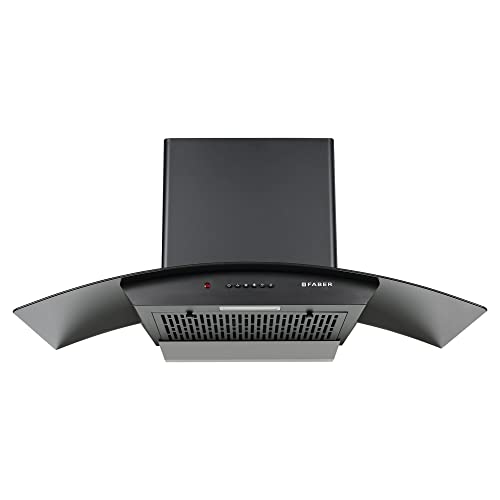
- Type: Curved glass, Wall mounted, Heat Auto-Clean Chamber | Black Finish with Curved Glass
- Size: 90 cm [3-5 burner stove for wall mounted chimneys] | Filter Surface Area: 52 x 30 cmsq
- Control Type: Push Button | Power: 240W |Noise Level: 58 dB | Lamp – 1 LED of 1.5W
2. Elica WDFL 600 BLDC HAC LTW MS NERO
Best suited for: Heavy cooking and buyers interested in BLDC technology
Elica’s WDFL 600 BLDC HAC LTW MS NERO is a more feature-focused 60 cm filterless chimney.
The official Elica product page lists a BLDC motor, filterless design, heat auto-clean technology, oil collector and 9-speed motion-sensor control. Its listed maximum airflow is 1425 m³/hr.
The Elica catalogue also lists the model with 1500 m³/hr maximum suction and a five-year comprehensive warranty plus lifetime motor warranty; because published specifications can vary by catalogue/version, check the exact listing for your chosen variant before buying.
Key Features
- 60 cm
- BLDC motor
- Filterless
- Heat auto-clean
- Motion control
- 9-speed control
- Oil collector
- LED lighting
- Available in larger widths as well
Consider it if: You cook frequently and want a more advanced motor/control system.

- Chimney Type: Curved Glass Chimney, Wall Mounted
- Size: 60cm (Suitable for 2-4 Burner Stove) | Annual Energy Consumption: 80 Watts | Power Requirement: 220 Volts
- Filter Type: Filterless | Auto cleaning with Oil collection tray for easy clean | Suction Power: 1500 m3/hr
3. Glen 6052 DI BL AC 60
Best suited for: Feature-rich chimney at a relatively accessible price
Glen’s 6052 DI BL AC 60 is a 60 cm filterless auto-clean chimney with 1200 m³/hr suction.
The current Glen listing showed it at around ₹9,990 during research and highlighted heat auto-clean, motion-sensor controls, digital display, inclined oil collection and auto-off.
Key Features
- 60 cm
- 1200 m³/hr suction
- Filterless design
- Heat auto-clean
- Motion sensor
- Digital display
- Oil collection system
- Auto-off
- 7-year motor warranty according to Glen’s listing
Consider it if: You want useful convenience features without immediately moving into premium-priced models.

- 𝗦𝘁𝘆𝗹𝗶𝘀𝗵 𝗧-𝘀𝗵𝗮𝗽𝗲 𝗗𝗲𝘀𝗶𝗴𝗻: Elegant T-shape design adds a sleek, premium touch while effectively covering your cooking area
- 𝗛𝗲𝗮𝘁 𝗔𝘂𝘁𝗼 𝗖𝗹𝗲𝗮𝗻 𝗧𝗲𝗰𝗵𝗻𝗼𝗹𝗼𝗴𝘆 𝘄𝗶𝘁𝗵 𝗢𝗶𝗹 𝗖𝗼𝗹𝗹𝗲𝗰𝘁𝗼𝗿 𝗧𝗿𝗮𝘆: Enjoy hassle-free maintenance with heat auto clean function that mel…
- 𝗦𝗺𝗮𝗿𝘁 𝗠𝗼𝘁𝗶𝗼𝗻 𝗦𝗲𝗻𝘀𝗼𝗿 𝘄𝗶𝘁𝗵 𝗧𝗼𝘂𝗰𝗵 𝗖𝗼𝗻𝘁𝗿𝗼𝗹 𝗣𝗮𝗻𝗲𝗹: Wave to start! Touch panel with motion sensing makes operation effortless …
4. Glen CH6064AC
Best suited for: Buyers who want multiple size options
The Glen CH6064AC is a curved-glass, filterless auto-clean chimney available in 60 cm and 90 cm variants.
Glen lists 1200 m³/hr airflow, touch controls with motion sensing and a seven-year motor warranty.
Key Features
- 1200 m³/hr
- Filterless
- Heat auto-clean
- Touch + motion controls
- Curved glass design
- 60 cm/90 cm options
- 7-year motor warranty
Its current listed price range was approximately ₹10,995–₹12,995, depending on size.
Consider it if: You’re deciding between a 60 cm and 90 cm kitchen setup.
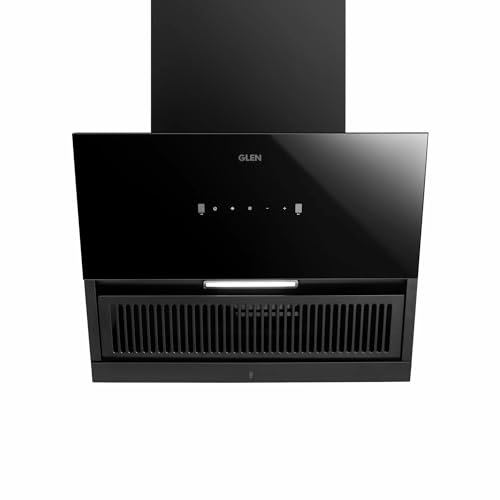
- 𝗗𝗲𝘀𝗶𝗴𝗻: This Glass chimney in black finish is designed to blend with your kitchen interiors seamlessly. It is elegant & …
- 𝗙𝗶𝗹𝘁𝗲𝗿𝗹𝗲𝘀𝘀: No more daily cleaning, no choked filters, no dangers of oil droplets or residue! Thanks to Glen’s Filterles…
- 𝗦𝘂𝗰𝘁𝗶𝗼𝗻: The Suction Capacity of 1200 meter cube per hour effectively throws away smoke & odor from the kitchen in one g…
5. Faber HOOD BONITO 3D IND HC SC FL BK 60
Best suited for: Buyers interested in Faber’s 3D-style suction design
The HOOD BONITO 3D IND HC SC FL BK 60 is listed by Faber as a 60 cm filterless auto-clean chimney with 1250 m³/hr suction.
Key Features
- 60 cm
- 1250 m³/hr
- Filterless
- Auto-clean
- Wall-mounted format
- Black finish
The current Faber listing showed it around ₹14,080 during research.
Consider it if: You want a higher-suction 60 cm Faber option.

- Mounting Type : Wall Mounted
- Width : 60Cm
- Suction : 1250m3/hr
6. Elica WDFL 606 HAC LTW MS NERO
Best suited for: Standard 60 cm Indian kitchen setups
Elica’s WDFL 606/906 range is offered in both 60 cm and 90 cm configurations.
The official catalogue lists 1350 m³/hr maximum suction, heat auto-clean, filterless operation, touch + motion controls and an oil collector.
Key Features
- 60 cm or 90 cm
- Up to 1350 m³/hr
- Filterless
- Heat auto-clean
- Motion-sensor control
- Touch controls
- Oil collector
- LED lighting
Consider it if: You want a conventional chimney format with a strong combination of suction and convenience features.
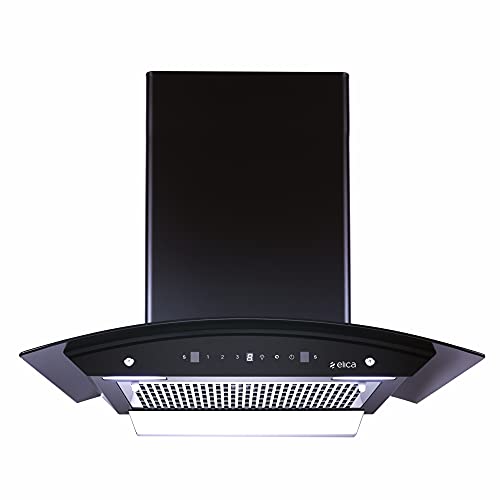
- Chimney Type: Curved Glass Chimney, Wall Mounted
- Size: 60cm (Suitable for 2-4 Burner Stove) | Annual Energy Consumption: 160 Watts | Power Requirement: 220 Volts
- Filter Type: Filterless | Auto cleaning with Oil collection tray for easy clean | Suction Power: 1350 m3/hr
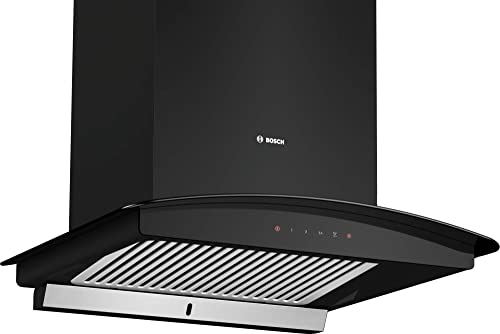
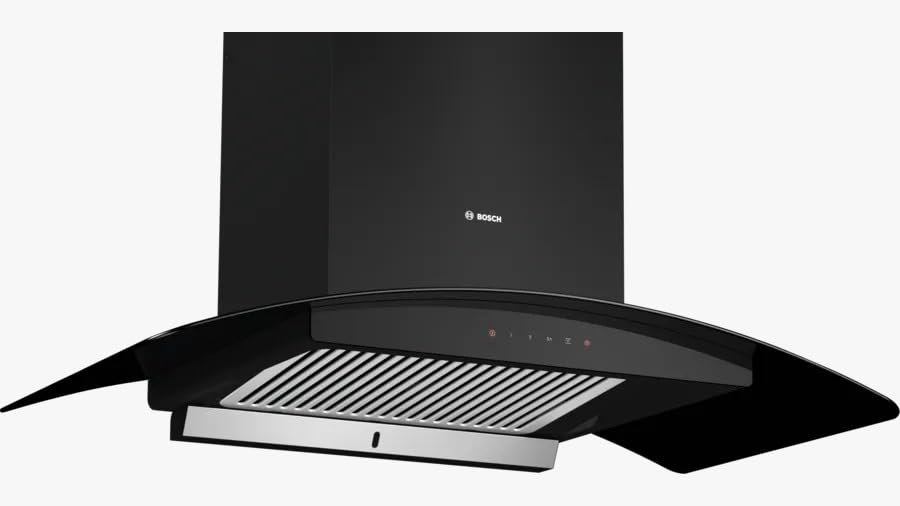
7. Bosch Wall-Mounted Cooker Hoods
Best suited for: Premium modular kitchens
Bosch takes a somewhat different approach from many Indian-market filterless chimney models.
Its current Indian range includes 60 cm and 90 cm wall-mounted cooker hoods, with models varying in extraction capacity, noise levels and design. Bosch’s own buying guide recommends choosing a hood at least as wide as the hob.
For example, the Bosch DWBA68H60I is a 60 cm wall-mounted model with a listed maximum air extraction of 700 m³/h and 67 dB sound power at maximum speed.
Consider it if: Your priority is premium appliance design and you are comfortable comparing European-style cooker hood specifications rather than simply chasing a high advertised m³/hr number.


📊 Kitchen Chimney Comparison
| Model | Width | Suction / Airflow | Filter | Auto-Clean | Notable Feature |
|---|---|---|---|---|---|
| Faber HOOD ALPHA | 60 cm | 1100 m³/hr | Filterless | Yes | Simple setup |
| Elica WDFL 600 BLDC | 60 cm | Up to 1425 m³/hr listed | Filterless | Yes | BLDC + 9-speed |
| Glen 6052 DI BL AC | 60 cm | 1200 m³/hr | Filterless | Yes | Digital display |
| Glen CH6064AC | 60/90 cm | 1200 m³/hr | Filterless | Yes | Motion sensor |
| Faber BONITO 3D | 60 cm | 1250 m³/hr | Filterless | Yes | 3D-style suction |
| Elica WDFL 606 | 60/90 cm | 1350 m³/hr | Filterless | Yes | Touch + motion |
| Bosch DWBA68H60I | 60 cm | 700 m³/h | Model-dependent | Model-dependent | Premium cooker hood |
Specifications vary by exact variant, and manufacturers may update models or listings.
📏 60 cm vs 90 cm Kitchen Chimney
One of the most important decisions is chimney width.
60 cm Chimney
A 60 cm chimney generally works well with:
- Compact kitchens
- 2–3 burner hobs
- Standard-width cooking platforms
- Smaller apartments
If your hob is around 60 cm wide, a 60 cm chimney can be a practical match.
90 cm Chimney
A 90 cm chimney is better suited to:
- Larger hobs
- 4–5 burner cooking setups
- Wider cooking platforms
- Larger modular kitchens
The basic rule is simple: the chimney should be at least as wide as the hob. Bosch’s own buying guide follows this principle.
Quick Guide
| Hob Size | Chimney Size |
|---|---|
| Small 2-burner | 60 cm |
| Standard 3-burner | 60 cm |
| Large 3/4-burner | 60–90 cm |
| 4/5-burner wide hob | 90 cm |
💨 What Is Suction Power?
Suction capacity is usually expressed in m³/hr — cubic metres per hour.
It indicates how much air the chimney is designed to move.
You’ll commonly see Indian-market models advertised around:
- 1000 m³/hr
- 1100 m³/hr
- 1200 m³/hr
- 1350 m³/hr
- 1500 m³/hr
- 1600 m³/hr
But higher isn’t automatically better.
A 1500 m³/hr chimney isn’t necessarily the right choice if:
- Your kitchen is small
- Your ducting is poorly installed
- The chimney is too narrow for the hob
- The duct has excessive bends
- You rarely cook oily food
The complete installation matters.
🧈 Filterless vs Baffle Filter Chimney
This is one of the biggest choices you’ll encounter.
Filterless Chimney
Filterless chimneys use a design that avoids a conventional removable grease filter.
Many current filterless models combine this with heat auto-clean technology and an oil collector.
Advantages
- Less routine filter scrubbing
- Easier grease management
- Convenient for frequent cooking
- Often paired with auto-clean systems
Disadvantages
- Usually costs more
- Auto-clean doesn’t mean completely maintenance-free
- Oil collectors still need cleaning
- Motor and internal components still require maintenance
Baffle Filter Chimney
Baffle filters use specially shaped metal filters to separate grease from the air stream.
Advantages
- Effective grease separation
- Familiar technology
- Often available at lower prices
- Filters can be removed and cleaned
Disadvantages
- Requires regular cleaning
- Grease can accumulate
- Maintenance is more hands-on
Which Should You Choose?
If you cook heavily every day, especially frying and tadka, a filterless auto-clean design can be attractive for convenience.
If you don’t mind periodically washing metal filters and want a simpler setup, a baffle-filter chimney can still make sense.
🔥 What Is Auto-Clean Technology?
Auto-clean is designed to make grease management easier.
In many Indian chimneys, a heating element warms accumulated oil and grease so that it can flow toward an oil collector.
Elica and Glen, for example, specifically describe heat auto-clean systems that help melt or collect grease.
Important:
Auto-clean does NOT mean zero cleaning.
You should still:
- Empty the oil collector
- Wipe accessible surfaces
- Clean the hood exterior
- Check the duct
- Follow the manufacturer’s maintenance instructions
⚙️ AC Motor vs BLDC Motor
AC Motor
Traditional chimney motors can provide strong extraction and are widely available.
They are often found in affordable and mid-range chimneys.
BLDC Motor
Brushless DC motors are increasingly common in premium chimneys.
Potential advantages include:
- Efficient motor operation
- Lower energy consumption in suitable operating conditions
- Variable-speed operation
- Reduced mechanical wear
- Quieter operation in some designs
Elica’s WDFL 600 BLDC model, for example, specifically uses a BLDC motor and 9-speed control.
Don’t choose BLDC solely because it sounds premium, though. Compare the complete chimney specifications, warranty and service support.
👋 Motion Sensor & Gesture Control
Modern chimneys increasingly include touchless controls.
Instead of touching the chimney, you can wave your hand to:
- Switch it on
- Change speed
- Turn lighting on/off
This can be especially useful when you’re cooking with oily or wet hands.
It’s a convenience feature, not a performance feature, so don’t pay a major premium for it if you don’t think you’ll use it.
🎛️ Touch Controls vs Push Buttons
Touch Controls
✔ Modern appearance
✔ Easy to wipe
✔ Often paired with digital displays
✔ Premium feel
Push Buttons
✔ Simple
✔ Familiar
✔ Usually straightforward to operate
✔ Can be cheaper
For a minimalist modular kitchen, touch controls can blend beautifully with the overall design.
For purely practical use, either can work.
🔇 How Important Is Chimney Noise?
Very important.
A chimney can have strong extraction and still become annoying if it is excessively loud.
Noise is generally measured in decibels (dB).
Bosch, for example, publishes sound-power information for its cooker hoods; its 60 cm DWBA68H60I is listed at 67 dB at maximum speed.
When comparing products, don’t look only at suction.
Check:
Suction + Noise + Motor + Installation
as a complete package.
🔌 Ducted vs Ductless Chimney
Ducted Chimney
A ducted chimney sends extracted air outside through a pipe.
Advantages
- Better suited to heavy cooking
- Removes smoke and odours outside
- Doesn’t depend on charcoal filtration for recirculation
Disadvantages
- Requires duct installation
- Needs an external exhaust route
- Installation can affect kitchen aesthetics
Ductless Chimney
A ductless chimney recirculates air through filtration rather than sending it outside.
Advantages
- Easier installation
- Useful where external ducting isn’t possible
- More flexibility for some kitchens
Disadvantages
- Requires suitable filters
- Filter replacement/maintenance matters
- Not the same as physically exhausting cooking air outdoors
For a new modular kitchen, check the duct route before purchasing the chimney.
🏠 Which Chimney Is Suitable for Your Kitchen?
Small Apartment Kitchen
Look for:
- 60 cm
- Around 1000–1200 m³/hr
- Filterless/auto-clean if you cook frequently
- Compact wall-mounted design
Regular Indian Family Cooking
Look for:
- 60–90 cm depending on hob
- Around 1200–1500 m³/hr class
- Auto-clean
- Good grease management
- Reliable service
Heavy Frying & Deep-Frying
Prioritise:
- Correct chimney width
- Strong extraction
- Filterless auto-clean or effective baffle filter
- Good ducting
- Convenient cleaning system
Premium Modular Kitchen
Look for:
- BLDC motor
- Touch/motion controls
- Lower noise
- Premium glass/metal construction
- Good lighting
- Strong service network
📐 Installation Matters More Than You Think
Even an expensive chimney won’t perform properly if it is installed poorly.
Before buying, check:
1. Duct Size
Follow the manufacturer’s recommended duct diameter.
2. Duct Length
Avoid unnecessarily long routes.
3. Excessive Bends
Too many bends can affect airflow.
4. Chimney Height
Install according to the manufacturer’s recommended clearance for your hob and chimney type.
5. Hob Alignment
The chimney should cover the cooking area properly.
6. External Vent
For ducted installation, make sure there is a suitable route to the outside.
🧽 How to Maintain a Kitchen Chimney
Even filterless models need some maintenance.
Every Few Days
- Wipe the exterior
- Clean visible grease
Regularly
- Empty the oil collector
- Wipe accessible surfaces
- Check for grease accumulation
Periodically
- Inspect the duct
- Check unusual noises
- Follow manufacturer servicing instructions
Avoid
❌ Ignoring oil collectors
❌ Spraying excessive water directly onto controls
❌ Using harsh chemicals on glass
❌ Blocking the duct
❌ Ignoring unusual motor sounds
🛒 Kitchen Chimney Buying Checklist
Before you click Buy, check these points:
✔ 1. Measure Your Hob
Know its exact width.
✔ 2. Select Chimney Width
Usually 60 cm or 90 cm.
✔ 3. Check Suction
Compare models within a similar category.
✔ 4. Decide Filter Type
Filterless vs baffle.
✔ 5. Check Auto-Clean
Especially useful for frequent cooking.
✔ 6. Check Motor
AC vs BLDC.
✔ 7. Check Noise
Look for published dB information where available.
✔ 8. Check Controls
Touch, push-button, remote or motion sensor.
✔ 9. Check Ducting
Confirm whether your kitchen supports ducted installation.
✔ 10. Check Warranty
Look separately at:
- Product warranty
- Motor warranty
- Installation coverage
- Service conditions
✔ 11. Check Installation Charges
The appliance price isn’t necessarily your final cost.
✔ 12. Check Service Availability
A chimney is a long-term appliance, so after-sales support matters.
💰 How Much Should You Spend?
Kitchen chimneys are available across a broad price range.
Under ₹10,000
Usually:
- Basic 60 cm options
- Lower/mid suction
- Simpler controls
- Some entry-level filterless models
₹10,000–₹15,000
This is where you can find many:
- Filterless models
- Auto-clean
- Motion controls
- Better suction
- Curved-glass designs
₹15,000–₹25,000
You can start seeing:
- Higher suction
- BLDC motors
- Better controls
- Premium finishes
- Larger sizes
₹25,000+
Often aimed at:
- Premium kitchens
- Higher-end brands
- Premium designs
- Advanced features
- Larger or specialised installations
❌ Common Kitchen Chimney Buying Mistakes
Mistake 1: Buying Based Only on Suction
1500 m³/hr doesn’t automatically mean the chimney is right for your kitchen.
Mistake 2: Choosing the Wrong Width
A chimney narrower than the cooking surface can reduce effective capture.
Mistake 3: Ignoring Ducting
Poor duct installation can undermine extraction performance.
Mistake 4: Assuming Auto-Clean Means Zero Maintenance
Oil collectors and accessible surfaces still need cleaning.
Mistake 5: Ignoring Noise
A powerful chimney that is unpleasantly loud may end up being used less often.
Mistake 6: Choosing Features You Won’t Use
Motion control, remote control and digital displays are convenient, but don’t sacrifice essential performance for them.
Mistake 7: Forgetting Service
Check whether installation and after-sales service are available in your area.
🍳 Kitchen Chimney Features That Actually Matter
If you want to simplify the entire buying decision, focus on these seven factors:
| Feature | Why It Matters |
|---|---|
| Chimney Width | Should match or exceed hob width |
| Suction | Determines extraction capacity |
| Filter Type | Affects grease management and cleaning |
| Auto-Clean | Reduces manual grease-cleaning work |
| Motor | Affects performance, efficiency and durability |
| Noise | Determines everyday comfort |
| Installation | Strongly affects real-world extraction |
🤔 Frequently Asked Questions
Is 1200 m³/hr enough for an Indian kitchen?
For many standard home kitchens, a 1200 m³/hr-class chimney can be a reasonable starting point, particularly when the chimney width and ducting are appropriate. However, cooking intensity, kitchen layout and installation all matter.
Is a filterless chimney better than a baffle-filter chimney?
They have different maintenance approaches. Filterless auto-clean models can reduce routine filter cleaning, while baffle-filter chimneys use removable metal filters that need periodic cleaning.
Is a 60 cm chimney enough?
A 60 cm chimney can work well with a similarly sized hob. If you have a wider 4–5 burner hob, consider a 90 cm chimney.
Is 1500 m³/hr too much for a small kitchen?
Not necessarily, but you shouldn’t select suction capacity in isolation. Chimney width, ducting, kitchen layout and cooking habits are equally important.
Do kitchen chimneys remove cooking smell?
A properly installed ducted chimney can help remove cooking fumes and odours by exhausting air outside. Performance depends on the chimney, duct design and installation.
Does a filterless chimney need cleaning?
Yes. Filterless doesn’t mean maintenance-free. Oil collectors, external surfaces and other accessible areas still need regular cleaning.
Is BLDC worth paying extra for?
It can be worth considering if you value efficiency, variable-speed operation and the features offered by the particular model. Compare the complete specification rather than buying solely because it has a BLDC motor.
Which chimney size is suitable for a 3-burner stove?
A 60 cm chimney is commonly suitable for many 3-burner setups, provided its coverage matches the actual hob.
Can I install a chimney without a duct?
Some ductless/recirculating models are designed for situations where external venting isn’t possible. However, ducted extraction is a different setup and should be considered when planning a new kitchen.
🏡 Final Thoughts
The best kitchen chimney isn’t necessarily the one with the highest suction number or the most expensive feature list.
For most Indian homes, start with the fundamentals:
Correct width → suitable suction → appropriate filter system → auto-clean → good ducting → manageable noise → reliable service.
For a standard 60 cm cooking setup, current options from Faber, Elica and Glen provide a wide range of filterless and auto-clean configurations, while premium brands such as Bosch offer a different style of cooker-hood ecosystem.
Most importantly, measure your hob and plan the ducting before you buy. A well-matched chimney that is correctly installed can be far more useful than an expensive model chosen only because its specification sheet looks impressive. 🍳✨