
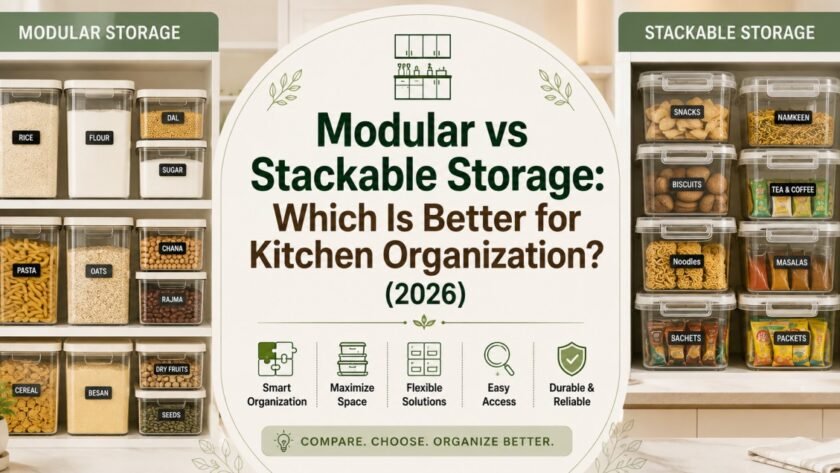

A kitchen can have plenty of containers and still somehow have zero organization. 😅 You stack one box on top of another, the lids disappear, three different container sizes refuse to cooperate, and suddenly finding a packet of pasta feels like an archaeological expedition.
That is where choosing the right storage system makes a real difference.
When comparing Modular vs Stackable Storage, the two can look almost identical at first glance. Both are designed to help you use your kitchen space more efficiently, both can reduce clutter, and both can be useful in cabinets, pantries and refrigerators. But they aren’t exactly the same thing.
Modular storage is more about creating a coordinated storage system, while stackable storage is primarily about making better use of vertical space.
And yes, a container can be both modular and stackable.
In this guide, we’re comparing Modular vs Stackable Storage to help you figure out which option makes more sense for your kitchen. We’ll look at space efficiency, accessibility, flexibility, cost, material, pantry organization, small kitchens and long-term usability.
Because the best storage system isn’t the one that looks the prettiest in a perfectly staged kitchen photo.
It’s the one that makes your actual kitchen easier to use every day.
Also Read | Best Pantry Storage Bins 10 Smart Kitchen Picks
Modular vs Stackable Storage at a Glance
Before getting into the details, here’s the simplest way to understand the difference.
| Feature | Modular Storage | Stackable Storage |
|---|---|---|
| Main Purpose | Creates a coordinated storage system | Maximizes vertical space |
| Space Efficiency | ⭐⭐⭐⭐⭐ | ⭐⭐⭐⭐⭐ |
| Flexibility | ⭐⭐⭐⭐⭐ | ⭐⭐⭐ |
| Vertical Storage | ⭐⭐⭐⭐ | ⭐⭐⭐⭐⭐ |
| Accessibility | ⭐⭐⭐⭐⭐ | ⭐⭐⭐⭐ |
| Customization | ⭐⭐⭐⭐⭐ | ⭐⭐⭐ |
| Small Kitchens | Excellent | Excellent |
| Pantry Organization | Excellent | Excellent |
| Cost | Moderate to High | Low to Moderate |
| Best Feature | System compatibility | Vertical stacking |
| Long-Term Use | Excellent | Very Good |
The important thing to remember is that Modular vs Stackable Storage isn’t always an either-or decision.
A good modular container system may also be stackable.
Likewise, a stackable container may work perfectly well alongside other containers without being part of a formal modular system.
What Is Modular Storage?
Let’s start with modular storage.
A modular storage system consists of containers or organizers designed to work together as a coordinated system.
The containers may come in several sizes, but they generally share design characteristics that allow them to fit neatly together.
Think of it like building blocks.
You might have:
- Small containers
- Medium containers
- Large containers
- Tall containers
- Wide containers
The idea is that you can combine them according to the available space.
For example, a tall container might fit perfectly beside two smaller containers on one shelf.
That’s the biggest strength of modular storage:
You’re organizing the storage system around the space available.
Instead of buying random containers and hoping they fit together, you create a more intentional arrangement.
🧩 What Makes Storage Modular?
Several characteristics can make a storage system modular.
1. Consistent Dimensions
Modular containers often use coordinated footprints.
This helps reduce awkward gaps between containers.
Instead of:
Big container + tiny container + weird gap + another random container
you can create:
Large container + medium container + medium container
with much less wasted space.
2. Multiple Sizes
A modular system usually offers different sizes for different purposes.
For example:
Small
Useful for:
- Spices
- Dry fruits
- Small snacks
- Seeds
- Baking ingredients
Medium
Useful for:
- Pasta
- Cereals
- Snacks
- Dal
- Pulses
Large
Useful for:
- Rice
- Flour
- Sugar
- Larger pantry staples
This gives you more flexibility than buying one huge set where every container is exactly the same size.
3. Compatible Lids
Some modular systems are designed with compatible or coordinated lids.
This can make everyday storage considerably less frustrating.
If you’ve ever had a kitchen drawer containing 17 containers and 11 lids that don’t belong to anything, you already understand why this matters. 😂
A well-designed system can make matching lids much easier.
4. Expandability
Another major advantage of modular storage is that you can often expand the system later.
You might start with six containers.
Then, after reorganizing your pantry, realize you need four more.
If the same system is still available, you can add to it without completely changing your setup.
That makes modular storage particularly appealing for people who want a long-term kitchen organization system.
🏠 Why Modular Storage Works Well in Kitchens
The kitchen is full of oddly shaped storage areas.
You have:
- Deep cabinets
- Narrow shelves
- Tall shelves
- Short drawers
- Corner cabinets
- Pantry shelves
- Refrigerator compartments
A modular system lets you choose different container dimensions based on those spaces.
For example, a narrow container might fit into a small cabinet section while a wider container occupies the larger section next to it.
This can help reduce unused space.
And that matters because in a small kitchen, every centimetre counts.
📦 What Is Stackable Storage?
Now let’s look at stackable storage.
The basic idea is much simpler.
Stackable storage is designed to let one container sit securely on top of another.
The primary objective is to use vertical space.
Instead of spreading containers across a shelf:
Container | Container | Container
you can create:
Container
⬇️
Container
⬇️
Container
This can dramatically change how efficiently you use a cabinet.
⬆️ Why Stackable Storage Is Useful
Most kitchen cabinets have more vertical space than people realize.
You might have a shelf that’s 40 cm high, but your containers only use 15 cm of that height.
The remaining space is essentially wasted.
Stackable containers can help you use that unused height.
This makes them especially useful for:
- Small kitchens
- Apartment kitchens
- Compact pantry cabinets
- Refrigerator shelves
- Tall cabinets
- Open shelving
🧱 What Makes a Container Stackable?
A properly designed stackable container usually has features that help maintain stability.
These can include:
- Flat or recessed lids
- Matching bases
- Interlocking shapes
- Stable edges
- Uniform dimensions
- Secure stacking surfaces
The important thing is stability.
A container isn’t genuinely useful as a stackable storage solution if the top one slides every time you open the cabinet.
🆚 Modular vs Stackable Storage: What’s the Actual Difference?
This is where things get interesting.
The easiest way to remember the distinction is:
Modular = System
Stackable = Feature
A modular system is designed to work as a coordinated group.
A stackable container is designed primarily to sit on top of another container.
So a product can be:
Modular but not highly stackable
It may be designed to fit beside other containers in a specific layout.
Stackable but not modular
It may simply be designed to sit securely on another identical container.
Modular + Stackable
This is often the best of both worlds.
You get coordinated dimensions and vertical storage.
📊 Modular vs Stackable Storage: Key Differences
| Category | Modular Storage | Stackable Storage |
|---|---|---|
| Primary Goal | Create an organized system | Save vertical space |
| Container Variety | Usually multiple sizes | May use identical sizes |
| Layout | Flexible | Usually vertical |
| Expansion | Excellent | Good |
| Customization | High | Moderate |
| Vertical Efficiency | Excellent | Excellent |
| Side-by-Side Efficiency | Excellent | Depends on shape |
| Accessibility | Usually easier | Can become harder when stacked |
| Budget | Often higher | Often more affordable |
| Best For | Complete pantry systems | Space-saving storage |
This distinction becomes especially important when you’re shopping.
If your biggest problem is “I have lots of containers but no system,” modular storage may be the better answer.
If your problem is “I don’t have enough shelf space,” stackable storage may be the better starting point.
🏆 Advantages of Modular Storage
Let’s break down why modular systems are so popular.
Better Customization
You can combine different sizes according to your pantry layout.
Consistent Appearance
Matching containers can make a kitchen look much cleaner.
Better Organization
Each size can be assigned to a specific category.
Easy Expansion
You can add compatible pieces later.
Efficient Cabinet Planning
Different dimensions can be arranged to minimize awkward gaps.
Good for Long-Term Systems
Once you’ve established a modular system, maintaining it can become easier.
⚠️ Disadvantages of Modular Storage
Modular systems aren’t perfect.
They Can Cost More
Buying several coordinated containers can be more expensive than picking up basic storage boxes individually.
You May Feel Pressured to Buy the Full Set
A beautiful modular collection can tempt you into buying containers you don’t actually need.
Don’t.
If you only need four containers, you don’t need fourteen because the packaging looks satisfying. 😂
Replacement Can Be Difficult
Some modular systems use specific dimensions or lid designs.
If a container breaks or disappears, finding an exact replacement may not always be easy.
Too Much Uniformity Can Be Limiting
Not every pantry item needs the same type of container.
Sometimes a simple basket or bin is more practical.
🧱 Advantages of Stackable Storage
Now for the other side of our Modular vs Stackable Storage comparison.
Excellent Vertical Space Utilization
This is the biggest advantage.
Stacking allows you to use the height of shelves instead of spreading everything horizontally.
Usually Easy to Understand
You don’t need an elaborate system.
Just stack the containers securely.
Often Affordable
Basic stackable storage options can be relatively inexpensive.
Easy to Add More
If you need another container later, you can often buy one separately.
Great for Small Kitchens
When floor and shelf space are limited, vertical organization can be extremely valuable.
⚠️ Disadvantages of Stackable Storage
Stackable storage also has limitations.
Bottom Containers Can Be Difficult to Access
If you stack four containers and need something from the bottom one every day, you’ll quickly become annoyed.
Overstacking Can Create Problems
More isn’t always better.
A five-container tower might technically save space, but if you have to dismantle the entire stack every morning, the organization system isn’t doing its job.
Different Shapes May Not Stack Well
Containers from different brands may have lids and bases that don’t work together.
Tall Stacks Can Become Unstable
Always consider the product’s design, load capacity and recommended stacking limits.
🏠 Modular vs Stackable Storage for Small Kitchens
If you have a small kitchen, both systems can be useful.
But the right choice depends on your specific problem.
Choose Modular Storage If:
- You want to organize an entire pantry
- You have several different shelf sizes
- You want containers to fit together
- You care about a coordinated appearance
- You want to expand the system later
Choose Stackable Storage If:
- Your biggest issue is limited shelf space
- You have unused vertical height
- You want an affordable solution
- You need storage for one particular cabinet
- You don’t want to commit to an entire system
Choose Both If:
You want maximum flexibility.
A modular container that is also stackable can give you coordinated organization while allowing you to use vertical space.
🫙 Modular vs Stackable Storage for Pantry Organization
Pantries are where the difference becomes particularly noticeable.
Imagine you have:
- Rice
- Dal
- Flour
- Sugar
- Pasta
- Cereal
- Snacks
- Dry fruits
A modular system can help you choose appropriate sizes for each category.
For example:
Large container → Rice
Large container → Flour
Medium container → Dal
Medium container → Sugar
Tall container → Pasta
Small container → Dry fruits
You can then arrange those containers side-by-side or stack compatible pieces.
This creates a more structured pantry rather than simply piling containers wherever they fit.
🧺 Don’t Forget Pantry Storage Bins
Not every pantry item needs to go into a food-storage container.
This is where pantry storage bins come in.
For example:
Pantry Bin
Can hold:
- Snack packets
- Biscuit packets
- Sachets
- Small boxes
- Pasta packets
- Chips
Airtight Container
Better for:
- Rice
- Dal
- Flour
- Sugar
- Dry fruits
Modular Storage System
Useful for creating a coordinated setup across multiple categories.
Stackable Storage
Useful when you need to maximize vertical shelf space.
The four can actually work together.
That’s why comparing Modular vs Stackable Storage shouldn’t make you feel like you have to choose only one type of product for your entire kitchen.
💡 The Smartest Approach: Combine Both
For many kitchens, the best approach isn’t:
Modular OR Stackable
It’s:
Modular AND Stackable.
Imagine a pantry where all your containers have coordinated dimensions.
Now imagine those same containers can securely stack.
You get:
Consistent system + vertical efficiency + better organization.
That’s a pretty solid combination.
🧠 Think About Accessibility Before Maximizing Capacity
Here’s one mistake people make when comparing Modular vs Stackable Storage.
They focus entirely on how many containers they can fit.
But storage capacity isn’t everything.
You also need to ask:
Can I reach it?
Can I see it?
Can I remove it?
Can I put it back easily?
Will I actually maintain this system?
If the answer is no, you’ve created storage that looks organized but functions badly.
And that’s not really organization.
🧹 Organization Should Make Your Kitchen Easier
The best kitchen-storage system should help you:
- Find ingredients faster
- Put things away easily
- See what you already own
- Keep shelves cleaner
- Reduce unnecessary purchases
- Make better use of cabinet space
It shouldn’t require a 17-step morning routine.
That’s why accessibility should always be considered alongside space efficiency.
🏆 Modular vs Stackable Storage: Which One Wins?
At this point, the answer is becoming clearer.
Modular Storage Wins for Flexibility
You get a coordinated system that can adapt to different pantry categories and shelf dimensions.
Stackable Storage Wins for Vertical Space
You can make better use of unused shelf height, which is particularly valuable in compact kitchens.
Modular + Stackable Wins Overall
When a storage system combines both characteristics, you get the benefits of organization and vertical efficiency without having to sacrifice one for the other.
But there is one final rule:
Buy for your kitchen, not for the fantasy kitchen you saw on Instagram. 😄
Measure your shelves. Look at what you actually store. Think about how often you access it. Then choose the storage system that solves the real problem.
That is ultimately what makes Modular vs Stackable Storage a useful comparison—not which one looks better, but which one makes your kitchen work better.
Choosing between Modular vs Stackable Storage becomes much easier once you stop looking at storage containers as individual products and start looking at the way they work together.
A beautiful container that doesn’t fit your cabinet is still a bad container. A stackable box that makes the bottom container impossible to reach isn’t really saving you time. And a modular system with sizes you never use? That’s just an expensive collection of plastic taking up space. 😄
So, let’s get practical.
🧩 Modular Storage Explained in More Detail
One of the biggest advantages of modular storage is that it gives you a system rather than a random collection of containers.
Instead of buying whatever container happens to look good at the store, modular storage encourages you to think about your kitchen as a series of storage zones.
For example, you might create:
🫙 Dry Ingredient Zone
- Rice
- Dal
- Flour
- Sugar
- Semolina
- Pulses
🍝 Breakfast & Pasta Zone
- Oats
- Cereals
- Pasta
- Noodles
- Cornflakes
🍪 Snack Zone
- Biscuits
- Chips
- Namkeen
- Chocolates
- Small snack packets
🌶️ Spice Zone
- Everyday spices
- Whole spices
- Seasoning mixes
Once you’ve divided the pantry into categories, modular containers can help you choose different sizes according to the quantity of each product.
This is where Modular vs Stackable Storage starts becoming more than a simple comparison of two container types.
You’re designing a storage system around your habits.
📐 Modular Storage Makes Better Use of Odd Spaces
Not every cabinet shelf is the same.
You might have one tall shelf, one short shelf and one particularly awkward section where only narrow containers fit.
A modular system can be useful because different container sizes can be combined.
For example:
Large + Medium + Small
instead of:
Large + Large + Large
The first arrangement may use the available shelf more efficiently.
This is especially useful in Indian kitchens, where cabinets can vary significantly in depth and height.
💡 Our Tip
Before buying a modular set, measure the actual usable space, not the total cabinet dimensions.
If your cabinet has hinges, rails or an internal frame, those can reduce the space available for containers.
🔄 Modular Storage Is Easier to Expand
Another major advantage of modular storage is the ability to expand gradually.
Let’s say you initially organize your pantry with six containers.
After a few weeks, you realize you need:
- Two more containers for pulses
- One larger container for flour
- Another medium container for cereal
If the system is still available, you can add compatible pieces.
This is much better than replacing the entire collection every time your storage needs change.
However…
Before choosing a modular brand, check whether individual containers are available separately.
Some systems are sold primarily as complete sets.
If you lose one lid or crack one container, replacing it could become unnecessarily expensive.
🧱 Stackable Storage: How to Use It Properly
Stackable storage is all about vertical efficiency.
But there’s a right way and a wrong way to stack.
The Wrong Way
You buy five containers.
You stack all five.
The bottom container contains something you use every day.
Now you have to remove four containers every morning.
Congratulations—you’ve technically saved shelf space and simultaneously created a new daily workout. 😂
The Better Way
Keep frequently used items:
At the top or within easy reach
Keep occasionally used items:
Lower in the stack
Keep rarely used products:
Higher or farther back
This simple arrangement makes stackable storage much more practical.
⬆️ Use Vertical Space Without Blocking Access
One of the biggest reasons people choose stackable storage is to make use of cabinet height.
But vertical space should be used strategically.
For example, if your cabinet is 40 cm tall and each container is 15 cm high, you might be able to create two useful levels rather than trying to squeeze three containers into the space.
More containers don’t automatically mean better organization.
Leave enough clearance to:
- Lift containers
- Open lids
- Remove individual items
- Clean the shelf
- See what’s stored
This is one of the most important principles when comparing Modular vs Stackable Storage.
🔒 Check Stack Stability
Not every container that looks stackable is equally stable.
Before purchasing stackable storage, look for:
- Stable bases
- Flat lids
- Matching dimensions
- Recessed lid areas
- Interlocking features
- Manufacturer stacking recommendations
If the containers wobble when stacked empty, they aren’t going to magically become more stable when filled.
In fact, they’ll usually become heavier and potentially harder to manage.
🫙 Glass vs Plastic for Modular and Stackable Storage
Material is another important consideration.
Plastic Storage
Plastic is popular because it is generally:
- Lightweight
- Easy to handle
- Available in many sizes
- Convenient for stacking
- Less likely to shatter
Plastic can be particularly practical for upper shelves where you want to keep weight manageable.
Glass Storage
Glass can be useful for:
- Dry ingredients
- Countertop storage
- Frequently used foods
- Aesthetic pantry setups
But glass is heavier.
If you’re building a tall stack, weight becomes more important.
For a detailed comparison, our Glass vs Plastic Containers guide covers the differences in greater detail.
🧼 Cleaning and Maintenance
Storage containers live in the kitchen, which means they eventually encounter:
- Flour dust
- Oil
- Spices
- Food crumbs
- Moisture
- Sticky residues
A storage system that’s difficult to clean will eventually become frustrating.
Look For:
- Smooth surfaces
- Wide openings
- Removable lids
- Minimal grooves
- Simple shapes
- Easy-to-wash materials
This applies equally when comparing Modular vs Stackable Storage.
A sophisticated system isn’t useful if cleaning it requires a tiny brush, three toothpicks and an engineering degree. 😂
🏠 Modular vs Stackable Storage for Different Kitchen Areas
Different areas of your kitchen benefit from different storage styles.
Pantry
Modular storage: ⭐⭐⭐⭐⭐
Stackable storage: ⭐⭐⭐⭐⭐
Both work well.
Use modular containers when you’re storing different quantities of dry ingredients and stackable containers when vertical space is limited.
Refrigerator
Modular storage: ⭐⭐⭐⭐⭐
Stackable storage: ⭐⭐⭐⭐
Modular containers can make it easier to create consistent sections.
Stackable containers can work well for leftovers, fruits, vegetables and prepared foods, provided the containers are suitable for refrigerator use.
Kitchen Cabinets
Modular storage: ⭐⭐⭐⭐⭐
Stackable storage: ⭐⭐⭐⭐⭐
The best option depends on cabinet dimensions.
For tall cabinets, stackable containers can make excellent use of vertical height.
For cabinets with different shelf dimensions, modular systems may provide more flexibility.
Countertop
Modular storage: ⭐⭐⭐⭐
Stackable storage: ⭐⭐⭐
Countertops usually benefit from keeping things accessible without creating tall stacks.
A few coordinated modular containers can look cleaner than multiple mismatched boxes.
🌶️ Modular vs Stackable Storage for Spices
Spices are an interesting example because they don’t necessarily require large containers.
A modular spice system can help create consistent sizing.
You could have:
- Small containers for everyday spices
- Slightly larger containers for whole spices
- A separate section for spice blends
Stackable Spice Storage
Stacking can save shelf space, particularly if your spice collection is large.
However, don’t create a tower so tall that you have to dismantle it every time you need turmeric.
If spices are one of your biggest kitchen-organization problems, our Best Spice Racks and Spice Organization Ideas guides can help you build a dedicated system.
🍚 Modular vs Stackable Storage for Rice, Dal and Flour
For staple ingredients, the decision is slightly different.
You need to think about:
- Capacity
- Airtightness
- Lid quality
- Material
- Handling
- Frequency of use
A large modular container can be useful because you can select different capacities for different ingredients.
For example:
Large → Rice
Large → Flour
Medium → Dal
Medium → Sugar
Stackability can then help you use the available vertical space.
But Don’t Overstack Heavy Containers
A large container filled with rice can become surprisingly heavy.
Instead of creating a tall stack of heavy containers, keep heavier items lower and lighter containers higher.
📦 Modular vs Stackable Storage for Snacks
Snack packets are a completely different storage problem.
You generally don’t need airtight containers for individually packaged snacks.
Instead, organization is the priority.
A stackable pantry bin can work beautifully here.
For example:
Bin 1
Biscuits
Bin 2
Chips & Namkeen
Bin 3
Chocolate & Small Snacks
This keeps lightweight products together while making them easier to access.
Our Best Pantry Storage Bins guide goes deeper into this type of organization.
🧠 Which System Is More Flexible?
This is where modular storage has a clear advantage.
A modular system can be rearranged according to changing needs.
Maybe today you need:
3 large + 4 medium + 2 small
Next year, your pantry requirements may change.
You might need:
2 large + 5 medium + 4 small
A modular system can potentially accommodate those changes more easily.
Stackable storage is flexible in terms of height, but modular storage tends to be more flexible in terms of overall arrangement.
That’s an important distinction in the Modular vs Stackable Storage debate.
💰 Which Is More Affordable?
This one depends heavily on the products you choose.
Stackable Storage
Usually offers a lower entry cost.
You can buy one or two containers and add more later.
Modular Storage
Can require a larger initial investment, particularly if you’re purchasing a coordinated set.
However, modular storage can offer better long-term value if you actually use the entire system.
Our Advice
Don’t compare only the price per container.
Compare:
Price + capacity + usability + durability + compatibility
A ₹100 container that doesn’t fit your cabinet isn’t necessarily cheaper than a ₹200 container that works perfectly.
This is subjective, but modular systems generally have an advantage when you’re aiming for a coordinated pantry.
👀 Which Looks Better?
Matching:
- Shapes
- Sizes
- Lids
- Labels
- Materials
can create a cleaner appearance.
Stackable containers can look equally good when they’re from the same range.
The problem usually isn’t stackable storage itself.
It’s mixing 14 different container designs and hoping they somehow look intentional. 😂
🧹 How to Keep Either System Organized
Whether you choose modular or stackable storage, follow a few simple rules.
Rule 1: Give Every Category a Home
Don’t let snacks migrate into the baking section.
Rule 2: Keep Daily Items Accessible
Your everyday rice container doesn’t need to be buried at the back.
Rule 3: Don’t Overfill
Leave enough room to remove items easily.
Rule 4: Review Your Pantry Regularly
Check for expired products and duplicates.
Rule 5: Don’t Buy Storage Without a Problem to Solve
If your kitchen is already organized, you don’t need another container just because it looks cute.
🏆 Modular vs Stackable Storage: Which Is Better for a Small Kitchen?
For a genuinely small kitchen, both can be excellent.
But if you have to choose one:
Choose Stackable Storage When:
Your main problem is limited vertical or shelf space.
Choose Modular Storage When:
Your main problem is poor organization and mismatched containers.
Choose Modular + Stackable When:
You want a complete long-term organization system.
This combination gives you coordinated dimensions while still allowing you to use vertical space.
📊 Modular vs Stackable Storage: Best Choice by Need
| Your Main Problem | Better Choice |
|---|---|
| Not enough vertical space | Stackable |
| Mismatched containers | Modular |
| Complete pantry makeover | Modular |
| Limited budget | Stackable |
| Need different container sizes | Modular |
| Want consistent appearance | Modular |
| Deep shelves | Stackable with handles |
| Small kitchen | Both |
| Large pantry | Modular |
| Easy expansion | Modular |
| One small cabinet | Stackable |
| Long-term organization | Modular |
🛒 What to Check Before Buying
No matter which side of Modular vs Stackable Storage you prefer, use this checklist before spending money.
📏 Measure
Record:
Width × Depth × Height
🫙 Check Capacity
Think about the quantity of food you actually store.
🔒 Check Lid Quality
Especially for dry ingredients.
⬆️ Check Stackability
Look for stable stacking rather than simply a flat lid.
🧼 Check Cleaning
Avoid unnecessarily complicated designs.
🏋️ Check Weight
Heavy ingredients need stronger containers and lower placement.
🔄 Check Replacement Options
Particularly important for modular systems.
💰 Compare Total Cost
Don’t judge value only by the price of one container.
🚨 One More Important Mistake to Avoid
Don’t automatically transfer every food item into a storage container.
Some foods are perfectly fine in their original packaging when properly stored.
A storage container should solve a genuine problem.
For example:
Good Reason
Your rice bag is difficult to store and you’re constantly spilling it.
A suitable airtight container makes sense.
Another Good Reason
Your snack packets are scattered across three shelves.
A pantry bin makes sense.
Not Such a Good Reason
“Everyone online has matching containers, so I need 30 of them.”
Nope. 😂
That’s how organization becomes clutter.
🏡 Combining Modular, Stackable and Pantry Storage
The most effective kitchen doesn’t necessarily rely on one storage format.
You can create layers.
Layer 1 — Airtight Containers
For:
- Rice
- Dal
- Flour
- Sugar
- Cereals
Layer 2 — Pantry Bins
For:
- Snacks
- Packets
- Sachets
- Bottles
Layer 3 — Modular Arrangement
Use coordinated container dimensions to organize the cabinet.
Layer 4 — Stackable Storage
Stack compatible containers to use vertical space.
This combination can create a highly functional pantry without requiring additional cabinetry.
🧠 The Practical Winner
After comparing Modular vs Stackable Storage, the biggest takeaway is that they’re solving slightly different problems.
Modular storage asks:
“How can I create a flexible system where everything works together?”
Stackable storage asks:
“How can I use more of the vertical space I already have?”
Both questions matter.
And for many kitchens, the answer is to use both.
A modular container that is also securely stackable can provide the flexibility of a system while maximizing cabinet height.
That’s why you shouldn’t choose storage based only on the word printed on the packaging.
Look at the dimensions, design, stability, accessibility and your actual kitchen layout.
Your kitchen doesn’t need more containers.
It needs the right containers in the right places. ❤️
The Modular vs Stackable Storage debate ultimately comes down to one simple question:
Do you need a complete storage system, or do you mainly need to make better use of your available space?
If your kitchen has mismatched containers, awkward cabinet gaps and a pantry that never seems to stay organized, modular storage can give you a more structured approach.
If your biggest problem is limited shelf space, stackable storage can help you make better use of vertical height without taking up additional floor space.
And if you want the best of both worlds, look for modular containers that are also stackable.
Let’s break down exactly how to choose.
🏆 Modular vs Stackable Storage: Which One Should You Choose?
There isn’t one universal winner.
Your kitchen layout, budget and storage habits matter more than the label on the box.
Here’s the simplest way to decide:
| If You Need… | Choose |
|---|---|
| A complete kitchen storage system | Modular Storage |
| More vertical space | Stackable Storage |
| Different container sizes | Modular Storage |
| Affordable individual containers | Stackable Storage |
| A coordinated pantry | Modular Storage |
| Maximum shelf utilization | Stackable Storage |
| Long-term flexibility | Modular Storage |
| Small-kitchen organization | Both |
| Best overall flexibility | Modular + Stackable |
🏠 Best Choice for Small Kitchens
Small kitchens need storage that works upward and efficiently.
If your cabinets have unused vertical space, stackable containers can be an easy solution.
Instead of using one shelf for three containers spread across the surface, you may be able to create two levels of storage.
However, don’t stack containers simply because you can.
You still need to access them.
For a Small Kitchen, Look For:
- Compact footprints
- Stackable designs
- Transparent containers
- Multiple sizes
- Secure lids
- Easy-to-clean surfaces
- Handles where appropriate
A modular system can be particularly useful if your small kitchen has several different cabinet dimensions.
🏢 Best Choice for Apartment Kitchens
Apartment kitchens often have limited cabinet space and fewer opportunities for permanent storage modifications.
This makes Modular vs Stackable Storage especially relevant.
Stackable Storage Works Well When:
You need to maximize existing cabinet height.
Modular Storage Works Well When:
You want different container sizes that can be arranged around your existing shelves.
Our Pick
For most apartment kitchens, we’d lean toward a combination of modular and stackable storage.
Use modular containers for your main pantry staples and stackable bins for snacks, packets and smaller items.
That gives you flexibility without requiring additional cabinetry.
🫙 Best Choice for Pantry Staples
For staples such as:
- Rice
- Dal
- Flour
- Sugar
- Semolina
- Pulses
- Dry fruits
the most important features are usually:
Capacity + airtightness + durability + accessibility.
A modular airtight container system can be particularly useful because you can choose different capacities according to how much of each ingredient you normally keep.
Example:
Large container → Rice
Large container → Flour
Medium container → Dal
Medium container → Sugar
Small container → Dry fruits
If compatible, these containers can then be stacked to make better use of cabinet height.
🍪 Best Choice for Snacks and Packets
Snack packets don’t always need airtight storage.
For these, organizational bins can be more practical.
Use Stackable Bins For:
- Biscuits
- Chips
- Namkeen
- Instant noodles
- Small snack packets
- Sachets
A handled bin is particularly useful if your shelf is deep.
You can simply pull the whole bin forward rather than reaching behind everything else.
For more ideas, see our guide to Best Pantry Storage Bins.
🌶️ Best Choice for Spices
Spices require a slightly different approach.
You generally want:
- Easy visibility
- Quick access
- Compact containers
- Consistent sizing
- Easy cleaning
A modular spice-container system can create a cleaner arrangement.
Stackable spice organizers can also save shelf space.
However, avoid creating a tall stack of everyday spices.
If you use turmeric, cumin or chilli powder every day, you shouldn’t have to dismantle half your spice tower to reach them.
That’s where accessibility wins over maximum capacity.
For more inspiration, check out our Spice Organization Ideas and Best Spice Racks guides.
🧹 Best Choice for Easy Maintenance
When comparing Modular vs Stackable Storage, don’t forget about cleaning.
Kitchen storage containers should be easy to:
- Empty
- Wash
- Dry
- Wipe
- Reassemble
Simple shapes are usually easier to maintain.
Avoid designs with excessive grooves or tiny corners if they’re difficult to clean.
Our Tip
Every few weeks, clean one pantry section at a time rather than waiting until the entire kitchen needs a deep clean.
Small maintenance sessions are much easier than one giant pantry disaster.
💰 Modular vs Stackable Storage: Which Is More Affordable?
Generally, simple stackable storage tends to offer a lower entry price.
You can buy one or two containers and add more when required.
Modular systems can cost more because you’re paying for:
- Coordinated dimensions
- Multiple sizes
- Compatible designs
- Matching lids
- System compatibility
But price isn’t everything.
A cheaper container that doesn’t fit your cabinet is money wasted.
Likewise, buying a 20-piece modular set when you only need six containers isn’t necessarily a smart purchase.
The Better Question Is:
How much am I paying for useful storage?
Not:
How much am I paying per container?
🔄 Modular vs Stackable Storage: Which Is More Flexible?
Modular Storage
Wins when you want to change the arrangement.
You can often combine different sizes and create new configurations as your storage needs change.
Stackable Storage
Wins when you want a straightforward way to add vertical storage.
You can often add another container without redesigning the entire system.
Winner for Flexibility
🏆 Modular Storage
Winner for Simplicity
🏆 Stackable Storage
👀 Which Looks Better?
This is subjective, but modular systems usually have an advantage when you’re creating a coordinated pantry.
Matching:
- Container shapes
- Lids
- Labels
- Sizes
- Materials
can make shelves look much cleaner.
But don’t underestimate the visual impact of simply using the same style of stackable bins.
You don’t need an expensive modular system to have an attractive pantry.
Consistency matters more than price.
⚠️ Common Storage Mistakes to Avoid
Even the Best Modular vs Stackable Storage system can fail if you make these mistakes.
❌ Buying Before Measuring
Always measure the cabinet first.
❌ Buying Too Many Containers
Start with your actual storage needs.
❌ Overstacking
More containers aren’t automatically better.
❌ Ignoring Accessibility
A storage system should make your life easier.
❌ Using the Wrong Container for the Job
A pantry bin isn’t necessarily an airtight food-storage container.
❌ Storing Heavy Items Too High
Keep heavy containers on lower shelves whenever possible.
❌ Ignoring Cabinet Doors
Remember that door clearance can affect how much storage you can actually use.
❌ Buying Only for Aesthetics
A beautiful pantry that is annoying to use isn’t successful organization.
📏 How to Measure Your Kitchen Before Buying
Before purchasing Modular vs Stackable Storage, grab a measuring tape.
Measure:
Width
The horizontal space available.
Depth
How far the shelf extends.
Height
The vertical clearance between shelves.
Cabinet Opening
The opening may be smaller than the actual internal space.
Door Clearance
Make sure the container doesn’t interfere with the cabinet door.
Handle Clearance
If you’re buying handled bins, make sure the handle doesn’t hit the cabinet frame.
🛒 What to Look for When Buying Modular Storage
If modular storage is your preferred option, check:
✔ Compatible Sizes
Make sure different containers are designed to work together.
✔ Lid Compatibility
Shared lid sizes can make life much easier.
✔ Available Capacities
Look for sizes that match your actual pantry requirements.
✔ Replacement Availability
Check whether individual pieces can be purchased separately.
✔ Stackability
Even if modularity is your priority, stackability is a useful bonus.
✔ Material Quality
Choose according to what you’re storing and how frequently the containers will be handled.
🛒 What to Look for When Buying Stackable Storage
For stackable storage, pay particular attention to:
✔ Stability
Containers shouldn’t slide around easily.
✔ Lid Design
Flat or recessed lids can help with stable stacking.
✔ Weight Capacity
Important for heavier ingredients.
✔ Height
Don’t choose containers that make your shelves difficult to access.
✔ Visibility
Clear containers can make pantry organization easier.
✔ Accessibility
Think about how you’ll remove the bottom container.
🧠 How to Build a Hybrid Storage System
You don’t have to pick only one side of the Modular vs Stackable Storage debate.
A hybrid system can actually be the most practical solution.
Step 1: Use Modular Containers for Pantry Staples
Store:
- Rice
- Dal
- Flour
- Sugar
- Pasta
in appropriately sized containers.
Step 2: Stack Compatible Containers
Use vertical space where practical.
Step 3: Add Pantry Bins
Use separate bins for:
- Snacks
- Packets
- Sachets
- Small boxes
Step 4: Use Labels
Keep categories obvious.
Step 5: Keep Daily Items Accessible
Don’t hide everyday ingredients under a giant tower.
Step 6: Keep Heavy Containers Low
Use lower shelves for heavier items.
This gives you a system that is both organized and practical.
📊 Modular vs Stackable Storage: Final Comparison
| Feature | Modular Storage | Stackable Storage | Winner |
|---|---|---|---|
| Vertical Space | Excellent | Excellent | 🤝 Tie |
| Flexibility | Excellent | Good | Modular |
| Ease of Expansion | Excellent | Very Good | Modular |
| Affordability | Moderate | Excellent | Stackable |
| Complete Pantry System | Excellent | Good | Modular |
| Small Kitchen | Excellent | Excellent | 🤝 Tie |
| Deep Shelves | Very Good | Excellent with handles | Stackable |
| Consistent Appearance | Excellent | Very Good | Modular |
| Different Container Sizes | Excellent | Moderate | Modular |
| Simple Setup | Very Good | Excellent | Stackable |
| Long-Term Organization | Excellent | Very Good | Modular |
| Best Overall | Excellent | Excellent | Hybrid |
🏆 Our Verdict: Modular vs Stackable Storage
So, Modular vs Stackable Storage — which is better?
🥇 Choose Modular Storage If You Want:
A complete, coordinated and flexible kitchen organization system.
It’s particularly useful if you’re reorganizing an entire pantry or kitchen cabinet setup.
🥈 Choose Stackable Storage If You Want:
A simple, affordable way to use more vertical space.
It’s particularly useful for small kitchens, compact cabinets and individual storage problems.
👑 Choose Modular + Stackable If You Want the Best Overall Setup
This is our preferred approach.
A storage system that is both modular and stackable can give you:
- Better organization
- More usable shelf space
- Flexible container sizes
- Easier expansion
- Cleaner appearance
- Better vertical storage
The key is not to maximize the number of containers.
It’s to maximize useful storage.
🧺 How This Fits Into Your Kitchen Storage System
Think of your kitchen organization in layers.
Layer 1: Airtight Containers
For food that benefits from sealed storage.
Layer 2: Modular Containers
For creating a coordinated pantry system.
Layer 3: Stackable Storage
For making use of vertical shelf space.
Layer 4: Pantry Bins
For grouping packets, snacks and small items.
Layer 5: Labels
For keeping everything in its designated place.
This approach is much more practical than trying to force every item into one type of container.
🧹 How to Keep Your Storage System Organized
Even the smartest Modular vs Stackable Storage setup will eventually become messy if you don’t maintain it.
Try this simple routine.
Weekly
Return misplaced items to their designated zones.
Monthly
Check for:
- Expired products
- Empty packets
- Duplicate items
- Spills
- Damaged containers
Every Few Months
Remove containers from the shelves and clean the storage area properly.
When Shopping
Check what you already have before buying more.
This is especially easy when using transparent storage.
💡 7 Simple Rules for Better Kitchen Storage
1. Measure Before Buying
Always.
2. Buy for Your Actual Needs
Don’t buy containers simply because they’re attractive.
3. Use Vertical Space
But don’t sacrifice accessibility.
4. Keep Heavy Items Low
It makes handling easier.
5. Group Similar Items
Create clear categories.
6. Keep Daily Items Accessible
Convenience matters.
7. Don’t Over-Organize
If the system is too complicated, you won’t maintain it.
Simple systems usually win in the long run.
🔬 Our Research Methodology
For this Modular vs Stackable Storage guide, we evaluated both storage approaches based on the factors that matter in everyday kitchen organization.
Our assessment considered:
- Space efficiency
- Vertical storage
- Container dimensions
- Stack stability
- Accessibility
- Material
- Storage capacity
- Flexibility
- Cleaning requirements
- Expansion potential
- Pantry compatibility
- Small-kitchen suitability
- Overall value
We also considered how modular and stackable systems work with different kitchen-storage needs, including pantry staples, snacks, packets, spices and small kitchen items.
Rather than assuming that one system is automatically better, we looked at which storage method solves which problem.
❓ Frequently Asked Questions
1. What is the difference between modular and stackable storage?
Modular storage is designed as a coordinated system where different containers work together. Stackable storage is primarily designed to allow containers to sit securely on top of one another and use vertical space.
A container can be both modular and stackable.
2. Is modular storage better than stackable storage?
Neither is universally better.
Modular storage is generally better for flexibility and complete organization, while stackable storage is particularly useful for maximizing vertical space.
3. Are modular containers stackable?
Many modular containers are stackable, but not all modular systems have the same stacking capabilities.
Always check the manufacturer’s design and stacking recommendations.
4. Which is better for a small kitchen?
Both can work well.
Stackable storage is excellent when your main problem is limited vertical or shelf space. Modular storage is useful when your kitchen has multiple storage areas that require different container sizes.
5. Which is better for pantry organization?
Modular storage can be particularly useful for creating a complete pantry system, while stackable bins and containers can help maximize available shelf height.
A combination of both often works best.
6. Do stackable containers really save space?
They can help you use vertical space more efficiently, but they don’t physically create additional storage.
The biggest benefit is reducing unused space above containers.
7. Is modular storage worth the extra cost?
It can be worth the investment if you want a coordinated system that you’ll use for years.
However, don’t buy a large modular set if you only need a few containers.
8. Can I use modular and stackable storage together?
Absolutely.
In fact, combining both can create a very efficient kitchen organization system.
Use modular containers for different categories and stack compatible containers where vertical space is available.
9. Which storage system is easier to maintain?
Both can be easy to maintain if the design is simple.
Look for smooth surfaces, easy-to-clean materials and containers that don’t require complicated rearrangement.
10. What should I consider before buying kitchen storage containers?
Measure your shelves first.
Then consider:
- Dimensions
- Capacity
- Material
- Lid design
- Stackability
- Accessibility
- Cleaning
- Weight
- Replacement availability
- Price
Your storage should solve a specific problem rather than simply add more containers.
🏁 Final Thoughts
The Modular vs Stackable Storage debate doesn’t really have a one-size-fits-all answer—and that’s actually good news.
If you’re building a complete pantry from scratch, modular storage gives you the flexibility to create a coordinated system around different ingredients and cabinet dimensions.
If you’re struggling with limited shelf space, stackable storage lets you take advantage of vertical height without requiring additional cabinets.
And if you want the most practical setup, choose modular storage that is also stackable whenever the design, dimensions and budget make sense.
Most importantly, don’t organize your kitchen for the sake of making it look perfect for one afternoon.
Organize it so that you can find things quickly, put them away easily and keep the system working six months from now.
Because the real test of a good kitchen-storage system isn’t how beautiful it looks on day one.
It’s whether you can still find the flour without moving seventeen containers on a random Tuesday morning. 😂













[…] Also Read | Modular vs Stackable Storage Which Is Best? […]