
A kitchen trolley sounds like a simple purchase. You need some extra storage, you see a trolley with wheels, and you’re tempted to click Buy Now.
But then comes the slightly annoying question:
Should you choose steel or plastic? 🤔
That’s where the Steel vs Plastic Kitchen Trolleys debate begins.
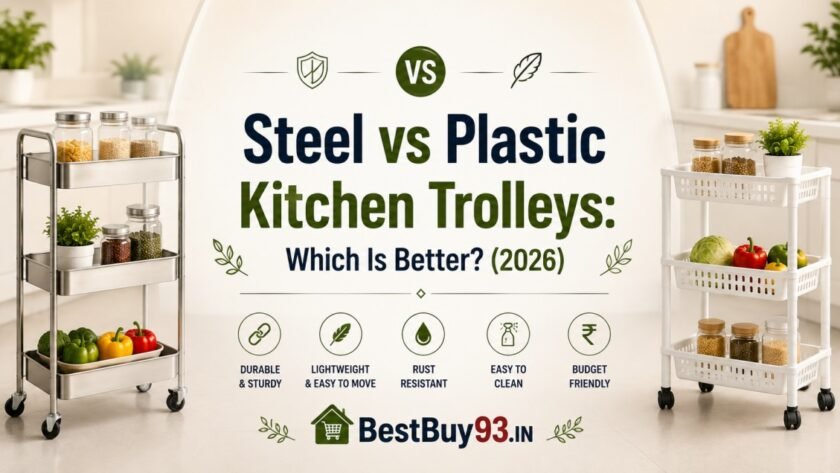
Both materials have their advantages. A steel trolley can offer excellent strength, stability and a more premium appearance, while a plastic trolley is usually lighter, easier to move and more budget-friendly.
And here’s the important bit: the more expensive material isn’t automatically the better choice for every kitchen.
If you’re storing heavy containers, bottles and appliances, the strength of steel can be valuable. But if you’re living in a small apartment and simply need a lightweight cart for snacks, spices or everyday supplies, plastic may actually be more convenient.
The Steel vs Plastic Kitchen Trolleys comparison therefore isn’t really about finding one universal winner. It’s about figuring out which material fits your kitchen, your storage needs and your budget.
In this guide, we’ll compare both options across durability, weight, moisture resistance, cleaning, stability, mobility, storage capacity, appearance, price and long-term value.
We’ll also explain what to look for before buying and which material makes the most sense for small kitchens, heavy storage, rental homes and everyday kitchen organization.
So, steel or plastic?
Let’s settle this properly. 🌶️🛒
⚖️ Steel vs Plastic Kitchen Trolleys: Quick Comparison
Before we dive into the details, here’s the short version.
| Feature | 🧱 Steel Trolley | 🧴 Plastic Trolley |
|---|---|---|
| Durability | ⭐⭐⭐⭐⭐ | ⭐⭐⭐⭐ |
| Weight | Heavier | Lightweight |
| Stability | Excellent | Good |
| Moisture Resistance | Excellent with suitable finish | Excellent |
| Cleaning | Easy | Very Easy |
| Mobility | Good | Excellent |
| Heavy Storage | Excellent | Moderate |
| Price | Medium–High | Low–Medium |
| Appearance | Premium | Practical |
| Long-Term Use | Excellent | Good |
| Small Kitchens | Good | Excellent |
| Portability | Good | Excellent |
🏆 Quick Take
Steel wins for strength and long-term durability.
Plastic wins for lightweight portability and affordability.
But that’s only the beginning of the Steel vs Plastic Kitchen Trolleys comparison.
🛒 What Is a Kitchen Trolley?
A kitchen trolley is a movable storage unit, usually fitted with wheels or casters.
Unlike a conventional cabinet, it doesn’t need to stay in one place.
You can use a trolley for:
- Vegetables
- Fruits
- Spice jars
- Airtight containers
- Cooking oils
- Snacks
- Tea and coffee supplies
- Utensils
- Small appliances
- Cleaning products
- Pantry items
Some kitchen trolleys are designed specifically for kitchens, while others are multipurpose utility carts that can be used throughout the home.
This is one reason kitchen trolleys have become useful for small-space organization.
You can add storage without installing another cabinet or changing the entire kitchen layout. Kitchen Trolleys
🧱 Why Does Trolley Material Matter?
At first glance, the material may not seem particularly important.
After all, a trolley is just a trolley, right?
Not quite.
The material affects almost everything about the trolley:
Durability
How well it handles daily use.
Weight
How easy it is to move.
Stability
How it behaves when fully loaded.
Moisture Resistance
Important in a kitchen where water and steam are common.
Cleaning
Some surfaces are much easier to wipe down.
Appearance
Steel can create a more modern, premium look, while plastic tends to look more casual and practical.
Price
Plastic generally costs less, although construction quality matters.
That’s why the Steel vs Plastic Kitchen Trolleys decision deserves more thought than simply choosing whichever one looks nicer in the product photograph. Kitchen Trolleys
🧱 Steel Kitchen Trolleys: What You Need to Know
Steel kitchen trolleys are popular because of their strength and durability.
But there’s an important distinction:
Steel isn’t always stainless steel.
A trolley can be made from ordinary steel with a protective coating, powder-coated steel, chrome-finished steel or stainless steel.
These materials can behave differently in terms of corrosion resistance and maintenance.
Why Choose Steel?
Steel is particularly useful when you need a trolley to carry heavier items.
For example:
- Large jars
- Oil bottles
- Cookware
- Appliances
- Heavy pantry containers
- Multiple glass containers
A well-built steel trolley can also feel considerably more stable when you’re moving it around.
The Premium Factor
Steel, especially stainless steel, can also look more integrated into a modern kitchen.
Instead of looking like temporary storage, a well-designed steel trolley can look like an actual part of the kitchen furniture. Kitchen Trolleys
🧴 Plastic Kitchen Trolleys: What You Need to Know
Plastic trolleys take a completely different approach.
Their biggest advantage is lightweight convenience.
A plastic trolley is generally easier to lift, move and reposition than a comparable steel model.
That’s useful when you frequently change your kitchen setup or want to move the trolley between rooms.
Why Choose Plastic?
Plastic trolleys can be excellent for:
- Snacks
- Spices
- Lightweight pantry items
- Cleaning products
- Tea and coffee supplies
- Small containers
- Fruits and vegetables
They’re also usually easier on the wallet.
For someone who simply wants additional storage without making a major investment, plastic can make plenty of sense. Kitchen Trolleys
🧱 Steel vs Plastic Kitchen Trolleys: Durability
Let’s start with one of the biggest differences.
🥇 Steel
Steel generally has the advantage when it comes to strength and structural durability.
A properly constructed steel trolley can handle heavier loads without bending or flexing as easily as lower-quality plastic.
This makes steel particularly attractive if your trolley will hold heavy pantry containers or kitchen equipment.
However, construction matters.
A thin or poorly made steel trolley isn’t automatically stronger than a well-designed plastic trolley.
🧴 Plastic
Good-quality plastic can be surprisingly durable for everyday storage.
It can handle lightweight and medium-weight items very well.
However, lower-quality plastic may:
- Flex under heavy loads
- Crack under impact
- Warp in unsuitable conditions
- Develop stress marks over time
So when comparing Steel vs Plastic Kitchen Trolleys, don’t simply ask:
“Which material is stronger?”
Also ask:
“How well is this particular trolley constructed?”
🏆 Winner: Steel
For heavy-duty and long-term structural durability, steel generally gets the advantage.
⚖️ Steel vs Plastic Kitchen Trolleys: Weight
Now we flip the advantage.
🧱 Steel
Steel is heavier.
That’s not necessarily a disadvantage.
The additional weight can actually make a trolley feel more stable, particularly when it’s loaded.
But it also means moving the trolley requires more effort.
🧴 Plastic
Plastic is considerably lighter.
This makes it convenient if you frequently need to:
- Move the trolley
- Clean underneath it
- Reorganize the kitchen
- Move it between rooms
- Pull it out of a narrow space
For renters or people who frequently rearrange their homes, that flexibility can be useful.
🏆 Winner: Plastic
For pure portability, plastic wins.
💧 Steel vs Plastic Kitchen Trolleys: Moisture & Rust
This is where things get slightly more complicated.
A kitchen is naturally exposed to:
- Water
- Steam
- Humidity
- Oil
- Food splashes
Steel
Not all steel is equally resistant to moisture.
Stainless Steel
Generally an excellent choice for kitchens.
Coated Steel
Can also perform well, provided the protective coating remains intact.
Ordinary Unprotected Steel
More vulnerable to corrosion.
So if you’re considering steel, check what type of steel or finish is actually being used.
Don’t assume that the word “steel” automatically means rust-proof.
Plastic
Plastic doesn’t rust.
That makes it naturally appealing for areas where water exposure is common.
However, plastic can still accumulate:
- Grease
- Food residue
- Dust
- Stains
So rust-free doesn’t mean maintenance-free.
🏆 Winner: Depends
Plastic wins for rust resistance.
Stainless steel wins for a combination of durability and moisture suitability.
🧹 Steel vs Plastic Kitchen Trolleys: Cleaning
Kitchen storage gets dirty.
There’s really no escaping it.
Oil splashes, spice powder and dust eventually find their way onto almost everything.
🧱 Steel
Smooth steel surfaces are generally easy to wipe.
Stainless steel can be particularly convenient for kitchen environments.
However, mesh or perforated steel designs may require more effort if food particles collect in the openings. Kitchen Trolleys
🧴 Plastic
Plastic surfaces are also generally easy to clean.
A lightweight plastic trolley can often be moved easily so you can clean around and underneath it.
Some plastic designs have grooves or textured surfaces, though, which can collect dust and residue.
🏆 Winner: Slight Advantage to Plastic
For everyday lightweight cleaning and portability, plastic gets the edge.
🛞 Steel vs Plastic Kitchen Trolleys: Stability
This is where the heavier weight of steel becomes useful.
A steel trolley typically feels more planted, especially when loaded with heavier items.
Plastic trolleys can also be stable, but very lightweight designs may move more easily when you pull out a container or place something on the top shelf.
For Better Stability
Look for:
- Wide base
- Strong frame
- Good-quality wheels
- Lockable casters
- Proper weight distribution
And regardless of material, put heavier items on the bottom shelf.
🏆 Winner: Steel
Steel generally offers better stability, particularly for heavier storage.
📦 Steel vs Plastic Kitchen Trolleys: Storage Capacity
Capacity isn’t just about how many shelves a trolley has.
It’s also about how much weight those shelves can safely handle.
Steel
Better suited to:
- Large glass containers
- Heavy bottles
- Cookware
- Small appliances
- Bulk pantry storage
Plastic
Better suited to:
- Snacks
- Packets
- Small containers
- Spices
- Lightweight pantry supplies
- Cleaning products
A four-tier plastic trolley might technically offer more shelves than a three-tier steel trolley, but that doesn’t necessarily make it better for heavy storage.
🏆 Winner: Steel
For heavy-duty storage, steel has the advantage.
🏠 Steel vs Plastic Kitchen Trolleys for Small Kitchens
Small kitchens require a slightly different approach.
Here, footprint and mobility become extremely important.
A lightweight plastic trolley can be easier to pull out of a narrow gap and move when you’re cooking.
However, a slim steel trolley can provide excellent stability while still using very little floor space.
Our Recommendation
For a very small kitchen, prioritize:
- Width
- Depth
- Wheel quality
- Weight
- Storage capacity
Material should come after these factors.
A perfectly sized plastic trolley is better than an oversized steel trolley that blocks your walking space.
And vice versa.
💰 Steel vs Plastic Kitchen Trolleys: Price & Value
Price is one of the biggest differences between the two.
🧱 Steel Kitchen Trolleys
Steel trolleys generally cost more, particularly when they’re made from stainless steel or feature a strong metal frame, quality wheels and a premium finish.
You’re paying for:
- Stronger construction
- Higher load capacity
- Better stability
- Longer potential lifespan
- Premium appearance
But that doesn’t automatically make steel better value.
If you’re only storing lightweight packets and spice jars, spending significantly more on heavy-duty steel may not make much sense.
🧴 Plastic Kitchen Trolleys
Plastic trolleys are usually more budget-friendly.
They’re particularly attractive if you need:
- Basic storage
- Lightweight organization
- Temporary storage
- Rental-friendly furniture
- A second trolley for another part of the kitchen
For a modest budget, plastic can give you plenty of storage without a large investment.
🏆 Winner: Plastic
For upfront affordability, plastic wins.
For long-term heavy-duty value, steel may justify its higher price.
🎨 Steel vs Plastic Kitchen Trolleys: Appearance
This one is subjective, but material definitely influences the overall look.
🧱 Steel
Steel especially stainless steel or a well-finished powder-coated design can look:
- Modern
- Sleek
- Minimalist
- Professional
- Premium
It can blend particularly well with contemporary modular kitchens.
A stainless-steel trolley can even look like a deliberate part of the kitchen rather than an extra storage cart.
🧴 Plastic
Plastic tends to have a more casual and practical appearance.
That isn’t necessarily bad.
Modern plastic trolleys are available in plenty of colours and designs, and some can look perfectly good in a kitchen.
But if you’re trying to create a premium, coordinated kitchen aesthetic, steel generally has an advantage.
🏆 Winner: Steel
For a more sophisticated kitchen appearance, we’d choose steel.
🌡️ Steel vs Plastic Kitchen Trolleys: Heat & Kitchen Environment
This is an important consideration that often gets ignored.
Kitchens naturally have heat from:
- Gas stoves
- Induction cooktops
- Ovens
- Air fryers
- Toasters
- Steam
🧱 Steel
Steel is generally better suited to areas exposed to normal kitchen heat.
That doesn’t mean you should place a trolley directly next to a gas flame or against a hot appliance.
But as a material, steel offers better tolerance for typical kitchen environments.
🧴 Plastic
Plastic requires more caution around heat.
Different plastics have different heat tolerances, and prolonged exposure to high temperatures can potentially cause deformation or damage.
So don’t position a plastic trolley directly beside a stove simply because there’s a convenient gap there.
🏆 Winner: Steel
For kitchens with more heat exposure, steel is generally the safer material choice but neither material should be placed directly against a heat source.
🛞 Steel vs Plastic Kitchen Trolleys: Mobility
Here’s where plastic fights back.
🧱 Steel
A steel trolley can be heavier even before you put anything on it.
Add several bottles and containers, and the total weight increases quickly.
Good wheels can make a huge difference, but a fully loaded steel trolley may still require more effort to move.
🧴 Plastic
Plastic’s lower weight makes it easier to:
- Pull out
- Push back
- Move between rooms
- Reposition during cleaning
- Move around a small kitchen
This is particularly useful if you don’t keep your trolley in a permanent location.
🏆 Winner: Plastic
For mobility, plastic has the clear advantage.
🧂 Steel vs Plastic Kitchen Trolleys for Spice Storage
If you’re planning to use your trolley for spices, the material itself isn’t necessarily the deciding factor.
Instead, look at:
- Shelf depth
- Shelf height
- Stability
- Visibility
- Jar compatibility
- Ease of cleaning
A three-tier plastic trolley can work beautifully for spice jars.
A steel trolley can do the same.
For a Small Spice Collection
Plastic is perfectly adequate.
For Heavy Glass Jars or Large Containers
Steel is preferable.
And if you’re specifically organizing spices, check out our Spice Organization Ideas guide as well.
🫙 Steel vs Plastic Kitchen Trolleys for Airtight Containers
Airtight containers can become surprisingly heavy when they’re filled with:
- Rice
- Flour
- Pulses
- Sugar
- Dal
- Dry fruits
This is where steel starts making more sense.
A strong steel trolley is generally better suited for heavier pantry storage.
Plastic can still work if the trolley is specifically designed for heavier loads and you stay within its weight rating.
🏆 Winner: Steel
For heavier pantry containers, we’d choose steel.
🥔 Steel vs Plastic Kitchen Trolleys for Fruits & Vegetables
Vegetable storage is a different story.
You generally want:
- Airflow
- Easy cleaning
- Easy access
- Lightweight storage
- Ventilated shelves or baskets
Both materials can work well.
Steel
Particularly good when the trolley uses perforated or mesh baskets.
Plastic
Good for lightweight produce and easy movement.
If you’re constantly moving vegetables around, plastic’s lower weight can be convenient.
🏆 Winner: Tie
For produce, design matters more than material.
🏡 Steel vs Plastic Kitchen Trolleys for Rental Homes
Renters often benefit from storage that doesn’t require permanent installation.
Both steel and plastic trolleys can be freestanding.
But plastic can have an additional advantage: it’s easier to move when you relocate.
If you’re moving homes frequently, lifting a lightweight plastic trolley is considerably easier than carrying a heavy steel unit loaded with kitchen supplies.
🏆 Winner: Plastic
For portability and frequent relocation, plastic gets the edge.
🌧️ Steel vs Plastic Kitchen Trolleys During Monsoon
If you’re dealing with humid conditions, material choice deserves some attention.
Steel
Stainless steel is an excellent option.
But ordinary steel or damaged powder coating can potentially develop corrosion when repeatedly exposed to moisture.
Plastic
Plastic doesn’t rust, making it naturally attractive in damp environments.
However, you still need to keep it clean and dry because moisture can contribute to grime and mould growth around food residue.
🏆 Winner: Depends
Stainless steel → Excellent
Quality plastic → Excellent
Unprotected steel → Less desirable
🧽 Steel vs Plastic Kitchen Trolleys: Long-Term Maintenance
A trolley isn’t maintenance-free just because it has wheels.
Steel Maintenance
You’ll want to:
- Wipe spills promptly
- Keep the surface clean
- Check wheels periodically
- Inspect coated areas for damage
- Avoid prolonged standing water
Stainless steel is generally straightforward to maintain.
Plastic Maintenance
Plastic is usually very easy to wipe.
However, inspect for:
- Cracks
- Warping
- Loose joints
- Damaged wheels
- Stress marks
If a shelf starts bending under weight, it’s time to reduce the load.
🏆 Winner: Slight Advantage to Plastic
Plastic generally requires less fuss for everyday cleaning.
🏋️ Steel vs Plastic Kitchen Trolleys: Heavy-Duty Storage
This is probably the clearest category in the entire comparison.
If you’re planning to store:
- Large oil bottles
- Flour containers
- Rice containers
- Heavy cookware
- Small appliances
- Glass jars
- Bulk groceries
steel is the better choice.
A properly constructed steel frame provides better structural support for heavier loads.
Plastic works beautifully for lightweight organization, but heavy-duty storage is where steel earns its higher price.
🏆 Winner: Steel
📦 Steel vs Plastic Kitchen Trolleys: Everyday Storage
For everyday items such as:
- Snacks
- Tea
- Coffee
- Spices
- Packets
- Small containers
- Kitchen towels
plastic can be completely sufficient.
You don’t necessarily need a heavy-duty metal trolley just to store biscuit packets and tea bags.
🏆 Winner: Plastic
For lightweight everyday organization, plastic provides excellent practicality.
🔄 Steel vs Plastic Kitchen Trolleys: Flexibility
Think about how often you rearrange your kitchen.
If the trolley stays in one place permanently, weight isn’t a huge concern.
But if you regularly:
- Move it during cooking
- Clean behind it
- Change your kitchen layout
- Move it between rooms
plastic becomes more attractive.
Steel is better suited to permanent or semi-permanent storage.
Plastic is better suited to flexible storage.
🏆 Winner: Plastic
📊 Steel vs Plastic Kitchen Trolleys: Category-by-Category Winners
Now let’s make the comparison super simple.
| Category | Winner | Why |
|---|---|---|
| Durability | 🧱 Steel | Stronger construction |
| Heavy Storage | 🧱 Steel | Better load handling |
| Stability | 🧱 Steel | Heavier and more rigid |
| Premium Appearance | 🧱 Steel | More sophisticated finish |
| Heat Tolerance | 🧱 Steel | Better suited to kitchen environments |
| Affordability | 🧴 Plastic | Usually lower upfront cost |
| Lightweight Design | 🧴 Plastic | Easier to lift |
| Mobility | 🧴 Plastic | Easier to move |
| Portability | 🧴 Plastic | Convenient for relocation |
| Easy Cleaning | 🧴 Plastic | Lightweight and simple to wipe |
| Rust Resistance | 🧴 Plastic | Doesn’t rust |
| Long-Term Heavy Use | 🧱 Steel | Better structural durability |
| Small Kitchen Flexibility | 🧴 Plastic | Easy to reposition |
| Pantry Containers | 🧱 Steel | Better for heavier loads |
| Spice Storage | 🤝 Tie | Depends on design |
| Vegetable Storage | 🤝 Tie | Depends on ventilation |
| Value for Lightweight Storage | 🧴 Plastic | Lower cost |
| Premium Kitchen | 🧱 Steel | Better visual integration |
👍 Steel Kitchen Trolley: Pros & Cons
| What We Like | What We Don’t Like |
|---|---|
| Excellent durability | Usually heavier |
| Strong load capacity | Can cost more |
| Better stability | Harder to move when fully loaded |
| Premium appearance | Some steel finishes can corrode |
| Good for appliances | May be unnecessary for lightweight storage |
| Suitable for long-term use | Higher-quality models can be expensive |
🧴 Plastic Kitchen Trolley: Pros & Cons
| What We Like | What We Don’t Like |
|---|---|
| Lightweight | Lower load capacity on some models |
| Affordable | Can look less premium |
| Easy to move | Some models can flex |
| Easy to clean | Lower-quality plastic may crack |
| Doesn’t rust | Heat exposure requires caution |
| Good for everyday storage | Can feel less stable when overloaded |
🏆 So Far, Who Is Winning?
The Steel vs Plastic Kitchen Trolleys comparison is actually pretty balanced.
🧱 Steel is winning for:
Strength + Stability + Heavy Storage + Durability + Premium Appearance
🧴 Plastic is winning for:
Price + Mobility + Portability + Lightweight Storage + Rust Resistance
And that tells us something important.
The right material depends on what you’re putting inside the trolley.
If you’re storing five kilos of rice, a giant oil bottle and heavy glass containers, don’t buy a lightweight plastic trolley simply because it’s cheaper.
If you’re storing tea bags, spices, snacks and kitchen towels, you probably don’t need to spend a small fortune on stainless steel either.
💡 The Smartest Approach
Instead of asking:
“Which material is better?”
Ask:
“What am I going to store, and how often will I move it?”
That’s the better buying question.
Heavy + Permanent Storage
👉 Steel
Lightweight + Frequently Moved
👉 Plastic
Premium Kitchen
👉 Steel
Budget Kitchen
👉 Plastic
Humid Environment
👉 Stainless Steel or Quality Plastic
Rental Home
👉 Plastic or lightweight steel
🛒 How to Choose Between Steel and Plastic Kitchen Trolleys
🧱 If You’re Buying a Steel Kitchen Trolley
Don’t stop at the word “steel.”
Check what kind of steel or finish the trolley actually uses.
Look for:
- Stainless steel construction where possible
- Strong welded joints
- A stable frame
- Good-quality wheels
- Lockable casters
- Adequate shelf thickness
- Rust-resistant finish
- Stated weight capacity
Stainless Steel vs Regular Steel
This distinction matters.
Stainless steel is generally better suited to moisture-prone kitchen environments because of its corrosion resistance.
Regular or coated steel can still be perfectly useful, but the protective finish matters.
If the coating becomes chipped or damaged, exposed metal can become more vulnerable to corrosion.
So if your trolley will live beside the sink, spending a little more on a suitable material can make sense.
🧴 If You’re Buying a Plastic Kitchen Trolley
Plastic isn’t automatically cheap or flimsy.
The quality can vary considerably.
Look for:
- Thick shelves
- Rigid construction
- Strong joints
- Quality wheels
- A stable base
- Suitable load capacity
- Smooth surfaces
- Good-quality plastic
Avoid a trolley where the shelves visibly flex when you press them.
If it bends while empty, imagine what happens after you fill it with jars, bottles and groceries. 😬
📏 Measure Before You Buy
This deserves repeating because it’s probably the most common kitchen-trolley buying mistake.
Measure:
Width
Will the trolley fit into the intended gap?
Depth
Will it interfere with walking space or cabinet doors?
Height
Can you comfortably access the top shelf?
Clearance
Can nearby refrigerator, cabinet or kitchen doors open properly?
Pull-Out Space
If you’re buying a slim trolley, can you actually pull it completely out?
A trolley isn’t useful if you have to perform a sideways yoga pose every time you want the bottom shelf.
🛞 Check the Wheels
Whether you choose steel or plastic, wheels matter enormously.
Look for:
- Smooth movement
- Strong wheel mounts
- 360-degree rotation
- Lockable casters
- Wheels suitable for your flooring
Why Lockable Wheels Matter
Once you’ve positioned the trolley where you want it, locking the wheels prevents it from moving around while you’re using it.
This is particularly useful if you’re storing:
- Glass jars
- Bottles
- Appliances
- Heavy pantry containers
⚖️ Check the Weight Capacity
Don’t judge a trolley’s strength by appearance alone.
A trolley may look strong but have a surprisingly low recommended load.
Check:
- Maximum total load
- Maximum load per shelf
- Whether the stated capacity applies evenly across all tiers
A Simple Rule
Heavy items → Bottom shelf
Medium-weight items → Middle shelf
Lightweight items → Top shelf
This improves stability and makes the trolley easier to move.
🏠 Steel vs Plastic Kitchen Trolleys for Different Kitchen Types
The best choice changes depending on your kitchen.
🏢 Small Apartment Kitchen
Best Choice: Plastic or Slim Steel
Prioritize:
- Narrow footprint
- Lightweight design
- Easy movement
- Compact shelves
If you’re constantly pulling the trolley out of a narrow space, plastic may be more convenient.
🏡 Spacious Kitchen
Best Choice: Steel
You have more room to accommodate a larger trolley, so the additional weight becomes less of an issue.
A steel trolley can provide substantial storage for:
- Appliances
- Pantry containers
- Cookware
- Bottles
🏠 Rental Home
Best Choice: Plastic or Freestanding Steel
Avoid anything requiring permanent installation.
A freestanding trolley can move with you when you move homes.
If you relocate frequently, plastic has the advantage because it’s easier to carry.
🌧️ Humid Kitchen
Best Choice: Stainless Steel or Quality Plastic
Avoid poorly protected regular steel if the trolley will regularly come into contact with moisture.
🍳 Heavy-Use Kitchen
Best Choice: Steel
If you cook frequently and need your trolley to carry substantial weight, steel is the more sensible option.
🧂 What Should You Store in Each Material?
Here’s a simple guide.
| Item | Steel | Plastic |
|---|---|---|
| Spice jars | ✅ | ✅ |
| Tea & coffee | ✅ | ✅ |
| Snacks | ✅ | ✅ |
| Packets | ✅ | ✅ |
| Fruits | ✅ | ✅ |
| Vegetables | ✅ | ✅ |
| Oil bottles | ✅ | ⚠️ Depends on capacity |
| Large glass jars | ✅ | ⚠️ Depends on capacity |
| Rice containers | ✅ | ⚠️ Depends on capacity |
| Flour containers | ✅ | ⚠️ Depends on capacity |
| Heavy cookware | ✅ | ❌ Usually not ideal |
| Small appliances | ✅ | ⚠️ Check load rating |
The important thing is that material alone doesn’t determine suitability.
The manufacturer’s load rating and construction matter too.
💰 How Much Should You Spend?
You don’t need to spend a fortune.
💸 Budget: Under ₹1,000
Plastic and basic utility trolleys are the obvious choices.
Good for:
- Snacks
- Spices
- Packets
- Light household items
💵 Mid-Range: ₹1,000–₹3,000
This is probably the sweet spot for many households.
You’ll find:
- Better plastic trolleys
- Metal-frame models
- 3-tier carts
- 4-tier organizers
- Better wheels
- More attractive designs
💎 Premium: ₹5,000+
This is where you start getting into premium stainless-steel construction, heavier-duty designs and furniture-style kitchen storage.
Only spend this much if the additional durability, finish or functionality actually matters to you.
Don’t spend ₹7,000 on a trolley to store three packets of biscuits.
Your biscuits don’t need luxury accommodation. 😂
⚠️ Common Steel vs Plastic Kitchen Trolleys Buying Mistakes
❌ 1. Assuming All Steel Is Rust-Proof
Regular steel and stainless steel aren’t the same.
Always check the material specification.
❌ 2. Assuming All Plastic Is Flimsy
Quality plastic can be perfectly durable for everyday storage.
Look at construction and load capacity.
❌ 3. Ignoring the Wheels
A trolley is only as useful as its mobility.
❌ 4. Overloading the Shelves
Don’t exceed the manufacturer’s stated weight capacity.
❌ 5. Buying Before Measuring
Always measure the space first.
❌ 6. Placing Plastic Directly Beside Heat
Keep plastic away from direct heat sources unless the manufacturer specifically states otherwise.
❌ 7. Buying a Huge Trolley for a Tiny Kitchen
More storage isn’t useful if you lose your walking space.
❌ 8. Choosing Looks Over Function
A gorgeous trolley that doesn’t fit your containers or can’t handle the weight isn’t a good purchase.
👍 Steel Kitchen Trolley: Final Pros & Cons
| Pros | Cons |
|---|---|
| Excellent durability | Heavier |
| Better stability | Usually costs more |
| Handles heavier loads | Can be harder to move when full |
| Premium appearance | Some steel finishes can corrode |
| Good for appliances | May be unnecessary for lightweight storage |
| Suitable for long-term use | Premium stainless steel can be expensive |
🧴 Plastic Kitchen Trolley: Final Pros & Cons
| Pros | Cons |
|---|---|
| Lightweight | Lower load capacity on some models |
| Affordable | Can look less premium |
| Easy to move | Can flex under heavy loads |
| Easy to clean | Low-quality plastic can crack |
| Doesn’t rust | Heat exposure needs consideration |
| Great for everyday storage | May be less stable when overloaded |
🔬 Our Research Methodology
For this Steel vs Plastic Kitchen Trolleys guide, we evaluated the two materials based on practical kitchen requirements rather than simply choosing a winner based on price or appearance.
We considered:
- Material construction
- Durability
- Weight
- Stability
- Moisture resistance
- Cleaning requirements
- Storage capacity
- Load considerations
- Wheel design
- Mobility
- Kitchen layout
- Small-space suitability
- Heat exposure
- Long-term usability
- Price and value
We also considered different real-world scenarios, including compact kitchens, rental homes, humid environments, heavy pantry storage and everyday kitchen organization.
The objective was to determine where steel makes more sense and where plastic makes more sense, rather than suggesting that one material is universally superior.
🏆 Steel vs Plastic Kitchen Trolleys: Final Verdict
So, after comparing everything, which one should you buy?
Well…
🥇 Steel Wins If You Want:
- Maximum durability
- Better stability
- Heavy-load storage
- Long-term use
- Premium appearance
- Better support for appliances and heavy containers
Our Steel Pick:
Stainless steel, particularly if the trolley will be exposed to moisture.
💰 Plastic Wins If You Want:
- Affordable storage
- Lightweight construction
- Easy movement
- Easy relocation
- Simple everyday organization
- Rust-free material
Plastic is particularly practical for renters, compact kitchens and lightweight storage.
🏆 Overall Winner: Steel
If we have to choose one overall winner in the Steel vs Plastic Kitchen Trolleys comparison, we’d give the advantage to steel.
Why?
Because a well-built steel trolley generally offers better:
Durability + Stability + Load Capacity + Long-Term Value
But and this is important that doesn’t mean everyone should buy steel.
If you’re on a budget or mainly need lightweight storage, plastic can actually be the smarter purchase.
The easiest way to decide:
| Your Priority | Choose |
|---|---|
| Heavy storage | 🧱 Steel |
| Long-term durability | 🧱 Steel |
| Premium appearance | 🧱 Steel |
| Stability | 🧱 Steel |
| Low price | 🧴 Plastic |
| Lightweight design | 🧴 Plastic |
| Easy movement | 🧴 Plastic |
| Frequent relocation | 🧴 Plastic |
| Rust resistance | 🧴 Plastic |
| Moisture-prone kitchen | 🧱 Stainless Steel / 🧴 Plastic |
| Small kitchen | 🧴 Plastic / Slim Steel |
❓ Frequently Asked Questions
1. Is steel better than plastic for a kitchen trolley?
Generally, steel is better for heavy-duty storage, stability and long-term durability. Plastic is better when affordability, lightweight construction and portability are more important.
2. Are plastic kitchen trolleys durable?
Yes. Good-quality plastic kitchen trolleys can be durable for everyday lightweight and medium-weight storage. Always check the manufacturer’s load capacity and construction quality.
3. Do steel kitchen trolleys rust?
Some can. Stainless steel offers much better corrosion resistance, while ordinary or poorly protected steel may be more vulnerable to rust, particularly in damp environments.
4. Which is better for a small kitchen?
Both can work. A slim plastic trolley is easier to move, while a slim steel trolley may provide better stability. The dimensions and footprint should be your first priority.
5. Which kitchen trolley material is easier to clean?
Both can be easy to clean. Plastic is lightweight and generally simple to wipe, while smooth stainless-steel surfaces are also easy to maintain.
6. Are plastic trolleys suitable for heavy storage?
Some are, but you should check the manufacturer’s weight rating before using one for heavy containers, appliances or cookware.
7. Which is better for long-term use?
A well-built steel trolley generally has the advantage for long-term heavy use because of its structural strength and stability.
8. Is stainless steel better than plastic for kitchen storage?
For heavy-duty, moisture-prone and long-term kitchen storage, stainless steel can be an excellent choice. Plastic remains attractive when low weight, portability and affordability are the priorities.
🔗 Related Kitchen Storage Guides
If you’re planning a complete kitchen organization setup, check out:
- Best Kitchen Trolleys for Smart Kitchen Storage in India (2026)
- Kitchen Storage Guide: 25 Smart Tips for an Organized Kitchen (2026)
- Spice Organization Ideas
- Best Spice Racks
- Best 5 Airtight Containers for Kitchen Storage in India (2026)
- Glass vs Plastic Containers: Which One is Better for Kitchen Storage? (2026)
Together, these articles create a useful kitchen-storage content cluster covering containers, spices, trolleys and material comparisons.