
Smartphone cameras have become ridiculously capable.
You can record 4K video, cinematic slow motion, HDR footage and surprisingly professional-looking travel videos using the same device you were scrolling Instagram on five minutes ago.
But there is one problem smartphone manufacturers still cannot completely eliminate:
your hands move.
Walk while recording and you may get tiny vertical bumps.
Turn quickly and the footage can jerk.
Try filming yourself while travelling and suddenly your beautiful European street vlog looks like CCTV footage from an earthquake. 😭
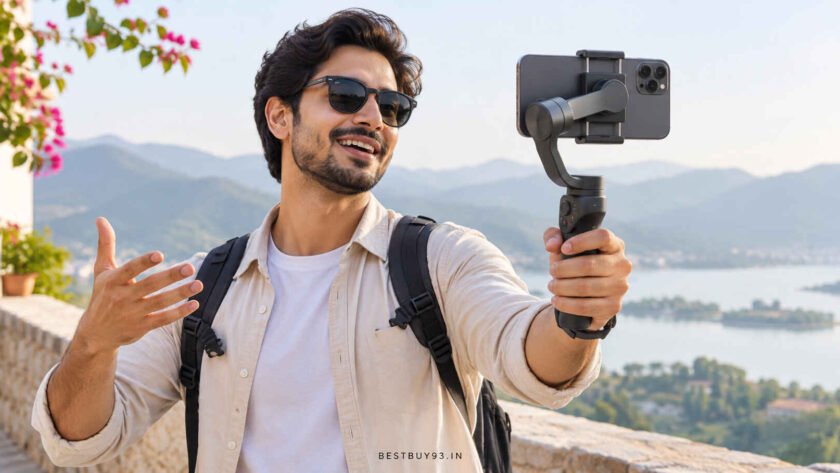
That is where a smartphone gimbal comes in.
A 3-axis phone gimbal uses small motors to counteract unwanted movement across pan, tilt and roll axes, helping create smoother walking shots, pans, reveals, tracking shots and solo-vlogging footage.
Modern models go much further. Many now combine:
- AI subject tracking
- gesture controls
- built-in selfie sticks
- mini tripods
- fill lights
- remote controls
- 360-degree pan tracking
- smartphone charging
- native-camera tracking
For this guide, we compared current smartphone gimbals suitable for vloggers based on stabilisation, phone compatibility, payload, tracking, portability, extension rods, tripods, battery life, vertical-video support and overall creator workflow.
Our Best Overall pick is the DJI Osmo Mobile 8, while the Insta360 Flow 2 Pro is particularly attractive for iPhone creators. The Hohem iSteady M7 is the stronger choice for heavier phones and more elaborate mobile filmmaking rigs.
Quick Picks: Best Smartphone Gimbals for Vlogging
| Smartphone Gimbal | Best For | Max Phone Weight | Approx. Gimbal Weight | Battery Claim |
|---|---|---|---|---|
| DJI Osmo Mobile 8 | Best Overall | 300g | 370g* | Up to 10 hrs |
| Insta360 Flow 2 Pro | Best for iPhone | 300g | 357g | Up to 10 hrs |
| Hohem iSteady V3 Ultra | Best for Solo Creators | 400g | 428g | Up to 9 hrs |
| Hohem iSteady M7 | Best for Heavy Phones | 500g | 629g | Up to 12 hrs |
| Zhiyun Smooth 5S AI | Best for Manual Control | 300g | 625g | Highly usage-dependent |
| Insta360 Flow 2 | Best Compact Value Pick | 300g | 348g | Up to 10 hrs |
| Digitek DSG 009F AI | Best Budget India Pick | Phone-size based | 382g | Check exact listing |
*DJI’s quoted 370g figure includes the built-in tripod, magnetic phone clamp and multifunctional module.
Best Overall: DJI Osmo Mobile 8
Best for iPhone: Insta360 Flow 2 Pro
Best for Solo Creators: Hohem iSteady V3 Ultra
Best for Heavy Phones: Hohem iSteady M7
Best for Manual Filmmaking: Zhiyun Smooth 5S AI
Best Value Compact Pick: Insta360 Flow 2
Best Budget India Pick: Digitek DSG 009F AI
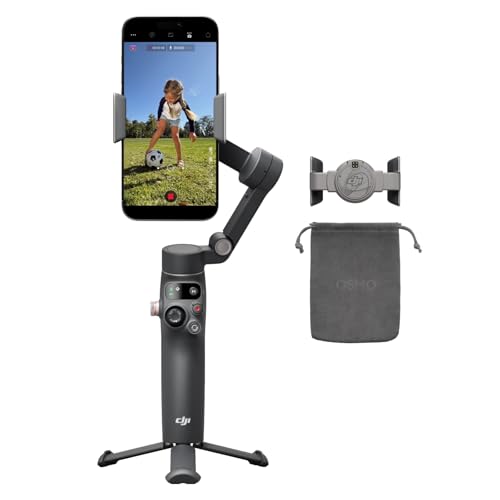
1. DJI Osmo Mobile 8 — Best Overall Smartphone Gimbal
If you want one gimbal that covers the widest range of ordinary vlogging situations without becoming a giant filmmaking rig, the DJI Osmo Mobile 8 is our Best Overall choice.
DJI lists the Osmo Mobile 8 with:
- three-axis stabilisation
- 360° unlimited pan rotation
- built-in 215mm extension rod
- built-in tripod
- phone charging
- native tracking support
- intelligent tracking through its Multifunctional Module
- approximately 10-hour rated battery life
It supports smartphones weighing approximately 170–300g, measuring 67–84mm wide and 6.9–10mm thick.
Why We Recommend It
The OM8 feels designed specifically around the way modern creators actually shoot.
Imagine filming a travel vlog.
One minute you’re walking with the gimbal.
Then you want a wider selfie.
Extend the built-in rod.
Next you want a static talking segment.
Open the built-in tripod.
Then you want the camera to follow you.
Use tracking.
Then your phone battery starts dying.
The gimbal can even supply power to the phone.
That’s a far more useful feature set than simply saying:
“Look, our motors stabilise things.”
DJI also added unlimited 360° pan movement and support for low-angle shooting, expanding the creative camera moves available compared with older generations.
Battery Reality Check
DJI quotes about 10 hours under controlled conditions.
But the company also states that enabling intelligent tracking reduces this to approximately five hours, while using tracking plus maximum fill-light brightness can bring operation down to roughly four hours.
So please don’t interpret “10 hours” as:
10 hours of maximum-brightness tracking while charging your phone.
Physics has terms and conditions too. 😭
Best For
Travel vloggers, lifestyle creators, beginner YouTubers, iPhone/Android users and anyone wanting one polished all-round gimbal.
Pros
- Excellent all-round feature set
- 3-axis stabilisation
- 360° pan rotation
- 215mm extension rod
- Built-in tripod
- Native-camera tracking support
- Phone charging
- Compact 370g-class setup
- Magnetic phone mounting
- Strong creator ecosystem
Cons
- 300g phone limit can be restrictive with heavy accessories
- Full smart features depend partly on module/app configuration
- Battery drops substantially with tracking and lighting
- Premium compared with basic gimbals
Verdict
For most vloggers, DJI Osmo Mobile 8 offers the best combination of portability, stabilisation, tracking and built-in creator tools.

- Native Tracking With Audio [4] & Lighting [1] – Level up your shots with a DJI gimbal that combines tracking, audio rece…
- Seamless 360° Pan Rotation – Enjoy 360° horizontal rotation for immersive shots. Intelligent tracking lets you follow su…
- Direct Phone Connection for Tracking [2] – Instantly connect your phone to the foldable gimbal for quick setup and intel…
- Native Tracking With Audio [4] & Lighting [1] – Level up your shots with a DJI gimbal that combines tracking, audio rece…
- Seamless 360° Pan Rotation – Enjoy 360° horizontal rotation for immersive shots. Intelligent tracking lets you follow su…
- Direct Phone Connection for Tracking [2] – Instantly connect your phone to the foldable gimbal for quick setup and intel…
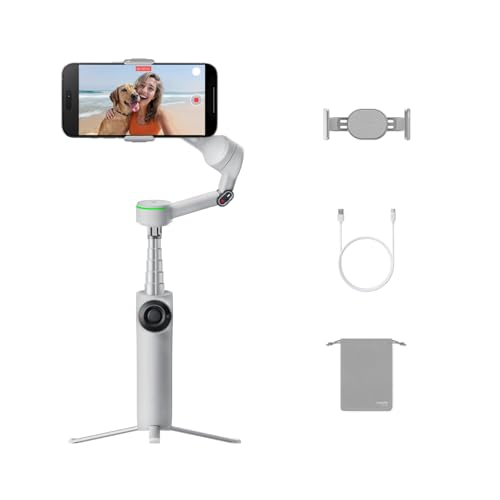
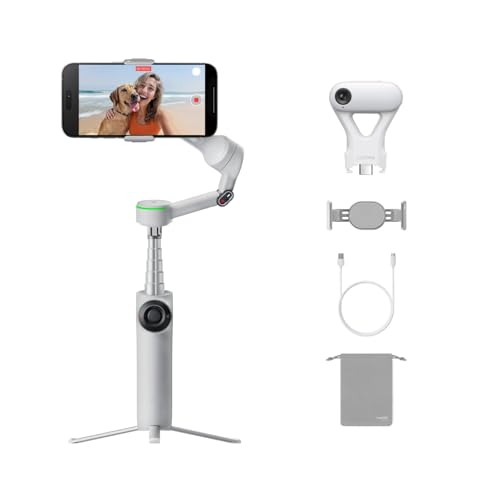
2. Insta360 Flow 2 Pro — Best Smartphone Gimbal for iPhone Creators
If you’re heavily invested in the iPhone ecosystem, the Insta360 Flow 2 Pro deserves very serious consideration.
Its standout feature is Apple DockKit support, which allows native tracking across more than 200 compatible iOS apps according to Insta360.
That means you’re less dependent on recording everything through one manufacturer’s camera app.
For creators who livestream, FaceTime, use social apps or shoot using different camera applications, that can be enormously convenient.
Specifications That Matter
Insta360 lists:
- approximately 357g gimbal weight
- 130–300g phone support
- 64–84mm phone width
- 6.9–10mm phone thickness
- built-in 210mm selfie stick
- integrated tripod
- approximately 10-hour battery life
- 360° continuous pan rotation
Why We Recommend It
The Flow 2 Pro packs an unusual amount of functionality into something that still feels like a travel accessory rather than filmmaking equipment.
Fold it.
Put it in your bag.
Open it when needed.
You get:
gimbal + selfie stick + mini tripod + power-bank functionality
in one device.
That is exactly the kind of product solo travel creators benefit from.
Tracking
Its 360° pan movement allows the gimbal to continue following a moving subject instead of reaching a physical rotation limit too quickly.
Insta360 also supports multi-person tracking and AI-assisted tracking options.
Best For
iPhone vloggers, solo travel creators, lifestyle creators, fitness creators and users who frequently switch between apps.
Pros
- Apple DockKit support
- Native tracking across many compatible iOS apps
- 360° continuous pan
- 210mm selfie stick
- Built-in tripod
- 10-hour rated battery
- Compact foldable form
- 300g payload support
Cons
- Some advantages are particularly iPhone-focused
- Android users should check specific tracking/app compatibility
- 300g limit means heavy cases/accessories can be problematic
- AI Tracker availability depends on bundle
Verdict
For an iPhone-first creator, Flow 2 Pro may actually be more attractive than DJI depending on how much you value app-wide native tracking.
- Versatile Tracking in 200+ iOS Apps: The first and only gimbal series with Apple DockKit*. An advanced gimbal stabilizer…
- Active Zoom Tracking: A first* for gimbals, Flow 2 Pro can track fast movement precisely, even at up to 15x zoom! Perfec…
- Multi-Person Tracking: A smart phone gimbal that tracks and frames your whole group! Ideal for family gatherings, campin…
- All-in-One Content Creation Tool: All your essential tools in one AI phone gimbal. A built-in tripod for iPhone and Andr…
- AI Tracker: Compatible with all platforms and devices, the AI Tracker delivers precise tracking even in challenging envi…
- Active Zoom Tracking: A first1 for gimbals, Flow 2 can track fast movement precisely, even at up to 15x zoom! Perfect fo…
- Versatile Tracking in 200+ iOS Apps: The first and only gimbal series with Apple DockKit*. An advanced gimbal stabilizer…
- AI Tracker: Compatible with all platforms and devices, the AI Tracker delivers precise tracking even in challenging envi…
- Active Zoom Tracking: A first* for gimbals, Flow 2 Pro can track fast movement precisely, even at up to 15x zoom! Perfec…
3. Hohem iSteady V3 Ultra — Best for Solo Creators
Most solo creators face one annoying problem:
You can’t see whether the camera is following you correctly when you’re standing several metres away.
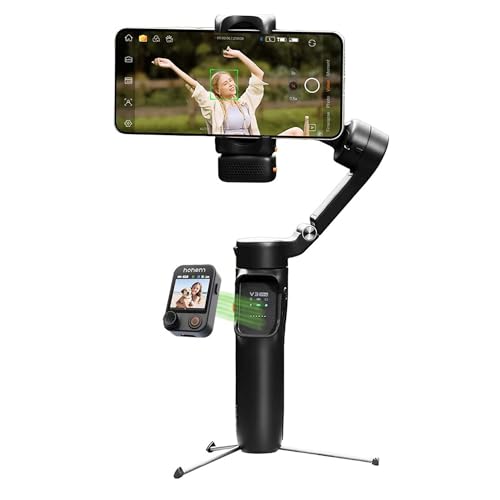
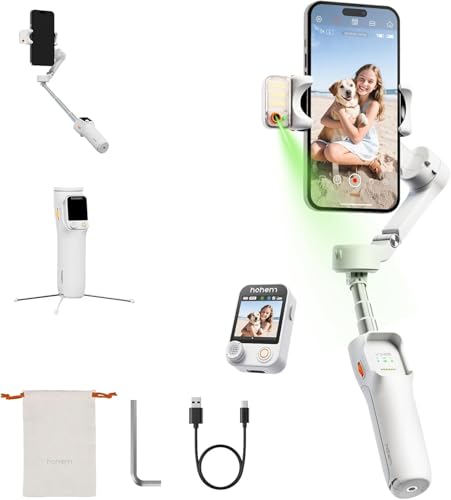
The Hohem iSteady V3 Ultra addresses this with a detachable touchscreen remote.
Hohem lists:
- 428g gimbal weight
- 400g maximum payload
- 58–98mm phone-width support
- 360° infinite pan
- built-in extension pole
- built-in tripod
- detachable 1.22-inch touchscreen remote
- AI tracking
- three-colour fill light
- approximately nine-hour rated runtime
Why We Recommend It
That remote fundamentally changes solo shooting.
Instead of:
position phone → walk into frame → hope → walk back → check footage → repeat
you can control and monitor more of the setup remotely.
Hohem quotes remote operation up to roughly 10 metres for the touchscreen controller.
The gimbal also supports 400g, giving you significantly more headroom than the 300g limit used by DJI and Insta360 models.
That becomes useful when your smartphone has:
- a heavy protective case
- large camera bump
- magnetic accessories
- filter adapter
- small microphone
- external lens
Best For
Solo vloggers, cooking creators, fitness videos, dance videos, tutorials and creators filming themselves from a distance.
Pros
- 400g payload
- Detachable touchscreen remote
- Live-feed-oriented solo workflow
- 360° infinite pan
- AI tracking
- Built-in extension pole
- Built-in tripod
- Integrated fill light
- Foldable
Cons
- Heavier than DJI/Insta360 alternatives
- More complex than a simple beginner gimbal
- Approximate nine-hour rating drops with tracking/light use
- Remote itself has limited battery life
Verdict
If self-filming is your primary workflow, the V3 Ultra’s remote can be more useful than another cinematic shooting mode you’ll use twice.

- 【Al Tracking Smartphone Gimbal】hohem iSteady V3 stabilizer equipped with a magentic AI traker sensor, it works with all …
- 【Detachable Remote Control】Versatile Control at Your Fingertips. Control your phone camera with ease and precision, ensu…
- 【3-Axis Stabilization iSteady 8.0 】hohem iSteady V3 phone gimbal stabilizer,with a decade of technical refinement behind…

- Tracking Everything You Can See: The new AI tracker of Hohem iSteady V3 Ultra smartphone gimbal can accurately track not…
- Touch to Control, Shoot with Ease: New visual touchscreen detachable remote control makes gimbal operation more intuitiv…
- 360° Infinite Pan Following: Except for the new iSteady 9.0 stabilization technology ensures anti-shake, the 360° infini…
- 【AI Vision Sensor & Seamless Tracking】 Built-in high-precision AI vision sensor enables stable, fluid auto-tracking of p…
- 【3-Axis Stabilization & Lossless Vertical Shooting】 A powerful 3-axis motor system effectively counteracts hand shake, e…
- 【Built-in Telescopic Extension Rod & Dual-Color Temperature Fill Light】 Innovative integrated retractable extension rod …
- 【AI Vision Sensor & Seamless Tracking】 Built-in high-precision AI vision sensor enables stable, fluid auto-tracking of p…
- 【Built-in Telescopic Extension Rod & Dual-Color Temperature Fill Light】 Innovative integrated retractable extension rod …
- 【3-Axis Stabilization & Lossless Vertical Shooting】 A powerful 3-axis motor system effectively counteracts hand shake, e…
4. Hohem iSteady M7 — Best for Heavy Phones and Creator Rigs
Now we reach the gimbal for people who looked at a 300g payload limit and said:
“Cute.”
The Hohem iSteady M7 supports smartphones and rigs weighing up to 500g.
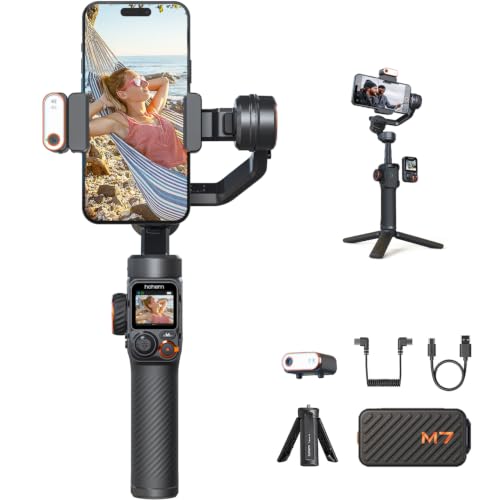
Hohem specifies:
- 629g gimbal weight
- 500g maximum payload
- 58–90mm phone width
- 6.9–12.5mm thickness
- 360° infinite pan
- detachable 1.4-inch touchscreen remote
- 205mm built-in extension pole
- AI tracker
- RGB/CCT fill light
- approximately 12-hour runtime under ideal stationary conditions
Why We Recommend It
Payload.
Simple.
A modern flagship smartphone with a thick case can already become surprisingly heavy.
Now add:
- mobile lens
- filter system
- SSD
- microphone receiver
- adapter
- cage
and compact gimbals can quickly reach their limits.
The M7 gives creators much more breathing room.
Remote Live View
Hohem’s detachable controller can operate from around 10 metres away, while the company quotes video transmission up to approximately seven metres.
That makes it particularly interesting for:
- livestreaming
- solo filming
- studio podcasts
- product demonstrations
- workout videos
Battery
Hohem claims:
- about 12 hours balanced/stationary
- about 8 hours with AI tracking
- around 3–4 hours using tracking plus fill light
Again: feature-heavy operation eats battery.
Best For
Serious mobile filmmakers, heavy flagship phones, smartphone cages and accessory-heavy creator rigs.
Pros
- Huge 500g payload
- 1.4-inch remote screen
- App-independent-style AI tracking workflow
- Built-in extension pole
- RGB/CCT fill light
- 360° pan
- Reverse phone charging
- Excellent for complex rigs
Cons
- 629g before tripod
- Large folded dimensions
- Much less pocketable
- Premium price
- Overkill for casual vlogging
Verdict
For an iPhone or Android phone loaded with creator accessories, the M7 is the model I would trust before trying to force everything onto a lightweight travel gimbal.

- 3 colors & Magnetic Fill Light – The fill light offers 3 different color temperature settings and 10 brightness levels. …
- Multiple creative modes & Multi-Functional Ports – Enjoy limitless creative freedom with 600° Inception Mode, allowing f…
- Max Payload 280g & Universal Compatibility – Benefit from a 20% increase in motor torque, enabling the gimbal to handle …
- 【Enhanced Magnetic Al Tracker】With hohem isteady m7 phone gimbal, you can now track any subject with phone native camera…
- 【Detachable Touchscreen Remote】The hohem isteady m7 phone stabilizer now comes with a detachable 1.4" full color touchsc…
- 【Built-in Extension Rod】The built-in sturdy aluminum extension rod helps you to get creative shots from high or low angl…
5. Zhiyun Smooth 5S AI — Best for Manual Filmmaking Control
The Zhiyun Smooth 5S AI feels less like a selfie-stick replacement and more like a filmmaking tool.
Zhiyun rates it for smartphones weighing approximately 150–300g, while the gimbal itself weighs around 625g.
That immediately tells you the priority:
Portability is not the main story.
Control is.
Why We Recommend It
The Smooth 5S AI caters to creators who enjoy deliberate filmmaking.
Its design focuses on:
- three-axis stabilisation
- physical controls
- AI tracking
- lighting accessories
- advanced movement modes
- manual creative operation
The available configurations can include additional magnetic fill lighting alongside the integrated lighting setup.
Battery Claim Needs Context
Zhiyun quotes a runtime range from approximately 2 hours 20 minutes to 26 hours depending on conditions.
That enormous range exists because the maximum figure is measured under low-demand/standby-style conditions, while using multiple lights at maximum brightness dramatically reduces runtime.
So do not look at “26 hours” and immediately crown it battery king.
Best For
Mobile filmmakers, cinematic vloggers, creators who enjoy manual movement and people who prioritise control over compactness.
Pros
- Strong physical controls
- 3-axis stabilisation
- AI tracking
- Lighting options
- Cinematic movement modes
- 300g payload
- Long potential standby runtime
Cons
- Approximately 625g
- Bulky compared with Flow or Osmo Mobile
- Learning curve
- Battery performance varies dramatically with lighting usage
Verdict
If you enjoy actively operating the gimbal rather than relying entirely on automated tracking, the Smooth 5S AI is one of the more filmmaker-oriented choices.

- [Always Follow the Target] ZHIYUN Smooth 5S AI features an innovative AI tracking module for rapid and responsive target…
- [Make Every Moment Shine] Smooth 5S AI gimbal features a built-in high-power fill light for stunning illumination. The P…
- [Pro-Level Stability] With the same orthogonal 3-axis structure as pro camera stabilizers and advanced stabilization alg…
6. Insta360 Flow 2 — Best Compact Value Gimbal
Not every vlogger needs the Pro version.
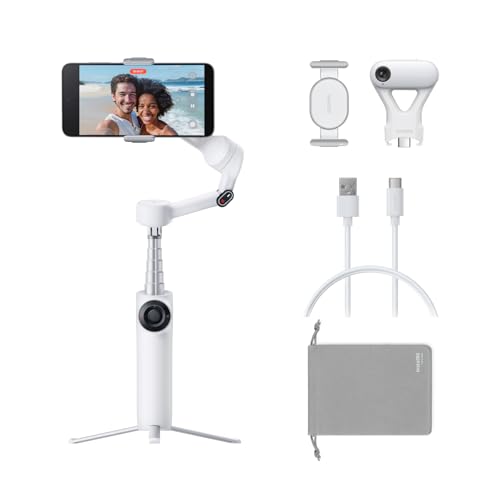
The regular Insta360 Flow 2 shares much of the same compact hardware philosophy while coming in lighter at approximately 348g.
It supports phones weighing 130–300g, includes an approximately 207mm built-in selfie stick, built-in tripod and up to 10-hour rated runtime.
Why We Recommend It
This is the model for someone whose priorities are:
- compact
- simple
- travel-friendly
- affordable
- still genuinely useful
Rather than:
“I require seventeen tracking systems and a remote command centre.”
The Flow 2 series can also use Insta360’s optional AI Tracker for iOS/Android tracking beyond the company’s app ecosystem.
Key Difference vs Flow 2 Pro
The Pro model’s major attraction is its broader Apple DockKit integration and continuous 360° pan capability.
The regular Flow 2 has a more limited pan mechanical range.
Best For
Travel, beginner vloggers, casual YouTube filming and creators prioritising portability.
Pros
- Only around 348g
- Foldable
- Built-in 207mm selfie stick
- Built-in tripod
- 300g payload
- 10-hour rated battery
- AI tracking available with compatible tracker/bundle
Cons
- No Flow 2 Pro-style continuous 360° pan
- Less compelling native iPhone integration
- Tracking features vary by bundle
- 300g payload ceiling
Verdict
If the Flow 2 Pro’s advanced tracking isn’t important, the Flow 2 may be the smarter value purchase.

- All-in-One Content Creation Tool: All your essential tools in one AI phone gimbal. A built-in tripod for iPhone and Andr…
- Active Zoom Tracking: A first1 for gimbals, Flow 2 can track fast movement precisely, even at up to 15x zoom! Perfect fo…
- Multi-Person Tracking: A smart phone gimbal that tracks and frames your whole group! Ideal for family gatherings, campin…
7. Digitek DSG 009F AI — Best Budget Smartphone Gimbal in India
Budget gimbals are tricky.
Some are basically glorified selfie sticks with one motor and enough “AI” written on the listing to frighten ChatGPT.
The Digitek DSG 009F AI, however, is a proper 3-axis model aimed specifically at Indian buyers.
Digitek lists:
- 3-axis stabilisation
- AI face tracking
- telescopic extension system
- external microphone support
- 382g weight
- portrait/landscape switching
- 55–90mm phone width compatibility
- 7–12mm phone thickness compatibility
Why We Recommend It
Availability and after-sales practicality matter.
Digitek is much easier for many Indian buyers to find than niche imported gimbal brands.
The built-in telescopic system also makes it convenient for:
- selfie videos
- talking-head clips
- travel
- Shorts/Reels
- live streaming
Digitek’s current product collection shows several 3-axis models in roughly the ₹5,000–₹7,500 bracket, though availability fluctuates.
Important Caveat
The manufacturer page for the AI 009F was showing sold out when checked, so availability may depend on Amazon, camera stores or other marketplace stock.
Best For
Indian creators on a tighter budget who want real three-axis stabilisation.
Pros
- 3-axis design
- India-focused availability
- AI face tracking
- Extendable rods
- External mic support
- Around 382g
- Horizontal/vertical switching
- More affordable than premium models
Cons
- Less sophisticated ecosystem than DJI/Insta360
- Stock fluctuates
- Tracking/app experience may not match premium systems
- Exact package features can vary between AI/non-AI versions
Verdict
For budget-conscious Indian vloggers, this offers a useful middle ground between cheap selfie-stick stabilisers and ₹10,000+ premium gimbals.

- 𝗪𝗶𝗱𝗲 𝗔𝗻𝗴𝗹𝗲: Capture expansive scenes and broaden your creative possibilities.
- 𝟯 𝗔𝘅𝗶𝘀 𝗧𝗲𝗰𝗵𝗻𝗼𝗹𝗼𝗴𝘆: Digitek DSG-009F features advanced 3 Axis stabilization, ensuring smooth and steady footage.
- 𝗧𝗲𝗹𝗲𝘀𝗰𝗼𝗽𝗶𝗰 𝗘𝘅𝘁𝗲𝗻𝗱𝗮𝗯𝗹𝗲 𝗥𝗼𝗱𝘀: Built-in 3 Telescopic Rods that are both extendable and adjustable, providing versatile shoo…

- 𝗣𝗿𝗲𝗰𝗶𝘀𝗶𝗼𝗻 𝗦𝘁𝗮𝗯𝗶𝗹𝗶𝘇𝗮𝘁𝗶𝗼𝗻: Enjoy smooth footage with the Digitek DSG-007F AI 3-Axis Gimbal's wide-angle stabilization, ens…
- 𝗜𝗻𝘁𝗲𝗹𝗹𝗶𝗴𝗲𝗻𝘁 𝗔𝗜 𝗧𝗿𝗮𝗰𝗸𝗶𝗻𝗴: Experience the future with the built-in AI Tracker, allowing your gimbal to follow subjects int…
- 𝗔𝗻𝗴𝗹𝗲 𝗖𝗼𝗻𝘁𝗿𝗼𝗹: Capture every angle with a 325° Roll Angle, 160° Tilt Angle, and 340° Pan angle providing unparalleled fl…
Smartphone Gimbal Comparison Table
| Model | Payload | Weight | Extension Rod | Tripod | 360° Pan | Standout Feature |
|---|---|---|---|---|---|---|
| DJI Osmo Mobile 8 | 300g | ~370g | 215mm | Built-in | Yes | Best overall workflow |
| Insta360 Flow 2 Pro | 300g | 357g | 210mm | Built-in | Yes | Apple DockKit |
| Hohem V3 Ultra | 400g | 428g | 193mm | Built-in | Yes | Touchscreen remote |
| Hohem M7 | 500g | 629g | 205mm | Included | Yes | Heavy-phone support |
| Zhiyun Smooth 5S AI | 300g | 625g | Model/config dependent | Accessory | Full pan range | Manual control + lights |
| Insta360 Flow 2 | 300g | 348g | 207mm | Built-in | Limited vs Pro | Compact value |
| Digitek DSG 009F AI | Phone-size based | 382g | Telescopic | Check bundle | 340° pan range | Budget India option |
What Does a Smartphone Gimbal Actually Do?
A modern phone already has optical and electronic stabilisation.
So why add another machine?
Because the two systems operate differently.
Your smartphone stabilisation primarily works inside the camera system or through software.
A gimbal physically moves the entire phone using motors.
Three-axis gimbals stabilise movement across:
Pan
Left and right rotation.
Tilt
Up and down movement.
Roll
Side-to-side horizon rotation.
That physical stabilisation becomes particularly useful during:
- walking
- running
- orbit shots
- cinematic reveals
- slow pans
- travel vlogs
- subject tracking
Do You Need a Gimbal If Your Phone Has OIS?
Not always.
For a simple static talking-head video, probably not.
For a short clip where you’re standing mostly still, your phone’s stabilisation may already be excellent.
A gimbal becomes much more useful when the camera itself moves deliberately.
For example:
Walking through a market.
Following someone.
Moving around a product.
Creating an orbit shot.
Walking backwards while presenting.
Those movements are where mechanical stabilisation starts earning its place in your bag.
What to Look for When Buying a Smartphone Gimbal
1. Check Your Phone’s Weight First
This is the rule people most commonly ignore.
Do not check your phone’s naked factory weight if you actually record with:
- case
- MagSafe accessory
- SSD
- lens
- filter
- microphone
Weigh the real recording setup.
A 227g phone can very quickly become a 300g+ rig.
2. Check Width and Thickness Too
Payload is not the only limitation.
DJI Osmo Mobile 8 supports approximately:
67–84mm width
and:
6.9–10mm thickness.
Hohem M7 accepts thicker phones up to approximately 12.5mm and considerably more weight.
Cases matter.
3. Decide Whether Tracking Works Outside the App
This is becoming one of the biggest differentiators.
Older gimbals often required you to use the manufacturer’s camera application for subject tracking.
Newer systems increasingly support:
- native camera tracking
- hardware AI trackers
- Apple DockKit
- third-party apps
This matters enormously if you shoot directly inside Instagram, TikTok, livestreaming software or your phone’s native camera.
4. Look for a Built-In Tripod
For vloggers, this is one of the most useful features.
Put the gimbal down.
Walk into frame.
Track yourself.
Suddenly the person holding your camera has been replaced by three tiny plastic legs.
Technology. 😂
5. Built-In Extension Rod
An extension rod helps with:
- wider selfies
- overhead shots
- low angles
- travel scenery
- group shots
Around 200mm is common among the premium all-in-one models in this list.
6. Battery Life
Do not compare battery figures blindly.
Manufacturers often quote maximum battery life under:
- balanced setup
- stationary operation
- lighting off
- tracking off
The moment you activate:
AI tracking + fill light + phone charging
runtime can drop dramatically.
7. Horizontal and Vertical Shooting
Any gimbal bought for social content in 2026 needs a sensible portrait workflow.
Because you will probably create:
YouTube → horizontal
and then immediately:
Shorts/Reels → vertical.
Check how easy the rotation is before buying.
AI Tracking vs App Tracking
App-Based Tracking
The gimbal’s app analyses your camera feed and instructs the motors to follow the subject.
Advantage
Can support advanced framing and creative modes.
Disadvantage
You may be forced to use the manufacturer’s camera app.
Hardware AI Tracking
A separate camera/sensor on the gimbal tracks you directly.
This allows tracking while using other camera applications.
Hohem relies heavily on this approach with devices such as the M7 and V3 Ultra.
Apple DockKit
Compatible gimbals can integrate with Apple’s tracking framework across supported iOS apps.
Insta360 says Flow 2 Pro supports DockKit tracking across 200+ compatible iOS apps.
DJI’s Osmo Mobile 8 also supports Apple DockKit-based native tracking.
For iPhone vloggers, this is becoming an increasingly important buying feature.
Smartphone Gimbal vs Tripod: Which Do You Need?
They solve different problems.
Buy a Tripod If:
You mostly record:
- talking-head videos
- cooking videos
- product demonstrations
- podcasts
- static tutorials
Buy a Gimbal If:
You mostly record:
- travel vlogs
- walking footage
- cinematic B-roll
- moving subjects
- follow shots
- dynamic Shorts/Reels
Modern gimbals with built-in tripods blur the line slightly.
But their tiny integrated tripod still does not replace a full-height camera tripod.
Smartphone Gimbal vs Electronic Stabilisation
Electronic stabilisation is fantastic.
But it frequently stabilises by cropping and digitally processing the frame.
A gimbal physically changes the camera orientation.
That gives you smoother deliberate movement while preserving more control over composition.
For the best result, creators often combine:
phone stabilisation + gimbal stabilisation + good walking technique.
Yes, your walking technique still matters.
Buying a ₹15,000 gimbal and sprinting like you’re escaping a dinosaur will not produce a Netflix dolly shot. 😭
Common Smartphone Gimbal Buying Mistakes
Buying Without Checking Phone Weight
The number-one mistake.
Cases and accessories count.
Buying for AI Features You Will Never Use
If all you need is smooth walking footage, you may not need the fanciest remote-tracking system.
Assuming More Payload Automatically Means Better
The Hohem M7 supports 500g.
Amazing.
It also weighs 629g.
For a three-hour walking tour, your wrist may have opinions.
Ignoring Folded Size
Travel creators should care almost as much about folded dimensions as stabilisation quality.
Gear that stays in the hotel room cannot stabilise anything.
Expecting Better Image Quality
A gimbal improves movement.
It does not improve:
- sensor size
- low-light noise
- dynamic range
- lens sharpness
- microphone quality
If your footage looks noisy at night, stabilising that noise beautifully does not solve the problem.
Forgetting About Audio
Your video can be silky smooth and still sound terrible.
For serious vlogging, pair the gimbal with a good wireless microphone or compatible external mic setup.
How We Selected These Smartphone Gimbals
For this guide, we compared current smartphone gimbals using criteria relevant specifically to vloggers:
- three-axis stabilisation
- phone payload
- phone width/thickness support
- gimbal weight
- folded portability
- subject tracking
- native-camera tracking
- detachable remotes
- extension poles
- built-in tripods
- vertical shooting
- battery life
- phone charging
- lighting
- creator accessories
- India availability
- overall value
Specifications were checked primarily against current manufacturer information from DJI, Insta360, Hohem, Zhiyun and Digitek.
Current 2026 independent buying guides also broadly identify the DJI Osmo Mobile 8, Insta360 Flow 2 Pro and Hohem M7 among the strongest current options, although different reviewers rank them differently depending on testing priorities.
BestBuy93.IN does not claim hands-on testing unless explicitly stated.
Prices, bundles and availability can change significantly, so always check exactly which tracker, light, remote, tripod or accessory is included before purchasing.
In Case You Are Looking For –
- Best Smartphones for YouTube Video Recording
- Best Camera Tripods for Vlogging
- Best Vlogging Cameras with Flip Screens for Content Creators
- Best Cameras for Beginner YouTubers
- Best USB Microphones for Voiceovers, Podcasts and YouTube Recording
- Best Smartphone Teleprompters for Recording Talking-Head Videos
- Best Portable SSDs for Backing Up Smartphone Photos and Videos
Frequently Asked Questions
Which smartphone gimbal is best for vloggers?
The DJI Osmo Mobile 8 is our best overall choice because it combines three-axis stabilisation, 360° pan rotation, built-in extension rod, tripod, tracking and phone charging in a relatively compact setup.
Which gimbal is best for iPhone?
The Insta360 Flow 2 Pro is particularly compelling for iPhone because of its Apple DockKit integration and tracking support across more than 200 compatible iOS apps.
DJI Osmo Mobile 8 also supports Apple DockKit.
Which smartphone gimbal supports the heaviest phones?
Among the models in this guide, the Hohem iSteady M7 has the highest stated payload at 500g.
That makes it particularly useful for heavy phones, thick cases and accessory-equipped rigs.
Which gimbal is best for solo creators?
The Hohem iSteady V3 Ultra is particularly good for solo creators because it includes a detachable touchscreen remote, AI tracking, extension pole and integrated tripod.
Can a gimbal work with Android phones?
Yes.
DJI, Insta360, Hohem, Zhiyun and Digitek all support Android smartphones, but exact app features can vary by phone model.
Always check the manufacturer’s compatibility list.
Do gimbals work with phone cases?
Sometimes.
Thin cases may work.
Thick rugged cases can push the phone beyond the supported:
- width
- thickness
- weight
If the phone does not balance properly, remove the case.
Do I need a gimbal for YouTube Shorts?
Not necessarily.
For stationary Shorts, a tripod may be enough.
A gimbal becomes especially useful for:
- walking Shorts
- fashion videos
- travel
- transitions
- cinematic B-roll
- follow shots
Is DJI Osmo Mobile 7 still worth buying?
Yes if the discount is substantial.
The Osmo Mobile 7 remains a capable three-axis stabiliser with an integrated tripod, up to 10-hour rated battery life and support for DJI’s tracking module.
However, the newer Osmo Mobile 8 adds features such as 360° pan rotation and improved native tracking functionality, so the older model should be clearly cheaper.
What about DJI Osmo Mobile 8P?
The newer Osmo Mobile 8P adds DJI’s FrameTap remote system, including remote control and phone-screen mirroring from up to around 10 metres, alongside upgrades to its tracking module and tripod design.
It is worth considering for creators who regularly film themselves from a distance.
For ordinary handheld travel vlogging, however, the standard OM8 is easier to justify on value.
Final Verdict
For most vloggers, the DJI Osmo Mobile 8 is our Best Overall smartphone gimbal.
It gives you the features creators genuinely use three-axis stabilisation, 360° pan movement, a built-in 215mm extension rod, integrated tripod, native tracking and phone charging without becoming excessively heavy.
If you’re an iPhone-first creator, the Insta360 Flow 2 Pro is arguably the strongest alternative thanks to Apple DockKit integration, 360° tracking, built-in selfie stick and excellent travel-friendly design.
For creators filming themselves alone, choose the Hohem iSteady V3 Ultra for its detachable touchscreen remote.
If your phone setup is heavy or packed with accessories, move up to the Hohem iSteady M7 and its 500g payload.
The Zhiyun Smooth 5S AI suits creators who want a more hands-on cinematic tool, while the standard Insta360 Flow 2 offers a cleaner balance of portability and price.
And for Indian beginners working with a tighter budget, the Digitek DSG 009F AI is worth considering when available.
The big buying lesson is simple:
Don’t ask which gimbal has the most AI features. Ask which one you will actually carry and use.
Because the world’s smartest tracking gimbal is spectacularly useless when it is sitting at home while you’re recording your Bali vlog handheld. 📱🎥✨