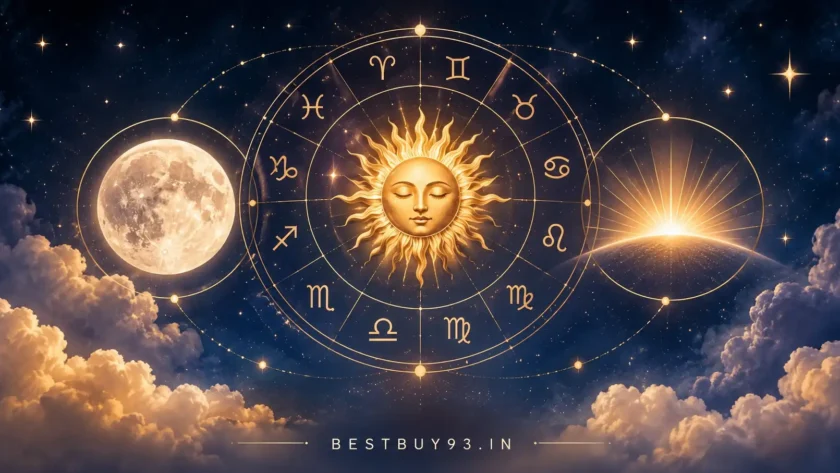

If someone asks, “What’s your zodiac sign?”, you’ll probably share the sign associated with your birthday. But astrology has a little more going on than that! Your birth chart includes three important placements often called the Big Three: Sun sign, Moon sign and Rising sign.
In astrological traditions, these placements represent different symbolic aspects of your personality. Your Sun sign is associated with your core identity, your Moon sign with your emotional world, and your Rising sign with your outward approach to life. They can all be different, which is why someone might identify with one sign privately but seem quite different when meeting new people.
In this guide, we’ll break down what each sign means, how they differ, what information you need to calculate them, and how to understand all three together. We’ll also look at the difference between Western and Vedic astrology, because the terminology can get confusing especially when one birth chart seems to show different signs from another.
Quick Answer: Sun Sign vs Moon Sign vs Rising Sign
- Sun sign: Traditionally represents your core identity, sense of self, vitality and conscious expression.
- Moon sign: Traditionally represents your emotions, instincts, inner needs and comfort zone.
- Rising sign: Also called the Ascendant, it represents your outward approach, first impressions and the starting point of your astrological houses.
The biggest practical difference is how each placement is calculated. Your Sun sign is generally determined by your birth date, your Moon sign requires the Moon’s position at your birth, and your Rising sign requires your exact birth time and birthplace.
What Is a Sun Sign?
Your Sun sign is the zodiac sign in which the Sun was positioned at the time of your birth, according to the zodiac system being used. It is the sign most people mean when they ask, “What’s your zodiac sign?”
For example, someone born in late October or early November may have a Scorpio Sun in the Western tropical zodiac, depending on the exact date and year.
In astrology, the Sun is traditionally associated with your central identity, confidence, personal goals, vitality and the way you consciously express yourself.
Think of it as the central character in your astrological story. It is not meant to describe every little detail about you, but it offers one symbolic perspective on your sense of self.
What Does Your Sun Sign Represent?
Astrologers commonly associate the Sun sign with:
- Core identity: How you understand and express your sense of self.
- Personal goals: What motivates you and what you want to achieve.
- Confidence: How you express your individuality.
- Vitality: Your symbolic source of energy and enthusiasm.
- Conscious expression: The qualities you may consciously identify with.
Why Is the Sun Sign So Popular?
Sun signs are popular because they are relatively easy to calculate. Most people only need their date of birth to find an approximate Sun sign.
This is why newspaper horoscopes, magazine predictions and many online zodiac guides are organised around Sun signs.
However, there’s one small catch: if you were born close to the date when the Sun changes zodiac signs, you may need your birth year, exact time and location to confirm the placement. Zodiac sign dates are useful guidelines, not universal cut-off times.
What Is a Moon Sign?
Your Moon sign is the zodiac sign occupied by the Moon at the time of your birth.
While the Sun sign is traditionally connected with conscious identity, the Moon sign is associated with your emotional world, instincts, habits and inner needs.
In simple language, if your Sun sign represents how you consciously express yourself, your Moon sign is often used in astrology to explore how you respond emotionally when nobody is watching.
For example, a person may appear confident and adventurous in public but prefer a peaceful, predictable environment at home. Astrologers might explore the Moon sign to understand that private side of their symbolic birth-chart profile.
What Does Your Moon Sign Represent?
In traditional astrological interpretations, the Moon sign is associated with:
- Emotional responses: How you may react to different situations.
- Inner needs: What makes you feel comfortable and secure.
- Instincts: Your automatic reactions and natural habits.
- Personal comfort: The environments and routines you may find reassuring.
- Private self: The emotional side you may not show everyone.
Why Does the Moon Sign Change More Frequently?
The Moon moves through the zodiac much faster than the Sun. It generally spends around two to two-and-a-half days in each zodiac sign.
This means two people born just a few days apart may have different Moon signs, even if they share the same Sun sign.
Your date of birth may be enough to calculate your Moon sign on many days. However, if the Moon changed signs on your birthday, the exact birth time becomes important.
Is Moon Sign the Same as Rashi?
Not necessarily in every context.
In Indian Vedic astrology, the term Janma Rashi commonly refers to the zodiac sign occupied by the Moon at birth in the sidereal zodiac. This is why Indian horoscope discussions often place considerable importance on the Moon sign.
However, a Western tropical Moon sign and a Vedic sidereal Moon sign may differ because the two systems use different zodiac reference points.
What Is a Rising Sign?
Your Rising sign, also known as the Ascendant, is the zodiac sign that was rising over the eastern horizon at the exact time and place of your birth.
Unlike your Sun and Moon signs, the Rising sign is not a planet or celestial body. It is a calculated point in your birth chart.
In astrology, the Ascendant is traditionally associated with your outward personality, first impressions, natural approach to unfamiliar situations and the way you interact with your surroundings.
For example, someone might have a quiet and reserved inner nature but come across as confident, expressive or energetic when meeting people. Astrologers may interpret the Rising sign as one symbolic explanation for that difference.
What Does Your Rising Sign Represent?
Astrologers commonly associate the Ascendant with:
- First impressions: How others may initially perceive you.
- Outward expression: Your natural manner and approach.
- Social behaviour: How you enter unfamiliar situations.
- Personal style: The way you present yourself to the world.
- Chart structure: The starting point for the twelve astrological houses.
Why Is the Exact Birth Time Important?
The Rising sign changes throughout the day as Earth rotates. It moves through all twelve zodiac signs over approximately 24 hours, often changing signs around every two hours.
However, this is only an average. The actual duration varies with the date and geographical latitude.
Even a difference of a few minutes can change the Ascendant’s degree. A larger error in birth time may produce a different Rising sign altogether.
That’s why a birth certificate, hospital record or reliable family record can be useful when calculating your Ascendant.
Is Rising Sign the Same as Lagna?
In Vedic astrology, the Ascendant is commonly known as Lagna or Udaya Lagna.
It plays an important role in the structure and interpretation of a Vedic birth chart, including the placement of the twelve houses.
Sun Sign vs Moon Sign vs Rising Sign: Key Differences
Now that we understand each placement individually, let’s compare them side by side.
| Feature | Sun Sign | Moon Sign | Rising Sign |
|---|---|---|---|
| Also called | Zodiac sign or Sun placement | Lunar sign or Rashi | Ascendant or Lagna |
| Astrological association | Core identity | Emotions and instincts | Outward approach and first impressions |
| Based on | Sun’s position | Moon’s position | Sign rising on eastern horizon |
| Information required | Birth date; exact details near sign changes | Birth date and sometimes exact time | Birth date, exact time and birthplace |
| How frequently it changes | About once a month | About every 2–2.5 days | Approximately every 2 hours, on average |
| Common use | General zodiac horoscopes | Emotional and inner-world interpretations | Chart houses and outward expression |
These are average astronomical timings and common astrological interpretations. Actual sign boundaries depend on the birth moment and the zodiac system used.
The Easiest Way to Remember the Difference
If you’re still mixing them up, remember this simple explanation:
- Sun sign: Your central identity.
- Moon sign: Your emotional world.
- Rising sign: Your approach to the outside world.
Imagine meeting someone for the first time. Their Rising sign is traditionally used to explore the impression they make. As you get to know them, their Sun sign represents another layer of their identity. Their Moon sign is associated with their private emotional needs and reactions.
Of course, real people are more complicated than three zodiac placements. That’s part of why astrologers interpret the entire birth chart rather than relying on one sign alone.
Why Are Your Sun, Moon and Rising Signs Sometimes Different?
This is one of the most common questions among people exploring astrology for the first time.
Your three placements are calculated using different astronomical positions. The Sun, Moon and Earth’s rotation do not follow the same cycle through the zodiac.
Consequently, there is no reason your three placements must fall in the same sign.
For example, an individual could have:
- Sun in Scorpio
- Moon in Cancer
- Rising in Gemini
In a traditional astrological interpretation, this combination might be explored as a blend of Scorpio’s intensity and determination, Cancer’s emotional sensitivity and Gemini’s curious, communicative outward approach.
Notice how each placement adds a different symbolic layer.
Can All Three Signs Be the Same?
Yes! Your Sun, Moon and Rising signs can all fall in the same zodiac sign.
For example, someone may have:
- Sun in Leo
- Moon in Leo
- Rising in Leo
Astrologers may interpret this as a strong concentration of Leo themes in the person’s Big Three.
Similarly, two placements may share a sign while the third is different.
There is no rule that says your Big Three must be three separate zodiac signs.
How to Find Your Sun, Moon and Rising Signs
Finding your Big Three is relatively straightforward if you have the correct birth information.
Here’s what you’ll need:
| Birth Information | Why It Matters |
|---|---|
| Date of birth | Helps calculate the Sun and Moon positions |
| Time of birth | Important for the Moon near sign changes and essential for the Rising sign |
| Place of birth | Provides the geographical coordinates needed to calculate the Ascendant |
Step 1: Find Your Sun Sign
Enter your birth date into a zodiac calculator that specifies whether it uses Western tropical or Vedic sidereal astrology.
If you were born close to a zodiac sign transition, use your exact birth time and birthplace for a more reliable result.
Step 2: Find Your Moon Sign
Use a birth-chart calculator or Moon-sign calculator.
Enter your date of birth and, ideally, your exact birth time and location. This is particularly important if the Moon changed signs around your birth.
Step 3: Find Your Rising Sign
For this calculation, your exact birth time and birthplace are essential.
Enter all three details into a natal chart calculator. The result should identify your Ascendant along with its degree.
Step 4: Check Which Astrology System Is Being Used
Before comparing results from different websites, check whether the calculator uses:
- Western tropical astrology
- Vedic sidereal astrology
The two systems can produce different zodiac sign placements for the same birth moment. We’ll explain why below.
Helpful tip: Use the original birthplace, not your current city. The Rising sign is calculated using the local horizon at the time and place of birth.
What If You Don’t Know Your Exact Birth Time?
Don’t worry! Not knowing your birth time does not make your entire birth chart useless.
You can still explore some placements, but you should be careful about treating uncertain results as confirmed.
Here’s what you can generally calculate:
| Placement | Can You Find It Without Birth Time? |
|---|---|
| Sun sign | Usually yes |
| Moon sign | Often, but not always reliably |
| Rising sign | No, not reliably |
| Astrological houses | No, not reliably |
Can You Calculate Your Rising Sign Without a Birth Time?
There is no dependable way to confirm your Rising sign without knowing your birth time.
Some astrologers offer a process called birth time rectification, which attempts to estimate a birth time by comparing major life events with astrological techniques.
However, this is an interpretive process, not a guaranteed way to recover the exact time.
Avoid accepting a guessed Ascendant as a confirmed placement simply because its description sounds familiar.
What Can You Do Instead?
- Check your birth certificate.
- Ask your parents or family members.
- Look for hospital or maternity records if available.
- Use a calculator that clearly marks the Rising sign as unknown when the birth time is missing.
It is better to have an incomplete but honest chart than a complete chart based on an invented birth time!
How Do the Big Three Work Together?
The Big Three are generally interpreted together rather than as three separate personality labels.
Each placement adds a different perspective, and astrologers may examine how their signs interact.
Let’s look at a few simplified examples.
Example 1: Aries Sun, Pisces Moon and Libra Rising
In a traditional interpretation:
- Aries Sun: Associated with initiative, independence and action.
- Pisces Moon: Associated with sensitivity, imagination and emotional receptivity.
- Libra Rising: Associated with diplomacy, social awareness and harmony.
This combination might be interpreted as someone who enjoys taking the lead but also values emotional understanding and balanced interactions.
Example 2: Taurus Sun, Gemini Moon and Capricorn Rising
In astrological symbolism:
- Taurus Sun: Associated with stability, patience and consistency.
- Gemini Moon: Associated with curiosity, communication and mental stimulation.
- Capricorn Rising: Associated with responsibility, discipline and a practical approach.
An astrologer might read this combination as a blend of grounded personal values, an active inner mind and a composed outward manner.
Example 3: Leo Sun, Scorpio Moon and Sagittarius Rising
In traditional astrology:
- Leo Sun: Associated with creativity, confidence and self-expression.
- Scorpio Moon: Associated with emotional intensity, privacy and depth.
- Sagittarius Rising: Associated with openness, exploration and enthusiasm.
This combination may be interpreted as someone who expresses themselves confidently, experiences emotions intensely and approaches new experiences with curiosity.
These examples illustrate common astrological symbolism. They are not personality assessments or predictions about how a person must behave.
Western Astrology vs Vedic Astrology: Why Your Signs May Differ
This is especially important for readers in India.
Western astrology commonly uses the tropical zodiac, while traditional Vedic astrology uses the sidereal zodiac.
Both systems divide the zodiac into twelve signs, but they use different reference points.
Western Tropical Astrology
The tropical zodiac is linked to the seasonal cycle. Its starting point, 0° Aries, is defined by the March equinox.
This is the system commonly used in Western Sun-sign horoscopes.
Vedic Sidereal Astrology
Vedic astrology, also known as Jyotish, generally uses a sidereal zodiac that accounts for the apparent shift between the seasonal reference and the stellar background.
The correction used to align the sidereal zodiac is called Ayanamsha. Different calculation conventions exist, with Lahiri Ayanamsha widely used in India.
Why Does This Matter?
The two zodiac systems have gradually moved apart because of the Earth’s axial precession.
As a result, the same birth moment can produce different sign labels in tropical and sidereal charts.
For example, someone may have a Scorpio Sun in a Western tropical chart but a Libra Sun in a Vedic sidereal chart.
Neither result automatically means that one calculator is broken. The calculators may simply be using different zodiac systems.
| Feature | Western Tropical Astrology | Vedic Sidereal Astrology |
|---|---|---|
| Zodiac reference | Seasonal cycle | Stellar reference |
| Common terminology | Sun, Moon and Ascendant | Surya, Chandra Rashi and Lagna |
| Commonly used system | Tropical zodiac | Sidereal zodiac |
| Moon sign | Emotional interpretation | Important in Janma Rashi and traditional readings |
| Rising sign | Ascendant | Lagna |
Best practice: Always check the zodiac system before comparing your placements. Otherwise, you might end up comparing two different calculation methods as if one of them made a mistake.
Common Myths About Sun, Moon and Rising Signs
There are plenty of astrology explanations online, but a few misconceptions deserve attention.
| Myth | What to Understand Instead |
|---|---|
| Your Sun sign explains your entire personality. | It is one placement within a much larger birth chart. |
| Your Moon sign is always your real personality. | It is traditionally associated with emotions and inner needs, not a complete identity. |
| Your Rising sign is just your physical appearance. | Astrologers also connect it with your approach to life and chart houses. |
| Everyone has three different signs. | Two or all three placements can share the same sign. |
| Your Rising sign changes every month. | It changes throughout the day, roughly every two hours on average. |
| You can calculate your Rising sign using only your birthday. | You need the exact birth time and birthplace. |
| Western and Vedic astrology should give identical results. | They use different zodiac reference systems. |
| Astrology scientifically determines your personality. | Astrology is a belief and interpretive tradition, not a scientifically established personality test. |
The best way to explore astrology is with curiosity and an open mind. Use it as a cultural or symbolic framework for reflection rather than a fixed rulebook for your life.
Also Read | Vastu Shastra: Traditional Home Design Guide
Frequently Asked Questions
1. Which is more important: Sun sign, Moon sign or Rising sign?
There is no universal ranking. In astrology, each placement serves a different interpretive purpose. The Sun is associated with identity, the Moon with emotions and the Rising sign with outward approach and chart structure. Sun Sign vs Moon Sign vs Rising Sign
2. Can my Moon sign be different from my Sun sign?
Yes. The Sun and Moon move through the zodiac at different rates, so they can occupy completely different signs when you are born. Sun Sign vs Moon Sign vs Rising Sign
3. Does your Rising sign affect how people see you?
In traditional astrology, the Rising sign is associated with first impressions, outward manner and how you approach unfamiliar situations. It is one symbolic way astrologers interpret how a person presents themselves. Sun Sign vs Moon Sign vs Rising Sign
4. Why do I relate more to my Moon sign than my Sun sign?
Some people find the Moon sign descriptions more relatable because they focus on emotional needs, habits and private responses. Others identify more strongly with their Sun or Rising sign. Your personal experience does not need to match every astrological description. Sun Sign vs Moon Sign vs Rising Sign
5. Does your Rising sign change as you grow older?
Your natal Rising sign does not change. It is calculated from your birth moment and remains the same in your birth chart. Some astrological techniques interpret planetary transits and progressions over time, but they do not replace your original Ascendant. Sun Sign vs Moon Sign vs Rising Sign
6. Can two people have the same Sun, Moon and Rising signs?
Yes. People born at sufficiently close times and locations may share the same Big Three. However, their complete charts may still differ because of planetary degrees, houses and other placements. Sun Sign vs Moon Sign vs Rising Sign
7. Is Moon sign called Rashi in Indian astrology?
In common Vedic astrology usage, Janma Rashi usually refers to the Moon sign in the sidereal zodiac. It is an important reference point in many traditional Indian astrological practices. Sun Sign vs Moon Sign vs Rising Sign
8. What information do I need to calculate all three signs?
You need your date of birth, exact time of birth and birthplace. You should also check whether the calculator uses the tropical or sidereal zodiac. Sun Sign vs Moon Sign vs Rising Sign
Final Thoughts: Understanding Your Astrological Big Three
Your Sun sign, Moon sign and Rising sign offer three different perspectives within astrological traditions.
The Sun sign is traditionally linked with your core identity, the Moon sign with your emotional world, and the Rising sign with your outward approach to life. Together, they form an accessible starting point for exploring a birth chart.
If you’re new to astrology, don’t feel pressured to memorise all twelve signs or understand every planetary placement immediately. Start with your Big Three, learn what each represents, and explore how astrologers interpret them together.
And remember: your zodiac chart is not a box you have to fit into. Treat it as a symbolic language to explore, question and enjoy!