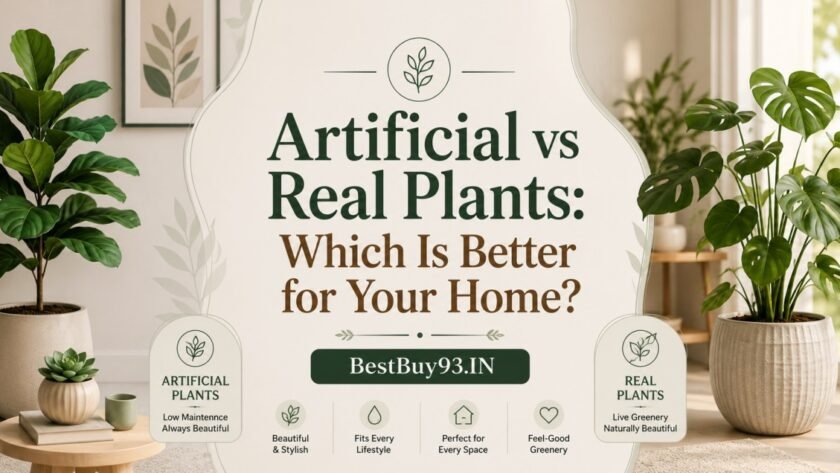

There is something about greenery that instantly makes a home feel more inviting. A few leafy plants can soften hard furniture lines, add colour to neutral interiors and make an otherwise empty corner feel intentionally styled. But then comes the eternal question:
Should you buy a real plant or an artificial one? 🪴🌿
Real plants bring living greenery into your home, but they also come with responsibilities. They need the right amount of light, water, suitable soil and occasional maintenance. Artificial plants, on the other hand, can give you a consistent decorative look without asking you to remember a watering schedule.
But does that automatically make artificial plants better?
Not necessarily.
The better choice depends on your lifestyle, available space, lighting conditions, maintenance preferences and what you actually want from your greenery.
In this Artificial vs Real Plants guide, we’ll compare both options across appearance, maintenance, sunlight, watering, growth, placement, longevity and cost so you can decide which works better for your home.
Also Read | 10 Best Artificial Plants for Every Home
🏆 Artificial vs Real Plants: Quick Comparison
| Feature | 🌿 Artificial Plants | 🪴 Real Plants |
|---|---|---|
| Watering | Not required | Required |
| Sunlight for growth | Not required | Usually required |
| Pruning | Not required | Often required |
| Fertilizing | Not required | Sometimes required |
| Growth | None | Natural growth |
| Appearance | Consistent | Changes naturally |
| Maintenance | Very Low | Low to High |
| Placement Flexibility | Excellent | Depends on plant |
| Longevity | Can last years with care | Depends on plant & care |
| Dust/Cleaning | Requires dusting | Requires leaf/soil care |
| Gardening Experience | No | Yes |
| Natural Living Organism | No | Yes |
| Styling Flexibility | Very High | Depends on conditions |
| Best For | Convenience | Natural greenery |
🌿 What Are Artificial Plants?
Artificial plants are decorative replicas made to resemble real plants.
They’re commonly manufactured using materials such as:
- Plastic
- Polyester
- Fabric
- Synthetic fibres
- Wire
- Foam
- Other manufactured materials
Better-quality artificial plants can feature detailed leaves, realistic stems, varied colours and textured surfaces.
Some are designed to look almost indistinguishable from the real plant from a normal viewing distance.
Why Do People Choose Them?
The biggest attraction is simple:
They look like greenery without requiring plant care.
You don’t need to worry about:
- Forgetting to water them
- Finding the right sunlight
- Repotting
- Pruning
- Fertilizing
- Seasonal growth
However, they aren’t completely maintenance-free.
They still need occasional dusting and cleaning, particularly if they’re placed in open areas.
🪴 What Are Real Plants?
Real plants are living organisms that grow naturally and require appropriate environmental conditions.
Depending on the plant variety, they may need:
- Water
- Sunlight
- Soil
- Nutrients
- Humidity
- Pruning
- Repotting
- Pest management
The amount of care varies dramatically.
A hardy Snake Plant is very different from a delicate tropical plant that needs carefully controlled conditions.
The Biggest Difference?
A real plant isn’t simply décor.
It is living greenery that changes over time.
New leaves appear.
Plants grow.
Some varieties flower.
Their appearance changes with the seasons and their growing conditions.
For many people, that’s part of the appeal.
👀 1. Appearance: Artificial vs Real
This is probably the first thing people consider.
🪴 Real Plants
Real plants naturally have:
- Irregular leaves
- Natural colour variations
- Different growth patterns
- Small imperfections
- Changing foliage
These imperfections are part of what makes them look authentic.
🌿 Artificial Plants
High-quality artificial plants can look surprisingly realistic.
The best versions usually have:
- Textured leaves
- Natural-looking veins
- Varied foliage
- Realistic stems
- Subtle colour differences
But poor-quality artificial plants can be immediately obvious.
🏆 Winner: Real Plants
For pure natural appearance, real plants have the advantage.
There is still something difficult to replicate about a genuinely living plant.
💧 2. Watering Requirements
Here’s where artificial plants have a very obvious advantage.
Artificial Plants
No watering required.
That’s it.
No watering schedule.
No checking whether the soil is dry.
No accidentally drowning the plant.
😂
Real Plants
Watering requirements depend on the species, pot size, soil, temperature and environment.
Some plants prefer consistently moist soil, while others can tolerate periods of dryness.
Overwatering can also be a problem.
🏆 Winner: Artificial Plants
If you want greenery without watering responsibilities, artificial plants win easily.
☀️ 3. Sunlight Requirements
Real plants need appropriate light to survive and grow.
Some prefer:
Bright Direct Light
While others prefer:
Bright Indirect Light
And some can tolerate:
Lower-Light Conditions
But “low light” doesn’t mean “no light.”
Every living plant has environmental requirements.
🌿 Artificial Plants
Artificial plants don’t photosynthesize.
They don’t need sunlight to survive.
That means you can place them in areas where real plants may struggle.
For example:
- Dark hallway
- Interior shelf
- Windowless corner
- Low-light office area
🏆 Winner: Artificial Plants
For placement flexibility, artificial plants have a major advantage.
✂️ 4. Pruning & Trimming
Real plants grow.
That’s part of their charm—but it also means they sometimes need maintenance.
Depending on the plant, you may need to:
- Remove damaged leaves
- Trim overgrowth
- Shape branches
- Remove dead foliage
Artificial plants don’t grow.
So there’s:
No pruning.
No trimming.
No seasonal shaping.
🏆 Winner: Artificial Plants
Especially for people who want decorative greenery rather than a gardening hobby.
🌱 5. Growth
This is where real plants completely change the equation.
Real Plants
They grow.
A small plant can eventually become a significant feature in a room.
Some can produce:
- New leaves
- Flowers
- Shoots
- Branches
Their appearance can evolve over time.
Artificial Plants
They remain essentially the same size and shape as when you purchased them.
That’s both an advantage and a limitation.
Advantage
Your décor remains predictable.
Limitation
You don’t get the satisfaction of watching the plant develop.
🏆 Winner: Real Plants
If you enjoy watching something grow and change, artificial plants obviously can’t provide that experience.
🧹 6. Cleaning & Maintenance
This category is a little more complicated.
Artificial plants don’t need watering or pruning, but they do collect dust.
Large leaves can become particularly noticeable when dusty.
Artificial Plant Maintenance
Usually involves:
- Dusting leaves
- Wiping suitable surfaces
- Cleaning the planter
- Occasionally rearranging foliage
Always follow the manufacturer’s care instructions.
Real Plant Maintenance
Can include:
- Watering
- Leaf cleaning
- Pruning
- Repotting
- Fertilizing
- Pest management
The exact requirements depend heavily on the plant.
🏆 Winner: Artificial Plants
For overall maintenance, artificial plants are generally much easier.
🏠 7. Placement Flexibility
This is one of the biggest advantages of artificial greenery.
A real plant has to live somewhere that meets its environmental requirements.
An artificial plant doesn’t.
You can use it:
- In a dark corner
- On a shelf
- In an interior hallway
- Beside a TV unit
- On a console
- In a bedroom
- In a workspace
As long as the location is appropriate for the artificial plant’s materials and construction, you have significantly more decorative freedom.
Real Plants
Placement is restricted by:
- Light
- Temperature
- Humidity
- Water access
- Plant-specific requirements
🏆 Winner: Artificial Plants
For purely decorative placement flexibility, artificial plants are hard to beat.
💰 8. Initial Cost
This one isn’t as straightforward.
You can find:
Artificial Plants
From inexpensive tabletop plants to large, premium artificial trees.
Real Plants
From inexpensive nursery plants to mature specimens and specialty varieties.
So neither category automatically wins based on purchase price.
The better question is:
What will the plant cost you over time?
Real plants may involve additional expenses such as:
- Soil
- Pots
- Fertilizer
- Repotting
- Plant supports
- Pest-control products
Artificial plants generally don’t require these ongoing plant-care purchases.
🏆 Winner: Depends
The initial price varies widely for both.
⏳ 9. Longevity
A good-quality artificial plant can remain decorative for years if it’s kept clean and protected from conditions that may damage its materials.
However, artificial foliage can eventually:
- Fade
- Lose shape
- Become brittle
- Show wear
especially if exposed to strong sunlight or unsuitable outdoor conditions.
Real Plants
Their longevity depends on:
- Species
- Care
- Environment
- Disease
- Pests
- Watering
- Light
Some indoor plants can live for many years with proper care.
🏆 Winner: Tie
Both can last for years, but the reason they last is completely different.
Artificial plants depend on material durability and care.
Real plants depend on appropriate growing conditions and care.
🧺 10. Styling Flexibility
Artificial plants are extremely flexible from a decorating perspective.
You can place them almost anywhere and keep the exact look you want.
Want a large green plant in a dark corner?
Done.
Want matching plants on two shelves?
Easy.
Want the same look throughout the year?
No problem.
Real plants are less predictable.
They grow, change shape and may look different depending on the season.
But that unpredictability can also make them more interesting.
🏆 Winner: Artificial Plants
For controlled interior styling, artificial plants offer more flexibility.
🌿 Real vs Artificial: The Fundamental Difference
After looking at these categories, the biggest distinction becomes clear.
Artificial Plants Are Primarily:
Decorative objects designed to resemble greenery.
Real Plants Are:
Living greenery that also functions as décor.
That difference explains almost everything else in the comparison.
Artificial plants prioritize:
Convenience + consistency + flexibility
Real plants prioritize:
Growth + natural character + living greenery
Neither is automatically the better choice.
🏠 Which One Fits Your Lifestyle?
Here’s a simple starting point.
Choose Artificial Plants If You:
✔ Travel frequently
✔ Have a busy schedule
✔ Don’t enjoy plant care
✔ Have dark corners
✔ Want consistent décor
✔ Prefer low-maintenance interiors
✔ Frequently rearrange your home
Choose Real Plants If You:
✔ Enjoy gardening
✔ Have suitable natural light
✔ Don’t mind regular maintenance
✔ Like watching plants grow
✔ Want living greenery
✔ Enjoy caring for plants
🏆 Artificial vs Real Plants: Part 1 Verdict
At this stage, the comparison is already pretty clear:
🌿 Artificial Plants Win At:
Convenience
Maintenance
Placement flexibility
Consistent appearance
Low-light décor
🪴 Real Plants Win At:
Natural appearance
Growth
Living greenery
Gardening experience
And neither one wins every category.
That’s exactly why this comparison is more useful than simply asking:
“Are artificial plants better?”
The better question is:
“Which type of plant is better for the way I live?”
Now we’re getting into the details that actually matter when you’re deciding what belongs in your home. 🪴✨
Because the choice isn’t simply about whether one looks better. It is also about how much time you have, what your room is like, how much maintenance you want, your budget, your lifestyle and how you plan to use the greenery.
🧹 1. Maintenance: Which Is Easier?
This is probably the biggest reason people choose artificial plants.
🌿 Artificial Plants
Artificial plants require very little ongoing care.
You generally don’t need to:
- Water them
- Prune them
- Fertilize them
- Repot them
- Monitor soil moisture
- Worry about plant diseases
Their main maintenance task is dusting.
Large artificial leaves can collect dust, especially when they’re placed near windows or in areas with regular household activity.
🪴 Real Plants
Real plants require a more active routine.
Depending on the species, you may need to:
- Water regularly
- Remove dead leaves
- Prune growth
- Fertilize
- Repot
- Monitor pests
- Adjust their location
- Manage sunlight
Some varieties are incredibly forgiving, while others can be surprisingly demanding.
🏆 Winner: Artificial Plants
If convenience is your priority, artificial plants clearly win.
👀 2. Appearance and Realism
This category deserves a more nuanced answer.
Real Plants
Real plants naturally have:
- Irregular leaves
- Different growth patterns
- Natural imperfections
- Changing colours
- New growth
- Different leaf sizes
Those little imperfections are exactly what make them feel alive.
Artificial Plants
High-quality artificial plants can look remarkably realistic.
However, quality varies significantly.
The most convincing versions usually feature:
- Textured leaves
- Natural-looking veins
- Subtle colour variation
- Realistic stems
- Varied leaf positioning
Cheap artificial plants may have:
- Glossy plastic leaves
- Uniform green colour
- Identical foliage
- Extremely straight stems
🏆 Winner: Real Plants
For natural authenticity, real plants still have the advantage.
But premium artificial plants can get surprisingly close.
☀️ 3. Light Requirements
Light is one of the biggest practical differences between the two.
🪴 Real Plants
Plants need light to photosynthesize, but different species have different requirements.
Some prefer:
Bright direct sunlight
Others prefer:
Bright indirect light
Some can tolerate:
Lower-light conditions
But even low-light plants generally need some usable light.
🌿 Artificial Plants
Artificial plants don’t need light to survive.
You can therefore use them in decorative areas where a real plant would struggle.
For example:
- Interior hallway
- Dark corner
- Windowless room
- Interior shelf
- Low-light office
🏆 Winner: Artificial Plants
For decorative flexibility, artificial plants win easily.
🏠 4. Indoor Environment
Real plants interact with their environment.
Temperature, humidity, airflow and light can affect their health.
A plant that thrives in one room may struggle in another.
Artificial plants are much less sensitive to these environmental changes.
They don’t care whether your room is:
- Dry
- Humid
- Warm
- Cool
- Bright
- Dim
However, their materials can still be affected by environmental conditions such as prolonged moisture or direct sunlight.
🏆 Winner: Artificial Plants
For environmental flexibility, artificial plants are easier.
🐾 5. Pets and Children
This category requires a little more thought.
With real plants, some species can be unsuitable for homes with pets or young children if the plant or its parts are harmful when eaten.
That means you should always check whether a specific plant is appropriate for your household.
Artificial plants don’t have plant toxicity in the same sense because they aren’t living plants.
However, artificial plants can still create other considerations.
For example:
- Small detachable pieces can be a concern for young children
- Small decorative elements can present choking risks
- Pots can tip over
- Leaves may be pulled or broken
🏆 Winner: Depends
Neither category should be treated as automatically safe.
For real plants, research the species.
For artificial plants, consider construction, stability and accessibility.
📏 6. Space Requirements
Artificial plants are generally more flexible because they don’t need a location that satisfies biological requirements.
You can place them:
- On shelves
- In hallways
- In corners
- Near furniture
- On desks
- In rooms with little natural light
Real plants require both physical space and suitable growing conditions.
🏆 Winner: Artificial Plants
For decorating unusual or restricted spaces, artificial greenery is more versatile.
🌱 7. Seasonal Changes
Real plants change naturally.
Depending on the species, you may notice:
- New leaves
- Flowering
- Leaf drop
- Colour changes
- Dormancy
- Growth spurts
This can make your home feel more connected to the seasons.
Artificial plants remain consistent.
Their leaves don’t grow, flowers don’t bloom and the overall appearance doesn’t change unless you physically rearrange them.
🏆 Winner: Real Plants
If you enjoy natural change and growth, living plants offer something artificial plants simply cannot reproduce.
🛋️ 8. Styling and Interior Design
Both can work beautifully in home décor.
Artificial Plants
They are particularly useful when you want:
Consistency
You can create a specific visual style and maintain it throughout the year.
They work well for:
- Modern interiors
- Minimalist homes
- Rental apartments
- Low-light rooms
- Staged spaces
- Workspaces
Real Plants
Real greenery can make interiors feel more organic and dynamic.
They work particularly well when you want:
- Natural texture
- Organic movement
- Living greenery
- Seasonal change
🏆 Winner: Tie
The better choice depends entirely on your interior and lifestyle.
💰 9. Long-Term Cost
Looking only at the purchase price can be misleading.
A real plant may be inexpensive initially, but ongoing care can involve additional costs.
Potential Real Plant Expenses
- Pot
- Soil
- Fertilizer
- Plant food
- Repotting
- Pest control
- Gardening tools
Artificial plants usually have fewer recurring expenses.
You may need:
- A planter
- Occasional cleaning supplies
- Replacement if the plant eventually becomes damaged or faded
🏆 Winner: Depends
For a single inexpensive plant, the difference may be small.
For someone building a large collection, ongoing maintenance costs can become more noticeable.
🧹 10. Durability
Artificial plants can last for years if they’re properly cared for.
But they aren’t indestructible.
They may eventually experience:
- Fading
- Brittle leaves
- Bent stems
- Material deterioration
This is particularly relevant when artificial plants are exposed to strong sunlight or outdoor weather.
Real plants can also have long lifespans, but their survival depends on proper care and environmental conditions.
🏆 Winner: Depends
Artificial plants: durability depends on material quality and exposure.
Real plants: longevity depends on species and care.
🪴 11. Beginner-Friendly Option
If you’re completely new to plants, artificial greenery can be a stress-free starting point.
You don’t have to learn:
- Watering schedules
- Soil types
- Light requirements
- Fertilizing
- Pruning
You simply choose the plant, place it and occasionally clean it.
But if you’re interested in learning gardening, starting with an easy-care real plant can also be rewarding.
🏆 Winner: Artificial Plants
For zero learning curve, artificial wins.
For learning and developing a hobby, real plants win.
🧳 12. Best for Frequent Travellers
If you travel frequently for work or personal reasons, real plants can become difficult to manage.
You need someone—or a reliable system—to care for them while you’re away.
Artificial plants don’t have this problem.
You can leave home for:
A weekend
A week
Several weeks
and the plant will look essentially the same when you return.
🏆 Winner: Artificial Plants
This is one of their most practical advantages.
🏢 13. Best for Renters
Renters often have restrictions around:
- Drilling
- Permanent installations
- Major modifications
Artificial plants can be easier because they don’t require you to modify the room for their survival.
A freestanding artificial plant can simply move with you.
Real plants can also be renter-friendly, of course, but their environmental needs still need to be considered.
🏆 Winner: Slight Advantage to Artificial
Especially if the renter frequently moves or has limited natural light.
🌿 14. Best for People Who Love Gardening
This one isn’t even close.
If you genuinely enjoy:
- Watering
- Repotting
- Pruning
- Propagating
- Watching new growth
- Learning about plant species
then real plants provide an experience artificial plants cannot.
The enjoyment isn’t just visual.
It’s interactive.
🏆 Winner: Real Plants
Because gardening is about caring for something living, not simply decorating a room.
🌎 15. Sustainability Considerations
This is where simplistic comparisons can become misleading.
Artificial plants are manufactured products and often contain synthetic materials.
That means their environmental impact includes considerations around:
- Manufacturing
- Plastic or synthetic materials
- Packaging
- Transportation
- Disposal
Real plants are living organisms, but their environmental footprint isn’t automatically zero either.
Consider:
- Nursery production
- Pots
- Soil
- Fertilizers
- Water consumption
- Transportation
- Plant sourcing
The most responsible choice depends on the specific product, plant, sourcing and how long you keep it.
🏆 Winner: No Universal Winner
It’s better to consider product longevity, responsible sourcing, materials and waste rather than assuming one category is automatically sustainable.
🧠 16. Artificial Plants Don’t Improve the Room’s Biology
This is an important distinction.
Artificial plants can make a room look greener.
But they are not living organisms.
They don’t:
- Photosynthesize
- Grow
- Reproduce
- Participate in natural biological processes
Real plants are living components of the environment.
So if you’re buying a plant because you specifically want a living organism in your home, artificial greenery obviously can’t provide that.
🪴 17. Real Plants Are Not Automatically “Better”
There’s a common assumption that real plants are always superior.
That’s not necessarily true.
A real plant that is:
- Constantly dying
- Poorly positioned
- Overwatered
- Underwatered
- Struggling for light
isn’t necessarily improving your home.
Meanwhile, a high-quality artificial plant can provide beautiful greenery in a location where a real plant simply wouldn’t survive.
The Better Question
Not:
“Which is objectively better?”
But:
“Which is better for this room and this lifestyle?”
That’s the answer that actually matters.
🌿 18. Artificial Plants Are Great for Difficult Spaces
Some areas simply aren’t suitable for living plants.
Think about:
Dark Hallways
Artificial plants can add greenery without worrying about sunlight.
Interior Shelves
A small artificial Pothos or Fern can work beautifully.
High Cabinets
You can add decorative greenery without needing to worry about watering.
TV Units
Artificial plants can soften hard furniture lines.
Offices
They provide visual greenery without requiring plant-care routines.
🪴 19. Real Plants Are Great for Dynamic Spaces
Real plants are especially rewarding when you have an environment where they can thrive.
For example:
Bright Window
A suitable plant can grow beautifully.
Sunny Balcony
You can experiment with different species.
Indoor Garden Corner
Multiple plants can create a living green zone.
Hobby Space
Real plants can become part of your daily routine.
🏠 20. Best Choice for Different Lifestyles
| Lifestyle | Recommended |
|---|---|
| Frequent Traveller | 🌿 Artificial |
| Very Busy Schedule | 🌿 Artificial |
| Loves Gardening | 🪴 Real |
| Wants Zero Maintenance | 🌿 Artificial |
| Has Good Natural Light | 🪴 Real |
| Has Dark Corners | 🌿 Artificial |
| Enjoys Watching Growth | 🪴 Real |
| Frequently Changes Décor | 🌿 Artificial |
| Wants Living Greenery | 🪴 Real |
| Rents & Moves Frequently | 🌿 Artificial |
| Wants a Gardening Hobby | 🪴 Real |
| Wants Easy Décor | 🌿 Artificial |
🌿 21. What About Mixing Artificial and Real Plants?
This may actually be the best solution for many homes.
You don’t have to choose one category for the entire house.
Instead, use each type where it makes the most sense.
Example Living Room
🪴 Real plant near a bright window
🌿 Artificial statement plant in a darker corner
🌿 Artificial Pothos on a shelf
This gives you both:
Natural greenery + low-maintenance décor
🏆 22. The Hybrid Approach
A balanced plant setup might look like this:
Bright Areas
Use real plants.
Dark Areas
Use artificial plants.
High-Maintenance Species
Use artificial alternatives if you love their appearance but don’t want their care requirements.
Small Decorative Areas
Either option works.
Large Statement Corners
Choose based on lighting and maintenance preferences.
This approach gives you much more freedom than treating the decision as an all-or-nothing choice.
⚠️ 23. Common Misconceptions
Myth 1: Artificial Plants Require No Maintenance
They don’t require plant care, but they still collect dust.
Reality:
Low maintenance, not zero maintenance.
Myth 2: Real Plants Are Always Expensive
Not necessarily.
Many beginner-friendly plants are affordable.
Reality:
Cost depends on species, size, pot and ongoing care.
Myth 3: Artificial Plants Always Look Fake
Low-quality ones often do.
Reality:
High-quality artificial plants can look remarkably realistic.
Myth 4: Real Plants Can Survive Anywhere
No.
Reality:
Every plant has environmental requirements.
Myth 5: Artificial Plants Are Only for People Who Can’t Keep Plants Alive
Not at all.
They can be a practical design choice for:
- Dark spaces
- Busy households
- Offices
- Rentals
- Frequent travellers
📊 Artificial vs Real Plants: Final Comparison
| Feature | 🌿 Artificial Plants | 🪴 Real Plants |
|---|---|---|
| Appearance | Can look highly realistic | Naturally authentic |
| Watering | Not required | Required |
| Sunlight | Not needed for growth | Required |
| Pruning | Not required | Often required |
| Fertilizing | Not required | May be required |
| Growth | No growth | Natural growth |
| Maintenance | Very Low | Low to High |
| Placement Flexibility | Excellent | Depends on species |
| Low-Light Areas | Excellent | Limited by plant type |
| Cleaning | Dusting required | Leaf/soil care |
| Consistency | Very High | Changes naturally |
| Gardening Experience | None | Yes |
| Long-Term Care | Minimal | Ongoing |
| Outdoor Use | Requires suitable construction | Depends on species |
| Styling Flexibility | Excellent | Depends on environment |
| Natural Living Element | No | Yes |
| Best For | Convenience & décor | Natural greenery & gardening |
🏆 Artificial vs Real Plants: Pros & Cons
| Option | What We Like | What We Don’t Like |
|---|---|---|
| Artificial Plants | Low maintenance, flexible placement, consistent appearance, no watering | Can look fake if poorly made, collects dust, made from manufactured materials |
| Real Plants | Natural appearance, growth, living greenery, gardening experience | Requires care, light and water; can develop pests or health problems |
🌿 Artificial Plants: When They Make More Sense
Artificial plants are particularly useful when convenience is more important than plant care.
Choose Artificial Plants If You:
✈️ Travel Frequently
You don’t have to arrange plant care every time you leave home.
⏰ Have a Busy Schedule
No watering schedule means one less thing to remember.
🌑 Have Dark Corners
Artificial greenery can decorate spaces where living plants may not receive enough light.
🏠 Rent Your Home
Freestanding artificial plants are easy to move from one home to another.
🎨 Change Your Décor Frequently
Their appearance remains consistent regardless of season or growing conditions.
🧹 Want Minimal Maintenance
Dusting is much easier than maintaining a living plant collection.
🪴 Real Plants: When They Make More Sense
Real plants are the better choice when the living aspect of the plant is part of what you want.
Choose Real Plants If You:
🌱 Enjoy Gardening
If caring for plants is something you genuinely enjoy, artificial greenery can’t replace that experience.
☀️ Have Suitable Natural Light
A bright window or suitable balcony can provide an excellent environment for many plant varieties.
🌿 Want Natural Growth
Watching new leaves appear and plants develop over time is part of the appeal.
🏡 Want Living Greenery
A real plant is more than decoration. It is a living part of your environment.
🌼 Enjoy Seasonal Changes
Flowers, new growth and changing foliage can add natural variation to your home.
🏠 Best Choice for Different Rooms
The best option can change from one room to another.
🛋️ Living Room
🏆 Best: Both
Living rooms often have enough space to use a combination.
For example:
Real plant near a bright window
Artificial plant in a darker corner
This gives you both natural greenery and low-maintenance décor.
🛏️ Bedroom
🏆 Best: Depends on Light and Routine
If your bedroom has good natural light and you enjoy plant care, a real plant can work beautifully.
If the room is darker or you want minimal maintenance, artificial greenery may be easier.
Good Artificial Options
- Snake Plant
- Eucalyptus
- Pothos
- Small Fern
💻 Home Office
🏆 Best: Either
A small real plant can add natural character if your desk receives suitable light.
Artificial plants work particularly well if your workspace is:
- Low-light
- Busy
- Small
- Frequently rearranged
Good Options
Succulent + Pothos + Small Snake Plant
🚪 Entryway
🏆 Best: Artificial or Hardy Real Plant
Entryways can sometimes have limited natural light.
A tall artificial Bamboo or Olive Tree can create an attractive first impression without requiring special care.
🌑 Dark Hallway
🏆 Best: Artificial
This is one of the easiest situations to decide.
If there isn’t enough usable natural light for a living plant, artificial greenery can provide the visual effect without asking the plant to survive somewhere unsuitable.
☀️ Balcony
🏆 Best: Real Plants
If your balcony provides suitable light and environmental conditions, real plants can thrive and create a genuine outdoor garden atmosphere.
If you choose artificial plants instead, select products specifically designed for outdoor conditions where appropriate.
🏠 Best Choice by Lifestyle
| Lifestyle | Best Choice |
|---|---|
| Frequent Traveller | 🌿 Artificial |
| Busy Professional | 🌿 Artificial |
| Gardening Enthusiast | 🪴 Real |
| First-Time Plant Owner | 🌿 Artificial / Easy-Care Real |
| Loves Watching Growth | 🪴 Real |
| Low-Light Home | 🌿 Artificial |
| Bright Home | 🪴 Real |
| Frequent Décor Changes | 🌿 Artificial |
| Wants Minimal Maintenance | 🌿 Artificial |
| Enjoys Gardening as a Hobby | 🪴 Real |
| Wants Flexible Placement | 🌿 Artificial |
| Wants Living Greenery | 🪴 Real |
🪴 The Hybrid Approach: Why Choose One?
Here’s our favourite solution:
Use both.
You don’t have to turn your home into an artificial jungle or a full-time botanical project.
Instead, assign each type of plant to the space where it makes the most sense.
Example:
Living Room Window
🪴 Real Monstera
Dark TV Corner
🌿 Artificial Olive Tree
Floating Shelf
🌿 Artificial Pothos
Work Desk
🪴 Small real plant
Entryway
🌿 Artificial Bamboo
This creates a more varied and practical arrangement.
🎨 How to Style Real and Artificial Plants Together
If you’re mixing both, there is one important rule:
Don’t make the artificial plants look obviously different from the real ones.
Choose artificial plants with:
- Natural-looking foliage
- Similar colour tones
- Realistic proportions
- Quality planters
You can also use similar planter materials throughout the room.
For example:
Real plant → beige ceramic planter
Artificial plant → matching beige ceramic planter
This creates visual consistency even though the plants themselves are different.
🌿 Don’t Overcrowd the Room
Whether your plants are real or artificial, more isn’t always better.
A living room doesn’t need:
- Five plants on the TV unit
- Three plants around the sofa
- Plants on every shelf
- A giant palm blocking the window
That’s not styling.
That’s a hostage situation. 😂🌿
Instead, create intentional greenery zones.
A Good Starting Point
One statement plant
One or two smaller plants
Then add more only if the room actually needs them.
🪴 How to Choose a Real Plant
If you’ve decided that real plants are better for your home, don’t simply choose the plant you like visually.
Check:
☀️ Light
How much natural light does the location receive?
💧 Water
How frequently does the plant need watering?
🌡️ Temperature
Does the room suit the plant?
📏 Mature Size
How large could it eventually become?
🐾 Household Considerations
If you have pets or children, research the specific plant’s suitability for your household.
🧹 Maintenance
Are you comfortable with pruning, repotting and regular care?
🌿 How to Choose an Artificial Plant
If artificial greenery is the better option, focus on quality.
Look For:
✔ Natural leaf shapes
✔ Subtle colour variation
✔ Textured foliage
✔ Realistic stems
✔ Good proportions
✔ Stable planter
✔ Appropriate size
✔ Easy-to-clean materials
Avoid:
❌ Extremely glossy leaves
❌ Neon green foliage
❌ Identical leaves everywhere
❌ Very thin plastic stems
❌ Poor-quality pots
❌ Plants that are clearly oversized for your room
🛒 Complete Buying Checklist
Before choosing between artificial and real plants, ask yourself:
🏠 About Your Room
☐ How much natural light is available?
☐ How much floor space do I have?
☐ Where will the plant be placed?
☐ Is the location accessible for watering?
⏰ About Your Lifestyle
☐ Do I travel frequently?
☐ Do I enjoy gardening?
☐ Do I have time for plant maintenance?
☐ Do I want a consistent appearance?
🌿 If Choosing Real
☐ Is the species suitable for the location?
☐ Does it need direct or indirect light?
☐ How often does it need water?
☐ How large will it become?
☐ Is it appropriate for my household?
🌿 If Choosing Artificial
☐ Does it look realistic?
☐ Are the leaves textured?
☐ Are the colours natural?
☐ Is the planter stable?
☐ Is it suitable for indoor/outdoor use?
☐ Does it require UV resistance?
🚨 Common Mistakes to Avoid
❌ Choosing a Real Plant Without Checking Light
A beautiful plant won’t thrive if its environment isn’t suitable.
❌ Buying Artificial Plants Based Only on Photos
Product photography can hide poor-quality materials.
❌ Ignoring Scale
A giant plant can overwhelm a small room.
❌ Forgetting the Planter
The pot is part of the overall design.
❌ Putting Too Many Plants Together
Greenery needs breathing room.
❌ Treating Artificial Plants as Completely Maintenance-Free
They still collect dust.
❌ Choosing Plants Only Because They’re Trending
Trends change.
Your room doesn’t have to.
🧪 Our Research Methodology
For this Artificial vs Real Plants comparison, we evaluated both options based on practical home-decor and lifestyle considerations rather than simply choosing a winner.
Our comparison considered:
- Appearance
- Realism
- Maintenance
- Water requirements
- Light requirements
- Growth
- Placement flexibility
- Longevity
- Initial and ongoing costs
- Cleaning requirements
- Indoor suitability
- Outdoor considerations
- Styling flexibility
- Lifestyle compatibility
- Space requirements
- Sustainability considerations
We also considered different household situations, including busy schedules, frequent travel, rental homes, low-light rooms, bright interiors, home offices and gardening-focused households.
The goal was to provide a balanced comparison that helps readers choose based on their actual needs rather than a blanket recommendation.
🏆 Final Verdict: Artificial vs Real Plants
So, after comparing both options from almost every angle, which one wins?
🌿 Artificial Plants Win For Convenience
Choose them when you want:
Low maintenance + flexibility + consistency
They’re excellent for busy homes, dark corners, rentals, offices and frequent travellers.
🪴 Real Plants Win For Natural Character
Choose them when you want:
Living greenery + growth + gardening + natural variation
They’re especially rewarding when you have suitable light and genuinely enjoy caring for plants.
🥇 But Our Overall Recommendation?
Don’t think of it as an either/or decision.
For many homes, the smartest approach is:
Real plants where they can thrive.
Artificial plants where they make more sense.
That gives you the best balance between natural greenery and practical décor.
And honestly, that’s probably the most realistic answer for modern homes.
You don’t need to become a full-time plant parent just because you like green décor. 🌿😂
❓ Frequently Asked Questions
Are artificial plants better than real plants?
Not universally. Artificial plants are better for low maintenance and flexible placement, while real plants are better for natural growth, living greenery and people who enjoy gardening.
Do artificial plants need sunlight?
They don’t need sunlight to grow. However, prolonged direct sunlight can fade some artificial materials, so choose suitable products for very bright or outdoor locations.
Do artificial plants need maintenance?
Yes, but very little. They mainly need regular dusting and occasional cleaning according to the manufacturer’s care instructions.
Are real plants difficult to maintain?
It depends on the species. Some real plants are relatively easy to care for, while others require more precise watering, lighting and maintenance.
Which is better for a low-light room?
Artificial plants are generally the easier choice because they don’t need light to survive.
Can I mix artificial and real plants?
Absolutely. Combining both can create a balanced home where real plants occupy suitable growing conditions and artificial plants fill decorative areas where living plants may struggle.
Are artificial plants worth buying?
They can be, especially if you want attractive greenery without regular watering, pruning or sunlight requirements. Quality matters, so choose realistic foliage and appropriate materials.
Are real plants better for home décor?
Real plants provide natural variation and growth, which many people find attractive. However, artificial plants can offer more predictable styling and placement flexibility.
Which is better for people who travel frequently?
Artificial plants are generally more convenient because they don’t need someone to water or care for them while you’re away.
Which is better for beginners?
Artificial plants require almost no plant-care knowledge. If you want to learn gardening, however, starting with an easy-care real plant can also be a rewarding option.