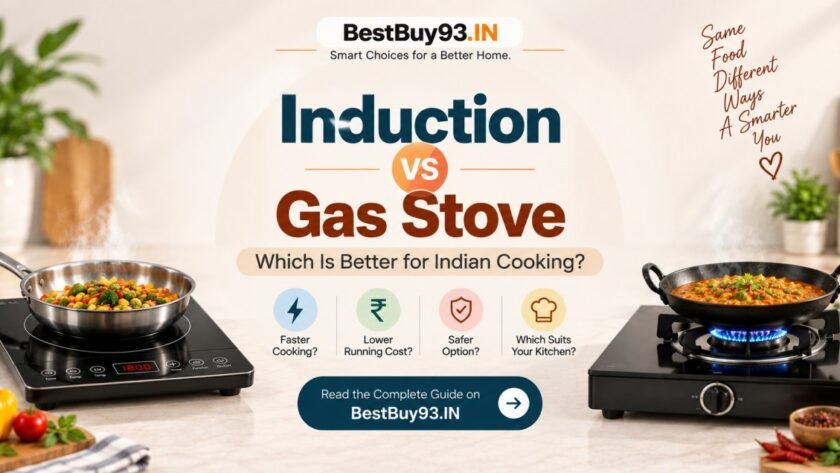

If you’re setting up a kitchen, replacing your old stove, or simply wondering whether an induction cooktop can really replace your gas stove, you’re not alone.
For years, the answer in Indian homes was simple: gas stove = cooking.
But induction cooktops have changed the equation. They heat quickly, are easier to clean, don’t use an open flame, and can be surprisingly convenient for everyday cooking.
At the same time, gas still has some very real advantages. It works with almost every type of cookware, gives you direct flame control, and remains extremely practical for rotis, phulkas, traditional tadka and high-heat cooking.
So, which is actually better: induction or gas?
The honest answer is: neither wins at everything.
For many Indian kitchens, the smartest solution may actually be induction + gas, rather than completely replacing one with the other.
Also Read | Best Induction Cooktops for Home in India
Let’s compare them properly. 👇
Quick Answer: Induction vs Gas Stove
Choose induction if you want faster heating, easier cleaning, no open flame, better energy efficiency and a modern, compact cooking setup.
Choose gas if you want maximum cookware compatibility, direct flame control, traditional Indian cooking flexibility and uninterrupted cooking during power cuts.
At a Glance
| Factor | Induction Cooktop | Gas Stove |
|---|---|---|
| Cooking Speed | ⭐⭐⭐⭐⭐ | ⭐⭐⭐⭐ |
| Energy Efficiency | ⭐⭐⭐⭐⭐ | ⭐⭐⭐ |
| Safety | ⭐⭐⭐⭐⭐ | ⭐⭐⭐ |
| Cleaning | ⭐⭐⭐⭐⭐ | ⭐⭐ |
| Cookware Compatibility | ⭐⭐⭐ | ⭐⭐⭐⭐⭐ |
| Flame Control | ⭐⭐⭐⭐ | ⭐⭐⭐⭐⭐ |
| Rotis/Phulkas | ⭐⭐⭐ | ⭐⭐⭐⭐⭐ |
| Pressure Cooker | ⭐⭐⭐⭐⭐ | ⭐⭐⭐⭐⭐ |
| Tadka | ⭐⭐⭐⭐ | ⭐⭐⭐⭐⭐ |
| Power-Cut Reliability | ❌ | ✅ |
| Kitchen Heat | Lower | Higher |
| Portability | Excellent | Low |
| Best Overall for Modern Kitchens | 🏆 | |
| Best for Traditional Cooking | 🏆 |
How Does an Induction Cooktop Work?
An induction cooktop doesn’t use a flame.
Instead, it uses electromagnetic induction to heat compatible cookware directly. The magnetic field interacts with the base of the vessel and generates heat in the cookware itself.
That’s why the pan can become extremely hot while the cooking surface doesn’t behave like a traditional gas burner.
This also explains one of the biggest advantages of induction:
The heat is generated where you actually need it the cookware.
There is no flame heating the surrounding air.
Induction cooktops generally work with cookware that has a magnetic base. A simple magnet test can help you check compatibility: if a magnet sticks firmly to the bottom of the vessel, there’s a good chance it will work with induction.
How Does a Gas Stove Work?
A gas stove burns LPG or PNG through a burner to produce a flame.
The flame then transfers heat to the bottom and sides of your cookware.
The biggest advantage is simplicity.
You can see the flame, adjust it instantly, move the vessel around, use almost any cookware and continue cooking without worrying about electricity.
For generations of Indian households, this familiarity is a major reason gas remains popular.
And honestly, there are certain cooking techniques where that direct flame still feels easier.
Induction vs Gas: Detailed Comparison
1. Cooking Speed
🏆 Winner: Induction
For tasks such as boiling water, heating milk, cooking rice or getting oil ready for frying, induction can be extremely quick.
Because the cookware itself is heated directly, less energy is wasted heating the surrounding air.
A good 1800W–2100W induction cooktop can be particularly useful for everyday Indian cooking.
Gas is also fast, especially when using a powerful burner, but induction often has the advantage when you’re repeatedly doing tasks such as:
- Boiling water
- Heating milk
- Making tea
- Cooking rice
- Pressure cooking
- Reheating food
- Heating oil
One important point
Gas gives you instant flame, while induction gives you direct pan heating.
So don’t confuse “instant flame” with “faster cooking.”
The actual cooking speed depends on cookware, power level, vessel size and the food being prepared.
2. Energy Efficiency
🏆 Winner: Induction
This is one of induction’s biggest technical advantages.
Gas combustion releases heat around the cookware, while induction transfers energy directly into compatible cookware.
The U.S. Department of Energy notes that induction can be substantially more efficient than gas cooking because heat is generated directly in the cookware.
That doesn’t automatically mean induction will always cost less for your household.
Why?
Because your electricity tariff matters.
For example, if your household is already using a large amount of electricity and moving to induction pushes consumption into a higher tariff slab, the financial advantage can become smaller.
Similarly, LPG consumption varies depending on:
- Family size
- Number of meals cooked
- Cooking duration
- Burner efficiency
- Cooking habits
- Use of pressure cookers
- Type of food prepared
So:
Induction = more energy-efficient technology.
But:
Energy efficiency ≠ automatically lower monthly bill in every household.
That’s an important distinction.
3. Monthly Running Cost
🏆 Winner: It Depends
This is where many comparison articles oversimplify things.
You’ll often see claims such as:
“Induction is always cheaper than LPG.”
That’s too broad.
The actual cost depends on your electricity rate, LPG price and cooking pattern.
Current Indian comparisons show that the gap can be relatively close in some situations, while induction can be cheaper in others.
A simple way to think about it
If your electricity tariff is relatively low and you cook efficiently, induction can make financial sense.
If you have expensive electricity, high household consumption and relatively efficient gas cooking, the savings may be much smaller.
Don’t forget the convenience factor
Gas also involves:
- LPG cylinder booking
- Cylinder storage
- Refilling
- Delivery
- Regulator and hose maintenance
Induction eliminates those fuel-handling issues but makes you dependent on electricity.
So don’t choose purely based on a headline saying “₹X cheaper per month.”
Calculate based on your own kitchen.
4. Safety
🏆 Winner: Induction
This is another major advantage of induction.
There is no open flame.
Many modern induction cooktops also include features such as:
- Automatic shut-off
- Pan detection
- Overheat protection
- Child lock
- Residual heat indicators
- Timer functions
The U.S. Department of Energy also highlights the fact that induction stops generating cooking heat when compatible cookware is removed.
Gas cooking has additional risks because it involves combustion and an open flame.
Gas appliances can also contribute combustion pollutants such as nitrogen dioxide indoors, particularly when ventilation is inadequate. The U.S. EPA identifies unvented gas stoves as an indoor source of nitrogen dioxide.
But remember
Induction is not burn-proof.
The cookware can still become extremely hot.
So children should still be supervised around an induction cooktop.
5. Cookware Compatibility
🏆 Winner: Gas
This is where gas absolutely dominates.
With gas, you can generally use:
- Stainless steel
- Aluminium
- Cast iron
- Copper
- Non-stick cookware
- Traditional kadhais
- Pressure cookers
- Clay cookware, where appropriate
- Round-bottom cookware
Induction is more selective.
Your cookware needs a compatible magnetic base.
The easy magnet test 🧲
Take a small magnet and place it against the bottom of your vessel.
Magnet sticks → likely induction-compatible.
Magnet doesn’t stick → probably not compatible.
Always check the manufacturer’s instructions, especially for specialty cookware.
6. Indian Cooking Performance
This is probably the most important section.
Because Indian cooking isn’t just “boil something and eat.”
We make:
- Dal
- Sabzi
- Roti
- Paratha
- Dosa
- Poori
- Pakora
- Tadka
- Chai
- Rice
- Pressure-cooked food
- Deep-fried snacks
- Curries
- Stir-fries
And different cooking methods favour different appliances.
Dal & Rice
Induction: Excellent
Pressure cookers and flat-bottomed compatible vessels work very well.
Sabzi
Both: Excellent
Induction gives precise heat control, while gas makes it easy to visually judge the flame.
Tadka
Gas: Slight advantage
Traditional tadka often feels easier on gas because you can directly control the flame.
But induction works perfectly well with the right flat-bottomed pan.
Roti & Phulka
Gas: Winner
This is one area where traditional gas cooking still has a major advantage.
Direct flame makes it easier to puff phulkas directly over the burner.
That said, you can make excellent rotis on induction using a suitable tawa and technique. Recent Indian cooking coverage has also highlighted that soft, puffed fulkas can be made successfully on induction.
Dosa
Both
A good induction-compatible flat tawa can work very well.
However, consistency depends heavily on the tawa material and base.
Deep Frying
Both
Induction offers precise temperature settings on many models.
Gas gives you direct flame adjustment.
High-Heat Wok Cooking
Gas: Winner
If you regularly use traditional round-bottom woks or rely heavily on flame-based high-heat cooking, gas is generally more flexible.
7. Kitchen Temperature
🏆 Winner: Induction
This is an underrated benefit.
Anyone who has cooked lunch for an entire family during an Indian summer knows exactly what we’re talking about. 😂🔥
Gas flames release heat into the surrounding environment.
Induction transfers much more of the cooking energy directly into compatible cookware.
That means your kitchen generally feels more comfortable while cooking.
This can be particularly useful in:
- Small kitchens
- Apartments
- Kitchens with limited ventilation
- Hot climates
- Homes without strong exhaust systems
And yes, your kitchen will still get warm from the food, cookware and steam but you aren’t adding an open flame to the equation.
8. Cleaning & Maintenance
🏆 Winner: Induction
This isn’t even a close competition.
A gas stove has:
- Burner caps
- Burner rings
- Pan supports
- Corners
- Gaps
- Grease traps
- Food particles
And somehow one tiny piece of onion always finds its way into the hardest possible place to clean. 😭
Induction usually has a smooth glass surface.
Once it has cooled down, you can wipe it clean relatively easily.
However…
Don’t clean an induction cooktop immediately with excessive water.
Follow the manufacturer’s cleaning instructions and avoid abrasive cleaners that can damage the surface.
9. Power Cuts
🏆 Winner: Gas
This is the biggest weakness of induction.
No electricity = no induction cooking.
If your area experiences frequent power cuts, depending completely on induction may become frustrating.
Gas doesn’t care.
As long as you have LPG/PNG and the stove is functioning, you can cook.
That’s why many Indian households prefer a hybrid setup.
10. Installation & Portability
🏆 Winner: Induction
A portable induction cooktop can simply sit on your kitchen counter.
You plug it in and start cooking.
No:
- LPG cylinder connection
- Gas pipe
- Burner installation
- Permanent countertop setup
This makes induction particularly useful for:
- Students
- Renters
- Small apartments
- Hostels
- Office pantries
- Temporary kitchens
- Secondary cooking stations
A gas stove is much more of a permanent kitchen appliance.
Induction vs Gas: Which Is Better for Different People?
🏠 For a Small Family
Winner: Induction
If you’re cooking relatively simple meals and electricity supply is reliable, induction can be extremely convenient.
It’s compact, easy to clean and fast.
👨👩👧👦 For a Large Family
Winner: Gas or Hybrid
Large families often need multiple burners simultaneously.
You may have:
- Dal on one burner
- Sabzi on another
- Milk or chai on another
A single induction cooktop can’t match that flexibility.
A multi-burner gas stove + induction backup can be much more practical.
🧑💻 For Working Professionals
Winner: Induction
If you’re cooking quickly before work or after returning home, induction makes a lot of sense.
You can quickly:
- Boil water
- Heat food
- Make eggs
- Cook noodles
- Prepare dal
- Reheat leftovers
And cleaning takes very little time.
👩🍳 For Traditional Indian Cooking
Winner: Gas
If your kitchen revolves around:
- Rotis
- Phulkas
- Traditional tadka
- Round-bottom kadhais
- Woks
- Flame-based cooking
Gas remains extremely practical.
🏢 For Renters
Winner: Induction
This is one of the easiest ways to add an additional cooking station without modifying your kitchen.
🌡️ For Hot Kitchens
Winner: Induction
If your kitchen already becomes unbearably hot during summer, induction is worth considering.
Should You Completely Replace Your Gas Stove With Induction?
Honestly? Not necessarily.
For many Indian households, the best solution isn’t “induction OR gas.”
It’s:
Induction + Gas
Think of it as having two specialists.
Use induction for:
⚡ Quick cooking
🍚 Rice
🥛 Milk
☕ Tea
🍲 Pressure cooking
🥘 Everyday curries
🔥 Reheating
🍳 Eggs
🧹 Easy cleanup
Use gas for:
🔥 Roti/phulka
🔥 Traditional tadka
🔥 High-heat cooking
🔥 Round-bottom cookware
🔥 Wok cooking
🔥 Multiple dishes simultaneously
⚡ Power-cut backup
This combination gives you the best of both worlds.
Induction vs Gas Stove: Common Buying Mistakes
Mistake 1: Buying a very low-wattage induction cooktop
For regular Indian cooking, extremely low-power models can feel slow.
For a primary induction cooktop, around 1800W–2100W is a practical range for many households, depending on the cooking load and electrical setup.
Mistake 2: Forgetting cookware compatibility
Don’t buy an induction cooktop and then discover that half your favourite vessels don’t work.
Check your cookware before switching.
Mistake 3: Looking only at the purchase price
A ₹1,500 induction cooktop isn’t necessarily better value than a ₹2,500–₹4,000 model.
Look at:
- Wattage
- Controls
- Safety features
- Warranty
- Build quality
- Pan detection
- Presets
- Electrical requirements
Mistake 4: Assuming induction is automatically cheaper
Efficiency and running cost aren’t exactly the same thing.
Your electricity tariff and LPG usage matter.
Mistake 5: Ignoring power cuts
If induction will be your only cooking appliance, consider how reliable your electricity supply is.
Mistake 6: Buying the wrong tawa
A perfectly good induction cooktop can seem “bad” if you’re using an incompatible or poorly suited tawa.
Always check the cookware base.
How Much Wattage Do You Need?
For most Indian homes:
| Induction Power | Best For |
|---|---|
| 1200–1400W | Light cooking, tea, reheating |
| 1600W | Basic everyday cooking |
| 1800W | Good all-round option |
| 2000W | Heavy everyday cooking |
| 2100–2200W | Faster/heavier cooking |
Our sweet spot
For a primary induction cooktop, we’d generally look around 1800W–2100W.
For occasional use or backup cooking, 1600W can be perfectly adequate.
Induction vs Gas: What About Electricity Consumption?
A 2000W induction cooktop does not mean you’re consuming 2 units of electricity every hour continuously.
That’s the maximum rated power.
If it runs at full 2000W for one hour, that’s approximately 2 kWh, or 2 units.
But in actual cooking, the appliance cycles and adjusts power depending on the selected setting and cooking requirement.
So your real electricity consumption depends on:
- Cooking time
- Heat setting
- Food type
- Cookware
- Quantity
- Appliance efficiency
This is why blanket statements such as “induction always costs ₹X per month” can be misleading.
Which One Is Better for Your Kitchen?
Here’s the simplest decision guide:
Choose Induction if:
- You want faster everyday cooking
- You want easier cleaning
- You dislike open flames
- Your electricity supply is reliable
- You have compatible cookware
- You live in a small apartment
- You want a portable cooking solution
- You want better energy efficiency
Choose Gas if:
- You cook lots of rotis
- You use traditional cookware
- You need multiple burners
- You frequently cook on high heat
- You want direct flame control
- Power cuts are common
- You don’t want cookware restrictions
Choose Both if:
- You cook a lot of Indian food
- You want a backup during power cuts
- You have enough kitchen space
- You want maximum flexibility
Induction vs Gas Stove: Final Verdict
There is no universal winner.
And honestly, anyone telling you that one completely destroys the other is probably oversimplifying the comparison.
🏆 Best for Speed & Efficiency: Induction
Induction is excellent for everyday cooking, particularly boiling, pressure cooking, reheating and quick meals.
🏆 Best for Traditional Indian Cooking: Gas
Gas remains incredibly flexible for rotis, phulkas, tadka, wok cooking and traditional cookware.
🏆 Best for Safety & Easy Cleaning: Induction
No open flame and a smooth cooking surface give induction a major advantage.
🏆 Best for Cookware Compatibility: Gas
You can use almost anything without worrying about magnetic bases.
🏆 Best Overall Setup: Induction + Gas
For many Indian homes, this is the smartest arrangement.
Use induction as your fast, clean and efficient everyday cooking option, while keeping gas available for traditional cooking, multiple-burner meals and power-cut backup.
And if you’re specifically looking to buy an induction cooktop, check out our guide to the Best Induction Cooktops for Home in India before making your decision.
Frequently Asked Questions
Is induction better than gas for Indian cooking?
Induction is better for speed, energy efficiency, safety and cleaning, while gas is more flexible for traditional Indian cooking. If you regularly make rotis, phulkas, use round-bottom cookware or cook during power cuts, gas still has important advantages.
Is induction cheaper than LPG?
It depends on your electricity tariff, LPG price and cooking habits. Induction is more energy-efficient, but the actual monthly cost isn’t identical for every household. Compare your electricity rate and LPG consumption before switching completely.
Can I cook roti on an induction cooktop?
Yes. You can make rotis on an induction cooktop using a compatible flat-bottomed tawa. However, gas remains more convenient if you prefer directly puffing phulkas over an open flame.
Does induction cook faster than gas?
Induction can be faster for many common tasks because it heats compatible cookware directly. Actual cooking speed depends on wattage, cookware, food quantity and heat setting.
Does induction work during a power cut?
No. An induction cooktop requires electricity. If power cuts are common in your area, keeping a gas stove as a backup is a practical option.
Can I use aluminium cookware on induction?
Standard aluminium cookware generally does not work on induction unless it has a compatible magnetic base. Check the manufacturer’s specifications or use the magnet test on the cookware base.
Which is safer: induction or gas?
Induction generally has a safety advantage because there is no open flame and many models include features such as pan detection and automatic shut-off. Gas requires careful handling of the flame, cylinder/pipe connections and ventilation.
What is the best wattage for an induction cooktop?
For many Indian households, 1800W–2100W is a practical range for everyday cooking. A 1600W model can work well for lighter cooking or backup use, while higher wattage can be useful for heavier cooking loads.
Research Methodology
This comparison focuses on the factors that actually matter in an Indian kitchen: cooking speed, energy efficiency, safety, cookware compatibility, cleaning, traditional cooking techniques, power reliability and practical household use.
For energy and safety considerations, we also reviewed current 2026 comparison coverage alongside technical guidance from the U.S. Department of Energy and U.S. EPA. Running-cost comparisons are treated as variable rather than presenting one universal monthly figure because electricity tariffs, LPG prices and household cooking patterns differ.
No hands-on testing is claimed in this article.