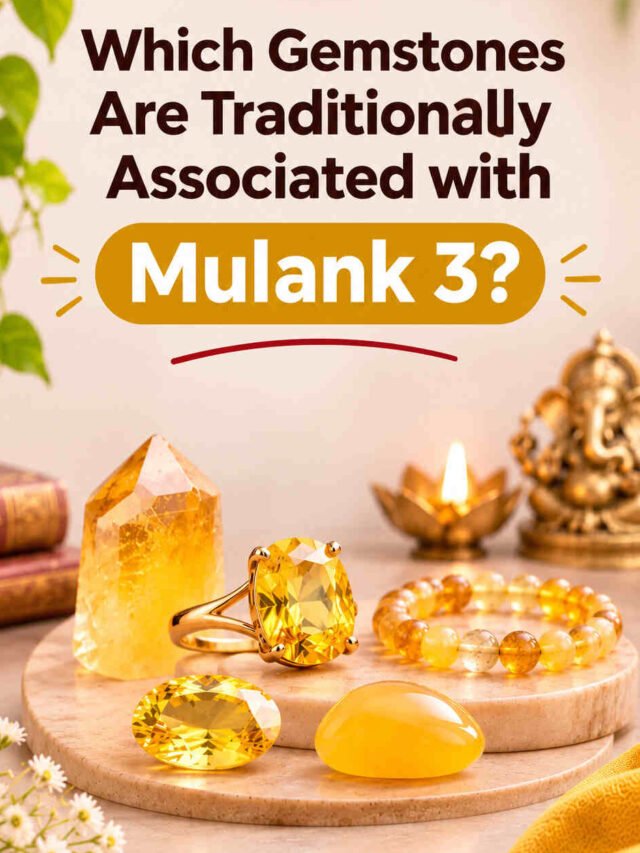

If your birth date is 3, 12, 21 or 30, your Mulank is traditionally considered 3 in Indian numerology. Mulank 3 is commonly associated with Guru or Jupiter, which is why yellow-coloured gemstones especially Yellow Sapphire or Pukhraj often appear in gemstone recommendations for this number.
But this is exactly where you should slow down before hitting “Buy Now.” 💛
Choosing a gemstone based on Mulank 3 should not mean buying the first yellow stone labelled Jupiter stone, Guru stone or Pukhraj alternative. Yellow Sapphire, Citrine and Yellow Topaz may look somewhat similar, but gemologically they are different stones with different durability, rarity, treatments and prices.
And there is another important distinction: numerology and Vedic astrology are related spiritual traditions, but they are not the same system. Your Mulank looks primarily at your birth date, whereas astrological gemstone recommendations may consider an entire birth chart.
So, before choosing a gemstone based on Mulank 3, it helps to understand what Mulank 3 represents, which stones are traditionally associated with it, how Yellow Sapphire differs from Citrine or Topaz, what to inspect when buying, and which common mistakes to avoid.
Important: Numerology and gemstone remedies are traditional belief systems. There is no scientific evidence that wearing a gemstone can guarantee luck, wealth, career growth, relationships or health outcomes. You can still enjoy these traditions for spiritual, cultural or personal reasons just make informed buying decisions.
Quick Answer: Which Gemstone Is Traditionally Associated With Mulank 3?
For people with Mulank 3, traditional Indian numerology usually connects the number with Jupiter (Guru) and consequently with yellow gemstones.
The most commonly discussed options are:
- 💛 Yellow Sapphire (Pukhraj): Traditionally considered the principal Jupiter gemstone.
- ✨ Citrine (Sunela): Often considered a more affordable yellow gemstone option in spiritual and crystal traditions.
- 🌼 Yellow Topaz: Sometimes sold as a Jupiter-associated yellow stone, but it is a different mineral from both Yellow Sapphire and Citrine.
- 🟡 Other yellow crystals: These may be used symbolically, but they should not automatically be treated as substitutes for Yellow Sapphire.
If you want a gemstone mainly for traditional numerology symbolism, Citrine may be an approachable choice.
If you specifically want to follow a traditional astrological Pukhraj recommendation, confirm whether Yellow Sapphire is actually suitable for you before investing in an expensive stone.
What Is Mulank 3 in Numerology?
Mulank, sometimes called the Birth Number, is calculated using the day of the month on which you were born.
You reduce the date to a single digit.
For example:
| Birth Date | Calculation | Mulank |
|---|---|---|
| 3 | 3 | 3 |
| 12 | 1 + 2 | 3 |
| 21 | 2 + 1 | 3 |
| 30 | 3 + 0 | 3 |
So anyone born on 3, 12, 21 or 30 of any month falls under Mulank 3 according to this system.
Traditional numerology descriptions commonly associate Mulank 3 with qualities such as:
- Learning
- Teaching
- Knowledge
- Organisation
- Leadership
- Discipline
- Ambition
- Communication
- Growth
- Wisdom
These are traditional symbolic interpretations, not scientifically established personality traits. Your personality obviously has more going on than one digit from your birthday. 😄
Which Planet Is Traditionally Associated With Mulank 3?
In Indian numerology traditions, Mulank 3 is associated with Guru, or Jupiter.
Jupiter traditionally represents themes such as:
- Knowledge
- Higher learning
- Wisdom
- Teachers and mentors
- Expansion
- Optimism
- Philosophy
- Spiritual development
- Prosperity
Because Jupiter is traditionally associated with yellow, Mulank 3 gemstone recommendations frequently revolve around yellow gemstones.
This is why you will repeatedly come across Yellow Sapphire, Citrine and sometimes Yellow Topaz while researching gemstones for Mulank 3.
However, matching a colour to a planet is not enough to determine gemstone quality or even whether two yellow stones are remotely the same thing.
Which Gemstone Is Traditionally Recommended for Mulank 3?
Yellow Sapphire or Pukhraj
Yellow Sapphire is the gemstone most traditionally associated with Jupiter, and therefore it is often recommended in numerology and Vedic astrology discussions connected with Mulank 3.
Gemologically, sapphire belongs to the mineral corundum family. While blue is the colour most people associate with sapphire, sapphire occurs in several colours, including yellow. Sapphire has a Mohs hardness of 9, making it a particularly durable jewellery gemstone.
That durability is one reason Yellow Sapphire works well in rings intended for regular wear.
Why Is Yellow Sapphire Associated With Mulank 3?
Within traditional belief systems, Pukhraj is associated with Jupiter and may symbolise:
- Wisdom
- Learning
- Confidence
- Growth
- Prosperity
- Good judgement
- Spiritual development
These are traditional associations rather than guaranteed effects.
Someone selling you a Pukhraj promising that you will receive a promotion in 21 days deserves more suspicion than your ex suddenly texting “Hey stranger.” 😭
Yellow Sapphire vs Citrine vs Yellow Topaz: What Is the Difference?
This is probably the most important buying distinction in the entire guide.
Yellow Sapphire, Citrine and Yellow Topaz can all appear yellow, but they are not different names for the same gemstone.
| Gemstone | Mineral Family | Relative Durability | Traditional Position | Typical Cost Level |
|---|---|---|---|---|
| Yellow Sapphire | Corundum | Very high | Principal Jupiter gemstone in many traditions | Premium |
| Citrine | Quartz | Good | Common affordable symbolic alternative | Affordable |
| Yellow Topaz | Topaz | Good | Sometimes used as a yellow spiritual gemstone | Mid-range to premium depending on quality |
Yellow Sapphire
Yellow Sapphire is yellow corundum. Sapphire reaches 9 on the Mohs hardness scale, making it one of the harder natural gemstones used in jewellery.
It tends to cost substantially more than ordinary Citrine, particularly when natural colour, good clarity, attractive cutting and credible laboratory documentation are involved.
Citrine
Citrine is yellow-to-orange quartz, not sapphire.
GIA describes Citrine as a transparent yellow to brownish-orange variety of quartz with a Mohs hardness of 7. Natural Citrine is relatively rare, and much of the Citrine available commercially is produced by heating amethyst.
Its affordability makes Citrine attractive for people who want:
- Yellow gemstone jewellery
- A symbolic Jupiter-associated stone
- Crystal bracelets
- Pendants
- An inexpensive introduction to gemstone traditions
Yellow Topaz
Topaz is yet another mineral.
It naturally occurs in several colours, including yellow, orange, pink and blue. GIA specifically warns buyers not to confuse Topaz with terms such as “topaz quartz,” because Citrine quartz and Topaz are different gemstones.
This matters enormously when shopping online.
Yellow colour ≠ Yellow Sapphire.
Is Citrine the Same as Pukhraj?
No.
Pukhraj generally refers to Yellow Sapphire, whereas Citrine is quartz.
They can both appear yellow, and Citrine is frequently discussed as an affordable alternative within spiritual or astrological retail, but they are not gemologically interchangeable.
GIA identifies Citrine as quartz, while sapphire belongs to corundum.
So if a listing says:
“Natural Pukhraj Citrine Yellow Sapphire”
…read the description very carefully.
That title may be combining unrelated keywords for search visibility rather than telling you exactly what stone you are receiving.
Should Every Mulank 3 Person Wear Yellow Sapphire?
Not necessarily.
This is one of the biggest misconceptions around numerology gemstones.
If you are following numerology alone, you may choose a yellow gemstone symbolically because Mulank 3 is associated with Jupiter.
However, traditional Vedic astrology uses a considerably more detailed system. An astrologer may consider factors such as:
- Ascendant or Lagna
- Placement of Jupiter
- Houses ruled by Jupiter
- Strength of Jupiter
- Planetary aspects
- Mahadasha and Antardasha
- Other planetary combinations
Therefore, someone can have Mulank 3 without automatically receiving the same astrological gemstone recommendation as every other Mulank 3 person.
This distinction becomes particularly important with expensive gemstones such as Yellow Sapphire.
If you’re simply buying a Citrine bracelet because you enjoy its colour and Mulank symbolism, the decision can be relatively casual.
If you’re spending serious money on a high-quality Pukhraj specifically as an astrological remedy, it makes sense to seek qualified guidance first.
What Should You Look for When Choosing a Gemstone for Mulank 3?
1. Know Exactly Which Gemstone You Are Buying
Before comparing carats or prices, determine whether the stone is:
- Yellow Sapphire
- Citrine
- Yellow Topaz
- Yellow quartz
- Synthetic Sapphire
- Glass imitation
- Another yellow gemstone
Never rely solely on the listing’s colour.
2. Check Whether the Gemstone Is Natural, Synthetic or Imitation
These terms do not mean the same thing.
Natural gemstone: Formed naturally.
Synthetic/lab-grown gemstone: Created in a laboratory but may share essentially the same chemical and physical properties as its natural counterpart.
Imitation: A different material designed to resemble the gemstone.
A seller should clearly disclose what you’re buying.
3. Ask About Treatments
Gemstone treatments are common and aren’t automatically bad.
The problem is undisclosed treatment.
Heat treatment is widely used in the gemstone industry. GIA notes that heating is an accepted treatment for sapphire, while most Citrine on the market results from heat treatment of amethyst.
For an expensive Yellow Sapphire, ask:
- Is it heated?
- Is it diffusion treated?
- Is it fracture filled?
- Is treatment disclosed on the certificate?
- Is the report from an independent gemological laboratory?
Treatment can significantly influence value.
4. Look at Colour
For spiritual jewellery, many buyers naturally gravitate towards a pleasant yellow or golden-yellow appearance.
From a gem-buying perspective, however, don’t assume:
darker yellow = more powerful gemstone.
Gemological value depends on several factors, and spiritual claims about colour intensity cannot be scientifically verified.
Choose a colour you genuinely enjoy wearing.
5. Examine Clarity
A natural gemstone doesn’t necessarily need to be perfectly flawless.
In fact, inclusions may occur naturally.
But avoid stones with fractures or inclusions that may compromise durability particularly if you’re purchasing an expensive Sapphire for everyday ring wear.
GIA notes that inclusions can affect sapphire’s value and can become a concern if they threaten durability.
6. Don’t Ignore the Cut
A poorly cut expensive gemstone can look dull.
Good cutting helps a stone:
- Reflect light attractively
- Appear lively
- Display colour evenly
- Sit properly in jewellery
GIA specifically highlights cut as an important factor affecting a sapphire’s appearance.
So don’t obsess over carat weight while ignoring what the stone actually looks like.
7. Get Certification for Expensive Stones
For inexpensive Citrine jewellery, laboratory certification may cost more than it practically adds to the purchase.
For expensive Yellow Sapphire, however, an independent gemological report can be valuable.
A credible report can help identify:
- Gemstone species
- Whether the stone is natural
- Detectable treatments
- Measurements
- Weight
- Colour observations
Remember: a certificate establishes gemological information. It does not certify that a stone will bring luck or produce spiritual results.
Does Carat Weight Matter for Mulank 3 Gemstones?
This gets messy online because you will encounter formulas such as:
- X carats per body weight
- A minimum number of rattis
- A specific carat for Jupiter
- Larger gemstone = stronger result
These recommendations belong to traditional astrological practice, not established gemological science.
From a jewellery perspective, carat simply measures gemstone weight.
A larger stone is not automatically:
- Better quality
- More natural
- More beautiful
- More spiritually powerful
Instead, balance:
quality + authenticity + cut + budget + wearability.
For precious Yellow Sapphire, choosing a smaller but better-documented stone can make more sense than buying a huge suspiciously inexpensive one.
Which Metal Is Traditionally Used for Mulank 3 Gemstones?
Traditional Jupiter-related gemstone practices commonly associate Yellow Sapphire with gold.
Depending on the tradition or practitioner, alternatives may also be suggested.
For ordinary jewellery, however, your choice can simply depend on:
- Budget
- Skin sensitivity
- Jewellery style
- Durability
- Personal preference
Citrine looks beautiful in yellow gold, silver and gold-plated settings, so there is no reason your jewellery has to become an astrological engineering project unless you specifically want to follow those traditions. 😄
Which Finger Is Traditionally Used for Yellow Sapphire?
In many traditional Vedic astrology practices, Yellow Sapphire associated with Jupiter is worn on the index finger, frequently of the right hand.
However, practices vary.
Your dominant hand, gender, school of astrology and individual chart interpretation may change what a practitioner recommends.
Therefore, treat this as traditional practice rather than a universal rule.
If you are wearing the gemstone simply as jewellery or symbolic numerology jewellery, you can choose whichever finger feels comfortable.
Which Day Is Traditionally Associated With Mulank 3 Gemstones?
Because Mulank 3 is associated with Jupiter, Thursday is traditionally linked with Jupiter-related practices.
Some traditions recommend first wearing Yellow Sapphire on a Thursday, sometimes during the morning and after prayer or cleansing rituals.
Again, this is a ritual tradition not something required for the physical gemstone to function as jewellery.
If you enjoy ritual, it can make the experience personally meaningful.
If you don’t, your gemstone will not suddenly file a complaint with Jupiter. 😄
Should the Gemstone Touch Your Skin?
Some astrological traditions recommend setting the stone so its underside touches the skin.
This is based on spiritual belief rather than gemological necessity.
For jewellery construction, what matters more practically is that the setting:
- Secures the gemstone
- Protects vulnerable edges
- Fits comfortably
- Does not scratch your skin
- Can withstand regular wear
Natural vs Treated Yellow Sapphire: Which Should You Choose?
Treatment does not automatically mean fake.
Heat-treated sapphires are common and accepted within the jewellery industry. GIA notes that heat treatment is accepted for sapphire, although confirmation that a fine-quality stone shows no evidence of heat may increase rarity and value.
Your decision should depend on:
Choose a treated stone if:
- Treatment is clearly disclosed
- You’re comfortable with it
- The price reflects the treatment
- You care more about appearance and affordability
Consider an untreated stone if:
- Natural untreated status matters personally
- You are buying a premium gemstone
- You have credible laboratory documentation
- Your budget allows the premium
What you should not do is pay untreated-natural prices for an undisclosed treated stone.
Is Citrine a Good Budget Option for Mulank 3?
For someone primarily interested in numerology symbolism, yellow gemstone jewellery or crystal traditions, Citrine can be a very practical option.
It is attractive, relatively durable and significantly more affordable than fine Yellow Sapphire.
GIA notes that Citrine is popular partly because of its affordability and availability in larger sizes without the dramatic price-per-carat increases seen with some precious gemstones.
Citrine may suit you if:
- You want affordable Mulank 3 jewellery.
- You prefer bracelets or pendants.
- You are new to gemstones.
- You want yellow gemstone aesthetics without a major investment.
- You’re comfortable treating the practice symbolically.
Consider Yellow Sapphire instead if:
- A qualified practitioner specifically recommends Pukhraj.
- You specifically want traditional Yellow Sapphire.
- You’re comfortable with the higher cost.
- You can verify authenticity.
Common Mistakes to Avoid When Choosing a Mulank 3 Gemstone
Buying Based Only on the Word “Pukhraj”
Read the mineral identification.
A yellow stone being sold under multiple gemstone keywords should immediately make you investigate further.
Assuming Citrine and Yellow Sapphire Are the Same
They’re not.
Citrine is quartz. Yellow Sapphire is corundum.
Buying the Largest Stone You Can Afford
Bigger isn’t automatically better.
Prioritise authenticity and quality before raw size.
Ignoring Treatments
Ask sellers to disclose treatments particularly for higher-value gemstones.
Falling for Guaranteed Results
Be extremely cautious of claims such as:
- “Guaranteed promotion”
- “Instant marriage”
- “100% money attraction”
- “Removes every problem”
- “Scientifically proven luck”
- “Guaranteed Jupiter activation”
Gemstones can hold cultural, symbolic and personal meaning, but these outcomes aren’t scientifically guaranteed.
Spending Too Much Because of Fear
A gemstone should never be sold to you with threats like:
“If you don’t wear this immediately, something bad will happen.”
That is pressure selling, not sensible spiritual guidance.
Following Numerology Advice as Medical or Financial Advice
Gemstones should never replace:
- Medical treatment
- Mental-health care
- Financial planning
- Legal advice
- Career preparation
Enjoy spiritual practices alongside practical decision-making not instead of it.
How We Researched This Guide
For this guide, we separated two different kinds of information.
Traditional numerology information was treated as cultural and spiritual belief rather than scientific fact.
For physical gemstone characteristics, we reviewed gemological information including:
- Mineral identity
- Hardness
- Treatments
- Colour
- Clarity
- Cut
- Care
- Natural vs synthetic considerations
We also referred to information published by the Gemological Institute of America (GIA) when distinguishing Sapphire, Citrine and Topaz.
We have not personally tested gemstones, and this guide does not claim that gemstone remedies produce scientifically proven outcomes.
Key Takeaways Before Buying
Before purchasing any gemstone marketed for Mulank 3, remember these seven points:
- Mulank 3 includes birth dates 3, 12, 21 and 30.
- Jupiter or Guru is traditionally associated with Mulank 3.
- Yellow Sapphire/Pukhraj is the principal gemstone traditionally connected with Jupiter.
- Citrine is quartz and is not Yellow Sapphire.
- Yellow Topaz is also a separate gemstone.
- Check authenticity and treatment before spending heavily.
- Gemstone spiritual benefits are traditional beliefs, not scientifically guaranteed outcomes.
Frequently Asked Questions
Which gemstone is best for Mulank 3?
Traditional Indian numerology commonly associates Yellow Sapphire or Pukhraj with Mulank 3 because the number is connected with Jupiter. Citrine is also popular as a more affordable yellow gemstone option. However, if you’re following astrology rather than numerology alone, gemstone suitability may depend on your complete birth chart.
Can Mulank 3 people wear Citrine?
Yes, Citrine is commonly used in contemporary crystal and numerology practices as an affordable yellow gemstone associated symbolically with Jupiter themes. However, Citrine is quartz, not Yellow Sapphire, and should not be sold to you as though the two gemstones were identical.
Is Pukhraj the same as Yellow Sapphire?
In the Indian gemstone and astrological context, Pukhraj generally refers to Yellow Sapphire. Yellow Sapphire belongs to the corundum mineral family. Buyers should still verify the actual gemstone through a reliable seller and, for high-value purchases, consider independent gemological documentation.
Is Citrine the same as Yellow Topaz?
No. Citrine and Topaz are entirely different minerals. Citrine is quartz, while Topaz is its own mineral species. Historically, yellow quartz was sometimes confused with Topaz, which is one reason misleading names can still cause confusion among buyers today.
Can every person born on 3, 12, 21 or 30 wear Yellow Sapphire?
Numerology may associate all these dates with Mulank 3, but traditional Vedic astrology does not recommend gemstones based only on the birth number. If you want to wear an expensive Yellow Sapphire specifically as an astrological remedy, consider checking your complete horoscope first.
Which day is traditionally associated with Mulank 3?
Thursday is traditionally associated with Jupiter or Guru, the planet linked with Mulank 3. Some gemstone traditions therefore recommend beginning Jupiter-related practices on a Thursday. This is a cultural or spiritual practice rather than a scientifically necessary requirement.
Should I buy a certified Yellow Sapphire?
For a valuable Yellow Sapphire, independent gemological documentation can be useful because it may identify the gemstone and disclose detectable treatments. Certification is especially relevant when the price is significant. However, a gemological report verifies the stone’s characteristics not astrological effectiveness.
Is a more expensive gemstone spiritually more powerful?
There is no scientific evidence establishing a relationship between gemstone price, carat weight and spiritual effectiveness. A higher price may reflect factors such as rarity, colour, clarity, cut, treatment status or provenance. Buy based on authenticity, quality, budget and your personal reasons for wearing the stone.
Final Verdict
If you have Mulank 3, Yellow Sapphire or Pukhraj is the gemstone most traditionally connected with your number because Mulank 3 is associated with Jupiter or Guru.
But that does not mean every Mulank 3 person needs an expensive Yellow Sapphire.
For someone exploring numerology casually or wanting symbolic jewellery, Citrine can be a more affordable and accessible choice.
If you specifically want an astrological Pukhraj, take the purchase more seriously: understand your recommendation, verify that you’re actually buying Yellow Sapphire, ask about treatments and consider independent certification for expensive stones.
Most importantly, don’t let beautiful yellow colour or clever marketplace keywords replace proper gemstone identification.
Choose the gemstone because you understand what it is, what the tradition says about it, what it costs and why you personally want to wear it.
That is a much better foundation than buying a mysterious “Jupiter miracle stone” at 2 a.m. because an Instagram Reel scared you into it. 💛✨