
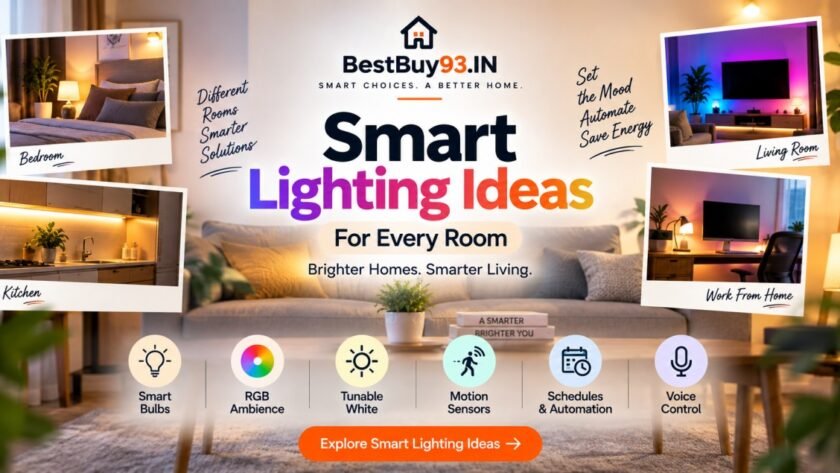

Smart lighting isn’t just about changing a bulb from white to purple. 🌈💡
The real magic happens when your lights work around your routine turning on when you enter a room, becoming warmer in the evening, switching off automatically at bedtime, or creating the perfect ambience for a movie night.
And the best part? You don’t need to redesign your entire home or spend a fortune to get started.
A couple of smart bulbs, smart switches, LED strips or motion sensors can completely change how a room feels and functions.
In this guide, we’ll share practical smart lighting ideas for every room, including bedrooms, living rooms, kitchens, home offices, balconies and entertainment spaces. We’ll also explain how to use RGB, tunable white, smart bulbs, sensors, schedules, voice control and automation without turning your home into a confusing mess of apps and gadgets.
For Indian homes, we’ll also cover useful considerations such as B22 vs E27 fittings, Wi-Fi connectivity, power cuts, electrical safety and choosing lighting that works with your existing setup. 🇮🇳🏠
Also Read | RGB vs White Smart Lights: Which One Should You Buy?
📌 Smart Lighting Ideas: Quick Answer
The best smart lighting setup combines good everyday illumination with automation and ambience.
For most homes, start with:
- 💡 Smart bulbs for easy installation
- 🤍 Tunable white lights for everyday use
- 🌈 RGB lights for ambience and entertainment
- 🚶 Motion sensors for automatic lighting
- ⏰ Schedules for routines
- 🗣️ Voice control for hands-free operation
- 🔗 Matter-compatible devices if you want broader smart-home interoperability
You don’t need to automate everything.
Automate the annoying stuff first.
That’s where smart lighting actually earns its keep.
💡 1. Create a Warm Evening Lighting Routine
One of the easiest smart lighting ideas is to change your lighting automatically as the day progresses.
During the day, you may prefer brighter, cooler light.
At night, warmer and dimmer lighting can make the room feel more relaxed.
You could create a routine such as:
7:00 AM → Bright white
6:30 PM → Neutral white
9:30 PM → Warm white + 50% brightness
11:30 PM → Lights OFF
Instead of manually adjusting everything every evening, the smart-home system handles it.
This is one of those automations that sounds boring until you’ve used it for a week.
Then suddenly you’re wondering why every house doesn’t do it. 😄
🛋️ 2. Turn Your Living Room Into a Multi-Mood Space
Your living room probably isn’t used for just one thing.
It’s where you:
- Watch TV
- Talk to family
- Read
- Work occasionally
- Entertain guests
- Relax after work
So why should the lighting have only one setting?
Create different lighting scenes.
☀️ Day Mode
Bright neutral or cool white lighting.
🍿 Movie Mode
Dim warm lighting with subtle accent lights.
🎉 Party Mode
RGB lighting with colourful accent effects.
📖 Reading Mode
Brighter, focused white lighting.
🌙 Relax Mode
Warm, dim lighting.
You can save each configuration as a scene in your smart-lighting app or compatible ecosystem.
🌈 3. Use RGB Lights as Accent Lighting
Here’s where RGB smart lights are genuinely fun.
You don’t necessarily need RGB as your primary room lighting.
Instead, use it as accent lighting.
Think:
Main ceiling light → White
Behind TV → RGB
Shelf → RGB
Cabinet → Warm white
This gives you colour when you want it without sacrificing useful illumination.
RGB is particularly effective behind:
- TVs
- Desks
- Shelves
- Headboards
- Cabinets
- Entertainment units
And no, the entire room doesn’t have to be neon purple. 😂
A subtle colour wash can look much more sophisticated.
📺 4. Create a Home Theatre Lighting Setup
You don’t need an expensive cinema room to make movie nights feel better.
Try this:
Before the movie
Warm lights → 30–40% brightness
Movie starts
Main lights → OFF
Accent lights → Dim
Movie ends
Lights → Slowly return to warm brightness
This can be done using smart bulbs, LED strips or compatible smart switches.
The key is to avoid placing bright lights directly behind or beside the television where they can create distracting reflections.
🎮 5. Build a Gaming Lighting Setup
Gaming is probably one of the most obvious places to use RGB lighting.
But instead of covering every surface in RGB strips, focus on layers.
Layer 1: Desk lighting
Use a smart RGB light strip behind the desk.
Layer 2: Background lighting
Add a lamp or wall-mounted smart light behind the monitor.
Layer 3: Ambient lighting
Use a floor lamp or accent bulb in the corner.
The result is much more immersive than one RGB bulb hanging from the ceiling.
You can also create different scenes:
🎮 Gaming Mode
🎬 Movie Mode
🎧 Music Mode
🌙 Late Night Mode
🛏️ 6. Make Your Bedroom Lighting More Relaxing
Bedrooms are one of the best places for smart lighting.
But here’s the thing:
You don’t need crazy RGB lighting in your bedroom.
For most people, warm or tunable-white lighting is more useful.
Try:
Morning
Brighter, cooler white.
Evening
Warm white at lower brightness.
Bedtime
Very dim warm lighting.
Midnight
Motion-activated low-level lighting.
This gives you enough light to move around without blasting your eyes with a bright ceiling light.
🌙 7. Add Under-Bed Motion Lighting
This is a surprisingly useful smart lighting idea.
Install a motion sensor and a low-level LED strip under your bed.
Then create:
Motion detected + nighttime → Under-bed light ON
After a few minutes:
No motion → Light OFF
Now when you get up at 2 AM, you don’t need to turn on the main bedroom light.
Your feet get enough illumination to navigate the room while the rest of the bedroom stays dark.
It’s simple.
It’s practical.
And unlike RGB disco lighting, you’ll probably use it every night. 😄
🚪 8. Automate Your Entryway
Your entrance is another great place for motion-based lighting.
You can create:
Door opens → Entry light ON
or:
Motion detected after sunset → Entry light ON
Then:
No motion for 2 minutes → Light OFF
This is especially useful when you’re returning home with groceries and don’t particularly feel like performing the one-handed phone-unlock-and-flashlight dance.
🍳 9. Use Smart Lighting Under Kitchen Cabinets
Kitchen lighting should be practical first.
Under-cabinet lighting can illuminate:
- Countertops
- Cutting areas
- Sink areas
- Breakfast counters
Smart LED strips can make this lighting easier to automate.
For example:
6:00 PM → Kitchen accent lights ON
11:00 PM → Kitchen lights OFF
You can also use motion detection:
Motion detected → Under-cabinet light ON
This can be especially useful at night when you want to grab a glass of water without turning on every kitchen light.
📚 10. Create a Dedicated Reading Corner
Have a favourite chair where you read?
Turn it into a mini smart-lighting zone.
Use a smart lamp or smart bulb that provides:
- Adjustable brightness
- Warm/cool white adjustment
- Scheduling
- Voice control
Create a simple:
Reading Mode → Warm/neutral white + comfortable brightness
You don’t need RGB here.
Your book doesn’t need nightclub lighting.
💻 11. Improve Your Home Office Lighting
Smart lighting can make a home office much more flexible.
During working hours, use brighter neutral or cooler white lighting.
In the evening, transition toward warmer tones.
A simple routine could be:
9 AM → Work mode
6 PM → Evening mode
10 PM → Lights off
You can also use smart lighting to create a consistent background if you attend video calls or create content.
For creators, this can be particularly useful.
A well-lit background makes a desk setup look considerably more polished on camera.
🎥 12. Create a Content-Creation Lighting Setup
If you’re filming YouTube videos, reels, tutorials or product content, smart lighting can become part of your setup.
Try combining:
Key light
A dedicated light facing you.
Background light
A smart RGB bulb or LED strip behind you.
Accent light
A small lamp highlighting a shelf, plant or product.
Then create presets:
🎥 Recording
🎮 Gaming
📱 Reels
🌙 Night
The smart lighting isn’t replacing your key light.
It’s helping you control the background and ambience quickly.
🚿 13. Add Soft Bathroom Night Lighting
A bright bathroom ceiling light at 2 AM?
Absolutely brutal. 😂
Instead, add low-level smart lighting where practical.
For example:
Motion detected between 11 PM and 6 AM → Low-level light ON
During the daytime:
Normal brightness
This gives you a softer nighttime experience without leaving the bathroom completely dark.
Because bathrooms are wet areas, make sure any lighting product you install is appropriately rated for its location. Don’t casually put a regular indoor LED strip somewhere it can be exposed to water.
🌿 14. Light Up Your Balcony or Patio
Smart outdoor lighting can make balconies and patios much more inviting.
Consider:
- Smart outdoor-rated bulbs
- Weather-appropriate LED strips
- Decorative smart lamps
- Motion sensors
- Timers
Create:
Sunset → Outdoor lights ON
11:00 PM → Lights dim
Midnight → Lights OFF
For outdoor installations, always check the product’s IP/weather-resistance rating and installation requirements.
🖼️ 15. Highlight Wall Art and Shelves
Smart lighting doesn’t have to illuminate the entire room.
Use it to highlight specific objects.
Try accent lights around:
- Artwork
- Plants
- Bookshelves
- Display cabinets
- Collectibles
- Architectural features
A warm accent light can make an ordinary shelf look considerably more premium.
This is essentially layered lighting and it can make a bigger visual difference than simply buying a brighter bulb.
🚶 16. Use Motion Sensors in Hallways
Hallways are perfect candidates for motion-based lighting because you don’t need them illuminated constantly.
Set:
Motion detected → Light ON
No motion → Light OFF
You can make it even smarter:
Daytime → No automatic light
After sunset → 70% brightness
Late night → 20% brightness
Now your lighting responds not only to movement but also to the time of day.
🪜 17. Add Smart Lighting to Staircases
Staircases are another useful location for automation.
Instead of leaving the lights on all night:
Motion detected at bottom → Stair lights ON
Motion detected at top → Stair lights ON
Then:
No motion → Lights OFF
For homes with children, older adults or frequent nighttime movement, practical lighting here can be more valuable than decorative RGB effects.
For electrical installations, especially permanent stair lighting, use appropriate professional installation where required.
🧠 18. Create a “Good Night” Smart Lighting Routine
This is probably one of the easiest smart-home routines to set up.
Say:
“Good night.”
Then your smart-home system can:
- Turn living-room lights OFF
- Turn kitchen lights OFF
- Dim bedroom lights
- Turn selected accent lights OFF
- Leave a small night light ON
One command.
Multiple actions.
That’s the whole point of smart-home automation.
🌅 19. Create a Sunrise-Style Morning Routine
You can also reverse the idea.
Instead of waking up and immediately facing a blinding ceiling light, create a gentle morning routine.
For example:
7:00 AM → Bedroom light gradually brightens
7:15 AM → Warmer-to-neutral white
7:30 AM → Normal brightness
Some smart lighting systems support gradual transitions and scheduled scenes.
It’s a small quality-of-life upgrade, but one that can make mornings feel less like an emergency evacuation. 😄
🧳 20. Use Smart Lighting While You’re Away
Smart lighting can also help when you’re travelling.
Instead of leaving every light on, create an automation that makes the home appear occupied.
For example:
7 PM → Living-room lamp ON
10 PM → Living-room lamp OFF
10:05 PM → Bedroom lamp ON
11 PM → Bedroom lamp OFF
Randomized or varied schedules can make the pattern less predictable than simply turning one light on at exactly the same time every day.
Of course, smart lighting shouldn’t be treated as a replacement for proper home security.
🔌 Smart Bulbs vs Smart Switches: Which Should You Use?
This is an important decision.
Smart Bulbs
Best when you want:
- RGB colours
- Individual bulb control
- Dimming
- Tunable white
- Easy installation
- Rental-friendly upgrades
Great for:
Bedrooms, lamps, desks and decorative lighting.
Smart Switches
Best when you want:
- Control of existing fixtures
- Multiple bulbs controlled together
- Wall-switch integration
- A more permanent setup
Great for:
Ceiling lights, fans and fixed lighting circuits where compatible.
However, smart switches involve electrical wiring, so installation should be handled appropriately rather than treating the switch like a USB accessory.
🌈 RGB vs Tunable White: Which Is Better?
For smart lighting ideas, this distinction matters.
RGB
Best for:
🎮 Gaming
🎬 Entertainment
🎉 Parties
🌈 Decorative lighting
📸 Content backgrounds
Tunable White
Best for:
💻 Work
📚 Reading
🛏️ Bedrooms
🍳 Kitchens
🏠 Everyday illumination
RGBW / RGB+CCT
Best for:
🏆 People who want both.
If your budget allows it, RGBW or RGB+CCT can be a particularly versatile choice because you get coloured lighting plus dedicated white-light control.
🇮🇳 Smart Lighting Tips for Indian Homes
Before buying smart lighting products in India, don’t forget the boring-but-important stuff.
Check the Socket
Look for:
B22 or E27, depending on your fixture.
B22 fittings are common in Indian homes, while E27 screw fittings are also widely used.
Check Wi-Fi Requirements
Many smart bulbs operate on 2.4GHz Wi-Fi.
Make sure the device is compatible with your home network before buying.
Consider Power Cuts
Check how the device behaves when electricity returns.
Does it:
- Stay off?
- Turn on automatically?
- Restore its previous state?
That small detail can make a big difference.
Check Electrical Ratings
For smart switches and smart plugs, always check the rated electrical load.
Don’t connect high-power appliances to a device simply because its plug physically fits.
Consider Your Ecosystem
If you’re already using:
- Alexa
- Google Home
- Apple Home
- Samsung SmartThings
- Matter
choose compatible lighting products.
Otherwise, you’ll eventually end up with five apps and a mild existential crisis. 😭
🛒 What to Look for When Buying Smart Lighting
Here’s our smart-lighting checklist.
| Feature | Why It Matters |
|---|---|
| Lumens | Determines brightness |
| Colour temperature | Controls warm/cool white |
| RGB | Enables coloured lighting |
| RGBW/RGB+CCT | Better colour + white flexibility |
| CRI | Helps with natural-looking colours |
| Dimming | Useful for ambience |
| Socket type | Ensures physical compatibility |
| Wi-Fi support | Determines network requirements |
| Matter support | Can improve ecosystem interoperability |
| Alexa/Google/Apple support | Enables voice control |
| Scheduling | Automates routines |
| Motion compatibility | Enables sensor-based lighting |
| App quality | Important for setup and control |
| Power recovery | Important during power cuts |
| IP rating | Important for suitable outdoor/wet-area products |
🧪 Our Research Methodology
We evaluated these smart lighting ideas based on practical everyday usefulness rather than simply adding more gadgets.
Our recommendations consider:
- Lighting purpose
- Brightness
- Colour temperature
- RGB capabilities
- Smart-home connectivity
- Automation potential
- Voice control
- Sensor compatibility
- Ecosystem support
- Matter compatibility
- Installation complexity
- Socket compatibility
- Electrical safety
- Suitability for Indian homes
- Long-term usefulness
The goal is simple: recommend smart lighting that solves real problems instead of creating gadget clutter.
💰 Do You Need Expensive Smart Lighting?
Absolutely not.
A smart lighting setup can start with one smart bulb.
For example:
Budget Setup
1 smart bulb
→ Phone control
→ Dimming
→ Scheduling
Better Setup
2–3 smart bulbs + smart speaker
→ Voice control
→ Scenes
→ Room-based routines
Advanced Setup
Smart bulbs + switches + sensors + LED strips
→ Motion automation
→ Time-based lighting
→ Multi-room scenes
→ Advanced routines
Build gradually.
There’s no prize for having the most smart bulbs in your house. 🏆😂
🏆 10 Best Smart Lighting Ideas to Try First
If you don’t want to read the entire guide again, start with these:
- 🌅 Automatic morning lighting
- 🌙 Warm evening lighting
- 🛏️ Under-bed motion lighting
- 📺 Movie-night lighting
- 🎮 Gaming RGB setup
- 💻 Home-office lighting routine
- 🚪 Motion-activated entryway
- 🍳 Kitchen under-cabinet lighting
- 🪜 Automatic staircase lighting
- 🗣️ “Good Night” voice routine
These provide a good balance of function, convenience and ambience.
Also Read | Best Smart Bulbs in India: Top Picks
❓ Frequently Asked Questions
What is the best smart lighting idea for beginners?
Start with one smart bulb and one simple schedule. For example, automatically turn a living-room or bedroom light on in the evening and off at bedtime.
Are RGB smart lights useful for everyday lighting?
They can be, but RGB is generally most useful for ambience and decorative lighting. For everyday illumination, white or tunable-white lighting is often more practical.
What is better: smart bulbs or smart switches?
Smart bulbs are easier to install and offer features such as RGB colours and individual bulb control. Smart switches are better for permanent fixtures and conventional lighting circuits. The right choice depends on your home and the type of lighting you want to automate.
Do smart lights work without Wi-Fi?
It depends on the product. Some smart lights support Bluetooth or other local connectivity, while Wi-Fi models may require network connectivity for certain features. Always check the manufacturer’s specifications.
Can smart lights work during a power cut?
No mains-powered smart light can illuminate without electrical power. Once power returns, the device’s behaviour depends on its power-recovery settings.
Can I use smart lights in a rented home?
Yes. Smart bulbs and plug-in smart lamps are particularly rental-friendly because they usually don’t require permanent electrical modifications.
Are smart lights worth buying?
They can be, especially if you use scheduling, dimming, voice control, sensors or automation. If you only need basic illumination, conventional LED lighting can still offer excellent value.
Should I choose RGB or tunable white?
Choose RGB for gaming, entertainment and ambience. Choose tunable white for everyday lighting, work, reading and bedrooms. Choose RGBW or RGB+CCT if you want both.
🏁 Final Verdict: Build a Smarter Lighting Setup
The best smart lighting setup isn’t the one with the most bulbs, the most colours or the longest list of features.
It’s the one that makes your everyday routine easier. 💡🏠
Start with the basics:
Smart bulb → schedule → dimming → voice control → sensor → automation.
Then expand based on what you actually need.
Use tunable white where good everyday illumination matters. Use RGB where ambience and entertainment matter. Add motion sensors in places where lights are frequently left on. And use schedules to make repetitive tasks disappear into the background.
For Indian homes, remember to check B22/E27 compatibility, 2.4GHz Wi-Fi requirements, electrical ratings, power-cut behaviour and smart-home ecosystem compatibility before purchasing.
And most importantly, don’t automate something just because you can.
Automate what saves time, improves comfort or makes your home easier to live in.
That’s when smart lighting stops being a collection of colourful gadgets and starts becoming a genuinely useful part of your home. ✨🏠💡