
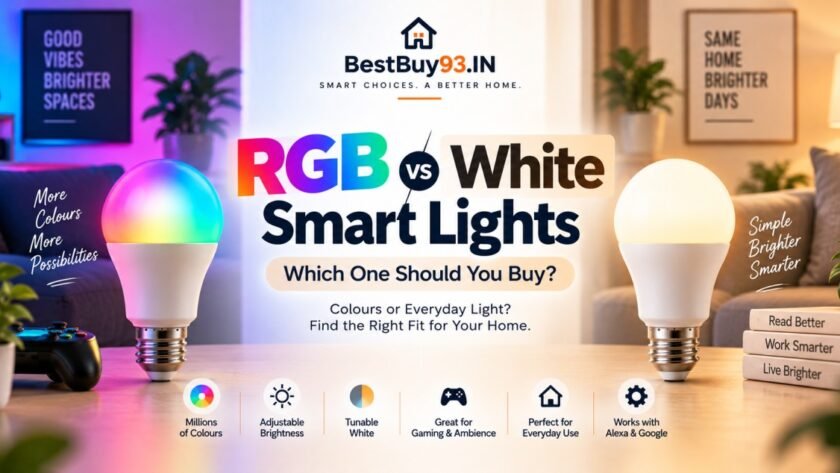

Smart lighting has come a long way from simply choosing between warm white and cool white. Today, you can buy smart lights that glow in millions of colours, automatically change their colour temperature throughout the day, sync with music, work with Alexa or Google Home, and become part of a larger home-automation setup. 💡🏠
But there’s one question that confuses a lot of first-time buyers:
Should you buy RGB smart lights or White smart lights?
The answer isn’t as simple as saying RGB is better because it has more colours. In everyday use, white light is often more useful, while RGB becomes valuable when you want ambience, entertainment, gaming, parties or decorative lighting.
There’s also a third option that deserves attention: tunable white. These lights let you move between warm and cool white without necessarily giving you full RGB colour control. Philips Hue, for example, separates its lighting range into White, White Ambiance, and White and Color Ambiance, illustrating how different these lighting categories can be.
So, let’s break down RGB vs White smart lights, what each type actually does, where it works best, and which one makes more sense for an Indian home. 🇮🇳
📌 RGB vs White Smart Lights: Quick Answer
Choose RGB smart lights if you want colourful ambience, entertainment lighting, gaming setups or decorative effects.
Choose White smart lights if your priority is everyday illumination, reading, working, cooking and a comfortable home environment.
And if you want the best balance, RGB + tunable white (RGBW/RGBWW) is usually the most versatile option because it can provide both coloured lighting and useful shades of white.
| Feature | RGB Smart Lights | White Smart Lights |
|---|---|---|
| Colour options | 🌈 Millions of colours | Usually one or adjustable white tones |
| Everyday illumination | ⭐⭐⭐⭐ | ⭐⭐⭐⭐⭐ |
| Ambience | ⭐⭐⭐⭐⭐ | ⭐⭐⭐ |
| Gaming/entertainment | ⭐⭐⭐⭐⭐ | ⭐⭐ |
| Reading/work | ⭐⭐⭐ | ⭐⭐⭐⭐⭐ |
| Warm/cool adjustment | Depends on model | Often available with tunable white |
| Energy efficiency | Depends on bulb | Depends on bulb |
| Best for | Mood & entertainment | Everyday lighting |
| Best overall flexibility | ⭐⭐⭐⭐⭐ with RGBW | ⭐⭐⭐⭐ |
💡 What Are RGB Smart Lights?
RGB stands for Red, Green and Blue.
An RGB smart light combines these LED colours in different intensities to create a wide range of coloured light.
That means you can potentially have:
🔴 Red
🟢 Green
🔵 Blue
🟣 Purple
🟠 Orange
🩷 Pink
🩵 Cyan
…and plenty of combinations between them.
Many modern smart lighting systems advertise millions of colours. Philips Hue, for example, describes its White and Color Ambiance range as offering more than 16 million colours alongside white-light control. (Philips Hue)
You can normally control RGB lights using an app, remote, voice assistant or automation platform, depending on the product.
RGB smart lights are particularly useful for:
- 🎮 Gaming rooms
- 🎬 Home theatres
- 🎉 Parties
- 🛋️ Living-room ambience
- 🖥️ Desk setups
- 📸 Content-creation backgrounds
- 🪩 Decorative lighting
But there’s a catch.
RGB doesn’t automatically mean better white light.
And that’s something many buyers discover only after purchasing.
🤍 What Are White Smart Lights?
White smart lights are designed primarily for illumination rather than colourful effects.
However, “white smart light” can mean two different things.
Fixed White
The bulb produces one particular white colour temperature, such as warm white.
Philips Hue’s White bulbs, for example, use a fixed 2700K warm-white output while still providing smart features such as dimming and scheduling.
Tunable White
Tunable-white lights allow you to adjust the colour temperature.
For example:
Warm white → relaxing
Neutral white → everyday use
Cool white → focused tasks
Philips Hue’s White Ambiance range allows users to adjust between warmer and cooler white tones, making it more flexible for spaces used for different activities.
This distinction matters.
A tunable-white smart bulb can be much more useful than a basic fixed-white bulb, even though it doesn’t offer rainbow colours.
🌈 RGB vs White: What’s the Real Difference?
Here’s the easiest way to think about it:
RGB
“I want to change the mood.”
White
“I want good light.”
Tunable White
“I want the right white light for different situations.”
RGBW / RGB+CCT
“I want basically everything.” 😎
That last category is particularly interesting for people building a more sophisticated smart home.
🏆 RGB vs White Smart Lights: Which Is Better?
There isn’t one universal winner.
It depends entirely on how you use your room.
🛋️ For Living Rooms
Winner: RGB + White
Your living room can serve multiple purposes.
You might want:
Warm white → Evening relaxation
Cooler white → Cleaning or reading
RGB → Movie night or party
This is where a full-colour smart light can be useful because you’re not locked into one lighting style.
🛏️ For Bedrooms
Winner: White / Tunable White
You probably don’t need bright purple lighting at 7 AM. 😂
For bedrooms, warm white lighting is generally much more practical for relaxing.
A tunable-white smart bulb lets you shift toward warmer tones in the evening while still giving you brighter or cooler lighting when needed.
Philips Hue specifically positions warmer white light around 2700K for relaxing spaces such as bedrooms and living rooms. (Philips Hue)
Best choice: Tunable white.
💻 For Home Offices
Winner: Tunable White
This is one area where people sometimes buy RGB because it looks cool on Instagram.
But when you’re sitting at your desk for six hours, useful illumination matters more than rainbow colours.
A tunable-white bulb can let you adjust the light according to the activity.
For example:
🌅 Morning → Brighter/cooler
💻 Work → Neutral/cooler
🌆 Evening → Warmer
That’s considerably more useful than making the ceiling purple.
🎮 For Gaming Rooms
Winner: RGB 🏆
Okay, this is where RGB gets to shine—literally.
RGB lighting can create:
- Gaming ambience
- Colour scenes
- Dynamic effects
- Accent lighting
- Immersive setups
You can match the lighting to your gaming desk, monitor setup or room theme.
And yes, red lighting makes your gaming setup approximately 37% more powerful.
Okay, that’s completely made up. 😂
But it does look cool.
🎬 For Home Theatres
Winner: RGB
RGB lights can create a cinematic environment.
You can use dim coloured accent lighting around the room while keeping the main screen area relatively dark.
The important thing is not to make the lighting so bright that you’re competing with the television.
Subtle RGB usually works better than turning your living room into a nightclub.
📚 For Reading
Winner: White / Tunable White
If your main objective is reading, focus on:
- Brightness
- Colour temperature
- Glare
- Light distribution
- Colour rendering
RGB isn’t the priority.
A good white or tunable-white light is generally the more sensible choice.
🎉 For Parties
Winner: RGB
This one isn’t even close.
Want:
🟣 Purple?
🔵 Blue?
🔴 Red?
🟢 Green?
RGB gives you the flexibility.
Some smart-lighting ecosystems also offer scenes and dynamic effects designed specifically for entertainment.
Philips Hue, for example, supports coloured lighting and dynamic effects designed for different moods and activities. (Philips Hue)
🔥 The Problem With RGB-Only Smart Lights
Here’s the part manufacturers don’t always put in huge letters.
RGB isn’t necessarily the best way to create high-quality white light.
A simple RGB system mixes red, green and blue LEDs to produce colours. But dedicated white LEDs or additional white LED channels can produce more useful white illumination.
That’s why you’ll often see terms such as:
- RGBW
- RGBWW
- RGB+CCT
- RGBCCT
These systems add dedicated white-light capabilities alongside RGB.
For example, Philips Hue describes its gradient products as RGBWWIC, combining colour capabilities with white-light ranges. (Philips Hue)
So if you want both great colours and genuinely useful white light, don’t automatically choose a cheap RGB-only bulb.
🤍 Why Tunable White Deserves More Attention
Here’s our slightly controversial take:
For most homes, tunable white is more useful than RGB.
Why?
Because you can actually use it every day.
Imagine your bedroom:
Morning ☀️
Brighter, cooler white.
Afternoon 💻
Neutral white for work.
Evening 🌙
Warm white for relaxation.
You don’t need 16 million colours to accomplish any of that.
Philips Hue’s White Ambiance system is specifically designed around changing colour temperature for different activities and times of day. (Philips Hue)
And smart lighting brands are increasingly adding automatic white-temperature features. TP-Link, for example, documents an Auto White feature on supported Tapo multicolour bulbs that can adjust colour temperature based on local time. (TP-Link)
🇮🇳 Which Smart Light Is Better for Indian Homes?
For Indian buyers, there’s another consideration:
What are you actually replacing?
If you’re replacing the primary bulb in a bedroom or living room, prioritize:
- Brightness
- Socket compatibility
- White-light quality
- Wi-Fi reliability
- Dimming
- Scheduling
- Voice compatibility
If you’re adding decorative lighting, RGB becomes much more attractive.
Also check whether the bulb uses a B22 or E27 fitting before buying.
B22 fittings are common in Indian homes, while E27 screw fittings are also widely used in lamps and fixtures.
Don’t discover the difference after delivery.
That’s a very expensive way to learn what a socket looks like. 😭
📶 Wi-Fi, Bluetooth or Hub-Based Smart Lights?
RGB vs White isn’t the only decision.
You also need to understand how the smart light connects.
Wi-Fi
Usually convenient for beginners.
You can often control the light through an app and, depending on the ecosystem, remotely.
Bluetooth
Useful for simple local control and some ecosystems.
Philips Hue, for example, supports Bluetooth control on compatible products, while adding a Hue Bridge unlocks broader system capabilities.
Zigbee / Hub-Based
Often used in larger smart-lighting ecosystems.
The hub can coordinate multiple devices and may provide additional reliability and functionality.
Matter
Matter isn’t a replacement for RGB or white lighting.
It’s an interoperability standard that can help compatible smart-home devices work across supported ecosystems.
So you can have a:
Wi-Fi + Matter + RGB smart bulb
or:
Wi-Fi + Matter + tunable-white smart bulb
They’re separate concepts.
🛒 What to Look for When Buying RGB or White Smart Lights
Before buying, check these specifications.
1. Brightness — Lumens 💡
Don’t judge brightness by wattage alone.
Look at lumens.
A smart bulb with millions of colours isn’t very useful if it’s too dim to properly illuminate the room.
2. Colour Temperature
If you’re buying a white or RGBW light, check the supported Kelvin range.
A broader range gives you more flexibility.
For example, Philips Hue offers white-light ranges extending from warm tones to cooler daylight depending on the product category.
3. RGB vs RGBW
If you want colourful lighting and good white lighting, look for RGBW or RGB+CCT rather than assuming RGB alone is sufficient.
4. Dimming
Dimming is one of the most useful smart-light features.
A bulb that supports precise dimming can be useful throughout the day.
5. CRI
If you’re buying lighting primarily for everyday illumination, pay attention to CRI (Color Rendering Index).
A higher CRI generally means colours appear more naturally under the light.
This matters particularly in:
- Bedrooms
- Dressing areas
- Kitchens
- Workspaces
- Makeup areas
6. Socket Type
Check:
B22?
E27?
Make sure the bulb physically fits your fixture.
7. Voice Assistant Compatibility 🗣️
Check whether your bulb supports:
- Amazon Alexa
- Google Home
- Apple Home
- Samsung SmartThings
- Matter
Don’t assume compatibility just because the product says “smart.”
8. App & Automation
A good smart bulb should ideally offer:
- Scheduling
- Scenes
- Timers
- Dimming
- Remote control
- Device sharing
- Automation
These features are often more useful than having another 500,000 colours you’ll never use.
📊 RGB vs White Smart Lights: Final Comparison
| Category | RGB | White | Tunable White | RGBW/RGB+CCT |
|---|---|---|---|---|
| Everyday lighting | ⭐⭐⭐⭐ | ⭐⭐⭐⭐⭐ | ⭐⭐⭐⭐⭐ | ⭐⭐⭐⭐⭐ |
| Colour effects | ⭐⭐⭐⭐⭐ | ⭐ | ⭐ | ⭐⭐⭐⭐⭐ |
| Relaxation | ⭐⭐⭐⭐ | ⭐⭐⭐⭐⭐ | ⭐⭐⭐⭐⭐ | ⭐⭐⭐⭐⭐ |
| Work/study | ⭐⭐⭐ | ⭐⭐⭐⭐ | ⭐⭐⭐⭐⭐ | ⭐⭐⭐⭐⭐ |
| Gaming | ⭐⭐⭐⭐⭐ | ⭐⭐ | ⭐⭐⭐ | ⭐⭐⭐⭐⭐ |
| Parties | ⭐⭐⭐⭐⭐ | ⭐ | ⭐ | ⭐⭐⭐⭐⭐ |
| White-light flexibility | ⭐⭐ | ⭐⭐ | ⭐⭐⭐⭐⭐ | ⭐⭐⭐⭐⭐ |
| Overall versatility | ⭐⭐⭐⭐ | ⭐⭐⭐ | ⭐⭐⭐⭐⭐ | ⭐⭐⭐⭐⭐ |
🧪 Our Research Methodology
For this comparison, we looked beyond the simple RGB vs white label.
We evaluated smart lighting based on:
- Colour capabilities
- White-light quality
- Colour temperature
- Brightness
- Dimming
- Smart-home connectivity
- Voice-assistant support
- Automation
- Ecosystem compatibility
- Everyday usability
- Indian-home considerations
- Long-term flexibility
We also checked current manufacturer information from established smart-lighting brands because specifications and supported smart-home features can change between models and generations. (Philips Hue)
❓ Frequently Asked Questions
Is RGB better than white smart lights?
Not necessarily. RGB is better for colourful ambience and entertainment, while white or tunable-white lights are generally better for everyday illumination.
Which is better for a bedroom: RGB or white?
White or tunable white is usually the better choice for a bedroom. Warm white can create a more relaxing environment, while tunable white gives you flexibility throughout the day.
Are RGB smart bulbs good for reading?
They can provide light, but a dedicated white or tunable-white smart bulb is generally a better choice for reading because you can prioritize useful brightness and white-light quality.
What is RGBW?
RGBW adds a dedicated white LED channel to RGB lighting. This can provide more useful white light while retaining the ability to produce colours.
What is RGB+CCT?
RGB+CCT combines RGB colour control with adjustable correlated colour temperature, allowing you to control both colours and shades of white.
Do RGB smart bulbs use more electricity?
Not necessarily. Energy consumption depends on the bulb’s power rating, brightness level, technology and how long you operate it. The RGB label alone doesn’t determine electricity consumption.
Can RGB smart bulbs produce warm white light?
Some can, but the quality of white light varies. RGB-only systems may not produce the same quality of white illumination as bulbs with dedicated white LED channels.
Should I buy RGB or tunable white?
If you mainly need practical everyday lighting, choose tunable white. If you want entertainment and colourful ambience, choose RGB. If you want both, look for RGBW or RGB+CCT.
🏁 Final Verdict: RGB vs White Smart Lights
So, RGB or White?
Here’s the simple answer:
🏠 For everyday home lighting
Tunable White wins.
🎮 For gaming
RGB wins.
🎬 For entertainment
RGB wins.
🛏️ For bedrooms
Warm/tunable white wins.
💻 For workspaces
Tunable white wins.
🎉 For parties
RGB wins.
🏆 For maximum versatility
RGBW / RGB+CCT wins.
If you’re buying your first smart light, don’t automatically choose RGB just because millions of colours sounds impressive.
Think about how you’ll actually use the light.
If it’s your main bedroom or living-room light, good white illumination and adjustable colour temperature may matter far more than rainbow effects.
But if you’re building a gaming setup, home theatre or entertainment room, RGB can transform the atmosphere in a way ordinary white lighting simply can’t.
And if you don’t want to choose between the two?
That’s exactly why RGBW and RGB+CCT smart lights exist. 💡🌈
The smartest lighting choice isn’t the one with the most colours.
It’s the one that gives you the right light when you actually need it. 🏠✨
Also Read | Best Smart Bulbs in India: Top Picks