
Your smartphone camera is probably the camera you carry everywhere. Whether you’re photographing beautiful sunsets, capturing travel memories, shooting food pictures for Instagram or creating YouTube videos, modern smartphones make photography incredibly convenient.
But sometimes, the built-in camera has its limitations. You might want to photograph the tiny details of a flower, capture a wider landscape, experiment with dramatic fisheye shots or create cinematic-looking videos.
That’s where smartphone camera lenses come in.
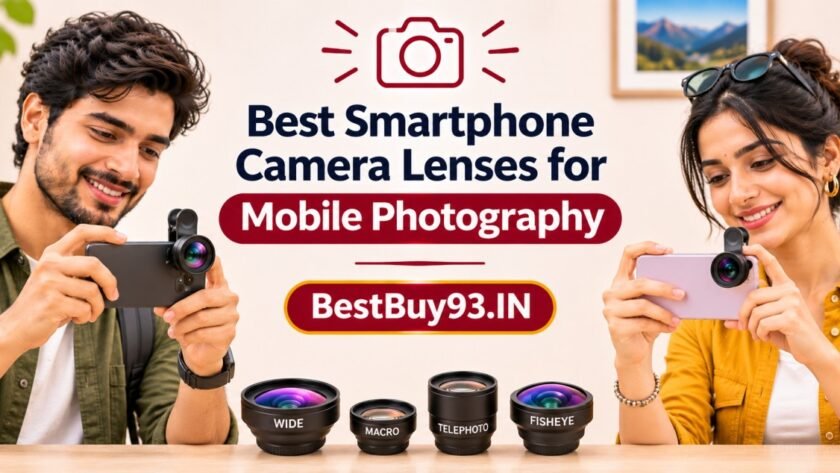
These compact accessories attach to your phone’s camera and offer different photographic perspectives. Depending on the type, they can help you capture close-up details, wider scenes, distant subjects or creative visual effects without carrying a traditional camera.
However, not every mobile camera lens is worth purchasing. Some inexpensive kits offer several attachments but may compromise image quality, while premium options require specific mounting systems and phone compatibility.
In this guide, we’ll explore the best smartphone camera lenses for mobile photography in India, compare popular lens kits, explain what each lens does and help you choose the right accessory for your photography style.
Whether you’re a beginner, travel enthusiast, product photographer or content creator, here’s what you should know before buying.
What Is a Smartphone Camera Lens?
A smartphone camera lens is an external optical accessory that attaches over one of your phone’s built-in camera lenses.
It changes the way your phone captures an image by modifying the field of view, magnification, perspective or focusing distance.
Most mobile camera lenses are available in two formats:
- Clip-on lenses: Attach to the phone using a universal clip that sits over the camera module.
- Case-mounted lenses: Connect to a compatible phone case or dedicated mounting system for more precise alignment.
Depending on the design, a mobile camera lens can help you photograph small objects, capture wider landscapes, experiment with fisheye effects or create cinematic video.
However, an external lens does not upgrade your phone’s camera sensor, autofocus system or image-processing hardware. Its purpose is to add a different optical effect or capability.
Different Types of Mobile Camera Lenses
Before exploring individual products, let’s understand the most common types of smartphone camera lenses.
| Lens Type | What It Does | Best For |
|---|---|---|
| Macro Lens | Captures tiny subjects and close-up details | Flowers, jewellery, textures and products |
| Wide-Angle Lens | Expands the field of view | Landscapes, architecture and group photos |
| Telephoto Lens | Provides a tighter view of distant subjects | Portraits, wildlife and distant details |
| Fisheye Lens | Creates a dramatic curved perspective | Creative photography and artistic shots |
| Anamorphic Lens | Creates a widescreen cinematic look | Short films, reels and video production |
| CPL Filter | Reduces certain reflections and glare | Water, glass and outdoor photography |
Which one should beginners choose?
A macro and wide-angle combination is a practical starting point if you want to experiment with different types of mobile photography. If you already own a smartphone with excellent wide-angle and telephoto cameras, a dedicated macro or anamorphic accessory may offer a more interesting addition.
10 Best Smartphone Camera Lenses for Mobile Photography
Here are ten smartphone lens products and lens-kit options worth exploring. The selection includes budget-friendly clip-on kits, macro accessories and more specialised options.
1. APEXEL 2-in-1 0.45X Wide-Angle and 12.5X Macro Lens Kit
Best for: Beginners who want to experiment with wide-angle and macro photography.
The APEXEL 2-in-1 lens kit combines two popular mobile photography accessories: a wide-angle lens and a macro lens.
The wide-angle attachment is designed to capture a broader scene, while the macro attachment helps photograph small subjects and fine details.
It’s a useful combination for people who enjoy photographing flowers, food, travel destinations, decorative objects and everyday subjects.
What we like:
- Two different lens effects in one kit.
- Useful for beginners exploring mobile photography.
- Macro photography adds a creative dimension.
- Compact accessory for travel.
What we don’t like:
- Clip alignment can affect image quality.
- Wide-angle results may overlap with your phone’s built-in ultra-wide camera.
- Not a replacement for dedicated camera equipment.
Buying tip: Check the mounting clip and camera alignment before using it. Remove a bulky phone case if it prevents the attachment from sitting correctly.
2. APEXEL 4K Telephoto Macro Lens
Best for: Close-up photography and experimenting with detailed subjects.
If you enjoy photographing small objects, jewellery, plants and textures, a dedicated macro-oriented lens deserves consideration.
The APEXEL 4K Telephoto Macro Lens listing is an option to explore for mobile photography enthusiasts looking beyond basic wide-angle attachments.
Macro photography is particularly interesting because it reveals details that are easy to overlook with everyday phone photography.
You can experiment with:
- Flower petals and pollen.
- Jewellery details.
- Fabric textures.
- Small decorative objects.
- Insects and natural textures.
What we like:
- Specialised close-up photography option.
- More focused than buying a large collection of unrelated filters.
- Suitable for creative photography experiments.
What we don’t like:
- Working distance and focusing can take practice.
- Compatibility and mounting requirements need checking.
- Not intended as a general-purpose replacement for your phone camera.
3. SKYVIK Signi 3-in-1 Mobile Phone Camera Lens Kit
Best for: Beginners who want multiple creative lens options.
The SKYVIK Signi 3-in-1 kit is worth considering if you want a small collection of external mobile photography accessories.
Multi-lens kits are useful for experimenting with different perspectives without purchasing individual accessories separately.
Before purchasing, check the exact lens combination included in the current package, its mounting arrangement and the phone models supported.
What we like:
- Multi-purpose lens-kit format.
- Useful for creative experimentation.
- A convenient option for people exploring mobile photography accessories.
What we don’t like:
- More attachments do not automatically mean better image quality.
- Individual lens performance may vary.
- Compatibility should be verified before ordering.
4. Adcom 2-in-1 Mobile Phone Camera Lens
Best for: Smartphone users looking for a branded lens accessory.
Adcom offers mobile photography accessories for people interested in experimenting with external phone lenses.
This 2-in-1 option is worth comparing with universal clip-on lens kits.
Before adding it to your shopping cart, check which optical effects are included, whether a mounting clip or case is required and whether the attachment works with your phone’s camera arrangement.
What we like:
- Two-in-one accessory format.
- An option to compare with generic clip-on kits.
- Useful for exploring external mobile camera accessories.
What we don’t like:
- Confirm the included lens specifications before purchasing.
- Compatibility varies with the phone and mounting arrangement.
- Compare the current package contents against the listed price.
5. Adcom 4-in-1 Mobile Phone Camera Clip-On Lens Kit
Best for: Users interested in experimenting with multiple photographic effects.
A 4-in-1 lens kit can be appealing if you enjoy trying different photography styles.
Instead of purchasing separate accessories, you get multiple lens options in one package.
However, don’t choose a kit just because the product title contains a large number of lenses. Look at the actual lens types and whether they provide effects you will use.
What we like:
- Multiple lens accessories in one package.
- Useful for photography experimentation.
- Can offer more creative options than a single-purpose attachment.
What we don’t like:
- Some lens effects may be used only occasionally.
- Optical performance can differ between attachments.
- Mounting and alignment remain important.
6. APEXEL 10-in-1 Phone Camera Lens Kit
Best for: Creative photographers who enjoy experimenting.
A multi-accessory mobile lens kit can be an interesting purchase if you enjoy trying different photographic effects.
The APEXEL 10-in-1 listing combines different lens and filter-style accessories. Depending on the package, these may include wide-angle, macro, fisheye, telephoto and creative filter attachments.
This kind of kit is more suitable for experimentation than for someone who needs one specific professional-quality lens.
What we like:
- Variety of creative effects.
- Useful for trying different photography styles.
- Multiple accessories in one collection.
What we don’t like:
- Not every attachment will be equally useful.
- More components mean more accessories to carry and store.
- Verify the exact kit contents before purchasing.
7. APEXEL 6X Telemacro Lens
Best for: Mobile photographers exploring specialised close-up photography.
The APEXEL 6X Telemacro Lens is a more specialised accessory to consider if close-up photography is your main interest.
Unlike basic wide-angle and macro combinations, telemacro-style photography aims to provide a different balance between magnification and working distance.
This can be interesting when photographing small subjects where getting extremely close is inconvenient.
What we like:
- Specialised photography accessory.
- Interesting option for macro enthusiasts.
- More focused use case than an ordinary multi-lens kit.
What we don’t like:
- Higher purchase cost than basic clip-on kits.
- Check exact phone compatibility and mounting requirements.
- Requires careful focusing and alignment.
8. Apexel 0.45X Wide-Angle and 12.5X Macro Lens Kit
Best for: Everyday photography and close-up experiments.
This APEXEL combination is another option for people who want to explore two common mobile photography effects.
The wide-angle attachment is intended to capture a broader field of view, while the macro attachment is intended for close-up subjects.
It is worth comparing the product specifications, optical construction and mount design with other two-in-one kits before purchasing.
What we like:
- Combines two useful lens categories.
- Suitable for beginners.
- A compact accessory format.
What we don’t like:
- Wide-angle results may not outperform a phone’s native ultra-wide camera.
- Close-up photography requires practice.
- Check whether the mounting clip works with your phone case.
9. APEXEL 5-in-1 Mobile Phone Camera Lens Kit
Best for: Users who want a larger collection of creative accessories.
The APEXEL 5-in-1 lens kit is another multi-accessory option for people who like experimenting with mobile photography.
A kit with several lens types can be useful when you want to try different compositions and visual effects.
However, think about your actual photography requirements. If you mostly photograph food, flowers and products, a dedicated macro accessory may be more useful than a large kit.
What we like:
- Multiple accessories in one package.
- Offers different creative possibilities.
- Useful for experimentation.
What we don’t like:
- Not every attachment may suit everyday photography.
- Requires storage for several small accessories.
- Confirm the current package contents and compatibility.
10. APEXEL 2-in-1 Phone Lens with Clip
Best for: Users looking for another macro and telephoto-style accessory combination.
The APEXEL 2-in-1 phone lens with clip is worth exploring if you want to compare a specialised lens combination against basic wide-angle and macro kits.
Before buying, examine the exact magnification, intended camera, working distance and mounting instructions.
A product labelled telephoto or telemacro should not automatically be assumed to work with every smartphone camera.
What we like:
- Specialised external lens option.
- Useful for comparing different mobile photography setups.
- Clip-based mounting format.
What we don’t like:
- Check whether the lens works with your exact phone.
- A clip alone does not guarantee precise optical alignment.
- Results depend on the phone camera and shooting technique.
Quick Comparison: Best Smartphone Camera Lenses
| Product | Lens Category | Best For | Buying Consideration |
|---|---|---|---|
| APEXEL 2-in-1 0.45X + 12.5X | Wide-angle + Macro | Beginners | Check clip alignment |
| APEXEL 4K Telephoto Macro | Macro-oriented | Close-ups | Check working distance |
| SKYVIK Signi 3-in-1 | Multi-lens kit | Experimentation | Verify included lenses |
| Adcom 2-in-1 | Two-in-one kit | Everyday experimentation | Confirm specifications |
| Adcom 4-in-1 | Multi-lens kit | Creative effects | Check package contents |
| APEXEL 10-in-1 | Multi-lens and filter kit | Creative photography | More accessories to manage |
| APEXEL 6X Telemacro | Telemacro | Close-up enthusiasts | Check mounting system |
| APEXEL 0.45X + 12.5X | Wide-angle + Macro | Everyday use | Check phone compatibility |
| APEXEL 5-in-1 | Multi-lens kit | Experimentation | Check actual lens selection |
| APEXEL 2-in-1 with Clip | Specialised lens kit | Creative close-ups | Verify intended camera |
Our practical recommendation: Don’t automatically choose the kit with the most attachments. Start with the type of photography you actually enjoy. A well-aligned macro lens can be more useful than a ten-piece kit that mostly stays inside its storage pouch.
How to Choose the Right Smartphone Camera Lens
Choosing a mobile camera lens becomes easier when you know what to look for.
A. Identify Your Photography Style
Start by deciding what you want to photograph.
| Photography Style | Recommended Lens |
|---|---|
| Flowers and tiny objects | Macro |
| Travel and landscapes | Wide-angle |
| Portraits | Telephoto |
| Creative social media pictures | Fisheye |
| Cinematic video | Anamorphic |
| Product photography | Macro |
Your photography style should determine the lens, not the number of accessories included in the package.
B. Check Smartphone Compatibility
This is one of the most important buying considerations.
Smartphone camera modules are positioned differently across models. A universal clip may not align correctly with every camera.
Check:
- Exact phone model compatibility.
- Camera module dimensions.
- Clip width and opening.
- Whether the case needs to be removed.
- Which built-in camera the attachment is designed to cover.
Some premium lenses require a dedicated case or mounting system rather than a universal clip.
C. Look at Optical Quality
The quality of the glass and optical construction matters.
Look for clear information about:
- Optical glass.
- Lens coatings.
- Distortion control.
- Chromatic aberration.
- Edge sharpness.
- Reflections and flare.
Avoid assuming that labels such as HD, 4K or professional automatically indicate superior optical quality.
D. Understand Magnification
Macro and telephoto lenses often advertise magnification numbers.
However, a higher number does not automatically mean a better photograph.
Consider the actual working distance, field of view, focus behaviour and image quality.
E. Check the Mounting System
A poorly aligned lens can create dark corners, blurry edges and distorted images.
A sturdy mounting arrangement should hold the accessory securely over the intended camera.
If you plan to use the lens regularly, a dedicated case-mounted system may be more convenient than repeatedly adjusting a universal clip.
F. Consider Your Budget
You can explore mobile photography accessories at different price points.
- Under ₹500: Basic universal clip-on kits.
- ₹500–₹1,500: Entry-level macro and wide-angle combinations.
- ₹1,500–₹3,000: More specialised or multi-accessory kits.
- Above ₹3,000: Specialist accessories that require closer inspection of compatibility and optical specifications.
These are approximate shopping bands, not fixed market prices.
Clip-On vs Case-Mounted Smartphone Camera Lenses
Both mounting systems have advantages and limitations.
| Feature | Clip-On Lens | Case-Mounted Lens |
|---|---|---|
| Installation | Attaches using a clip | Connects to a compatible case or mount |
| Compatibility | Often designed for multiple phones | Usually model or mount specific |
| Portability | Easy to carry | May require a dedicated case |
| Alignment | Needs careful adjustment | Can offer more consistent positioning |
| Convenience | Useful for occasional use | Convenient for frequent use |
| Price | Often more affordable | Can cost more |
Which One Should You Choose?
A clip-on lens is a reasonable starting point if you are experimenting with mobile photography.
If you regularly use external lenses for professional content creation, a dedicated mounting system may provide a more convenient setup.
Tips for Getting Better Results with Mobile Camera Lenses
Buying an external lens is only half the process. You also need to understand how to use it.
1. Clean the Camera and External Lens
Fingerprints, dust and smudges can reduce image clarity.
Clean both optical surfaces using an appropriate lens-cleaning cloth before shooting.
2. Align the Lens Properly
Make sure the attachment is centred over the intended smartphone camera.
Even a small alignment error can create dark corners or uneven sharpness.
3. Use the Correct Camera
Some smartphones automatically switch between their built-in cameras.
If your external lens is designed for the main 1x camera, make sure the phone is actually using that camera.
4. Experiment with Natural Light
Good lighting can make a noticeable difference.
Try shooting near a window or outdoors in soft daylight, especially when capturing macro subjects.
5. Keep Your Phone Stable
Macro and telephoto photography can make camera movement more noticeable.
Use a stable grip, a small tripod or a suitable phone support when needed.
6. Check the Edges of Your Photos
Don’t inspect only the centre of the image.
Look for:
- Dark corners.
- Blurry edges.
- Unwanted reflections.
- Colour fringing.
- Distortion.
If the image looks worse than your phone’s native camera, remove the attachment and compare the results.
7. Test Before Recording Important Content
Take a few test photographs and record a short video before starting a full shoot.
This is especially important when using anamorphic or specialised macro lenses.
Pros and Cons of Smartphone Camera Lenses
| Reasons to Buy | What to Keep in Mind |
|---|---|
| Adds creative photographic perspectives | Not every lens improves image quality |
| Can enable specialised macro photography | Requires careful alignment |
| Compact and portable | Small accessories can be easy to misplace |
| Some kits offer multiple lens types | Not every included lens may be useful |
| Useful for content creation | Compatibility varies by phone |
| Can be more affordable than dedicated camera equipment | Cannot replace a phone’s sensor or processing system |
Frequently Asked Questions
1. Are smartphone camera lenses worth buying?
They can be worthwhile if you want a specific effect or capability that your phone does not already offer. Macro and anamorphic lenses can be particularly interesting additions. However, they do not automatically improve every photograph.
2. Which mobile camera lens is best for beginners?
A macro and wide-angle combination is a practical starting point for beginners. It allows you to experiment with close-up photography and wider compositions without purchasing multiple individual accessories.
3. Can I use a clip-on camera lens with any smartphone?
Not necessarily. Many universal clips are designed for broad compatibility, but camera placement, phone cases and camera module sizes can affect alignment. Check compatibility before purchasing.
4. Which mobile lens is best for macro photography?
A dedicated macro lens is the most suitable option for photographing small objects, flowers, textures and jewellery. Compare the working distance and magnification rather than choosing only by the highest advertised number.
5. Do smartphone camera lenses improve image quality?
Not automatically. They change the optical view, but the final image still depends on the phone’s camera, the external lens quality, alignment, lighting and shooting technique.
6. What is the difference between macro and telephoto lenses?
A macro lens is designed for close-up photography, while a telephoto lens provides a narrower field of view for distant subjects. They serve different photographic purposes.
7. Is a 10-in-1 mobile camera lens kit better than a 2-in-1 kit?
Not necessarily. A 10-in-1 kit may offer more creative effects, but a two-in-one kit can be more practical if it includes the two lenses you actually need. Optical quality and compatibility matter more than the number of attachments.
8. Can I use an external lens for YouTube videos?
Yes. External lenses can help create different video perspectives, including macro and anamorphic effects. Check whether the attachment works with your phone’s video camera and whether additional software is required.
9. Are smartphone camera lenses compatible with iPhones and Android phones?
Some universal clip-on accessories are designed for both iPhones and Android phones. Dedicated case-mounted lenses may support only selected models. Always check the manufacturer’s compatibility list.
10. Do I need a tripod for mobile camera lenses?
A tripod is not compulsory, but it can help when shooting macro, telephoto or low-light photographs. A stable setup makes it easier to compose and focus accurately.
Final Verdict: Which Smartphone Camera Lens Should You Buy?
The best smartphone camera lens depends on what you want to capture.
If you’re just starting, a two-in-one macro and wide-angle kit is a practical way to explore mobile photography. If you enjoy close-up photography, consider a dedicated macro accessory. For more specialised work, explore telemacro and anamorphic options after checking their compatibility requirements.
Our biggest recommendation is to avoid buying a lens simply because its packaging promises ten different effects. Your phone already has a capable camera system, and an external accessory should add something genuinely useful.
Start with one lens that suits your photography style, learn how to align and use it properly, and experiment with different compositions.
Because great mobile photography isn’t always about having more equipment. Sometimes, it’s about seeing an ordinary subject from a completely different angle. 📸
For More Blogs Related To Camera and their Lenses – Follow BestBuy93.IN