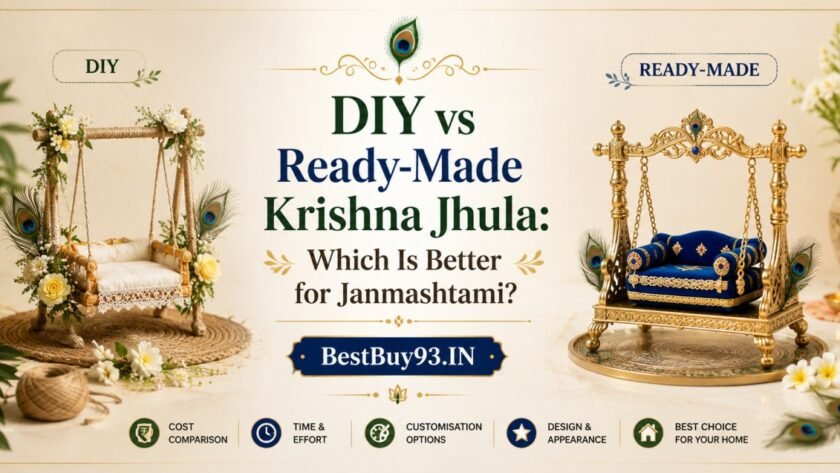

A beautifully decorated Krishna jhula can easily become the star of a Janmashtami setup. Whether you’re placing Laddu Gopal in a small home mandir or creating a more elaborate festive display, the jhula gives the entire arrangement a lovely centrepiece.
But there’s one decision that comes up every year: should you make the Krishna jhula yourself or simply buy a ready-made one?
DIY sounds attractive because you can choose the size, colours and decorations yourself. You can turn a simple base into something completely personal with flowers, fabric, beads, ribbons and peacock-feather accents. And yes, if you enjoy crafts, making one can be genuinely fun.
Then there’s the ready-made option.
Buy it. Place it. Decorate it. Done. 😄
For someone short on time, a ready-made Laddu Gopal jhula can save a surprising amount of effort. But that convenience can come at a higher price, and you have less control over the exact design.
So in this guide, we’re putting DIY vs Ready-Made Krishna Jhula head-to-head. We’ll look at cost, time, effort, customisation, appearance, durability, storage and practicality to help you figure out which option makes more sense for your Janmashtami celebration.
Also Read | Best Janmashtami Decorations from Amazon India
⚖️ DIY vs Ready-Made Krishna Jhula at a Glance
Before getting into all the details, here’s the quick version.
| Factor | DIY Krishna Jhula | Ready-Made Krishna Jhula |
|---|---|---|
| Initial Cost | Can be low to moderate | Usually moderate to high |
| Time Required | Higher | Low |
| Effort | Higher | Low to moderate |
| Customisation | ⭐⭐⭐⭐⭐ | ⭐⭐⭐ |
| Convenience | ⭐⭐ | ⭐⭐⭐⭐⭐ |
| Design Flexibility | ⭐⭐⭐⭐⭐ | ⭐⭐⭐ |
| Finish | Depends on your work | Usually more consistent |
| Reusability | Depends on materials | Usually good |
| Storage | Depends on design | Depends on size |
| Best For | Creative/custom setups | Quick & convenient setup |
🏆 The quick takeaway
Choose DIY if you enjoy crafting, want a very specific design or already have suitable materials at home.
Choose ready-made if you want a finished jhula without spending hours building and decorating it.
And there’s a third option that often makes the most sense:
Buy a simple ready-made jhula and customise the decoration yourself.
That gives you a stable base while still letting you add your own personality. Honestly, that’s a pretty solid middle ground. 🪷
🔎 Why the Krishna Jhula Matters
The jhula isn’t just another decoration sitting somewhere in the corner.
When you’re celebrating Janmashtami with Laddu Gopal, the jhula often becomes the visual centrepiece of the setup. That’s why its size, shape, finish and decoration can have a bigger impact than you might initially expect.
A beautifully decorated jhula can work with:
- 🌼 Artificial or fresh flowers
- 🦚 Mor pankh
- 🎀 Decorative fabric
- ✨ LED lights
- 🔔 Small hanging ornaments
- 🪷 Traditional decorative elements
- 💙 Krishna-themed colours
The important thing is proportion.
A tiny jhula surrounded by enormous decorations can disappear visually. A giant jhula in a small mandir can make the entire setup feel cramped.
So before deciding between DIY and ready-made, think about the space first.
🛠️ What Is a DIY Krishna Jhula?
A DIY Krishna jhula is essentially a cradle or swing that you create, assemble or customise yourself rather than purchasing a fully finished decorative jhula.
The exact approach can vary considerably.
Some people may create a simple decorative cradle using readily available craft materials. Others may start with a basic wooden or metal structure and then customise it with fabric, flowers, beads and other decorations.
The biggest advantage is control.
You decide:
- The size
- The colours
- The decoration
- The materials
- The overall theme
- How elaborate or minimal it looks
If you’ve already got craft supplies at home, the DIY route can also reduce the amount you need to spend on decorative extras.
But there is a catch.
DIY doesn’t necessarily mean free.
You may need materials, tools, adhesive, fabric, decorative elements and — most importantly — time.
And time is a cost too, even if it doesn’t appear on the shopping bill.
🛍️ What Is a Ready-Made Krishna Jhula?
A ready-made Krishna jhula is a commercially produced swing/cradle designed for Laddu Gopal or Krishna decoration.
Instead of constructing the basic structure yourself, you’re purchasing a finished product that you can generally place, assemble if required and decorate according to your preference.
Ready-made options can range from simple designs to highly decorative jhulas.
Depending on the particular product, you may find differences in:
- Material
- Size
- Shape
- Finish
- Colour
- Cushioning
- Decorative elements
- Assembly requirements
- Hanging mechanism
Because these details vary between products, checking the individual product listing is important before buying.
The biggest advantage is obvious:
Convenience.
You don’t have to start from scratch.
For someone preparing for Janmashtami at the last minute, that can be a very big deal.
💰 DIY vs Ready-Made: Don’t Look Only at the Price
At first glance, DIY can appear to be the obvious budget winner.
You might think:
“I’ll just make it myself. How expensive could it be?”
Well… famous last words. 😂
The final cost depends on what you already have at home and what you need to purchase.
For a DIY project, your expenses could include:
- Base materials
- Wood, board or other structural material
- Fabric
- Decorative flowers
- Beads or ribbons
- Paint or finishing material
- Adhesive
- Hooks or hardware
- Other decorative accessories
A ready-made jhula, meanwhile, has a more straightforward purchase price.
So the better question isn’t:
“Which one is cheaper?”
It’s:
“Which one gives me better value for the amount of money, time and effort I’m willing to spend?”
That’s a much more useful comparison.
⏰ Time: The Hidden Cost of DIY
This is probably the biggest difference between the two options.
A ready-made jhula can save you considerable preparation time.
With DIY, you may need to:
- Decide on the design.
- Source materials.
- Build the basic structure.
- Assemble the pieces.
- Decorate it.
- Make adjustments.
- Clean everything up afterward.
If you’re someone who genuinely enjoys DIY projects, none of that may feel like work.
But if you’re already juggling festival shopping, cleaning, pooja preparations and family plans, spending hours constructing a jhula might not sound quite as charming. 😄
DIY wins on:
Creative satisfaction
Ready-made wins on:
Convenience
And depending on your schedule, convenience can be worth paying for.
🎨 Customisation: DIY Takes the Crown
This is where DIY has a clear advantage.
Want a blue-and-gold Krishna theme?
You can make it.
Want a simple white-and-floral design?
You can make it.
Want mor pankh, beads, specific flowers and a particular fabric?
Again, you have complete control.
With a ready-made jhula, you’re largely choosing from the designs available for purchase.
You can still decorate a ready-made jhula yourself, but the underlying structure, size and basic appearance are already determined.
So if personalisation is your number-one priority, DIY is hard to beat.
🏡 Think About Your Available Space
Before buying or building anything, measure the location where the jhula will sit.
Check:
- Width
- Height
- Depth
- Available clearance
- Space around the idol
- Space needed for decoration
This becomes particularly important if your Krishna jhula is going on a compact mandir shelf or table.
Small space?
A compact jhula with minimal decoration may work best.
Large display?
You can consider a more elaborate structure and additional decorative elements.
The important thing is that the jhula should fit naturally into the setup, rather than forcing the rest of the decoration around it.
🪷 What Should You Consider Before Choosing?
There are several factors worth weighing before deciding between DIY and ready-made.
1. Your Budget
If you’re working with a strict budget and already have suitable materials, DIY may make sense.
If you’re buying everything from scratch, compare the total material cost with the price of a ready-made option.
2. Your Time
Have plenty of time before Janmashtami?
DIY becomes more realistic.
Need something quickly?
Ready-made is usually the more practical choice.
3. Your Crafting Skills
DIY can be incredibly rewarding if you’re comfortable making things.
But if you’ve never built anything before, don’t underestimate the frustration of trying to make a stable, attractive jhula from scratch.
Pinterest makes everything look suspiciously easy. 😂
4. Desired Appearance
If you have a very specific vision, DIY gives you more freedom.
If you simply want a polished-looking jhula without designing one yourself, ready-made may be easier.
5. Stability
This is one area where appearance should never be the only consideration.
The jhula needs to be appropriately stable for its intended use. A beautiful design isn’t useful if the structure is unstable.
When buying ready-made, pay attention to the product’s construction and specifications.
For DIY projects, make stability a priority from the beginning rather than treating it as an afterthought.
6. Reusability
Think beyond one Janmashtami.
A well-made jhula that can be carefully stored and brought out again next year may offer much better long-term value.
Consider whether the design can be:
- Disassembled
- Stored safely
- Protected from dust
- Reassembled easily
This applies to both DIY and ready-made options.
🔬 How We Compare DIY and Ready-Made Jhulas
For this comparison, we’re evaluating both approaches based on the factors that matter most to someone preparing a Janmashtami setup:
- Overall cost
- Time commitment
- Effort involved
- Customisation
- Appearance
- Practicality
- Stability considerations
- Reusability
- Storage
- Convenience
- Suitability for different types of homes and celebrations
For ready-made products, specific details such as dimensions, materials, included accessories, ratings and current pricing can vary by listing, so those details should always be verified before purchasing.
We also don’t assume that DIY is automatically cheaper or that ready-made is automatically better. The right choice depends on what you value most.
🤔 So, Which One Should You Choose?
At this stage, the answer is already becoming pretty clear.
Choose DIY if:
- 🎨 You enjoy crafting
- 🪷 You want complete creative control
- 💰 You already have many materials
- 🧵 You want a highly personalised design
- ⏰ You have enough time
- 🏡 You need a very specific size
Choose Ready-Made if:
- ⚡ You want a quick setup
- 🛍️ You don’t want to source materials
- 😌 You prefer convenience
- ✨ You want a consistent finished appearance
- ⏰ Janmashtami is approaching quickly
- 🪷 You don’t want to spend hours on construction
Or choose the middle path:
Ready-made structure + DIY decoration.
This is worth considering if you want the convenience of a finished base but still want to personalise the final Krishna setup.
🛠️ 1. DIY Krishna Jhula — Best for Customisation
A DIY Krishna jhula gives you complete control over the design.
You can start with a basic structure or create the entire jhula yourself, depending on your skills and the materials available to you. From there, you can customise practically everything.
Want a traditional floral jhula? Done.
A blue-and-gold Krishna theme? Easy.
A tiny minimalist cradle for a small mandir? Absolutely.
A colourful, elaborate jhanki-style setup? You can go as far as your creativity takes you.
🎨 What You Can Customise
With DIY, you can control:
- Size and proportions
- Colour combination
- Fabric
- Flowers
- Beads and ribbons
- Decorative motifs
- Mor pankh accents
- Backdrop
- Lighting
- Overall theme
This is the biggest advantage of going DIY.
Instead of adapting your decoration to whatever designs are available online, you can create something specifically for your Krishna idol and your home.
💰 Is DIY Actually Cheaper?
It can be.
But don’t assume it automatically will be.
If you already have cardboard, fabric, decorative flowers, ribbons, beads or other craft supplies at home, your additional cost can be relatively low.
If you’re starting from zero, however, the expenses can quickly add up.
You may need to purchase:
- Structural materials
- Decorative material
- Fabric
- Flowers
- Adhesives
- Paint
- Hooks or hardware
- Finishing materials
And then there’s the cost nobody puts on the receipt:
Your time.
If the project takes an entire afternoon — or several evenings — that matters too.
❤️ Why We Like DIY
The personal touch.
A handmade Krishna jhula can feel much more special because you created it specifically for your celebration.
It can also be modified every year. Maybe this year you want flowers and mor pankh; next year you can change the fabric and create an entirely different theme.
😬 What We Don’t Like
DIY quality depends heavily on the materials and construction.
A project can look fantastic in your head and slightly less fantastic when reality enters the chat. 😂
Structural stability, clean finishing and proportion also require attention.
DIY Pros & Cons
| Pros | Cons |
|---|---|
| Highly customisable | Takes more time |
| Can use existing materials | Requires effort |
| Unique design | Finish depends on your skills |
| Can fit unusual spaces | Materials can add up |
| Personal and creative | Stability needs careful attention |
| Can be modified later | More preparation required |
🏆 Best For
Creative people who enjoy DIY projects and want a personalised Krishna setup.
🛍️ 2. Ready-Made Krishna Jhula — Best for Convenience
Now let’s flip the equation.
A ready-made Krishna jhula takes the construction headache out of the picture.
You choose the design, check the dimensions, place the order and — once it arrives — you can focus on decorating it.
Depending on the product, some jhulas may require minor assembly while others may arrive largely ready to use. Always check the individual listing for the exact assembly requirements.
✨ What You Get
Ready-made options can come in a variety of styles, materials, sizes and finishes.
Depending on the particular product, you may find:
- Decorative cradle designs
- Wooden or metal structures
- Cushioned seating
- Hanging chains
- Decorative detailing
- Krishna-themed finishes
- Different size options
The important thing is not to assume that every ready-made jhula includes the same accessories.
Check exactly what’s included before buying.
⚡ Why We Like Ready-Made
The biggest advantage is simple:
It saves time.
You don’t need to source every material or figure out how to construct the basic structure.
And if you’re already busy with Janmashtami preparations, that convenience can be worth paying for.
😬 What We Don’t Like
You have less control over the underlying design.
You may find a jhula that looks beautiful but is slightly too large, too small or not quite the colour you wanted.
And unlike DIY, you can’t simply redesign the structure from scratch.
You can still personalise the decoration, but the base design is already decided.
Ready-Made Pros & Cons
| Pros | Cons |
|---|---|
| Very convenient | Usually costs more than basic DIY |
| Saves time | Less structural customisation |
| Consistent finish | Limited to available designs |
| Easy to decorate | Dimensions may not suit every space |
| Good for last-minute setup | Accessories may cost extra |
| Many styles available | Must check product specifications |
🏆 Best For
Anyone who wants a beautiful Krishna jhula without spending hours making one.
⚔️ 3. DIY vs Ready-Made: Direct Comparison
Here’s where things get interesting.
| Factor | DIY Krishna Jhula | Ready-Made Krishna Jhula |
|---|---|---|
| 💰 Cost | Potentially lower | Usually higher upfront |
| ⏰ Time | High | Low |
| 🛠️ Effort | High | Low–Moderate |
| 🎨 Customisation | ⭐⭐⭐⭐⭐ | ⭐⭐⭐ |
| ✨ Consistent Finish | Depends on execution | ⭐⭐⭐⭐ |
| ⚡ Convenience | ⭐⭐ | ⭐⭐⭐⭐⭐ |
| 📏 Size Flexibility | ⭐⭐⭐⭐⭐ | ⭐⭐⭐ |
| 🪷 Personal Touch | ⭐⭐⭐⭐⭐ | ⭐⭐⭐ |
| ♻️ Reusability | Depends on construction | Usually good |
| 🏡 Small-Space Adaptability | Excellent if made accordingly | Depends on available sizes |
| 🧹 Post-Festival Storage | Depends on design | Depends on design |
| 👨👩👧 Family Crafting Activity | ⭐⭐⭐⭐⭐ | ⭐⭐ |
| 🏆 Best For | Creative custom setups | Quick, polished setups |
The verdict from the table?
DIY wins on flexibility.
Ready-made wins on convenience.
That’s basically the heart of the entire debate.
💸 4. Which One Is Actually More Affordable?
This is probably the question most shoppers have.
And unfortunately, there’s no single answer.
DIY can be cheaper when:
- You already have materials.
- You have basic craft supplies.
- You don’t need an elaborate structure.
- You’re making a simple jhula.
- You’re comfortable doing the work yourself.
Ready-made can offer better value when:
- You would need to buy all the DIY materials.
- You don’t have the tools or supplies.
- Your time is limited.
- You want a polished structure.
- You don’t want to experiment with construction.
The hidden DIY calculation
Imagine you spend a small amount on the base but then realise you need fabric, flowers, adhesive, decorative pieces and other materials.
Suddenly, the “cheap DIY project” isn’t quite as cheap.
That’s why you should calculate the total DIY cost, not just the cost of the main material.
⏰ 5. Which One Saves More Time?
No contest here.
🥇 Winner: Ready-Made
A ready-made jhula is designed to reduce preparation.
With DIY, you have to spend time planning, sourcing, constructing and decorating.
With ready-made, most of that work has already been done.
If you’re shopping close to Janmashtami and don’t have much preparation time left, ready-made is the obvious convenience choice.
🎨 6. Which One Looks Better?
This one is much harder to answer.
A professionally made ready-made jhula can have a very clean and consistent finish.
But a carefully made DIY jhula can look just as beautiful — and potentially much more personal.
The difference is execution.
Ready-made looks better when:
- You want a polished finish.
- You prefer structured designs.
- You don’t have much crafting experience.
- You want something that looks finished immediately.
DIY looks better when:
- You have a clear creative vision.
- You enjoy crafting.
- You pay attention to proportions.
- You coordinate colours and materials properly.
- You want something unique.
So don’t confuse expensive with beautiful.
A ₹500 DIY decoration can look more charming than a ₹2,000 setup that’s overloaded with random accessories.
🦚 7. Which One Offers More Customisation?
🏆 Winner: DIY — by a mile.
With DIY, you can make the jhula fit your exact theme.
For example:
Peacock Theme
Mor pankh + blue fabric + green accents + gold details.
Traditional Floral Theme
Yellow/orange flowers + red or gold fabric + traditional ornaments.
Minimal Theme
White fabric + subtle flowers + warm lights.
Royal Krishna Theme
Deep blue + gold + decorative beads + elaborate floral accents.
The possibilities are practically endless.
With ready-made, your customisation generally starts after you purchase the jhula.
🏡 8. Which Is Better for Small Homes?
This one depends on how unusual your space is.
If you have a very specific small shelf or corner where the jhula needs to fit, DIY can have an advantage because you can design it around those dimensions.
But if you find a ready-made jhula in exactly the right size, there’s no reason to make one yourself.
For small spaces:
DIY: Better size flexibility.
Ready-made: Better convenience.
Either can work — just measure first.
♻️ 9. Which One Is Better for Reuse?
Both can work well.
A sturdy DIY jhula can be carefully stored and brought out every Janmashtami.
A good ready-made jhula can do the same.
The bigger factor is construction quality.
Before storing either option, make sure:
- Decorative fabric is clean and dry.
- Flowers are free from dust.
- LED wires are neatly packed.
- Fragile decorative pieces are protected.
- The jhula is stored somewhere dry.
A reusable jhula becomes a small annual investment rather than a one-time festival purchase.
👨👩👧 10. DIY Can Be a Family Activity
There’s one advantage of DIY that doesn’t really show up in a comparison table.
It’s an experience.
If you enjoy making decorations together, building a Krishna jhula can become part of your Janmashtami preparation.
Kids can help with simple decorations, family members can choose colours and everyone can contribute ideas.
Of course, keep tools, adhesives, cutting equipment and structural work handled appropriately by adults.
The finished jhula isn’t just decoration anymore — there’s a little story attached to it.
And honestly, that’s pretty special. 🪷
🤝 11. The Hybrid Option: Best of Both Worlds?
Here’s an option that deserves more attention:
Buy the jhula. DIY the decoration.
Instead of constructing the actual structure yourself, purchase a simple ready-made jhula and personalise it.
You could add:
- 🌼 Artificial flowers
- 🦚 Mor pankh
- 🎀 Fabric
- ✨ LED lights
- 🔔 Decorative hangings
- 🪷 Small Krishna-themed accessories
This approach gives you the structural convenience of a ready-made jhula while keeping the creative freedom of DIY decoration.
Why this can be a smart compromise
You don’t have to worry about constructing the basic cradle.
At the same time, you aren’t stuck with a completely generic finished appearance.
You can make the jhula feel like your own.
🏆 Best For
People who want less work without sacrificing personalisation.
📊 DIY vs Ready-Made: Value Scorecard
| Category | Winner |
|---|---|
| Lowest potential cost | 🛠️ DIY |
| Fastest setup | 🛍️ Ready-Made |
| Customisation | 🛠️ DIY |
| Convenience | 🛍️ Ready-Made |
| Consistent finish | 🛍️ Ready-Made |
| Unique design | 🛠️ DIY |
| Small-space flexibility | 🛠️ DIY |
| Last-minute preparation | 🛍️ Ready-Made |
| Family craft activity | 🛠️ DIY |
| Easy starting point | 🛍️ Ready-Made |
| Best of both worlds | 🤝 Hybrid |
🧠 Our Take: Don’t Make This Harder Than It Needs to Be
There’s a tendency to think that DIY automatically means better, cheaper and more meaningful, while ready-made means expensive and less personal.
That’s not necessarily true.
If you love crafting, DIY can be fantastic.
If you’re short on time, ready-made is fantastic.
If you want a little bit of both, the hybrid approach is probably the most practical choice for many people.
The right answer isn’t about proving that one option is superior.
It’s about asking:
How much time do I have?
How much do I want to spend?
How customised do I want the jhula to be?
And, most importantly, do I actually enjoy DIY projects?
Because if the answer to that last question is no, there’s absolutely no award for spending six hours fighting with cardboard before Janmashtami. 😂
🛍️ What to Look for When Buying a Ready-Made Krishna Jhula
If you’ve decided that buying a ready-made jhula is the better option for you, don’t simply choose the prettiest one.
Check these factors first.
📏 1. Size & Dimensions
This should be your first check.
Measure the area where you plan to keep the jhula and compare it with the product’s listed dimensions.
Pay attention to:
- Overall width
- Overall height
- Depth
- Seating/cradle area
- Clearance around the jhula
- Space required for decoration
A jhula that looks tiny in a large display may be perfect for a small mandir.
Likewise, a large decorative swing can completely dominate a compact pooja shelf.
Measure first. Buy second.
🪵 2. Material
Ready-made Krishna jhulas can be made using different materials, including wood, metal and other manufactured materials.
The material affects:
- Weight
- Appearance
- Durability
- Stability
- Maintenance
- Storage
If you’re planning to reuse the jhula every year, pay attention to the construction quality rather than focusing only on decorative details.
⚖️ 3. Stability
A beautiful jhula isn’t much use if it feels unstable.
Look at the construction and, where provided, the manufacturer’s specifications regarding intended use.
For hanging styles, pay attention to the chains, hooks and attachment points.
For tabletop or standing jhulas, look at the base and overall structure.
If you’re making a DIY jhula, stability should be considered during construction rather than added as an afterthought.
✨ 4. Finish & Detailing
Look closely at the finishing details.
Depending on your preferred style, you might want:
- Simple polished wood
- Decorative metalwork
- Carved detailing
- Painted designs
- Beaded accents
- Fabric elements
Remember that a simpler jhula can actually be easier to decorate yourself.
If you plan to add flowers, mor pankh and fabric anyway, you don’t necessarily need to pay extra for an extremely elaborate base.
🪷 5. Decoration Compatibility
Think about what you want to add later.
Will you be using:
Flowers?
Make sure there’s enough room around the jhula.
Fabric?
Check whether the design allows you to attach or drape it neatly.
Mor pankh?
Make sure the decorative accents don’t make the jhula look overcrowded.
LED lights?
Plan where the lights will sit without interfering with the jhula.
A good base should make decorating easier — not turn it into a wrestling match. 😄
📦 6. Assembly & Storage
Some ready-made jhulas may arrive fully assembled, while others may require assembly.
Check the listing carefully for:
- Assembly instructions
- Included hardware
- Whether tools are required
- Whether the jhula can be dismantled
- Storage dimensions
If you’re going to use it every year, easier storage can be a surprisingly important advantage.
🎨 DIY Krishna Jhula Ideas
If you’ve decided to make your own jhula, you don’t have to build something outrageously complicated.
Sometimes the simplest designs look the best.
🌼 1. Floral DIY Jhula
Create a simple base and decorate it with artificial flowers.
Yellow, orange and white floral accents can give the setup a traditional festive appearance.
Add a small amount of fabric and a few decorative details, and you’re done.
Best for: Traditional Janmashtami themes.
🦚 2. Peacock-Themed Krishna Jhula
If you want a stronger Krishna theme, build the decoration around peacock-inspired colours.
Think:
- Blue fabric
- Green accents
- Gold details
- Mor pankh
- Small floral elements
The key is restraint.
You don’t need to cover every surface in peacock feathers.
A few strategically placed accents will usually look cleaner.
Best for: Krishna-themed home mandirs.
🤍 3. Minimal White & Gold Jhula
For a more modern setup, use a simple structure with white fabric and subtle gold decoration.
Add a few flowers and warm LED lights.
This works especially well when the rest of your home has a contemporary interior.
Best for: Minimal and modern homes.
💙 4. Royal Blue & Gold Jhula
A blue-and-gold theme can create a richer, more elaborate Krishna setup.
Use a deeper blue fabric with gold decorative accents and flowers.
A matching backdrop behind the jhula can complete the look.
Best for: Larger Janmashtami displays.
🏺 5. Jhanki-Style DIY Setup
If you’re creating a full Krishna jhanki, the jhula can become just one element of a larger scene.
You can surround it with:
- Artificial flowers
- Decorative matki
- Mor pankh
- Flute-themed décor
- Traditional hanging ornaments
- Warm lighting
This creates more of a complete Krishna-themed display rather than simply decorating the jhula.
🤝 The Hybrid Approach: Our Favourite Compromise
If you’re still stuck between DIY and ready-made, here’s the option I’d seriously consider:
Buy a basic ready-made jhula and decorate it yourself.
You get:
Ready-made structure
→ Less construction work.
DIY decoration
→ More creativity.
Reusable base
→ Better long-term practicality.
Your own colour theme
→ More personal.
This can be particularly useful if you don’t have the tools or experience required to construct a sturdy jhula but still want your Janmashtami setup to feel personal.
You aren’t paying someone else to design every decorative detail.
You’re simply buying the part that needs to be structurally reliable and doing the fun part yourself.
👨👩👧 Who Should Choose a DIY Krishna Jhula?
DIY is probably the better choice if:
🎨 You Love Crafting
If making decorations is part of the festival experience for you, DIY can be genuinely enjoyable.
💰 You Already Have Materials
If you have fabric, flowers, decorative supplies and other materials available, the total cost can be lower.
📏 You Need a Specific Size
A custom-built jhula can be useful when your available space doesn’t match standard product dimensions.
🪷 You Want Something Unique
If you want a design that isn’t available in regular online listings, DIY gives you much more creative freedom.
⏰ You Have Enough Time
This is important.
Don’t start a complicated DIY project the night before Janmashtami unless you enjoy living dangerously. 😂
🛍️ Who Should Choose a Ready-Made Krishna Jhula?
Ready-made is probably the better choice if:
⚡ You Want a Quick Setup
You can focus your time on decorating rather than construction.
😌 You Don’t Enjoy DIY
There is absolutely nothing wrong with admitting this.
Not everyone needs to become an expert craftsperson because Janmashtami is coming.
✨ You Want a Polished Base
A professionally manufactured jhula can give you a consistent starting point.
🕐 You’re Short on Time
If the festival is approaching and you still have multiple preparations left, buying can save considerable effort.
🪷 You’re a First-Time Buyer
A ready-made jhula can be a simpler starting point because you don’t need to figure out the entire structure yourself.
🏡 Best Choice for Small Homes
For a compact mandir or apartment setup, I’d prioritise size and simplicity over elaborate decoration.
A small ready-made jhula can be a great choice if you find the correct dimensions.
DIY can be even more flexible if you need something custom-sized.
Best small-space combination:
Compact jhula + small floral garland + mor pankh + subtle LED lighting
That’s enough to create a beautiful focal point without taking over the room.
💰 Best Choice for a Budget Setup
If you already have materials at home:
🏆 DIY wins.
But if you need to purchase every single material from scratch, compare the total DIY cost against ready-made options before deciding.
For a low-cost hybrid setup, consider:
Basic ready-made jhula + DIY flowers/fabric decoration
This lets you spend your money on the parts that matter most visually.
✨ Best Choice for a Premium Setup
If your goal is an elaborate Janmashtami display, a ready-made decorative jhula can provide a strong foundation.
Then build around it using:
- Coordinated backdrop
- High-quality-looking artificial flowers
- Mor pankh
- Decorative fabric
- Warm lighting
- Matching accessories
The trick to a premium appearance isn’t simply adding more things.
It’s coordination.
⚠️ Common Krishna Jhula Mistakes to Avoid
❌ Buying Without Measuring
Always check the available space.
❌ Ignoring the Idol’s Size
The jhula should be appropriately proportioned to the Laddu Gopal idol.
❌ Choosing Looks Over Stability
Pretty detailing shouldn’t distract you from the basic construction.
❌ Overdecorating
If you can’t see the jhula anymore because it’s buried under flowers, ribbons and ornaments, you’ve probably gone a little too far. 😄
❌ Forgetting Storage
A large decorative jhula may look great today but become annoying if there’s nowhere to store it afterward.
❌ Assuming DIY Is Automatically Cheaper
Calculate the total cost of materials and don’t forget the time involved.
❌ Assuming Ready-Made Is Automatically Better
A ready-made product still needs to fit your space, budget and decoration style.
📊 Final Decision Guide
| Your Priority | Best Choice |
|---|---|
| Lowest possible DIY cost | 🛠️ DIY |
| Maximum customisation | 🛠️ DIY |
| Specific dimensions | 🛠️ DIY |
| Fastest setup | 🛍️ Ready-Made |
| Least effort | 🛍️ Ready-Made |
| Consistent finished base | 🛍️ Ready-Made |
| First-time setup | 🛍️ Ready-Made |
| Family craft project | 🛠️ DIY |
| Small unusual space | 🛠️ DIY |
| Personalised decoration | 🤝 Hybrid |
| Convenience + creativity | 🤝 Hybrid |
| Elaborate festive setup | 🤝 Hybrid / Ready-Made |
❓ Frequently Asked Questions
1. Is it better to make or buy a Krishna jhula?
It depends on your priorities. DIY is better for customisation and can be economical when you already have materials. Ready-made is better for convenience, consistent construction and saving time.
2. Is a DIY Krishna jhula cheaper than a ready-made one?
It can be, but not always. Calculate the cost of all materials, decorative elements and any tools you need. If you’re starting from scratch, a ready-made jhula may offer better overall value for the time and effort involved.
3. Can I decorate a ready-made Krishna jhula myself?
Absolutely. In fact, this is one of the easiest ways to combine convenience with personalisation.
You can add flowers, fabric, mor pankh, lights and other decorations to create your preferred theme.
4. What size Krishna jhula should I buy?
Choose a size that comfortably suits your Laddu Gopal idol and the space where you plan to place the jhula.
Always compare the listed dimensions with your available space before purchasing.
5. What materials are best for a Krishna jhula?
Wood and metal are common choices for the structural part of a jhula, while decorative elements can include fabric, flowers, beads and other accessories.
The most important consideration is that the structure is appropriate for its intended use and stable.
6. How can I decorate a simple Krishna jhula?
A simple jhula can be transformed with artificial flowers, fabric, mor pankh, small decorative ornaments and subtle LED lighting.
You don’t need to add every available decoration.
7. Is a ready-made Krishna jhula good for small homes?
Yes, provided you choose the correct dimensions. Compact ready-made jhulas can be particularly convenient for apartments and small home mandirs.
8. Can I reuse a Krishna jhula every year?
A well-maintained jhula can potentially be reused for future Janmashtami celebrations. Store it in a clean, dry location and protect delicate decorative components from dust and damage.
9. What is the easiest Krishna jhula option for beginners?
A simple ready-made jhula is generally the easiest starting point. You can then personalise it with flowers, fabric, mor pankh and lights rather than attempting to construct the entire structure yourself.
10. What is the best alternative to making a Krishna jhula from scratch?
The hybrid approach is an excellent alternative: purchase a basic ready-made jhula and customise the decoration yourself.
It provides a reliable starting structure while still allowing plenty of creative freedom.
🏆 Final Verdict: DIY or Ready-Made Krishna Jhula?
So, after comparing the two from practically every angle, which one wins?
Honestly, there isn’t one universal winner.
🏆 Best Overall for Most People: Ready-Made Krishna Jhula
If you want a convenient, straightforward setup, a ready-made jhula is the easiest option. You can spend your time decorating rather than constructing the basic structure.
🎨 Best for Customisation: DIY Krishna Jhula
If creativity is your priority and you have the time and materials, DIY gives you complete control over the final design.
💰 Best Potential Budget Option: DIY
Especially when you already have suitable materials at home.
⚡ Best for Convenience: Ready-Made
No surprise here. Buy it, set it up and decorate.
🪷 Best for Beginners: Ready-Made
It removes much of the structural guesswork and lets you concentrate on the fun decorative part.
🤝 Best of Both Worlds: Hybrid
Ready-made jhula + DIY decoration gets our vote for the most balanced approach.
You get the convenience of a finished structure while still being able to personalise the jhula with flowers, fabric, mor pankh and your own chosen theme.
🪷 The Final Takeaway
The best Krishna jhula isn’t necessarily the one that costs the most or takes the most hours to make.
It’s the one that fits your space, suits your Laddu Gopal idol, matches your Janmashtami theme and doesn’t turn festival preparation into unnecessary stress.
If you love crafting, go DIY.
If you value convenience, buy ready-made.
And if you want a little of both, choose a simple ready-made jhula and decorate it yourself.
After all, Janmashtami should leave you with beautiful memories — not a pile of craft supplies and a glue gun staring back at you from the corner. 😄🦚🪷