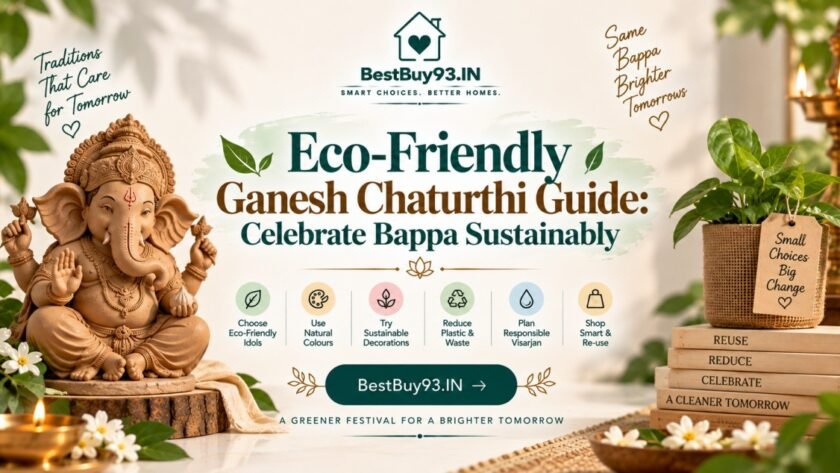

🌿 Ganesh Chaturthi is one of those festivals where the entire home suddenly feels more colourful, festive and alive. 🪔🌸 From bringing Bappa home to decorating the mandap, preparing modaks and finally saying goodbye during visarjan, every part of the celebration has its own charm.
But there is one question more families are asking today:
Can we celebrate Ganesh Chaturthi beautifully while creating less waste and pollution? 🌿
The answer is yes.
An eco-friendly Ganesh Chaturthi doesn’t mean giving up the traditions you love or making your decoration look boring. It simply means making smarter choices about the Ganesh idol, colours, decorations, lighting, flowers, plastic use and visarjan.
Maharashtra Tourism also highlights the traditional connection between Ganesh Chaturthi and nature, including the use of shadu clay idols, natural colours and smaller idols.
So, if you’re planning your Ganpati celebration at home in 2026, here’s a practical guide to celebrating Bappa with devotion while being a little kinder to the environment. ❤️🌱
Also Read | Best Ganesh Chaturthi Decoration Items for Home
🪔 What Does an Eco-Friendly Ganesh Chaturthi Actually Mean?
An eco-friendly Ganesh Chaturthi is not about achieving some unrealistic “zero-waste festival.”
It’s about reducing unnecessary environmental impact wherever you reasonably can.
Think of it as:
Better idol + safer colours + reusable decoration + less plastic + responsible visarjan = a more eco-conscious celebration. 🌿
You don’t have to replace everything you own.
For example, if you already have fairy lights, brass diyas, fabric, reusable torans or a wooden chowki, use them again instead of buying new decorations every year.
That is actually one of the easiest ways to make your celebration more sustainable.
Also Read | Clay vs POP Ganesh Idol: Which One Should You Choose? |
🌱 1. Choose a More Eco-Friendly Ganesh Idol
The idol is probably the biggest decision when planning an eco-conscious Ganesh Chaturthi.
Traditionally, Ganesh idols were made using clay and locally available natural materials. The Central Pollution Control Board (CPCB) notes that clay has traditionally been used for Ganesh idols, while the increased use of Plaster of Paris (POP), synthetic colours and plastic or thermocol accessories has raised concerns around immersion and water pollution.
Look for:
- 🌿 Natural clay or shadu mati
- 🎨 Natural or non-toxic colours where possible
- 🪷 Minimal synthetic decoration
- ♻️ Smaller, manageable idol sizes
- 🚫 Minimal plastic and thermocol accessories
But remember:
Clay does not automatically mean the entire idol is eco-friendly.
The paint, glitter, decorations, base and other materials used on the idol also matter.
So don’t simply believe a seller’s “100% eco-friendly” label. Ask what the idol is actually made from.
🎨 2. Pay Attention to the Colours
This is an often-overlooked part of eco-friendly Ganpati celebrations.
A beautifully painted idol may look fantastic in your living room, but the materials used to create that finish matter during immersion.
CPCB guidelines note concerns around inorganic colours and dyes containing heavy metals such as mercury, cadmium, arsenic and lead.
Where practical, look for:
- 🌿 Natural colours
- 💧 Water-based colours
- Non-toxic paints
- Biodegradable colour options
- Minimal glitter
- Minimal metallic coatings
If you’re buying an idol from a local artisan, simply ask:
“Is this painted with natural or water-based colours?”
That’s a much better question than only asking, “Kitna sundar hai?” 😂
🌸 3. Choose Natural or Reusable Decorations
You don’t need a giant decoration setup to make Bappa’s corner beautiful.
In fact, a simple setup can look more elegant.
Try combining:
🌼 Fresh Flowers
Marigold, jasmine and other locally available flowers can instantly create a festive atmosphere.
After the festival, collect the flowers separately rather than mixing them with general waste.
🌿 Greenery
Use:
- Mango leaves
- Banana leaves
- Fresh foliage
- Potted plants
- Simple floral arrangements
These can create a beautiful traditional look without relying entirely on plastic decoration.
🧵 Fabric Backdrops
Instead of buying a new plastic or PVC backdrop every year, consider using:
- Cotton fabric
- Silk-style fabric
- Dupatta
- Saree
- Reusable curtain
- Jute fabric
That old beautiful saree sitting in your cupboard can finally get a job. 😄
♻️ 4. Reuse Your Ganpati Decoration
One of the simplest eco-friendly ideas is also one of the cheapest:
Don’t buy new decoration every year just because the internet tells you there’s a new trend. 😂
Create a reusable decoration box containing:
- ✨ Fairy lights
- 🌸 Artificial flower strings
- 🪷 Torans
- 🧵 Fabric backdrops
- 🪔 Diyas
- 🏮 Lanterns
- 🌿 Artificial greenery
- 🪵 Wooden décor
- 🖼️ Reusable backdrop panels
Store everything carefully after visarjan.
Next year, you can change only one or two elements and still make the setup look completely different.
💡 5. Use LED Lights Instead of Excessive Decorative Lighting
Lighting makes a huge difference to a Ganpati setup.
But you don’t need dozens of decorative light strings.
A few strategically placed LED fairy lights can create a beautiful effect.
Try this combination:
Warm LED fairy lights + brass diyas + one decorative lamp = ✨ beautiful mandap
Also avoid placing electrical wires close to:
- Water
- The immersion area
- Wet flowers
- Pooja liquids
- Areas where children can easily pull them
Festive decoration should look beautiful and remain safe.
🪔 6. Bring Back the Traditional Diya
Nothing beats the glow of a traditional diya during Ganesh Chaturthi. ❤️
Instead of filling every corner with disposable battery-powered decorations, use reusable diyas where practical.
You can reuse the same:
- Brass diyas
- Terracotta diyas
- Metal lamps
- Decorative lanterns
year after year.
Just remember to keep open flames away from curtains, fabric backdrops, paper decorations and electrical wires.
🚫 7. Reduce Thermocol and Single-Use Plastic
This is one of the easiest changes you can make.
Thermocol may be lightweight and convenient for decoration, but it isn’t a good choice when you’re trying to reduce non-biodegradable festival waste.
The CPCB specifically highlights concerns around plastic and thermocol accessories used with idols.
Instead, consider:
- 📦 Cardboard
- 🧻 Paper
- 🌿 Natural leaves
- 🪵 Wood
- 🧵 Fabric
- 🎋 Bamboo
- 🪷 Reusable décor
You don’t need to completely eliminate every synthetic material overnight.
Just replace unnecessary single-use materials first.
🌺 8. Handle Nirmalya Responsibly
Flowers, leaves and other पूजा offerings shouldn’t automatically end up in the nearest water body.
Keep a separate container for nirmalya throughout the festival.
At the end of the celebration, separate:
- 🌸 Flowers
- 🌿 Leaves
- 🧵 Decorative threads
- 🪔 Organic offerings
- 🗑️ Non-organic waste
Mumbai’s civic arrangements for Ganpati 2026 include nirmalya collection and composting-related work at various locations.
If your local authority provides a dedicated nirmalya collection facility, use it.
🌊 9. Plan Your Ganpati Visarjan Before the Festival
This is where an eco-friendly celebration really matters.
Don’t wait until the final day to decide:
“Ab visarjan kahan karna hai?” 😅
Check your local municipal authority’s current arrangements before the festival.
For Mumbai, BMC is making arrangements for Ganpati immersion at designated locations, including artificial ponds. Current BMC records also show preparations for artificial immersion ponds for Ganpati Visarjan 2026.
So before bringing Bappa home, check:
- 📍 Nearest designated immersion point
- 🌊 Artificial immersion pond availability
- 🚗 Travel/transport requirements
- 🕐 Immersion timings or local instructions
- ♻️ Nirmalya collection arrangements
- 🗑️ Waste disposal facilities
🏠 10. Consider Home Visarjan Where Appropriate
For smaller eco-friendly idols, some families choose controlled home immersion where local guidance permits it.
The idea is simple:
A suitable container is prepared, the idol is immersed carefully, and the resulting material is handled responsibly rather than putting unnecessary pressure on a natural water body.
However, local municipal rules should always take priority.
Don’t assume that home immersion is permitted or suitable everywhere.
📏 11. Smaller Can Be Smarter
Bigger isn’t always better.
A massive idol may look spectacular, but a smaller idol can be:
- Easier to transport
- Easier to install
- Easier to protect from damage
- Easier to immerse
- Easier to manage at home
Maharashtra Tourism specifically notes smaller idols as part of environmentally conscious Ganesh Chaturthi practices.
And honestly, Bappa doesn’t need a 12-foot throne to bless your home. ❤️
🏡 12. Eco-Friendly Decoration Ideas for Small Homes
Living in a Mumbai apartment or a compact home?
You can still create a gorgeous Ganpati setup.
🌿 Minimal Green Setup
Use:
Clay idol + fabric backdrop + fresh leaves + marigold + warm fairy lights + brass diya
Simple. Elegant. Festive.
🌸 Floral Setup
Use:
Clay idol + reusable backdrop + marigold strings + loose flower petals + diyas
You get a beautiful traditional look without filling the entire room with plastic decoration.
🪵 Traditional Setup
Try:
Wooden chowki + brass diyas + cotton/silk fabric + mango-leaf toran + clay idol
This is especially good if you want a Maharashtrian-inspired aesthetic.
🛍️ Eco-Friendly Ganpati Shopping Checklist
Before you start shopping, save this list. 📌
Idol
☐ Clay/Shadu Mati idol
☐ Natural/non-toxic colours where possible
☐ Minimal synthetic decoration
☐ Suitable size for your home
☐ Stable base
Decoration
☐ Reusable backdrop
☐ Fabric
☐ Fresh flowers
☐ Natural leaves
☐ Reusable toran
☐ LED fairy lights
☐ Brass/terracotta diyas
Avoid Where Possible
☐ Excessive thermocol
☐ Single-use plastic décor
☐ Plastic flower overload
☐ Excessive glitter
☐ Unnecessary disposable decorations
Visarjan
☐ Check local immersion rules
☐ Identify designated immersion location
☐ Keep nirmalya separate
☐ Remove non-biodegradable decorations
☐ Follow municipal instructions
💰 Does Eco-Friendly Ganpati Have to Be Expensive?
Absolutely not.
In fact, it can sometimes save money.
Think about it.
If you buy a ₹2,000 decoration setup every year, that’s ₹2,000 every year.
But if you spend once on a reusable fabric backdrop, wooden décor, metal diyas and reusable lights, you can use them for several years.
💰 Budget-friendly approach
Use what you already own + buy a clay idol + fresh flowers + a few diyas.
You don’t need an Instagram-level mandap worth ₹20,000 to celebrate beautifully.
🌿 A Simple Eco-Friendly Ganpati Formula
If you’re completely confused about where to start, follow this:
1 Idol
Choose a manageable clay/shadu mati idol.
1 Backdrop
Use fabric or a reusable backdrop.
2–3 Natural Elements
Flowers + leaves + diya.
1 Lighting Layer
Warm LED fairy lights.
1 Visarjan Plan
Decide the designated immersion method before the festival.
That’s it.
Simple doesn’t mean boring.
Sometimes, less decoration actually makes Bappa the centre of attention. 🙏❤️
⚠️ What If You Already Bought a POP Idol?
Don’t panic.
If you’ve already purchased a POP idol, don’t throw it away or feel guilty.
The most important thing now is to follow your local authority’s immersion instructions and use the designated immersion arrangements available in your area.
In Maharashtra, current environmental guidance and court-related arrangements around POP idols and immersion are subject to specific rules. Maharashtra Pollution Control Board lists the state’s guidance on POP idol immersion, while current 2026 Mumbai arrangements include artificial immersion facilities.
So the practical approach is:
Don’t improvise. Check the current local rules and follow the designated visarjan process.
🌎 Eco-Friendly Ganesh Chaturthi: What Actually Matters?
You don’t have to make every single part of your celebration perfect.
Focus on the choices that make the biggest difference:
| Choice | Better Approach |
|---|---|
| Ganesh Idol | Natural clay/shadu where suitable |
| Colours | Natural/non-toxic options |
| Decoration | Reusable or natural materials |
| Flowers | Fresh/local where practical |
| Lighting | Efficient LED lights |
| Plastic | Reduce single-use items |
| Thermocol | Avoid where possible |
| Nirmalya | Keep separate |
| Visarjan | Follow designated local arrangements |
| Shopping | Buy only what you actually need |
❌ Common Eco-Friendly Ganpati Mistakes
1. Assuming “Clay” Means Everything Is Eco-Friendly
Check the colours, decorations and accessories too.
2. Buying New Décor Every Year
Reuse what you already have.
3. Throwing Nirmalya Into Water
Keep it separate and use designated collection/composting systems where available.
4. Ignoring Local Visarjan Rules
Rules and arrangements can change, so check current municipal guidance.
5. Going Overboard With “Eco-Friendly” Products
Buying 20 new “eco-friendly” decorations that you don’t need isn’t exactly sustainable either. 😅
The most sustainable decoration is often the one you already own.
🪔 Celebrate Beautifully, But Thoughtfully
An eco-friendly Ganesh Chaturthi doesn’t mean making the festival less colourful, less joyful or less traditional.
It means being a little more conscious about what we buy, what we use and where everything goes after the celebrations.
Choose a suitable clay or shadu mati idol, look for safer colours, reuse your decoration, reduce unnecessary plastic and thermocol, keep nirmalya separate and follow your local authority’s visarjan instructions. 🌿🙏
And most importantly, don’t get trapped in the idea that an eco-friendly Ganpati celebration has to be expensive.
A simple Bappa setup with flowers, fabric, warm lights and diyas can look absolutely beautiful. ✨
Because at the end of the day, the most important part of Ganesh Chaturthi isn’t how expensive your decoration was.
It’s the love with which you welcome Bappa into your home. ❤️
Ganpati Bappa Morya! 🙏🪔
Pudhchya Varshi Lavkar Ya! 🌸
📌 Quick Eco-Friendly Ganpati Checklist
Before buying:
🌿 Choose the idol carefully
🎨 Check the colours
📏 Select a manageable size
♻️ Plan reusable decoration
During the festival:
🌸 Keep nirmalya separate
💡 Use lights safely
🚫 Reduce single-use plastic
🪔 Reuse your décor
Before visarjan:
🌊 Check local rules
📍 Find the designated immersion location
🌿 Remove non-biodegradable decorations
♻️ Use nirmalya collection facilities where available
🌿 DIY Décor, Natural Materials & Sustainable Celebration
Ganesh Chaturthi is all about welcoming Bappa with love, devotion and a home full of festive energy. 🪔🙏
But here’s the thing: eco-friendly doesn’t have to mean boring, expensive or complicated.
You don’t need to turn your house into a jungle of bamboo, spend ₹20,000 on “sustainable” décor or completely change your traditional celebration.
Sometimes, the most eco-friendly approach is simply:
Buy less. Reuse more. Choose natural materials where practical. And plan your visarjan properly. 🌿
The Central Pollution Control Board’s revised idol-immersion guidelines encourage naturally occurring clay and colours, discourage materials such as POP, plastic and thermocol, and recommend designated confined immersion facilities and responsible handling of waste generated during immersion.
So, if you’re looking for practical ways to make your Ganesh Chaturthi celebration more eco-friendly in 2026, let’s get into the ideas that actually work. ❤️
🌱 What Makes Ganesh Chaturthi More Eco-Friendly?
Before buying anything, remember that sustainability isn’t about finding one magical “eco-friendly product.”
It’s about looking at the entire celebration.
Think about:
- 🪔 What is your Ganesh idol made from?
- 🎨 What colours and finishes are used?
- 🌸 What are your decorations made from?
- ♻️ Can you reuse them next year?
- 💡 How much lighting do you actually need?
- 🛍️ Are you buying things you already own?
- 🌊 Where will the idol be immersed?
- 🌿 How will you handle nirmalya?
A celebration becomes more sustainable when you reduce unnecessary waste across these stages.
🪔 1. Build Your Eco-Friendly Ganpati Setup Around the Idol
The idol should be the starting point—not the decoration.
If you’re specifically looking for an eco-conscious setup, consider a natural clay/shadu mati idol from a reliable artisan.
CPCB guidance places emphasis on naturally occurring clay and naturally occurring colours, while discouraging toxic/inorganic materials and single-use plastic or thermocol accessories.
Before buying, ask the seller:
“Idol kis material se bana hai?”
“Kaunse colours use kiye hain?”
“Isme POP ya thermocol ka use hua hai?”
“Base kis material ka hai?”
“Visarjan ke liye kya recommendation hai?”
These five questions can tell you much more than a sticker saying “Eco-Friendly.”
🎨 2. Natural Colours: What Should You Look For?
Colours are one of the most important details people often overlook.
If you’re buying a clay idol, don’t stop at:
“Clay hai na?”
Ask about the paint too.
CPCB’s revised guidance recommends naturally occurring colours instead of synthetic paints and chemicals where applicable.
🌿 Better choices to look for
Depending on the artisan and product:
- Natural pigments
- Mineral-based colours where appropriate
- Water-based colours
- Non-toxic colour options
- Minimal metallic finishes
- Minimal glitter
However, don’t assume that a product is environmentally harmless simply because the seller calls it “natural.”
Ask what was actually used.
🌸 3. DIY Marigold Backdrop
Want a beautiful Ganpati backdrop without buying a huge plastic decoration kit?
Try a simple marigold + fabric backdrop.
What you’ll need:
- 🌼 Marigold flowers or reusable artificial marigold strings
- 🧵 One large dupatta/saree/fabric
- 🌿 A few green leaves
- 🪔 Diyas
- ✨ Warm LED fairy lights
How to create it:
- Hang the fabric vertically behind the idol.
- Add marigold strings along the sides.
- Add a simple floral border.
- Place greenery around the lower section.
- Add warm lights behind or around the backdrop.
- Finish with two or three diyas.
That’s it.
You don’t need 15 different decorative elements.
One beautiful backdrop + flowers + lighting can be enough. ✨
🧵 4. Use a Saree or Dupatta as Your Backdrop
This is one of my favourite low-waste ideas because you may already have everything you need.
Have an old:
- Saree
- Dupatta
- Stole
- Curtain
- Cotton bedsheet
- Decorative fabric
lying around?
Use it as the backdrop.
Why it works:
✔️ No new plastic backdrop required
✔️ Reusable every year
✔️ Easy to wash and store
✔️ Easy to change colours
✔️ Works beautifully with flowers and lights
And honestly, a beautiful saree can sometimes look far more elegant than those giant shiny plastic backdrops. 😄
🌿 5. Try a Green Ganpati Theme
If you want something different from the usual red-and-gold decoration, try a green and earthy theme.
Use:
🌿 Green leaves
🪴 Small indoor plants
🧵 Beige/cotton fabric
🪵 Wooden elements
🌼 White or yellow flowers
🪔 Brass/terracotta diyas
✨ Warm lights
The result can look incredibly calm and premium.
And unlike a heavily themed plastic decoration setup, many of these elements can continue to be used after Ganesh Chaturthi.
🪵 6. Choose Reusable Materials for the Mandap
Instead of creating a completely new mandap every year, consider building a simple reusable structure.
Good options include:
- Wood
- Bamboo
- Metal frames
- Reusable fabric frames
- MDF panels designed for repeated use
The important thing isn’t simply the material.
Think about longevity.
A decoration that lasts five years may be a better choice than five different decorations purchased once each.
♻️ 7. Create a “Ganpati Decoration Box”
Here’s a very practical trick:
Create one dedicated storage box for your Ganpati decorations.
Label it:
🪔 GANPATI DECORATION
Inside, keep:
- ✨ Fairy lights
- 🌸 Artificial flowers
- 🪷 Torans
- 🧵 Backdrops
- 🪔 Diyas
- 🏮 Lanterns
- 🌿 Reusable greenery
- 🎀 Ribbons
- 🪵 Wooden décor
- 🔌 Extension boards
Every year, start decorating with this box first.
Only buy something new if there’s an actual gap.
This one habit can dramatically reduce unnecessary festive shopping.
🎨 8. DIY Paper Decorations
Paper is another easy material for DIY Ganpati decoration.
You can make:
- 🌸 Paper flowers
- 🪷 Lotus shapes
- 🦚 Peacock motifs
- ⭐ Paper stars
- 🌀 Paper fans
- 🏮 Paper lanterns
- 🌿 Leaf cut-outs
Simple paper-flower idea
Take coloured paper, cut several petal shapes, layer them together and secure the centre.
Make different sizes and attach them to a thread or backdrop.
You can store the finished decoration and reuse it next year if it remains in good condition.
🪷 9. Make a Lotus-Themed Eco-Friendly Mandap
A lotus theme works beautifully for a minimal Ganpati setup.
Colour palette:
Cream + soft pink + green + gold
Decoration:
🪷 Paper lotus flowers
🌿 Green leaves
🧵 Cream fabric
🪔 Brass diyas
✨ Warm fairy lights
🌸 A few fresh flowers
The trick is to keep the lotus theme subtle.
You don’t need 100 lotus flowers covering every surface.
A few large handmade elements can create a stronger visual impact.
🦚 10. Try a Peacock-Inspired Theme Without Plastic Décor
Want something colourful?
Try:
Peacock blue + green + gold
Instead of buying plastic peacock decorations, create the theme using:
- Fabric
- Paper artwork
- Reusable painted panels
- Flowers
- Leaves
- Diyas
You get the colour palette without turning the mandap into a plastic craft store. 😂
🏠 11. Eco-Friendly Ganpati Ideas for Small Apartments
If you live in a compact apartment, don’t try to recreate a giant society mandap inside your living room.
Use vertical space.
Try:
Wall + narrow chowki + fabric + flowers + lights
Keep the floor area clear.
A small corner can look beautiful with:
🌿 One backdrop
🌼 Two floral arrangements
🪔 Two diyas
✨ One string of lights
🙏 Bappa in the centre
That’s enough.
Small-space rule:
Decorate upward, not outward.
It keeps your home comfortable and makes cleanup much easier.
💡 12. Make Lighting More Sustainable
Lighting can completely transform your decoration.
But more lights don’t automatically mean a better setup.
Instead of covering the entire room with decorative lighting, create layers.
Layer 1 — Background
Warm LED fairy lights.
Layer 2 — Mandap
One decorative lamp or focused light.
Layer 3 — Traditional
Two or three diyas.
This gives you:
soft ambient light + focused Bappa lighting + traditional festive glow. 🪔✨
And remember to keep wires secure and away from water and open flames.
🌼 13. Choose Fresh Flowers Strategically
Fresh flowers are beautiful, but you don’t have to cover the entire mandap with them.
Instead:
Use flowers where they matter most:
- Around the idol
- On the chowki
- Along the backdrop
- At the entrance
- In the pooja thali
This gives you the festive look without creating an unnecessarily large quantity of floral waste.
After the festival, keep nirmalya separate from general waste.
♻️ 14. Reuse Artificial Flowers Instead of Throwing Them Away
There’s nothing wrong with using good-quality artificial flowers if you’re going to reuse them for years.
The sustainability question is:
“Will I use this repeatedly?”
Not simply:
“Is this made from natural material?”
If you buy one reusable flower garland and use it for five Ganesh Chaturthi celebrations, it can be a practical choice compared with repeatedly purchasing disposable decoration.
🚫 15. Skip the “More Is More” Decoration Trap
This deserves its own section. 😂
You open Instagram.
You see one beautiful Ganpati setup.
Then another.
Then another.
Suddenly you’re thinking:
“Mujhe bhi 14 feet ka backdrop chahiye.”
No.
Stop. 😂
Before buying anything, ask:
Do I already own it?
If yes → reuse it.
Will I use it again?
If no → think twice.
Is there a simpler alternative?
If yes → choose the simpler option.
This is sustainable shopping in its most practical form.
🛍️ 16. How to Shop for Eco-Friendly Ganpati Décor
When shopping online or offline, don’t only search:
“Eco-friendly Ganpati decoration.”
Instead, search by material.
Try:
- Reusable fabric Ganpati backdrop
- Wooden Ganpati decoration
- Bamboo decoration
- Paper Ganpati décor
- Cotton toran
- Reusable flower garland
- Brass diya
- Terracotta diya
- Reusable LED lights
This helps you evaluate the actual product instead of relying only on marketing terminology.
🔍 17. Read the Product Description Carefully
If you’re shopping online, check:
Material
Is it paper, fabric, wood, plastic, PVC or thermocol?
Size
Will it actually fit your mandap?
Reusability
Can you store and use it next year?
Quantity
Do you really need a 20-piece set?
Packaging
Is the product heavily packaged?
Reviews
Look for customer photos rather than relying only on promotional images.
🌊 18. Plan Your Visarjan Around the Idol You Choose
This is one of the most important practical decisions.
Your immersion plan should be considered before you buy the idol.
CPCB guidance recommends designated temporary confined ponds/tanks and safe disposal of solid waste generated during immersion activities.
For Maharashtra, don’t assume that every immersion method or location has the same rules.
MPCB currently lists specific guidance relating to eco-friendly idols and separate guidance for POP idols, so residents should check the latest local instructions applicable to their celebration.
🌊 19. Artificial Immersion Ponds Can Be a Practical Option
For families in Mumbai, designated artificial immersion facilities can be particularly useful.
BMC’s current 2026 preparations include artificial immersion ponds at multiple locations, along with manpower, cleaning and nirmalya-related arrangements.
That means you shouldn’t simply decide:
“Hum beach pe chale jayenge.”
Instead:
- Check your ward’s arrangements.
- Find the nearest designated location.
- Check whether an artificial pond is available.
- Follow the instructions at the site.
- Keep nirmalya separate.
🌺 20. Separate Nirmalya Before Leaving Home
Make one small bag/container for:
🌸 Flowers
🌿 Leaves
🪷 Natural offerings
And another for:
🧵 Threads
🎀 Plastic decorations
✨ Synthetic embellishments
🗑️ Other non-organic waste
This makes disposal much easier at the immersion point.
BMC’s 2026 preparations include nirmalya composting/treatment work at various wards and immersion locations.
🧹 21. Don’t Leave Decorations Behind
Before immersion, remove:
- Plastic garlands
- Decorative fabric
- LED lights
- Metal accessories
- Wooden stands
- Thermocol
- Plastic packaging
- Synthetic ornaments
The idol and the decoration are not one disposable unit.
Reuse or dispose of each material appropriately.
🏡 22. What About Home Immersion?
Home immersion can be an option in some circumstances, particularly for smaller idols, but local rules and instructions should always come first.
Don’t assume that a method is permitted simply because someone on social media did it.
If you’re considering home immersion:
- Check local guidance.
- Use a suitable container.
- Keep the area controlled.
- Handle the resulting material appropriately.
- Keep children supervised.
- Never pour material into a storm drain or unsuitable water source.
💰 23. Three Eco-Friendly Ganpati Setups by Budget
💚 Under ₹1,000
Best for: Small apartment
- Small clay idol
- Existing fabric backdrop
- Fresh flowers
- Existing diyas
- Existing fairy lights
🌿 ₹1,000–₹3,000
Best for: Small family setup
- Clay/shadu idol
- Reusable backdrop
- Flowers
- Reusable toran
- LED lights
- Diyas
- Small natural décor
🪔 ₹3,000+
Best for: Larger home setup
- Detailed clay/shadu idol
- Reusable wooden/bamboo décor
- Fabric backdrop
- Floral arrangement
- Brass décor
- Quality reusable lighting
The idea isn’t to spend more.
It’s to spend better.
📋 Your 2026 Eco-Friendly Ganpati Planning Checklist
Before Shopping
☐ Decide idol size
☐ Decide theme
☐ Check what decorations you already own
☐ Set a budget
☐ Decide your visarjan method
When Buying
☐ Ask about idol material
☐ Ask about colours
☐ Avoid unnecessary plastic/thermocol
☐ Prefer reusable décor
☐ Check dimensions
☐ Check product reviews
During Ganesh Chaturthi
☐ Keep nirmalya separate
☐ Use lights safely
☐ Reuse décor
☐ Avoid unnecessary disposable items
Before Visarjan
☐ Check current local instructions
☐ Find designated immersion location
☐ Remove decorations
☐ Separate nirmalya
☐ Carry the idol safely
🌿 The Best Eco-Friendly Decoration Is the One You Already Own
This is probably the most important takeaway from the entire guide.
You don’t need to replace your existing Ganpati decoration with “eco-friendly” versions every year.
If you already have:
a fabric backdrop + brass diyas + LED lights + reusable flowers + wooden chowki
then congratulations.
You already have a fantastic reusable decoration setup. ❤️
Just use it again.
🌿Budget, Shopping Checklist & Final Verdict
By now, we’ve covered the basics of an eco-friendly Ganesh Chaturthi and explored practical ideas for natural materials, DIY decoration, reusable décor and sustainable celebration.
But there’s still one very important question:
How do you actually put all of this into practice without overspending, overbuying or getting confused? 🤔
Because let’s be honest—once Ganesh Chaturthi shopping starts, it’s very easy to go from:
“Bas ek chhota sa decoration lenge.”
to:
“Ye bhi cute hai… ye bhi chahiye… arre ye lights bhi le lete hain!” 😂🛒
And suddenly your simple Ganpati setup has become a full-blown shopping project.
The good news?
You don’t need to buy everything.
A truly eco-conscious Ganesh Chaturthi is often about buying less, choosing carefully, reusing what you have and planning your visarjan responsibly.
So here’s the final practical guide to help you put together a beautiful, meaningful and more sustainable Ganpati celebration in 2026. 🌱🙏
🪔 1. Start With a Budget Before You Start Shopping
The easiest way to make festival shopping sustainable is to decide your budget before opening shopping apps or visiting the market.
Why?
Because festive shopping is emotional.
You see a beautiful Ganpati backdrop and immediately think:
“Bas ₹799 hi toh hai.”
Then another ₹499.
Then ₹299.
Then ₹1,299.
And suddenly you’re wondering where ₹5,000 disappeared. 😂
Instead, divide your budget into categories.
Example:
| Category | Suggested Priority |
|---|---|
| Ganesh Idol | ⭐⭐⭐⭐⭐ |
| Pooja essentials | ⭐⭐⭐⭐⭐ |
| Visarjan planning | ⭐⭐⭐⭐⭐ |
| Reusable decoration | ⭐⭐⭐⭐ |
| Flowers | ⭐⭐⭐ |
| Lighting | ⭐⭐⭐ |
| Optional décor | ⭐⭐ |
| Trendy one-time décor | ⭐ |
The exact amount will depend on your family and celebration.
The important thing is:
Don’t spend ₹3,000 on decoration and then realise you haven’t planned anything for visarjan.
💰 2. Three Practical Eco-Friendly Ganpati Budgets
You don’t need a massive budget to celebrate beautifully.
🌿 Budget 1: Under ₹1,000
Best for a small apartment or simple home celebration.
You can use:
- Small clay/shadu idol
- Existing fabric
- Existing fairy lights
- Fresh flowers
- Existing diyas
- Homemade paper decoration
🌸 Budget 2: ₹1,000–₹3,000
Best for a more decorated family setup.
Consider:
- Clay/shadu idol
- Reusable backdrop
- Floral decoration
- Reusable toran
- LED lights
- Diyas
- Small wooden or paper décor
🪔 Budget 3: ₹3,000+
Best for larger setups.
You can invest in:
- Detailed clay/shadu idol
- Reusable wooden/bamboo structure
- Quality fabric backdrop
- Brass décor
- Better lighting
- Reusable floral elements
But here’s the important part:
A higher budget doesn’t automatically make a celebration more eco-friendly.
What matters is what you’re buying and how long you’ll use it.
♻️ 3. Follow the “Buy Once, Use Many Times” Rule
If you’re buying decoration, ask yourself:
“Can I use this next year?”
If yes → 👍
“Can I use it for Diwali, Navratri or other celebrations?”
Even better.
For example:
Brass diya → Ganesh Chaturthi + Diwali + daily pooja
Fabric backdrop → Ganpati + Navratri + festive events
LED fairy lights → Ganpati + Diwali + Christmas + home décor
Wooden stand → Ganpati + other festive setups
These purchases have much better long-term value than single-use decorative pieces.
🛍️ 4. What Should You Actually Buy?
If you’re starting from zero, don’t try to buy an entire decoration kit.
Start with the essentials.
🪔 Must-Haves
☐ Ganesh idol
☐ Stable chowki/platform
☐ Backdrop
☐ Basic flowers
☐ Diyas
☐ LED lights
☐ Pooja essentials
☐ Nirmalya collection bag/container
☐ Safe transport/visarjan plan
🌸 Nice to Have
☐ Toran
☐ Artificial flower strings
☐ Decorative lantern
☐ Wooden décor
☐ Rangoli
☐ Small urli
✨ Completely Optional
☐ Large LED displays
☐ Oversized backdrops
☐ Rotating lights
☐ Large decorative props
☐ One-time-use themed kits
Remember:
Optional means optional. 😂
You don’t need all of them.
🚫 5. What Can You Skip?
If your goal is a more sustainable celebration, start by cutting things you don’t really need.
You can often skip:
❌ Excessive thermocol décor
❌ Disposable plastic decoration
❌ Too many plastic flower strings
❌ Single-use banners
❌ Huge quantities of glitter
❌ Decorative items that can’t be reused
❌ Excessive packaging
❌ Buying a completely new theme every year
Instead, invest in a few reusable pieces.
🌿 6. Don’t Confuse “Eco-Friendly” With “Expensive”
This is a very common misconception.
An eco-friendly Ganpati setup doesn’t have to mean:
₹10,000 handcrafted décor + designer idol + premium organic flowers. 😂
You can create a beautiful setup using things you already have.
Example:
Old saree + marigold + diya + existing fairy lights + clay idol
That’s it.
And it can look absolutely beautiful.
In fact, traditional materials often make the setup look more elegant than excessive synthetic décor.
🧵 7. Reuse Household Items for Decoration
Before shopping, walk around your house.
Look for:
In the wardrobe:
- Sarees
- Dupattas
- Scarves
- Decorative fabrics
In the kitchen:
- Brass plates
- Urli
- Metal bowls
- Copper décor
In storage:
- Fairy lights
- Lanterns
- Artificial flowers
- Torans
- Old festive décor
Around the house:
- Indoor plants
- Wooden trays
- Decorative stands
- Picture frames
You might already have 80% of your decoration.
You just haven’t looked at it as Ganpati décor yet. 😄
🌸 8. Fresh Flowers vs Artificial Flowers
This is not a simple “one is always better” situation.
Fresh flowers
Pros:
- Natural
- Traditional
- Beautiful fragrance
- Biodegradable when handled appropriately
Cons:
- Short lifespan
- Can create more organic waste if overused
- Need regular replacement
Reusable artificial flowers
Pros:
- Can be reused
- No daily replacement
- Easy to store
- Good for long-term decoration
Cons:
- Often made from synthetic materials
- Can become waste if purchased and discarded frequently
Practical approach:
Use fresh flowers as accents and reusable décor for the larger structure.
This gives you the festive look without buying huge quantities of flowers every day.
🎨 9. Don’t Fall for the “Eco-Friendly” Label Alone
This is especially important when shopping online.
A product can be marketed as:
“Eco-Friendly Ganpati Decoration”
but that doesn’t automatically tell you what it’s made from.
Read the material details.
Look for:
- Paper
- Cotton
- Jute
- Wood
- Bamboo
- Natural leaves
- Metal
- Reusable fabric
Be cautious about:
- PVC
- Excessive plastic
- Thermocol
- Mixed materials that are difficult to separate
- Glitter-heavy disposable products
The word “eco-friendly” is not enough.
Material and reusability matter.
🪔 10. Choose the Right Idol Size
A smaller idol can make the entire celebration easier.
Before buying, measure:
Your chowki
How much space is available?
Your backdrop
Will the idol cover the decoration?
Your doorway
Can the idol safely enter?
Your vehicle
If you’re transporting it, will it fit securely?
Your immersion plan
Can you safely carry and manage the idol?
A beautiful idol that barely fits inside your home is not a practical choice.
🌱 11. Choose a Reliable Artisan or Seller
CPCB’s revised idol-immersion guidelines advise पूजा organising committees to procure eco-friendly idols from registered or authorised craftsmen/artisans where applicable and specifically emphasize natural clay rather than POP or baked clay for permitted eco-friendly idol-making.
For individual home buyers, the practical lesson is simple:
Know who you’re buying from.
Ask:
- What material is used?
- What colours are used?
- Is POP used anywhere?
- What is the base made from?
- Are there plastic/thermocol accessories?
- What immersion method does the seller recommend?
A genuine artisan should be able to answer these questions clearly.
🌊 12. Plan Visarjan Before Buying the Idol
This is probably the most important practical tip in this entire guide.
Don’t buy an idol first and think about immersion later.
Instead:
Step 1
Choose your idol.
Step 2
Understand the idol material.
Step 3
Check your local immersion rules.
Step 4
Identify your designated immersion facility.
Step 5
Plan transportation.
Step 6
Prepare your nirmalya separately.
This makes the final day much less stressful.
🌊 13. Mumbai 2026: Check the Current Immersion Arrangements
If you’re celebrating in Mumbai, don’t rely on last year’s information.
BMC’s current 2026 preparations include natural and artificial immersion locations, with arrangements for labour, cleaning, transportation, immersion tanks and other facilities across different wards.
BMC records from September 2026 also show work related to nirmalya treatment/composting at immersion locations.
So before visarjan:
Check the latest BMC information for your area.
The closest immersion location isn’t necessarily the one you used last year.
♻️ 14. Prepare a Visarjan Kit
Instead of scrambling around on visarjan day, prepare one small bag beforehand.
Your kit can include:
☐ Clean cloth
☐ Extra towels
☐ Nirmalya bag
☐ Water bottle
☐ Basic first-aid supplies
☐ Phone power bank
☐ Idol support material if required
☐ Waste collection bags
If you’re travelling with children or elderly family members, also plan for water, comfortable footwear and a safe waiting arrangement.
🌺 15. Separate Nirmalya From Other Waste
Don’t mix everything into one bag.
Create two categories.
🌿 Organic/Nirmalya
- Flowers
- Leaves
- Natural offerings
🗑️ Non-organic
- Plastic
- Decorative wires
- Synthetic garlands
- Packaging
- Thermocol
- Other artificial accessories
This makes responsible disposal much easier.
BMC’s 2026 preparations include dedicated nirmalya processing/composting work at some immersion locations.
🚫 16. Never Leave Decoration in the Water
Before immersion, remove everything that doesn’t belong with the idol.
Take off:
- Plastic flowers
- LED lights
- Decorative fabric
- Metal ornaments
- Plastic wrappers
- Thermocol
- Artificial leaves
- Ribbons
- Packaging material
Your decoration should go home with you—not into the water.
🏠 17. What If You Want Home Immersion?
For small idols, some families consider home immersion or other controlled methods.
But this should never be treated as a universal rule.
Whether it is appropriate depends on:
- Idol material
- Idol size
- Local regulations
- Available space
- Waste-handling arrangements
If you are considering home immersion, check the latest local guidance first.
Municipal instructions always take priority over social-media hacks.
🌿 18. What If You Already Bought POP?
Don’t panic.
If you’ve already purchased a POP idol, the answer isn’t to throw it away.
Instead:
- Keep the idol safely.
- Don’t attempt to break it.
- Don’t dispose of it casually.
- Check the current local immersion guidance.
- Use the designated immersion facility/method applicable to your area.
- Separate all non-idol decorations and waste.
For future celebrations, you can consider a natural clay/shadu idol if that works for your family.
The goal is to make better choices going forward, not to feel guilty about a purchase you’ve already made.
🧹 19. Think About Post-Festival Cleanup
An eco-friendly celebration doesn’t end at visarjan.
The next day, you’ll still have:
- Flowers
- Packaging
- Decoration material
- Food containers
- Broken décor
- Used candles/diyas
- Plastic waste
Prepare separate bags or containers for different waste streams.
Store
Reusable décor.
Compost/hand over appropriately
Organic material where local facilities allow it.
Recycle
Clean recyclable material.
Dispose responsibly
Items that cannot be reused or recycled.
📦 20. Store Your Decoration Properly
Here’s how to make next year’s shopping much easier.
Before storing:
Clean → Dry → Fold → Label → Store
For example:
Box 1
✨ Lights & electrical décor
Box 2
🌸 Artificial flowers & torans
Box 3
🧵 Fabrics & backdrops
Box 4
🪔 Diyas & pooja décor
Box 5
🎨 DIY decorations
Write the contents on each box.
Next year, you’ll know exactly what you already own.
💡 21. The “One New Thing” Rule
Want something new every year?
That’s completely understandable.
Instead of buying an entirely new decoration setup, try:
One New Thing Every Year
For example:
2026: New fabric backdrop
2027: New reusable toran
2028: New wooden décor
2029: New lighting element
Your decoration gradually evolves without creating a pile of unused festival décor.
📊 22. Eco-Friendly Ganpati: What Matters Most?
If you want to simplify everything we’ve discussed, use this priority system:
| Decision | Priority |
|---|---|
| Idol material | ⭐⭐⭐⭐⭐ |
| Colour/material safety | ⭐⭐⭐⭐⭐ |
| Visarjan planning | ⭐⭐⭐⭐⭐ |
| Reducing plastic/thermocol | ⭐⭐⭐⭐ |
| Reusable decoration | ⭐⭐⭐⭐ |
| Nirmalya management | ⭐⭐⭐⭐ |
| Efficient lighting | ⭐⭐⭐ |
| Fresh flowers | ⭐⭐⭐ |
| Extra decorative props | ⭐ |
| Trendy one-time décor | ⭐ |
This doesn’t mean every family must follow the exact same order.
It’s simply a useful way to decide where your attention and money can have the most practical value.
🛒 23. The Ultimate Eco-Friendly Ganpati Shopping Checklist
🪔 Ganesh Idol
☐ Natural clay/shadu where suitable
☐ Suitable size
☐ Stable base
☐ Ask about colours
☐ Ask about materials
☐ Avoid unnecessary synthetic accessories
🌿 Decoration
☐ Reusable backdrop
☐ Fabric
☐ Fresh flowers
☐ Reusable flowers
☐ Natural leaves
☐ Wooden/bamboo elements
☐ Reusable toran
☐ Diyas
💡 Lighting
☐ LED fairy lights
☐ Safe extension board
☐ Secure wiring
☐ No wires near water
♻️ Waste
☐ Nirmalya bag/container
☐ Separate waste bags
☐ Reusable shopping bags
☐ Storage boxes
🌊 Visarjan
☐ Check local rules
☐ Find designated immersion location
☐ Check artificial pond availability
☐ Plan transport
☐ Remove decoration before immersion
☐ Carry nirmalya separately
❓ Eco-Friendly Ganesh Chaturthi FAQs
Is a clay Ganesh idol always eco-friendly?
Not necessarily.
Clay is generally a better starting point from an environmental perspective, but the paint, decorations, accessories and base also matter.
Is POP Ganesh idol completely banned?
Don’t assume that there is one blanket rule covering every situation.
Rules and enforcement can depend on the applicable state/local regulations and immersion arrangements.
Always check the current guidance applicable to your area.
Are artificial flowers eco-friendly?
Not automatically.
Their biggest advantage is reusability.
If you buy them and use them repeatedly for years, they can be a practical alternative to repeatedly purchasing disposable decorations.
Is thermocol okay for Ganpati decoration?
It is better to avoid unnecessary thermocol, especially where reusable or natural alternatives are available.
CPCB guidance specifically raises concerns around thermocol and plastic materials used with idols.
Can I reuse my Ganpati decoration?
Absolutely.
In fact, reusing decoration is one of the easiest ways to make your celebration more sustainable.
What should I do with flowers after visarjan?
Keep nirmalya separate and use the collection, composting or disposal facilities provided by your local authority where available.
Is an eco-friendly Ganpati more expensive?
Not necessarily.
Using existing décor, DIY decorations and reusable materials can actually reduce your overall spending.
Should I buy a huge Ganpati idol?
Not unless your home, budget, transport and immersion plan can comfortably accommodate it.
A manageable idol is often much easier to handle.
🪔 24. The 60-Second Eco-Friendly Ganpati Decision Test
Before buying anything, ask yourself these five questions:
1️⃣ Do I really need it?
If not → skip it.
2️⃣ Can I reuse it?
If yes → better.
3️⃣ Is there a simpler alternative?
If yes → consider it.
4️⃣ What material is it made from?
Don’t rely only on the product title.
5️⃣ What happens to it after the festival?
If you can’t answer this question, think twice before buying.
That’s your entire sustainable-shopping strategy in five questions.
🌿 25. The Best Sustainable Ganpati Setup Is Not the Most Expensive One
Imagine two setups.
Setup A
₹12,000 decoration.
Used once.
Mostly synthetic.
Thrown away or forgotten after the festival.
Setup B
₹3,500 setup.
Reusable fabric.
Wooden elements.
Existing diyas.
LED lights.
Fresh flowers.
Used again next year.
Which one is more sustainable?
The second one has a much stronger long-term case.
This is why sustainability isn’t simply about buying something labelled “eco-friendly.”
It’s about lifecycle thinking.
❤️ 26. Don’t Let Sustainability Take Away the Joy
There’s another side to this conversation that matters.
Ganesh Chaturthi is a celebration.
You shouldn’t spend the entire festival worrying:
“Was this flower sustainable enough?”
“Was this decoration perfect?”
“Did I make zero waste?”
That’s not the point.
Do what you reasonably can.
If you can’t eliminate plastic completely, reduce it.
If you can’t make every decoration yourself, reuse what you have.
If you already bought something that’s not ideal, don’t throw it away just to replace it.
Use it responsibly and make a better choice next time.
Progress is more practical than perfection. 🌱
🪔 Final Verdict: A Better Ganesh Chaturthi Starts With Better Choices
An eco-friendly Ganesh Chaturthi doesn’t require a completely different festival.
You can still have the beautiful:
🌸 Flowers
🪔 Diyas
✨ Lights
🙏 Ganpati idol
🎨 Colours
🏠 Decorated mandap
🍬 Modaks
❤️ Family celebrations
The difference is simply that you become more thoughtful about what you buy, what you reuse and what happens after the celebration.
If you’re starting from scratch, focus on these priorities:
🌿 1. Choose the idol carefully
Look for natural clay/shadu options where appropriate and ask about the colours and materials used.
♻️ 2. Reuse your decoration
Don’t replace perfectly good décor every year.
🎨 3. Be careful with materials
Reduce unnecessary plastic, thermocol and excessive synthetic decoration.
💡 4. Use lighting intelligently
A few well-placed LED lights and diyas can create a beautiful atmosphere.
🌺 5. Handle nirmalya separately
Use designated collection or composting arrangements where available.
🌊 6. Plan visarjan in advance
Check the current municipal guidance and use designated immersion arrangements.
For Mumbai, BMC’s current 2026 preparations include artificial immersion ponds and dedicated arrangements for immersion, cleaning, waste handling and nirmalya processing at various locations.
🛍️ 7. Buy less, but buy smarter
Before pressing “Buy Now,” ask:
Do I need this? Can I reuse it? What is it made from?
That’s it.
You don’t need to become a sustainability expert overnight.
Just make a few better decisions this Ganesh Chaturthi. 🌱
Because the most beautiful celebration isn’t necessarily the one with the biggest mandap or the most expensive decoration.
It’s the one where Bappa is welcomed with devotion, the family enjoys the festival, and we leave behind a little less waste. ❤️🙏
🌸 Your Final Eco-Friendly Ganpati Formula
Choose Better → Buy Less → Reuse More → Separate Waste → Plan Visarjan → Celebrate Happily
🪔 Bappa deserves our love.
🌿 Our environment deserves our care.
❤️ We can give both.
Ganpati Bappa Morya! 🙏🪔
Pudhchya Varshi Lavkar Ya! 🌸
📌 Eco-Friendly Ganesh Chaturthi Checklist at a Glance
IDOL: 🌿
Clay/Shadu → Suitable size → Ask about colours → Check materials
DECOR: ♻️
Reuse → Fabric → Flowers → Leaves → Wood → Paper → Diyas
LIGHTING: 💡
LED → Safe wiring → Don’t overdo it
SHOPPING: 🛒
Need it? → Reusable? → Material? → Future use?
WASTE: 🌺
Separate nirmalya → Separate non-organic waste → Recycle/reuse where possible
VISARJAN: 🌊
Check local rules → Find designated location → Remove decorations → Carry nirmalya separately
AFTER FESTIVAL: 📦
Clean → Dry → Store → Label → Reuse next year