
🪔 Choosing a Ganesh idol for Ganesh Chaturthi isn’t only about how beautiful the idol looks.
The material used to make the idol matters too especially because the idol eventually goes through visarjan, and what happens after immersion can have an impact on water bodies and the environment. 🌿🪔
The two materials you will commonly hear about are clay (shadu mati/mitti) and Plaster of Paris (POP).
Both can be moulded into beautifully detailed Ganesh idols, but they differ considerably in their composition, weight, durability, immersion behaviour, environmental impact and sometimes price.
So, if you’re standing at a Ganpati stall thinking:
“Clay loon ya POP? Dono toh same hi dikh rahe hain!” 😅
This guide will help you understand the difference before you bring Bappa home.
Also Read | Best Ganesh Chaturthi Decoration Items for Home
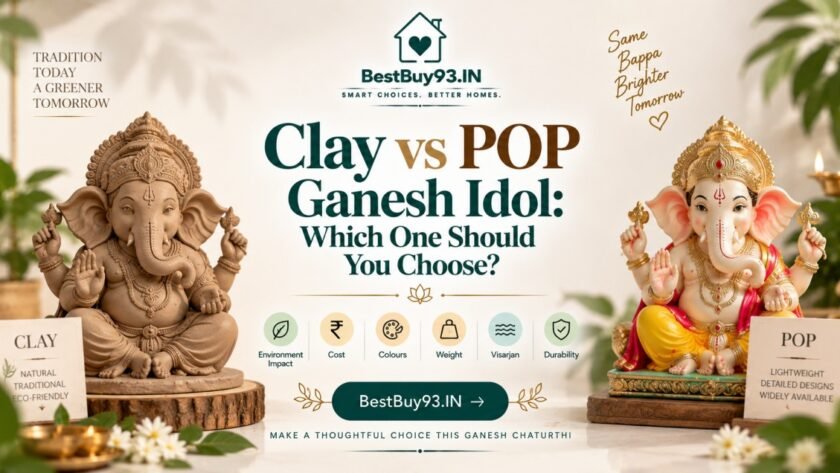
🪔 Clay vs POP Ganesh Idol: Quick Comparison
| Feature | Clay / Shadu Mati | POP – Plaster of Paris |
|---|---|---|
| Material | Natural clay/earth | Gypsum-based plaster |
| Traditional use | Traditionally used for idols | Became popular as a modern moulding material |
| Weight | Generally heavier | Generally lighter |
| Drying time | Usually longer | Generally faster |
| Detail & finish | Can be highly detailed | Easy to create sharp, consistent details |
| Durability | More delicate | Generally more resistant to handling |
| Water behaviour | Designed as a more natural immersion option | Does not readily dissolve in water |
| Environmental impact | Lower when paired with suitable natural/water-soluble colours | Greater concern, especially with immersion and unsuitable paints |
| Price | Can be higher depending on craftsmanship | Often cheaper to manufacture |
| Best for | Traditional & eco-conscious celebrations | Buyers prioritising light weight, finish and durability |
The Central Pollution Control Board’s idol-immersion guidance notes that clay was traditionally used for idols, while POP became popular because it is lighter and cheaper; it also highlights concerns around non-biodegradable materials and certain paints used on idols.
🌿 1. What Is a Clay Ganesh Idol?
A clay Ganesh idol is generally made from natural clay or shadu mati, a material traditionally associated with idol-making.
The clay is shaped, dried and then decorated.
Depending on the artisan and product, the idol may be finished using different types of colours, so don’t assume that “clay” automatically means every part of the idol is environmentally friendly.
That’s an important distinction.
A genuinely eco-conscious choice should ideally consider:
🌿 Natural clay
🎨 Suitable water-soluble/natural colours
🚫 Minimal plastic decoration
🚫 No thermocol-heavy accessories
The CPCB guidance specifically discusses traditionally made clay idols and recommends attention to materials and colours used in idol-making.
🧱 2. What Is a POP Ganesh Idol?
POP stands for Plaster of Paris.
It is a gypsum-based material that becomes mouldable when mixed with water and then hardens as it dries.
POP became popular among idol makers because it is:
- Lightweight
- Relatively inexpensive
- Easy to mould
- Faster to work with
- Suitable for detailed designs
- Convenient for mass production
The CPCB notes that POP became a favoured idol-making material over time because it is lighter and cheaper than traditional clay.
This explains why you’ll see so many POP idols in different sizes, shapes and finishes during Ganesh Chaturthi.
⚖️ 3. Clay vs POP: Which Idol Is Heavier?
One of the easiest differences to notice is weight.
Clay
Clay idols are generally denser and therefore heavier for a similar size.
This can make:
- Transport harder
- Carrying more difficult
- Handling more delicate
But it also gives the idol a solid, traditional feel.
POP
POP idols are generally lighter.
That can be useful if:
- You’re carrying the idol upstairs
- You live in a high-rise apartment
- You need to transport it by car
- The idol is relatively large
- Multiple people need to move it
🏠 For apartment living
Weight is worth considering before buying.
Don’t decide only by looking at the idol’s height.
A 2-foot idol can still be surprisingly difficult to move depending on its material and construction.
🎨 4. Which One Looks Better?
Honestly?
Both can look beautiful.
This is where personal preference and craftsmanship matter.
A skilled clay artisan can create an incredibly detailed and elegant idol.
A well-made POP idol can also have:
- Sharp facial details
- Intricate jewellery
- Smooth surfaces
- Detailed crowns
- Elaborate poses
So don’t assume:
Clay = simple
and
POP = beautiful.
That’s not accurate.
The quality of the sculptor matters enormously.
👑 5. Why Do POP Idols Often Have More Detailed Designs?
POP is convenient for mould-based production.
This allows manufacturers and artisans to reproduce:
- Intricate crowns
- Jewellery
- Decorative patterns
- Complex poses
- Fine facial details
with consistency.
That’s one reason POP idols became popular for highly decorative designs.
Clay can also achieve impressive detailing, but it may require more time and craftsmanship.
A recent report from Mumbai notes that clay idols can take longer to dry, while POP remains popular partly because of practical considerations such as cost, time and durability.
🌸 6. Which Idol Is More Fragile?
Clay
Clay is generally more delicate during:
- Transport
- Installation
- Decoration
- Handling
A careless move can damage:
- Fingers
- Trunk
- Crown
- Ears
- Decorative elements
So if you’re buying clay, transport it carefully.
POP
POP idols are generally easier to handle during transportation because of their lighter construction and moulded structure.
However, POP isn’t indestructible.
Thin decorative sections can still break.
Practical tip:
Never judge durability only by material.
Ask the seller:
“Is this solid clay or a lightweight/hollow construction?”
That can make a significant difference.
💧 7. What Happens When a Clay Ganesh Idol Is Immersed?
This is where the difference becomes especially important.
A natural clay idol is generally considered a more suitable material for immersion because clay can break down and return to the natural environment.
However, how quickly it breaks down depends on the clay, size, construction, coatings and immersion conditions.
So avoid exaggerated claims such as:
“Every clay idol disappears completely in 10 minutes.”
That’s not a reliable universal rule.
The more important point is that natural clay is fundamentally different from POP in how it behaves after immersion.
The CPCB’s guidance describes clay as the traditional idol material and highlights the environmental concerns associated with POP and non-biodegradable materials.
🚫 8. What Happens to a POP Ganesh Idol After Visarjan?
This is the biggest environmental concern.
POP idols do not readily dissolve in water.
Instead, they can break apart and remain in water bodies for extended periods.
The CPCB has highlighted that POP idols and certain decorative materials can contribute to pollution when immersed, while Maharashtra’s current environmental guidance specifically includes rules concerning POP idol immersion.
In Mumbai, the issue remains significant enough that the BMC announced plans in August 2026 to collect immersed POP idols and explore recycling options rather than allowing the material to accumulate in waterways.
That’s a pretty strong reminder that what happens after visarjan matters too.
🌊 9. It’s Not Just POP—Paints Matter Too
Here’s something many people forget.
You can buy a clay idol and still end up with an environmentally problematic idol if it is covered in unsuitable paints or decorative materials.
The CPCB has raised concerns about paints containing substances such as mercury, cadmium, arsenic and lead, depending on the colouring materials used.
Recent Mumbai civic efforts have also focused on promoting eco-friendly colours for Ganesh idols, showing that the environmental question isn’t simply “Clay vs POP.”
Think about the entire idol:
Material + Paint + Decoration + Immersion method
all matter.
🎨 10. How to Choose Eco-Friendly Colours
If you’re specifically looking for an eco-conscious Ganesh idol, ask the seller:
“Kaunsa colour use kiya hai?”
Don’t stop at:
“Eco-friendly hai.”
Ask what that actually means.
Look for information about:
- Natural colours
- Water-soluble colours
- Low-impact paints
- Non-toxic finishes
If the seller cannot explain what colours were used, don’t assume that an idol labelled “eco-friendly” is automatically environmentally safe.
💰 11. Which Is Cheaper: Clay or POP?
There isn’t one universal price difference.
Price depends on:
- Idol size
- Artisan
- Design
- Detail
- Material quality
- Colouring
- Decoration
- Local demand
- Brand/store
POP can have a cost advantage because it is relatively inexpensive and convenient to mould.
Clay idols may cost more when they involve:
- Hand sculpting
- Better-quality clay
- Detailed craftsmanship
- Natural colours
- Handmade finishing
So don’t assume:
Clay = expensive
or
POP = cheap.
Compare the actual product rather than the material alone.
🏙️ 12. Why POP Is Still Popular
If POP has environmental drawbacks, why do people continue buying it?
There are practical reasons.
POP can offer:
⚡ Faster production
💰 Lower manufacturing cost
🪶 Lower weight
🎨 Detailed designs
🧱 Greater handling convenience
📦 Easier mass production
These advantages matter to both manufacturers and buyers.
A 2026 report from Mumbai also points to time, cost and space constraints as factors influencing the continued popularity of POP idols despite the push toward clay.
So this isn’t simply a question of:
“People don’t care about the environment.”
Convenience, availability and affordability also influence buying decisions.
🏺 13. Why Choose a Clay Ganesh Idol?
If your priority is a more environmentally conscious celebration, clay has several advantages.
🌿 Natural material
Clay is a traditional natural material.
💧 Better suited to immersion
Compared with POP, natural clay is much more compatible with the concept of returning the idol material to the environment.
🪔 Traditional connection
Clay has a long history in idol-making.
♻️ Lower long-term material concern
It avoids the persistent POP residue associated with conventional POP immersion.
❤️ Meaningful choice
For many families, choosing clay becomes part of celebrating Ganesh Chaturthi more consciously.
🧱 14. Why Do Some People Still Prefer POP?
There are legitimate practical considerations.
POP may appeal to buyers who prioritise:
- Lightweight idols
- Highly detailed designs
- Lower prices
- Easy transportation
- Greater availability
- Durability during handling
So the comparison isn’t about pretending these advantages don’t exist.
It’s about deciding which priorities matter most to you.
🪔 15. Clay vs POP for Small Home Ganpati
If you’re bringing Bappa home to a small apartment, the decision becomes even more practical.
Choose clay if:
🌿 Environmental impact is a major priority
🪔 You prefer traditional materials
🏠 You’re comfortable handling a heavier idol
💧 You want a more immersion-friendly material
POP may appeal if:
🪶 Weight is your biggest concern
🎨 You want elaborate detailing
💰 You’re looking for a lower-cost option
📦 Easy handling is important
But if choosing clay, make sure your chowki and transport arrangements can comfortably handle the idol’s weight.
🚚 16. Transportation: Don’t Forget This
Imagine buying the perfect clay idol and then carrying it home on a crowded local road.
Not fun. 😅
Before purchasing, consider:
Distance
How far is the seller from your home?
Transport
Can you safely carry it in your car/taxi?
Packaging
Does the seller provide suitable protection?
Staircase/lift
Will it fit comfortably?
Installation
Can you place it on the chowki without damaging delicate parts?
A beautiful idol is not worth buying if you don’t have a safe way to transport it.
🔎 17. How to Tell If a Ganesh Idol Is Actually Clay
This is where buyers need to be careful.
Some idols can be finished in a way that makes the material difficult to identify visually.
Ask the seller directly:
“Is this pure clay/shadu mati or POP?”
Then ask:
“What colours have been used?”
And:
“Is it suitable for natural immersion?”
Don’t rely only on a sticker saying:
“Eco Friendly.”
Ask for the material details.
🧠 18. Simple Things to Check Before Buying
Before paying, check:
1️⃣ Material
Clay, POP or another material?
2️⃣ Paint
What type of colours have been used?
3️⃣ Weight
Can you safely transport it?
4️⃣ Construction
Is it solid, hollow or reinforced?
5️⃣ Fragile parts
Check the crown, trunk, fingers and decorative elements.
6️⃣ Base
Is it stable?
7️⃣ Size
Will it fit your chowki and decoration?
8️⃣ Visarjan plan
Where and how will you immerse it?
This eight-point check can prevent a lot of last-minute problems.
⚠️ 19. Don’t Confuse “Eco-Friendly” With “Clay” Automatically
This is one of the most important points in this entire guide.
A product may be advertised as:
🌿 Eco idol
🌱 Green Ganpati
♻️ Eco-friendly Ganesha
But you should still ask:
What is it made from?
What colours are used?
What happens during immersion?
There are alternatives to both conventional clay and POP, including idols made from other natural or biodegradable materials.
So the label alone isn’t enough.
🏞️ 20. What About Artificial Immersion Tanks?
This is an important part of the modern conversation.
Many cities provide artificial immersion facilities to reduce the impact on natural water bodies.
If your local authority provides such a facility, follow the local instructions.
In Mumbai, for example, BMC has continued arrangements for collecting and managing immersed idols, including POP idols, while exploring recycling routes for recovered POP material.
The practical rule:
Follow your municipal body’s current visarjan instructions.
Rules and facilities can vary by city and year.
🏆 21. So, Clay or POP—Which One Is Better?
If we look at the overall picture:
🌿 Best for environmental considerations:
Clay / Shadu Mati
🪶 Best for lightweight handling:
POP
🎨 Best for mass-produced intricate designs:
POP
🪔 Traditional material:
Clay
💧 Better suited to natural-material immersion:
Clay
💰 Potentially cheaper:
POP
❤️ Best choice for an eco-conscious home celebration:
Clay with suitable colours and minimal non-biodegradable decoration
The final choice is yours, but if environmental impact and immersion are important considerations, a natural clay idol with suitable colours is generally the more responsible option.
📋 22. Clay Ganesh Idol Buying Checklist
Before buying your idol, save this:
☑️ Confirm the material
☑️ Ask whether it is natural clay/shadu mati
☑️ Ask what colours were used
☑️ Avoid unnecessary plastic/thermocol decoration
☑️ Check idol weight
☑️ Check idol dimensions
☑️ Inspect fragile parts
☑️ Check the base stability
☑️ Plan safe transportation
☑️ Confirm your local immersion arrangements
☑️ Follow local civic/environmental instructions
🪔 Visarjan, Colours, Cost & Practical Buying Guide
Choosing a Ganesh idol is a deeply personal decision. For many families, the idol is not just a decoration for Ganesh Chaturthi it becomes the centre of the entire celebration. ❤️🙏
But when you’re standing in front of dozens of beautiful idols, there is one question that often gets overlooked:
What is the idol actually made of?
Clay and Plaster of Paris (POP) can look surprisingly similar from a distance, but their behaviour during transport, decoration and visarjan can be very different.
And there’s another important point that often gets missed:
The material isn’t the only thing that matters.
The paint, decorative accessories, size, immersion method and what happens to the idol after visarjan are all part of the environmental picture.
So before you choose Bappa this year, let’s look at the practical side of the Clay vs POP decision. 🌿🪔
Also Read | 5 Powerful Ganpati Mantras for Good Vibes
🌊 1. What Actually Happens During Visarjan?
This is probably the biggest difference between the two materials.
🌿 Clay Idol
Natural clay is generally much more compatible with the traditional concept of immersion because it can break down and return to an earth-like material.
However, the exact rate of breakdown depends on:
- Type of clay
- Idol size
- Construction
- Paint
- Coatings
- Immersion conditions
So don’t believe overly specific claims such as:
“This clay idol will completely dissolve in exactly 10 minutes.”
There is no universal timeline.
🧱 POP Idol
POP behaves very differently.
It does not readily dissolve in water like natural clay.
Instead, an immersed POP idol can break into pieces or sludge while remaining in the water body, which is one reason environmental authorities have raised concerns about POP idol immersion.
That’s why the material matters beyond simply how the idol looks on your pooja platform.
🎨 2. The Paint Can Be Just as Important as the Idol Material
Here’s something worth remembering:
Clay + unsuitable paint ≠ automatically eco-friendly
A clay idol may be made from a natural material, but the coating applied on top can affect what enters the water during immersion.
CPCB guidance encourages the use of naturally occurring colours or water-soluble, non-toxic natural dyes and discourages toxic or non-biodegradable chemical paints.
So when buying an idol, don’t ask only:
“Clay hai?”
Also ask:
“Kaunsa colour use kiya hai?”
That’s a much better question.
🌿 3. What Should You Look for in an Eco-Conscious Ganesh Idol?
If reducing environmental impact is important to you, look for a combination of:
🪔 Idol
Natural clay / shadu mati
🎨 Colours
Water-soluble and non-toxic colours, where available and appropriate
🌸 Decoration
Natural flowers and reusable décor
🚫 Avoid unnecessary materials
Especially excessive:
- Plastic
- Thermocol/polystyrene
- Non-biodegradable decorative elements
CPCB’s revised guidelines specifically encourage natural clay and address restrictions on materials such as POP, plastic and thermocol in idol-making and decoration.
📏 4. Does Idol Size Matter?
Absolutely.
People often focus only on:
“Kitne feet ka Ganpati hai?”
But size has practical and environmental implications.
A larger idol generally means:
- More material
- More weight
- More difficult transportation
- More difficult installation
- More challenging immersion
- More material requiring post-immersion handling
CPCB guidance encourages smaller idols and recommends restrictions on idol size as part of environmentally responsible immersion practices.
🏠 For home Ganpati
A smaller, well-crafted idol can actually be much easier to manage.
You don’t need a massive idol to create a beautiful celebration.
🪶 5. Lightweight Doesn’t Always Mean Better
POP has one very obvious advantage:
It’s generally lighter.
That makes transportation easier.
But don’t choose an idol purely because it’s easier to carry.
Think about the entire lifecycle:
Buy → Transport → Install → Celebrate → Immerse → Manage the remains
A lightweight POP idol may solve one problem handling but create additional challenges during immersion.
That’s why “lightweight” should be treated as one factor, not the final deciding factor.
🚚 6. Transporting a Clay Idol Safely
If you’re buying a clay idol, transportation needs a little more attention.
Before leaving the shop:
Ask the seller to secure the idol properly.
During transport:
- Keep the idol upright
- Avoid placing heavy objects around it
- Protect delicate areas
- Avoid unnecessary movement
- Don’t hold it by the trunk, crown or decorative parts
At home:
Have the chowki ready before bringing the idol inside.
That way you don’t end up carrying Bappa around the house while everyone is shouting:
“Idhar rakho!”
“Nahi nahi, udhar!” 😂
🏠 7. Check Your Chowki Before Buying the Idol
This is a surprisingly common mistake.
People choose the idol first and only later discover that the chowki is too small.
Before buying, measure:
Idol
- Height
- Width
- Depth
Chowki
- Width
- Depth
- Weight capacity
Decoration
- Backdrop width
- Available floor space
- Clearance around the idol
A beautiful idol should sit comfortably and securely.
👑 8. Don’t Judge an Idol Only by Its Paint Finish
Some idols look spectacular because they have:
✨ Metallic finishes
✨ Glitter
✨ Glossy coatings
✨ Heavy jewellery
✨ Bright colours
✨ Decorative accessories
But appearance doesn’t tell you what is underneath.
When comparing two idols, inspect:
- Material
- Paint
- Surface coating
- Decorative attachments
- Base construction
A simple-looking clay idol can actually be a more thoughtful purchase than a highly decorated idol with multiple synthetic materials.
🧾 9. What Does “Eco-Friendly Ganpati” Actually Mean?
This label is becoming increasingly common.
But eco-friendly isn’t necessarily a single standardised material description.
If a seller says:
“Eco-friendly idol hai.”
ask:
“Kis material ka hai?”
Then ask:
“Kaunsa colour use hua hai?”
And if relevant:
“Visarjan kaise karna recommended hai?”
A transparent seller should be able to explain the materials used.
Don’t buy purely because the product title contains:
Eco / Green / Natural / Environment Friendly
Look for actual material information.
🌊 10. Artificial Immersion Can Change the Practical Decision
If your local authority provides an artificial immersion pond or tank, you should consider using it.
Mumbai’s BMC currently provides artificial immersion ponds across wards and encourages citizens to use them as part of environmentally conscious Ganesh festival practices.
BMC’s 2026 arrangements also include equipment and services for artificial immersion sites, including retrieval and waste-management operations.
Why is this useful?
Artificial immersion facilities can help local authorities:
- Control the immersion process
- Retrieve idol remains
- Manage solid waste
- Reduce direct impact on natural water bodies
If you’re in Mumbai, check your local BMC immersion arrangements for the current year before visarjan.
🌸 11. Remove Decoration Before Immersion
The idol may be the centrepiece, but the surrounding decoration doesn’t necessarily belong in the water.
Before immersion, remove:
- Plastic decorations
- Cloth
- Jewellery that can be removed
- Flowers where instructed
- Thermocol
- Paper/plastic accessories
- Other non-idol decorative materials
CPCB/MPCB guidance recommends removing worship and decorative materials before immersion and collecting them separately for appropriate recycling, composting or disposal.
This is a small step that can make the immersion process much cleaner.
🌼 12. What About Flowers and Nirmalya?
Flowers are an important part of Ganesh Chaturthi but they should also be managed properly after the celebration.
Instead of throwing everything together with plastic bags:
Separate:
🌸 Flowers
🍃 Leaves
🧵 Cloth
🪔 Other reusable materials
♻️ Recyclables
🚫 Non-biodegradable waste
BMC currently provides nirmalya kalash at immersion locations and encourages citizens to use them for flower waste rather than mixing it with plastic waste.
This is a very simple habit that can make your celebration more responsible.
💰 13. Is a Clay Idol Always More Expensive?
Not necessarily.
The price depends on:
- Idol size
- Artisan
- Design
- Detail
- Material quality
- Painting technique
- Handmade work
- Location
- Festival demand
A basic clay idol may be affordable, while an elaborate hand-sculpted clay idol can cost significantly more.
Similarly, POP idols can range from inexpensive mass-produced pieces to expensive highly detailed designs.
So don’t compare:
Clay = expensive
POP = cheap
Instead compare:
Material + craftsmanship + size + finish + durability + seller reputation
🛍️ 14. Where Should You Buy Your Ganesh Idol?
You generally have three broad options.
🏪 Local Artisan
Pros:
- You can inspect the idol physically
- You can ask about materials
- You can discuss customisation
- You can support local craftsmanship
🛒 Festival Market
Pros:
- Large selection
- Multiple sizes
- Easy comparison
- Different price points
💻 Online
Pros:
- Convenient
- Easy price comparison
- More design options
But check carefully:
- Exact dimensions
- Material
- Weight
- Colour information
- Seller reviews
- Delivery date
- Return/replacement policy where applicable
For a fragile idol, seeing the actual product can be a significant advantage.
🔍 15. Questions to Ask the Seller
Screenshot this section before going Ganpati shopping. 📱
Ask:
Question 1
“Idol kis material ka hai?”
Question 2
“Pure shadu clay hai ya POP mixture bhi hai?”
Question 3
“Kaunsa colour use hua hai?”
Question 4
“Idol ka approximate weight kitna hai?”
Question 5
“Isme koi thermocol/plastic decoration attached hai?”
Question 6
“Transport ke liye packing milegi?”
Question 7
“Visarjan ke liye koi specific recommendation hai?”
If you’re buying an idol marketed as eco-friendly, these questions are especially useful.
🧐 16. Clay Idol Doesn’t Automatically Mean Perfect
Let’s clear up another misconception.
Choosing clay is a better starting point for an environmentally conscious idol, but it doesn’t automatically make the entire celebration environmentally neutral.
You still need to consider:
- Paint
- Glitter
- Plastic decoration
- Thermocol
- Packaging
- Flowers
- Immersion location
- Waste disposal
Think of it as a complete system.
Better choice:
Natural clay + suitable colours + minimal synthetic decoration + responsible immersion
That’s much more meaningful than simply buying something labelled “eco-friendly.”
🧱 17. What About Clay Mixed With Other Materials?
This is where buyers should be careful.
Some idols may be marketed loosely as:
- Clay idol
- Eco idol
- Shadu idol
- Natural idol
But the actual construction can vary.
If the material is important to you, ask the seller specifically whether the idol contains:
- POP
- Plastic
- Thermocol
- Synthetic structural materials
- Non-biodegradable coatings
Don’t be afraid to ask.
You’re buying the idol you have every right to know what it’s made from.
🌿 18. Can a Clay Idol Be Reused?
Generally, a clay idol intended for visarjan isn’t purchased with reuse as the primary purpose.
If you want a permanent decorative Ganesha for year-round use, consider a metal, stone, wood or other durable idol specifically designed for long-term use rather than treating a festival clay idol as a permanent sculpture.
CPCB guidance has also noted the use of durable metal idols as one approach that can reduce repeated immersion of painted idols.
For a traditional annual Ganpati celebration, however, the festival idol and permanent home décor idol are two different use cases.
🪔 19. What Should a Small Family Choose?
Let’s make this extremely practical.
Choose Clay if:
🌿 Environmental considerations are important
🪔 You prefer traditional materials
💧 You want an immersion-friendly material
🏠 You can comfortably manage the weight
❤️ You don’t mind handling the idol carefully
Consider POP if:
🪶 Weight is a major practical concern
🎨 You want elaborate moulded detailing
💰 Your available options are significantly more affordable
🚚 Transportation is difficult
But if you choose POP, use your local authority’s designated immersion arrangements and follow current instructions rather than assuming natural-water immersion is appropriate.
📊 20. A More Useful Way to Compare Clay & POP
Instead of asking “Which is better?”, score them according to your priorities.
| Priority | Clay | POP |
|---|---|---|
| Natural material | ⭐⭐⭐⭐⭐ | ⭐ |
| Traditional appeal | ⭐⭐⭐⭐⭐ | ⭐⭐⭐ |
| Lightweight | ⭐⭐ | ⭐⭐⭐⭐⭐ |
| Intricate moulded designs | ⭐⭐⭐⭐ | ⭐⭐⭐⭐⭐ |
| Easy handling | ⭐⭐ | ⭐⭐⭐⭐⭐ |
| Immersion suitability | ⭐⭐⭐⭐⭐ | ⭐ |
| Environmental considerations | ⭐⭐⭐⭐⭐* | ⭐⭐* |
| Mass availability | ⭐⭐⭐ | ⭐⭐⭐⭐⭐ |
| Handmade character | ⭐⭐⭐⭐⭐ | ⭐⭐⭐ |
| Long-term decorative use | ⭐⭐ | ⭐⭐ |
*The environmental outcome also depends on paint, decoration and immersion method.
This is why there isn’t a single answer for every family.
🧠 21. The 30-Second Buying Decision
Still confused?
Ask yourself these five questions:
1️⃣ Is environmental impact important to me?
Yes → Lean toward clay.
2️⃣ Do I need a very lightweight idol?
Yes → Weight becomes a major factor.
3️⃣ Am I comfortable transporting a delicate idol?
Yes → Clay becomes easier to consider.
4️⃣ Can I find a clay idol with suitable colours and trustworthy material information?
Yes → Stronger reason to choose clay.
5️⃣ What does my local authority recommend for immersion?
Follow that guidance.
That’s your answer.
🛒 22. What to Look for When Shopping This Year
If you’re buying your Ganesh idol in 2026, don’t rush into the first beautiful idol you see.
Take five minutes to check:
🪔 Material
Is it clay, POP or another material?
🎨 Colours
What kind of paint or colouring has been used?
📏 Size
Will it fit your home and chowki?
⚖️ Weight
Can you transport and install it safely?
🌿 Decoration
Are there unnecessary synthetic materials attached?
🌊 Visarjan
Where will you immerse it?
📍 Local rules
What does your municipal authority currently recommend?
This is especially important because immersion arrangements and local requirements can change.
🏆 23. Our Practical Recommendation
If your main priority is a more environmentally conscious Ganesh Chaturthi, our preference would be:
🥇 Natural clay / shadu mati
🥈 Suitable water-soluble/non-toxic colours
🥉 Minimal synthetic decoration
🌊 Designated or appropriate immersion facility
This combination addresses more of the actual environmental impact than simply buying a clay idol and stopping there.
For Mumbai residents, BMC currently provides artificial immersion ponds and has specific arrangements for Ganpati immersion and waste management during the 2026 festival.
❓ 24. Clay vs POP Ganesh Idol FAQs
Is clay Ganesh idol better than POP?
If your priority is reducing the environmental impact associated with idol immersion, natural clay is generally the preferable material. But the paint, decorations and immersion method also matter.
Does POP dissolve in water?
POP does not readily dissolve in water like natural clay. It can break down into pieces/sludge, which is why its immersion is an environmental concern.
Is every clay Ganesh idol eco-friendly?
No.
Check the paint, coatings and decorative materials too.
Is Shadu Mati the same as POP?
No. Shadu mati refers to a type of natural clay traditionally used for idol-making, while POP is a gypsum-based plaster.
Are clay idols heavier?
Generally, yes, for comparable size, although actual weight depends on construction and size.
Why are POP idols so popular?
They can be lightweight, economical, easy to mould and suitable for highly detailed designs.
Should I buy a small or large Ganpati idol?
For home celebrations, choose a size that you can safely transport, install and immerse. Smaller idols are also encouraged in environmental guidance.
Can I immerse my Ganpati idol at home?
Follow your local authority’s current rules and recommendations. Where designated artificial immersion facilities are provided, using them can help reduce pressure on natural water bodies. Mumbai currently provides artificial immersion ponds across wards.
What should I do with flowers after visarjan?
Separate flowers and other nirmalya from plastic and non-biodegradable waste. Use designated collection points where available. BMC currently provides nirmalya collection arrangements at immersion locations.
🪔 Budget, Buying Checklist & Final Verdict
By now, the Clay vs POP Ganesh Idol debate should be a little clearer.
We know that clay and POP differ in their material, weight, handling, detailing and behaviour during immersion. We also looked at why paint, decorations and the immersion method matter just as much as the idol material itself.
But there’s still one practical question:
“Okay, but which Ganesh idol should I actually buy?” 😅
That’s what this final part is about.
We’ll look at budget, size, shopping mistakes, seller questions, visarjan planning, eco-friendly choices and a simple decision framework so you can make your choice without getting confused at the last minute.
Also Read | Eco-Friendly Ganpati Gifts Your Friend Will Love
💰 1. How Much Should You Spend on a Ganesh Idol?
There is no fixed “correct” price for a Ganesh idol.
The cost can vary significantly depending on:
- Material
- Height
- Design
- Artisan
- Handcrafted detailing
- Paint and finishing
- Decoration
- Location
- Festival demand
A simple clay idol can be relatively affordable, while a highly detailed handcrafted idol can cost considerably more.
Similarly, POP idols are available across a wide range of prices.
So don’t assume:
Clay = expensive
or
POP = cheap.
The material is only one part of the final price.
🪔 2. A Better Way to Set Your Idol Budget
Instead of deciding:
“Mujhe ₹2,000 ka hi idol chahiye.”
decide what matters most to you.
🌿 If environment is your priority
Keep more of your budget for:
Natural clay + suitable colours + good craftsmanship
🎨 If design is your priority
You may spend more on:
Detailed craftsmanship + finishing + artistic work
🏠 If you’re decorating a small home
Spend less on the idol and more thoughtfully on:
A suitable-sized idol + beautiful backdrop + flowers + lighting
💰 If you’re on a tight budget
Don’t compromise on basic quality just to get a huge idol.
A smaller, beautifully finished idol can look far better than a large but poorly made one.
📏 3. Don’t Buy the Biggest Idol Your Budget Allows
This is one of the easiest mistakes to make.
You see a beautiful 3-foot Ganpati and think:
“Bas yehi chahiye!” 😍
Then you get home and realise:
- It doesn’t fit the chowki
- The backdrop is too small
- The room looks crowded
- Transport becomes difficult
- Visarjan becomes harder
For a home celebration, choose the idol according to your space and practical arrangements, not just the visual impact.
CPCB guidance also encourages smaller idols as part of more environmentally responsible immersion practices.
🏠 4. Match Idol Size to Your Home
A useful approach is to think about the entire setup.
Small apartment
Choose a compact idol that leaves enough room for:
- Chowki
- Backdrop
- Flowers
- Diyas
- People performing pooja
Medium living room
You have more flexibility, but still measure the area before buying.
Large home / dedicated pooja area
A larger idol may work, provided the platform, transportation and immersion arrangements are suitable.
Golden rule:
The idol should be the centre of the setup not the entire setup.
⚖️ 5. Think About Weight Before You Buy
This matters particularly when comparing clay and POP.
A clay idol can be considerably heavier than a similarly sized POP idol.
Before purchasing, ask:
“Approximate weight kitna hai?”
Then think about:
🚗 Transport
🛗 Lift
🪜 Stairs
🏠 Installation
🪵 Chowki capacity
🌊 Visarjan
If you’re buying a clay idol, don’t leave the weight question until the day of installation.
🛍️ 6. The Ultimate Ganesh Idol Shopping Checklist
Save this before you go shopping. 📱
🪔 Material
☐ Clay / Shadu Mati
☐ POP
☐ Other material
🎨 Finish
☐ Paint type confirmed
☐ No unnecessary coatings
☐ Colour quality checked
📏 Size
☐ Height measured
☐ Width measured
☐ Depth measured
⚖️ Weight
☐ Approximate weight confirmed
☐ Can be transported safely?
🏠 Base
☐ Stable base
☐ Fits your chowki
☐ No wobbling
🌿 Environmental considerations
☐ Material clearly disclosed
☐ Minimal plastic decoration
☐ No unnecessary thermocol
☐ Appropriate immersion plan
🚚 Transport
☐ Proper packaging
☐ Seller can assist with transport
☐ Fragile sections protected
🌊 Visarjan
☐ Local immersion rules checked
☐ Designated facility identified
☐ Nirmalya disposal planned
❓ 7. Questions You Should Ask the Seller
Don’t feel awkward asking questions.
You’re spending money on the idol, so ask.
Question 1
“Ye pure clay/shadu mati ka hai?”
Question 2
“POP mixed toh nahi hai?”
Question 3
“Kaunsa colour use hua hai?”
Question 4
“Idol ka weight approximately kitna hai?”
Question 5
“Isme plastic ya thermocol ka use hua hai?”
Question 6
“Visarjan ke liye kya recommendation hai?”
Question 7
“Transport ke liye packing karoge?”
If the seller can’t clearly answer basic material questions, think twice before purchasing an idol advertised as eco-friendly.
🌿 8. How to Identify a Better Eco-Conscious Choice
Don’t look for just one magic word.
Instead, look for the combination:
Better choice:
Natural clay/shadu mati
Suitable water-soluble/non-toxic colours
Minimal synthetic decoration
Responsible immersion
CPCB’s idol-immersion guidance recommends natural clay and environmentally preferable colouring/decorative materials, while raising concerns about POP, toxic dyes and non-biodegradable accessories.
That gives you a much more complete picture than simply checking whether the product description says “eco-friendly.”
🎨 9. What About Glitter, Jewellery & Decorative Accessories?
This is another area where buyers can overlook the bigger picture.
An idol may be made from clay but have:
✨ Glitter
🧵 Synthetic fabric
💎 Plastic jewellery
🌸 Artificial flowers
📦 Thermocol elements
attached to it.
That doesn’t automatically make the entire idol environmentally problematic in exactly the same way, but it does mean you should think about what will be removed, reused or disposed of before immersion.
Better approach:
Use removable decoration wherever possible.
After the festival:
Reuse → Recycle → Dispose responsibly
instead of immersing everything together.
🌊 10. Plan Visarjan Before You Buy the Idol
This sounds strange, but it’s actually one of the smartest things you can do.
Before buying, know:
Where?
Your designated immersion site or facility.
How?
Natural water body or artificial immersion facility according to local rules.
How will you transport it?
Car, auto, tempo or on foot?
Who will carry it?
A large idol can require several people.
What happens to the decorations?
Flowers, cloth, plastic and other materials should be separated appropriately.
This prevents a lot of last-minute stress.
🏙️ 11. If You’re in Mumbai
For Mumbai residents, this is particularly relevant.
BMC’s current 2026 Ganpati Visarjan arrangements include artificial immersion ponds across wards. BMC is actively encouraging citizens to use these facilities and has also provided nirmalya kalash at immersion locations for flower offerings, with instructions to avoid plastic bags.
BMC’s current 2026 operational preparations also include retrieval equipment, cleaning, waste management and other arrangements around artificial immersion sites.
So if you’re in Mumbai, check the current BMC immersion information for your ward rather than relying on an old social-media post or last year’s location list.
🌸 12. What Should You Do With Nirmalya?
After the pooja, don’t simply throw flowers and other offerings into a plastic bag.
Separate:
🌸 Flowers
🍃 Leaves
🧵 Cloth
♻️ Recyclable materials
🚫 Plastic/non-biodegradable waste
BMC says nirmalya collection containers are provided at immersion locations and the collected organic material is processed into compost for use in Mumbai gardens.
That’s a very simple habit that makes your celebration cleaner.
🪔 13. Clay Idol + Artificial Immersion: Does It Make Sense?
Yes.
Choosing clay doesn’t mean you must assume a natural water body is the only possible immersion route.
If your local authority provides an artificial immersion facility, you can follow that arrangement.
The important thing is:
Choose the idol thoughtfully + follow the local immersion system.
The CPCB’s guidelines emphasise designated immersion arrangements and environmentally responsible management of idols and associated materials.
💡 14. What If You Already Bought a POP Idol?
Don’t panic.
If you’ve already purchased a POP Ganesh idol, there’s no reason to feel guilty or stressed.
Instead, focus on responsible handling.
Do this:
✅ Follow your local authority’s immersion instructions
✅ Prefer designated/artificial immersion facilities where available
✅ Remove non-idol decorations before immersion
✅ Separate nirmalya
✅ Don’t throw plastic or thermocol into the water
✅ Follow local collection/retrieval instructions
The goal is to make the best responsible choice from where you are, not to turn a festival into a guilt trip.
🌿 15. What If You Want the Most Eco-Conscious Option?
If environmental impact is your top priority, think beyond clay.
Your setup can follow this formula:
Idol
🌿 Natural clay/shadu mati
Colours
🎨 Suitable water-soluble/non-toxic colours
Decoration
🌼 Fresh flowers
🌿 Natural leaves
🧵 Reusable fabric
Lighting
✨ Reusable LED/fairy lights
Visarjan
🌊 Follow designated/local immersion arrangements
Waste
♻️ Separate nirmalya and recyclables
That’s a much more complete approach to an environmentally conscious Ganesh Chaturthi.
💰 16. Where Should You Spend Your Money?
If your total Ganpati budget is limited, prioritise like this:
🥇 Idol quality
Choose a well-made idol that fits your needs.
🥈 Safe transport & installation
Don’t compromise here.
🥉 Decoration
Flowers and lighting can transform even a simple setup.
4️⃣ Reusable items
Spend a little more on things you’ll use next year.
5️⃣ Unnecessary extras
Keep these last.
You don’t need to spend ₹2,000 on a decorative item that will sit in a cupboard for 11 months.
🛒 17. Buy the Idol First or Decoration First?
Idol first.
This is especially important if you’re buying a larger or unusually shaped Ganpati.
Once you know:
- Idol height
- Idol width
- Idol colours
- Idol pose
- Chowki size
you can select a matching decoration theme.
Otherwise, you may buy a beautiful red backdrop and later bring home a Ganpati with colours that completely clash with it. 😂
🎨 18. Match Your Decoration to the Idol
For example:
Red/Gold Ganpati
Try:
Cream + Gold + Marigold
White/Green Ganpati
Try:
Greenery + White Flowers + Warm Lights
Pink Ganpati
Try:
White + Pink + Gold
Traditional Orange/Yellow Ganpati
Try:
Red + Yellow + Green
This makes the overall setup look much more intentional.
🧠 19. Don’t Let “Eco-Friendly” Become a Marketing Trap
This is worth repeating.
If the product listing says:
100% Eco-Friendly Ganpati
don’t immediately assume everything is perfect.
Look for actual information about:
- Idol material
- Paint
- Coatings
- Decorative materials
- Recommended immersion method
A transparent seller should be able to explain what makes the idol eco-friendly.
If the description is vague, ask questions.
📊 20. Final Clay vs POP Decision Table
| Your Priority | Better Fit |
|---|---|
| Natural material | 🌿 Clay |
| Traditional idol-making | 🪔 Clay |
| Lower environmental concern during immersion | 🌿 Clay |
| Lightweight handling | 🪶 POP |
| Highly intricate moulded design | 🎨 POP |
| Easy transportation | 🪶 POP |
| Eco-conscious celebration | 🌿 Clay + suitable colours |
| Small home | Either choose based on size/weight |
| Large idol | Consider weight & transport carefully |
| Best overall for environmentally conscious home use | 🌿 Clay |
This is not a statement that every clay idol is automatically environmentally safe or that every POP idol has the same environmental impact. Paint, accessories and immersion practices still matter.
❌ 21. Mistakes to Avoid While Buying
🚫 Buying by looks alone
A beautiful finish doesn’t tell you the material.
🚫 Not asking about weight
Especially for clay idols.
🚫 Buying before measuring your chowki
Very easy mistake.
🚫 Trusting “eco-friendly” without asking details
Always verify.
🚫 Ignoring the paint
Material isn’t the entire story.
🚫 Leaving transport until the last minute
Plan ahead.
🚫 Buying a huge idol for a small room
More height doesn’t automatically mean better.
🚫 Forgetting visarjan arrangements
Plan this before the festival.
🚫 Immersing decorations with the idol
Separate what can be removed and managed separately.
📝 22. One-Minute Ganesh Idol Buying Checklist
Before you pay, ask yourself:
☐ What is it made from?
☐ What colours were used?
☐ How much does it weigh?
☐ Does it fit my space?
☐ Can I transport it safely?
☐ Is the base stable?
☐ Are there plastic/thermocol decorations attached?
☐ Where will I immerse it?
☐ What are my local authority’s current instructions?
☐ Can I separate the decorations and nirmalya afterward?
If you can answer all ten, you’re ready. 🪔
❓ 23. Clay vs POP Ganesh Idol FAQs
Is clay better than POP for Ganesh Chaturthi?
If your priority is reducing the environmental concerns associated with idol immersion, natural clay is generally the preferable option. However, paint, decoration and immersion practices also matter.
Is Shadu Mati better than regular clay?
Shadu mati is traditionally used for Ganesh idols and is generally preferred for eco-conscious idol-making. However, buyers should still verify the actual material and colours used by the seller.
Does a clay idol dissolve immediately during visarjan?
No fixed time should be assumed. Breakdown depends on the idol’s size, construction, clay and immersion conditions.
Why is POP still used if it has environmental concerns?
POP is lightweight, economical, easy to mould and suitable for detailed designs, which makes it practical for both manufacturers and buyers.
Is an expensive Ganesh idol better?
Not necessarily.
Craftsmanship, material, proportions, finishing and suitability for your home matter more than the price tag alone.
Should I choose a small Ganpati idol?
For most home setups, choose an idol that you can safely transport, install and immerse. Smaller idols can also reduce material use and simplify handling.
Are eco-friendly Ganpati idols always made from clay?
No. Other materials and construction methods can also be marketed as eco-friendly. Always check the actual material and colouring details.
Can I use artificial immersion facilities?
If your local authority provides them, follow their instructions. Mumbai’s BMC currently provides artificial immersion facilities as part of its 2026 Ganpati arrangements.
🏆 Our Final Verdict
So…
🥇 Clay / Shadu Mati Our Pick for an Eco-Conscious Home Celebration
If you have the option to choose a natural clay/shadu mati idol with suitable colours, it is generally the direction we’d recommend for a more environmentally conscious Ganesh Chaturthi.
It aligns better with traditional idol-making and avoids many of the immersion concerns associated with POP. CPCB guidance specifically identifies natural clay as the traditional material and raises environmental concerns around POP, certain dyes and non-biodegradable decorative materials.
🪶 POP — Practical but Requires More Care Around Immersion
POP can be lighter, easier to transport and capable of detailed designs.
If you choose POP, the responsible thing is to follow your local authority’s designated immersion and waste-management arrangements, particularly where artificial immersion facilities are available.
Also Read | Best Things to Bring for Ganpati Darshan Checklist
❤️ The Bigger Picture
Ultimately, the Clay vs POP Ganesh Idol decision isn’t about finding a “perfect” festival.
It’s about making better choices wherever you can.
Choose an appropriate idol size.
Ask what it’s made from.
Check the colours.
Avoid unnecessary plastic and thermocol.
Use reusable decorations.
Separate nirmalya.
And follow your city’s current visarjan instructions.
For Mumbai, BMC’s 2026 arrangements include artificial immersion ponds and dedicated nirmalya collection facilities, so residents have practical options for a more managed immersion process.
Because celebrating Bappa beautifully doesn’t have to mean ignoring what happens after the celebration.
Bring Bappa home with love. Celebrate with joy. And say goodbye responsibly. 🪔🌿🙏
Ganpati Bappa Morya! ❤️