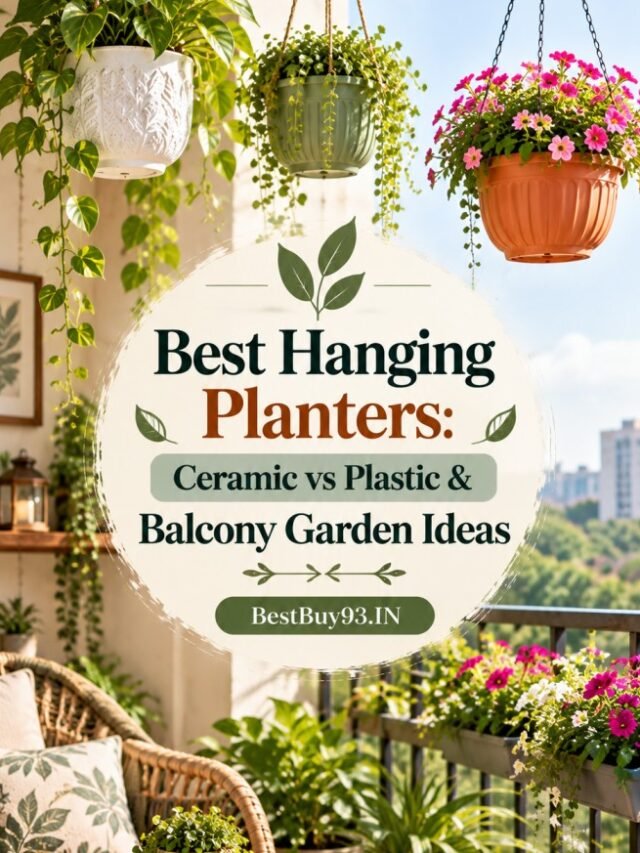
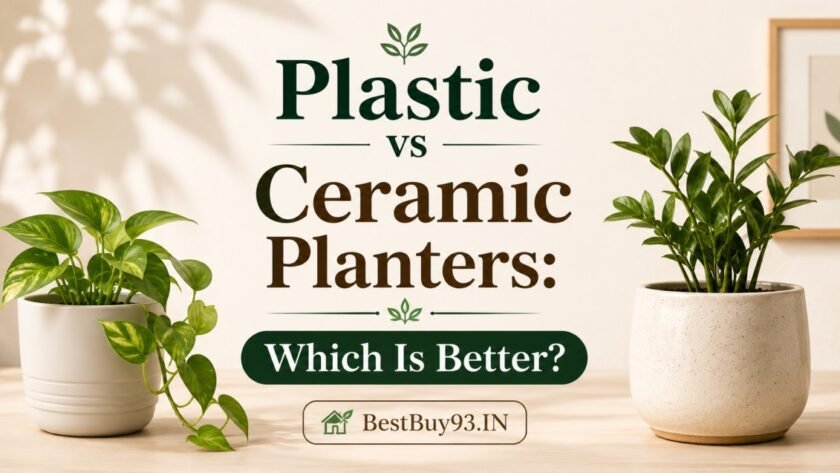

Choosing a planter sounds simple until you actually start shopping. Suddenly there are ceramic pots, plastic pots, terracotta, concrete, metal, woven baskets and somehow a plant pot has become a whole interior-design decision. 😅
Among all these options, plastic and ceramic planters remain two of the most popular choices for homes.
Both can look great, both can work well for plants, and both come in countless sizes and designs. But they behave quite differently when it comes to weight, durability, appearance, moisture, portability, stability and price.
So, when it comes to plastic vs ceramic planters, which one should you choose?
The honest answer is: it depends on your plant, location and priorities.
Also Read | Best Decorative Planters for Every Home
🆚 Plastic vs Ceramic Planters at a Glance
| Feature | 🪴 Plastic Planters | 🏺 Ceramic Planters |
|---|---|---|
| Weight | Lightweight | Heavier |
| Portability | Excellent | Limited |
| Durability | Usually resistant to impact | Can chip or break |
| Appearance | Highly variable | Often premium-looking |
| Design Variety | Very high | Very high |
| Stability | Depends on size and weight | Naturally more stable |
| Drainage | Commonly available | Depends on design |
| Indoor Use | Excellent | Excellent |
| Outdoor Use | Depends on material and UV suitability | Depends on finish and environmental conditions |
| Maintenance | Easy | Easy but requires careful handling |
| Cost | Often budget-friendly | Often more expensive |
| Best For | Portability & practicality | Décor & stability |
🪴 What Are Plastic Planters?
Plastic planters are containers made from various types of synthetic plastic materials and are available in almost every size and shape imaginable.
They’re especially popular because they’re:
- Lightweight
- Easy to move
- Affordable
- Easy to clean
- Available in many colours
- Available in many shapes
- Less likely to shatter when dropped
You can find plastic planters designed for everything from tiny succulents to large floor plants.
They’re also commonly used as nursery pots, which can then be placed inside decorative planters.
🌿 Why Are Plastic Planters So Popular?
The biggest advantage is simple:
Convenience.
Want to move your plant from one side of the balcony to another?
Easy.
Want to rearrange your living room?
No problem.
Want to lift a large plant without needing a mini weightlifting session?
Plastic helps. 😂
This makes plastic particularly useful for people who frequently rearrange their plants or live in smaller homes.
🏺 What Are Ceramic Planters?
Ceramic planters are made from clay-based materials that are shaped and fired at high temperatures.
They can be glazed or unglazed and come in a huge range of:
- Colours
- Textures
- Shapes
- Patterns
- Finishes
- Sizes
Ceramic planters are particularly popular for decorative interiors because they can look like home décor pieces rather than simple plant containers.
✨ Why Choose Ceramic Planters?
The biggest advantage of ceramic is often its visual appeal and substantial feel.
A well-designed ceramic planter can become part of your room’s décor.
It can introduce:
- Texture
- Colour
- Shape
- Contrast
- Visual weight
For example, a simple green Pothos in a matte cream ceramic planter can look much more intentional than the same plant sitting in a basic nursery pot.
⚖️ 1. Weight: Plastic Wins
If portability is important, plastic has a clear advantage.
Plastic planters are generally much lighter than ceramic ones.
That makes them useful for:
- Balconies
- Small apartments
- Hanging arrangements
- Shelves
- Windowsills
- Plants that need frequent movement
A large ceramic planter can become surprisingly heavy once you add soil and a mature plant.
🏺 Ceramic Weight
The weight of ceramic can actually be an advantage in some situations.
A heavier planter is less likely to move accidentally.
This can be useful for:
- Tall plants
- Floor plants
- Entryways
- Larger living rooms
- Areas with foot traffic
So weight isn’t automatically good or bad.
It depends on what you’re trying to achieve.
🛡️ 2. Durability: It Depends
This comparison isn’t as straightforward as saying one material is simply more durable.
Plastic
Plastic planters generally tolerate accidental knocks and drops better than ceramic.
They are less likely to shatter when handled roughly.
However, some plastics can:
- Become brittle
- Crack
- Fade
- Deform
particularly when exposed to unsuitable environmental conditions or prolonged sunlight.
Ceramic
Ceramic can last for years when handled carefully.
However, it can:
- Chip
- Crack
- Break
if dropped or hit hard.
Simple Rule
Rough handling → Plastic
Careful indoor styling → Ceramic
🎨 3. Appearance: Ceramic Usually Wins
This is where ceramic has a major advantage.
Plastic planters can look fantastic, but the quality varies significantly.
Some have realistic textures and premium finishes.
Others look exactly like what they are:
a plastic pot.
Ceramic naturally has a more substantial appearance.
It can feature:
- Matte finishes
- Glossy glazes
- Handmade textures
- Ribbed surfaces
- Speckled finishes
- Sculptural shapes
If the planter itself is supposed to be part of your décor, ceramic is often the easier choice.
🌈 4. Colour & Design Variety
Both materials offer impressive variety.
Plastic
You can find:
- Bright colours
- Neutral tones
- Metallic effects
- Stone-look finishes
- Wood-look finishes
- Ribbed designs
- Geometric shapes
Plastic gives manufacturers a lot of freedom.
Ceramic
Ceramic also offers an enormous range of styles.
Popular options include:
Cream
White
Beige
Terracotta
Sage green
Blue
Charcoal
Black
You can also find handmade-looking textures and decorative glazes.
💧 5. Drainage Matters More Than Material
When choosing a planter for a real plant, don’t get so distracted by plastic versus ceramic that you forget about drainage.
Water needs to be managed appropriately for the plant.
Look For:
- Drainage holes
- Suitable growing medium
- Appropriate pot size
- A way to manage excess water
A gorgeous planter with poor drainage isn’t necessarily a good home for a plant.
🌿 Plastic and Drainage
Plastic nursery pots commonly come with drainage holes.
This is one reason they’re popular among plant owners.
They can also be placed inside decorative outer pots.
🏺 Ceramic and Drainage
Ceramic planters may or may not have drainage holes depending on their design.
If your decorative ceramic pot doesn’t have drainage, you can use it as a cachepot.
What Is a Cachepot?
It’s essentially a decorative outer container that holds another plant pot inside.
This gives you:
Practical nursery pot + beautiful decorative planter
It’s a very useful combination.
🌡️ 6. Moisture & Temperature Considerations
The material of the planter can influence the environment around the plant, but the actual effect depends on the construction, thickness, soil mix and location.
Plastic
Plastic is generally non-porous, meaning it doesn’t absorb water in the same way porous materials can.
Ceramic
Glazed ceramic is also relatively resistant to water penetration through the glazed surface, while unglazed ceramic can behave differently.
This is one reason you should consider the specific type of ceramic, not simply label all ceramic planters as the same.
🏠 7. Indoor vs Outdoor Use
Both plastic and ceramic planters can potentially be used indoors or outdoors.
But the specific product matters.
Indoor
You can focus more heavily on:
- Appearance
- Size
- Weight
- Furniture compatibility
- Décor style
Outdoor
Consider:
- UV exposure
- Temperature changes
- Rain
- Wind
- Stability
- Material suitability
A planter being labelled “plastic” or “ceramic” doesn’t automatically tell you whether it is suitable for your particular outdoor environment.
☀️ Plastic Planters Outdoors
Some plastic planters are specifically designed for outdoor use and can be suitable for balconies, patios and terraces.
However, prolonged sunlight can affect certain plastics.
Before buying:
Check whether the product is:
UV-resistant
or
designed for outdoor use.
🌧️ Ceramic Planters Outdoors
Ceramic planters can also work outdoors, but environmental exposure and temperature conditions matter.
Certain ceramic finishes and constructions may be more suitable than others.
If you’re placing ceramic outdoors, check the manufacturer’s recommendations and consider:
- Rain
- Direct sunlight
- Temperature changes
- Weight
- Accidental impact
🪴 8. Stability: Ceramic Has the Advantage
For tall plants, a heavier planter can provide useful stability.
Imagine:
Tall artificial Bamboo + lightweight plastic pot + windy balcony
Not exactly a recipe for peace. 😂
A heavier ceramic planter can provide more resistance to movement.
However, the total weight of the plant and planter matters, especially on balconies and elevated surfaces.
🚚 9. Portability: Plastic Wins
If you’re someone who likes rearranging your home regularly, plastic is incredibly convenient.
You can easily:
- Move plants between rooms
- Rearrange shelves
- Change balcony layouts
- Rotate seasonal décor
- Move plants for cleaning
Ceramic planters can make the same tasks more cumbersome.
💰 10. Cost: Plastic Often Wins
Plastic planters are available across a huge price range, but basic options are generally affordable.
This makes them useful when:
- You’re buying several planters
- You’re decorating on a budget
- You need nursery pots
- You want temporary containers
Ceramic planters can be more expensive, particularly when they feature:
- Handmade finishes
- Large sizes
- Decorative glazing
- Detailed patterns
- Premium construction
But remember:
Price doesn’t automatically equal quality.
A cheap ceramic planter isn’t necessarily better than a well-made plastic one.
🌿 Which Material Is Better for You?
Choose Plastic If You Want:
✔ Lightweight containers
✔ Easy movement
✔ Budget-friendly options
✔ Impact resistance
✔ Lots of design choices
✔ Practical nursery pots
Choose Ceramic If You Want:
✔ Premium appearance
✔ More visual weight
✔ Decorative styling
✔ Stable floor planters
✔ Textured or glazed finishes
✔ A planter that becomes part of the décor
The material is only one part of the decision. Once you know the basic differences between plastic and ceramic planters, the next question is much more practical:
Which one actually makes sense for your home?
The answer changes depending on the plant you’re growing, where you’re placing it, how often you move it, and whether you’re buying primarily for function or décor.
Let’s get into the practical side of choosing between the two.
🪴 Plastic Planters: Pros & Cons
Plastic planters are popular for a reason. They’re lightweight, easy to handle and usually available at a wide range of prices.
Pros
- Lightweight and easy to move
- Usually affordable
- Resistant to shattering
- Available in many shapes and colours
- Easy to clean
- Good option for nursery pots
- Convenient for balconies and small spaces
- Available in large sizes without becoming excessively heavy
Cons
- Some designs can look less premium
- Certain plastics may fade with prolonged sunlight
- Lightweight pots can be less stable
- Quality varies significantly
- Some inexpensive options can become brittle over time
Best For
Practical, lightweight and budget-conscious plant setups.
🏺 Ceramic Planters: Pros & Cons
Ceramic planters are popular with home-decor enthusiasts because they can look beautiful even when the plant isn’t particularly dramatic.
Pros
- Premium decorative appearance
- Excellent variety of finishes
- Naturally heavier and stable
- Great for statement plants
- Works well with modern and traditional interiors
- Available in textured, glazed and handmade-style finishes
- Adds visual weight to a room
Cons
- Heavier to move
- Can chip or break
- Large ceramic planters can become very heavy with soil
- Some designs can be expensive
- Drainage isn’t guaranteed
- Less convenient for frequent rearranging
Best For
Stylish interiors, statement plants and stable floor arrangements.
🏠 Best Material by Room
Your room can actually make the decision easier.
🛋️ Living Room
Winner: 🏺 Ceramic
The living room is often where appearance matters most.
A textured ceramic planter can turn a simple plant into a proper décor feature.
Try:
Monstera + ribbed ceramic planter
Olive Tree + tall ceramic planter
Pothos + small ceramic pot
🛏️ Bedroom
Winner: 🏺 Ceramic
For bedrooms, neutral ceramic planters work particularly well.
Choose soft colours such as:
- Cream
- Beige
- White
- Muted green
- Soft grey
They add greenery without making the room feel visually busy.
💻 Home Office
Winner: 🪴 Plastic or Ceramic
This one is a tie.
For a desk plant, lightweight plastic is convenient.
For a larger plant beside the desk, ceramic can provide a more polished appearance.
Best Approach
Small plant → Plastic
Statement floor plant → Ceramic
🚪 Entryway
Winner: 🏺 Ceramic
A heavier planter can work well for a tall plant placed in an entryway.
It creates a stronger visual anchor and is less likely to move when someone walks past.
Try:
Tall plant + neutral ceramic planter
Just make sure it doesn’t obstruct the entrance or walkway.
🍳 Kitchen
Winner: 🪴 Plastic
For kitchens, practical maintenance often matters more than having a decorative statement piece.
Plastic planters can be easy to clean and move.
They’re particularly useful for:
- Herb-style plants
- Small greenery
- Windowsill plants
- Small decorative arrangements
🌿 Balcony
Winner: 🪴 Plastic — With a Few Conditions
Plastic can be a practical choice for balconies because it is lightweight and easy to move.
But for an exposed balcony, look for:
Outdoor suitability
and, where relevant,
UV resistance.
Important
Very lightweight planters may be less stable in strong winds.
So for tall plants, consider a design with an appropriate stable base.
🏡 Terrace
Winner: Depends on the Setup
For large terrace plants, ceramic can provide useful stability.
But moving large ceramic planters around can become difficult.
Choose Ceramic If:
You want permanent or semi-permanent placement.
Choose Plastic If:
You expect to rearrange your plants regularly.
🌱 Best Material by Plant Type
🌿 Pothos
Best: Both
Pothos works beautifully in:
- Ceramic pots
- Plastic nursery pots
- Hanging planters
For decorative placement, ceramic has the visual advantage.
🌴 Areca Palm
Best: Ceramic for Indoors
An Areca Palm can become a significant visual feature.
A tall ceramic planter can provide the weight and presence needed to balance it.
For large outdoor arrangements, a suitable lightweight planter may be more practical.
🌵 Succulents
Best: Ceramic
Small succulents look particularly attractive in decorative ceramic pots.
Try:
Small succulent + matte ceramic planter
for a simple desk or shelf arrangement.
🌿 Ferns
Best: Both
Ferns can work in either material.
For a natural look:
Fern + woven or ceramic planter
For practical balcony use:
Fern + suitable plastic planter
🌳 Artificial Trees
Best: Ceramic for Indoor Styling
Large artificial trees often benefit from a heavier decorative planter.
A tall ceramic planter can make the arrangement look much more intentional.
For artificial plants, you can also use suitable decorative fillers around the base to improve stability.
☀️ Best Material for Outdoor Use
Neither material automatically wins outdoors.
The better choice depends on the specific product and conditions.
Plastic
Look for:
- UV resistance
- Outdoor suitability
- Durable construction
- Appropriate thickness
- Stable base
Ceramic
Look for:
- Outdoor suitability
- Appropriate finish
- Weather compatibility
- Stability
- Suitable weight
For both materials, consider your area’s exposure to sun, rain and wind.
💧 Drainage: What Should You Choose?
For real plants, drainage is one of the most important considerations.
Plastic
Many plastic nursery pots have drainage holes.
This makes them extremely convenient.
Ceramic
Ceramic planters may or may not have drainage holes.
If there isn’t one, consider using the ceramic container as an outer decorative pot.
Example:
Plant → Nursery pot → Ceramic decorative planter
This setup gives you practical drainage while keeping the attractive appearance of ceramic.
🌿 Plastic vs Ceramic for Artificial Plants
If you’re buying a planter for an artificial plant, the decision changes slightly.
You don’t need to worry about:
- Root growth
- Drainage
- Soil
- Water retention
Instead, focus on:
Appearance
Does the planter look realistic and attractive?
Weight
Is it stable enough?
Size
Does it suit the artificial plant?
Location
Will it be indoors or outdoors?
Styling
Does it complement the rest of the room?
For indoor artificial plants, ceramic is often a strong decorative choice.
For large arrangements that need to be moved frequently, plastic can be much more convenient.
💰 Plastic vs Ceramic: Which Offers Better Value?
Value isn’t simply about the purchase price.
Think about:
Price + durability + convenience + appearance + intended use
Plastic
Usually wins when you need:
- Multiple planters
- Low cost
- Lightweight containers
- Frequent movement
Ceramic
Can offer better value when:
- The planter is a major décor element
- You want a premium appearance
- You plan to keep it in one location
- Stability matters
A ₹500 planter that works perfectly for your needs can be a better purchase than a ₹2,000 planter that looks beautiful but is completely impractical for your space.
🧹 Maintenance Comparison
| Maintenance Factor | Plastic | Ceramic |
|---|---|---|
| Dusting | Easy | Easy |
| Washing | Usually straightforward | Depends on finish |
| Moving | Very easy | More difficult |
| Scratches | Depends on finish | Can chip |
| Breakage | Lower risk | Higher risk |
| Outdoor cleaning | Easy when suitable | Depends on material |
| Long-term appearance | Depends on plastic quality | Usually retains decorative appeal well when cared for |
🎨 Which Looks More Expensive?
If appearance is your top priority, ceramic usually has the edge.
But don’t underestimate good-quality plastic.
Modern plastic planters can imitate:
- Stone
- Ceramic
- Wood
- Concrete
- Metal
Some designs are genuinely difficult to identify as plastic at first glance.
The Difference Often Comes Down To:
Finish + texture + proportions + planter design
A well-designed plastic planter can look much better than a poorly designed ceramic one.
📏 Size Matters More Than Material
Don’t choose a planter simply because it’s ceramic or plastic.
First consider its dimensions.
For Small Plants
Choose a compact planter.
For Medium Plants
Choose a proportional container with enough space.
For Large Plants
Prioritize stability and overall scale.
For artificial plants, the planter should also be large and stable enough to prevent the arrangement from becoming top-heavy.
🚫 Common Buying Mistakes
❌ Choosing Ceramic Because It Looks Premium
Premium appearance doesn’t automatically mean it’s the right choice.
❌ Choosing Plastic Only Because It’s Cheap
Cheap plastic isn’t always durable or visually appealing.
❌ Ignoring Drainage
Especially when buying for real plants.
❌ Forgetting About Weight
A huge ceramic planter can become extremely heavy once filled.
❌ Ignoring Outdoor Exposure
Always consider sunlight, rain and wind.
❌ Buying Without Measuring
Check:
- Plant height
- Planter diameter
- Planter height
- Available space
- Walkway clearance
❌ Ignoring Stability
Tall plants need appropriate support.
🪴 Simple Decision Guide
Still can’t decide?
Use this.
Choose Plastic If:
You want lightweight + affordable + portable.
Choose Ceramic If:
You want decorative + substantial + premium-looking.
Choose Plastic for:
🏠 Small spaces
🌿 Frequently moved plants
💰 Budget setups
🪴 Nursery pots
🌱 Practical plant collections
Choose Ceramic for:
🛋️ Living rooms
✨ Statement décor
🌿 Large indoor plants
🚪 Entryways
🏡 Permanent arrangements
Choosing between plastic and ceramic planters ultimately comes down to what you value most: portability, durability, appearance, stability, price or plant care.
Plastic is lightweight and practical, making it especially useful when you move plants frequently or want affordable containers. Ceramic, meanwhile, brings more visual weight and decorative appeal, making it a strong choice for living rooms, entryways and statement plants.
There is no single winner. The better planter is the one that fits your plant, your space and your lifestyle.
🆚 Plastic vs Ceramic Planters: Complete Comparison
| Feature | 🪴 Plastic Planters | 🏺 Ceramic Planters |
|---|---|---|
| Weight | Lightweight | Heavy |
| Portability | ⭐⭐⭐⭐⭐ | ⭐⭐ |
| Stability | Good depending on design | Excellent |
| Impact Resistance | Generally high | Lower |
| Appearance | Good to excellent | Excellent |
| Design Variety | Excellent | Excellent |
| Affordability | ⭐⭐⭐⭐⭐ | ⭐⭐⭐ |
| Maintenance | Easy | Easy |
| Drainage Options | Widely available | Varies |
| Indoor Use | Excellent | Excellent |
| Outdoor Use | Depends on product | Depends on product |
| Large Plants | Very practical | Stable but heavy |
| Small Plants | Excellent | Excellent |
| Artificial Plants | Excellent | Excellent |
| Frequent Moving | Best choice | Less convenient |
| Statement Décor | Good | Best choice |
🏆 Which Planter Should You Choose?
🪴 Choose Plastic If You Want:
- A lightweight planter
- Easy portability
- Affordable options
- Low-maintenance containers
- Something less likely to shatter
- Several planters without spending too much
- A practical nursery pot
Best For:
Apartments, balconies, plant collections and frequently rearranged spaces.
🏺 Choose Ceramic If You Want:
- A premium decorative appearance
- A heavier and more stable container
- A statement piece
- Textured or glazed finishes
- A planter that complements your interior design
- A permanent or semi-permanent arrangement
Best For:
Living rooms, bedrooms, entryways and large indoor plants.
🌿 Best Material by Use Case
| Use Case | Better Choice | Why |
|---|---|---|
| Budget-friendly plant collection | 🪴 Plastic | Affordable and lightweight |
| Living room statement plant | 🏺 Ceramic | More decorative |
| Small desk plant | Both | Depends on styling |
| Frequently moved plants | 🪴 Plastic | Easier to handle |
| Tall indoor plant | 🏺 Ceramic | Added stability |
| Nursery pot | 🪴 Plastic | Practical and commonly available |
| Small balcony | 🪴 Plastic | Easier to move |
| Windy outdoor area | Depends | Stability matters most |
| Artificial plant | Both | Based mainly on appearance and weight |
| Minimalist décor | 🏺 Ceramic | Clean premium finishes |
| Large plant collection | 🪴 Plastic | Easier and more economical |
| Decorative focal point | 🏺 Ceramic | Stronger visual presence |
🌱 Best Material for Different Plants
🌿 Pothos
Plastic or ceramic
Pothos is flexible enough to work with either material. Choose ceramic when appearance is important and plastic when portability matters.
🌵 Succulents
Ceramic
Small succulents look particularly attractive in compact ceramic pots.
For real succulents, however, make sure drainage requirements are properly addressed.
🌴 Areca Palm
Ceramic for indoor styling
A large Areca Palm benefits from a visually substantial planter.
For larger outdoor arrangements, a suitable lightweight planter can be more practical.
🌿 Ferns
Both
Ferns work beautifully with ceramic, plastic or woven decorative containers.
🌳 Large Artificial Trees
Ceramic for permanent indoor placement
A heavy decorative planter can help anchor a tall artificial tree.
For plants that need frequent repositioning, a lighter option may be more convenient.
💧 Drainage: The Feature You Shouldn’t Ignore
When choosing a planter for a real plant, drainage should be a priority.
The prettiest planter in the world won’t compensate for a container that doesn’t suit the plant’s watering requirements.
Look For:
✔ Drainage holes
✔ Appropriate pot size
✔ Suitable growing medium
✔ A way to manage excess water
If your favourite ceramic planter doesn’t have a drainage hole, you can use it as a decorative outer container.
Simple Setup:
Plant → Nursery Pot → Ceramic Planter
This gives you the practicality of a plastic nursery pot with the appearance of a decorative ceramic container.
🪴 What About Artificial Plants?
For artificial plants, drainage isn’t relevant.
Instead, focus on:
1. Weight
Will the planter remain stable?
2. Size
Is it proportional to the plant?
3. Appearance
Does it look good with the foliage?
4. Location
Will it be indoors or outdoors?
5. Stability
Could the arrangement tip over?
For a large artificial Olive Tree in a living room, ceramic can create a beautiful, substantial look.
For a lightweight artificial plant that you frequently move around, plastic can be the more practical option.
💰 Plastic vs Ceramic: Which Is Better Value?
Plastic Wins for:
Budget + quantity + portability
If you’re buying ten planters for a large plant collection, plastic can make a lot of financial sense.
Ceramic Wins for:
Décor + longevity of visual appeal + statement styling
A quality ceramic planter can become a permanent décor piece rather than simply a plant container.
The Real Rule
Don’t ask:
“Which one costs less?”
Ask:
“Which one gives me the features I actually need?”
That’s a much better way to judge value.
🧹 Maintenance Comparison
| Maintenance | Plastic | Ceramic |
|---|---|---|
| Dusting | Easy | Easy |
| Cleaning | Easy | Easy |
| Moving | Very easy | More difficult |
| Risk of breakage | Low | Higher |
| Scratches/chips | Depends on material | Possible |
| Outdoor cleaning | Easy if outdoor-rated | Depends on finish |
| Storage | Easy | Requires more care |
Neither material requires complicated maintenance.
The biggest difference is how carefully you need to handle the planter.
Plastic can generally tolerate more casual handling.
Ceramic deserves a little more care.
🎨 Which Looks Better?
This is subjective, but ceramic generally has an advantage when the planter itself is part of the décor.
A beautifully glazed or textured ceramic pot can add character even without a plant.
However, modern plastic planters have come a long way.
Good-quality designs can imitate:
- Stone
- Concrete
- Ceramic
- Wood
- Metal
So don’t automatically dismiss plastic as “cheap-looking.”
The Real Test:
Look at:
Texture + finish + proportions + colour + overall design
A thoughtfully designed plastic planter can look far better than a poorly designed ceramic one.
🏡 Best Planter for Your Lifestyle
If You Rent
🪴 Plastic
Moving is easier, and accidental damage is less stressful.
If You Have a Large Plant Collection
🪴 Plastic
Lower weight makes rearranging considerably easier.
If You Love Interior Styling
🏺 Ceramic
It gives you more opportunity to use the planter as a decorative element.
If You Frequently Rearrange Your Home
🪴 Plastic
Your back will thank you. 😂
If You Want a Permanent Statement Plant
🏺 Ceramic
The additional weight and decorative presence can be an advantage.
🛒 Plastic vs Ceramic Planter Buying Checklist
Before clicking Buy, check these points.
📏 Size
☐ Plant height
☐ Plant width
☐ Pot diameter
☐ Pot height
☐ Available floor/shelf space
🌿 Plant Requirements
☐ Real or artificial?
☐ Drainage required?
☐ Root space required?
☐ Appropriate container depth?
🏠 Location
☐ Living room?
☐ Bedroom?
☐ Balcony?
☐ Terrace?
☐ Entryway?
☀️ Outdoor Exposure
☐ Direct sunlight?
☐ Rain?
☐ Wind?
☐ UV exposure?
🪴 Practicality
☐ Easy to move?
☐ Stable enough?
☐ Suitable weight?
☐ Easy to clean?
🎨 Style
☐ Matches the room?
☐ Complements the plant?
☐ Works with existing colours?
🚫 Common Buying Mistakes
❌ Buying Based Only on Appearance
A beautiful planter can still be impractical.
❌ Ignoring Measurements
Always check dimensions before ordering online.
❌ Forgetting Drainage
Especially important for real plants.
❌ Using Lightweight Pots in Windy Areas
Stability matters outdoors.
❌ Choosing Heavy Ceramic Without Considering Placement
Think about how you’ll move it after filling it.
❌ Assuming All Plastic Is the Same
Material quality varies.
❌ Assuming All Ceramic Is the Same
Glazed, unglazed and differently constructed ceramic planters can behave differently.
❌ Forgetting the Plant’s Needs
The planter should work for the plant—not just look good in a product photograph.
🧪 Our Research Methodology
For this Plastic vs Ceramic Planters comparison, we evaluated the two materials across the factors that matter most when choosing a planter for everyday home use.
Our comparison considered:
- Weight
- Portability
- Stability
- Durability
- Appearance
- Design flexibility
- Cost
- Maintenance
- Drainage
- Indoor use
- Outdoor use
- Artificial plant compatibility
- Real plant requirements
- Long-term practicality
We also considered different use cases, including living rooms, bedrooms, home offices, balconies, terraces and entryways, rather than treating every planter as interchangeable.
🏆 Final Verdict: Plastic vs Ceramic Planters
So, which one wins?
🥇 Best for Practicality: Plastic
Choose plastic if you value:
Lightweight + affordable + portable + convenient
It’s especially useful for plant collections, balconies, nursery pots and spaces where plants are moved frequently.
🥇 Best for Décor: Ceramic
Choose ceramic if you value:
Style + stability + texture + visual presence
It’s particularly well suited to living rooms, bedrooms, entryways and statement plants.
🌿 Our Overall Recommendation
If you’re buying planters for real plants, don’t make the decision based solely on plastic versus ceramic.
Start with:
1. What does the plant need?
Then:
2. Where will the planter sit?
Then:
3. How much portability do you need?
And finally:
4. Which material fits your décor?
That order matters.
Because a planter isn’t successful just because it looks good.
It needs to work.
For a practical plant setup:
Plastic wins. 🪴
For a stylish decorative setup:
Ceramic wins. 🏺
For the best of both:
Use a plastic nursery pot inside a decorative ceramic planter.
Honestly, this hybrid approach is one of the smartest solutions for indoor plants. You get easy drainage and plant management while still getting that polished decorative finish.
❓ Frequently Asked Questions
Are plastic planters better than ceramic planters?
Not universally. Plastic is generally better for portability, affordability and practicality, while ceramic is often better for decorative appeal and stability.
Which is more durable, plastic or ceramic?
It depends on the type and quality of the product. Plastic generally handles drops and impacts better, while ceramic can last for many years if handled carefully but may chip or break when dropped.
Are ceramic planters better for indoor plants?
They can be an excellent choice, particularly when appearance and stability are important. Just make sure the planter suits the plant’s drainage requirements.
Are plastic planters good for outdoor plants?
Yes, provided the specific product is suitable for outdoor use. For areas with strong sunlight, check for appropriate UV resistance.
Which planter is better for a balcony?
Plastic can be convenient because it’s lightweight and easy to move. However, stability is important, particularly in windy areas, so the planter design matters as much as the material.
Do ceramic planters need drainage holes?
Real plants generally benefit from appropriate drainage. If a decorative ceramic planter doesn’t have drainage, you can use a nursery pot inside it.
Are plastic planters cheaper?
Plastic planters are often available at lower prices, particularly basic designs. However, premium plastic planters can also be expensive.
Which looks more premium, plastic or ceramic?
Ceramic generally has a more substantial decorative appearance, although high-quality plastic planters can feature very convincing textures and finishes.
Can I use ceramic planters for artificial plants?
Absolutely. Ceramic can be particularly effective for large artificial plants because its weight provides stability and its decorative appearance complements the foliage.
Which planter is easier to move?
Plastic is considerably easier to move because it is generally lighter.
Which planter is better for large plants?
For permanent indoor placement, ceramic can provide excellent stability. If you need to move the plant frequently, a suitable large plastic planter may be more practical.
Can I put a plastic pot inside a ceramic planter?
Yes. This is a practical setup for many real plants because the plastic nursery pot can provide drainage while the ceramic planter acts as the decorative outer container.