
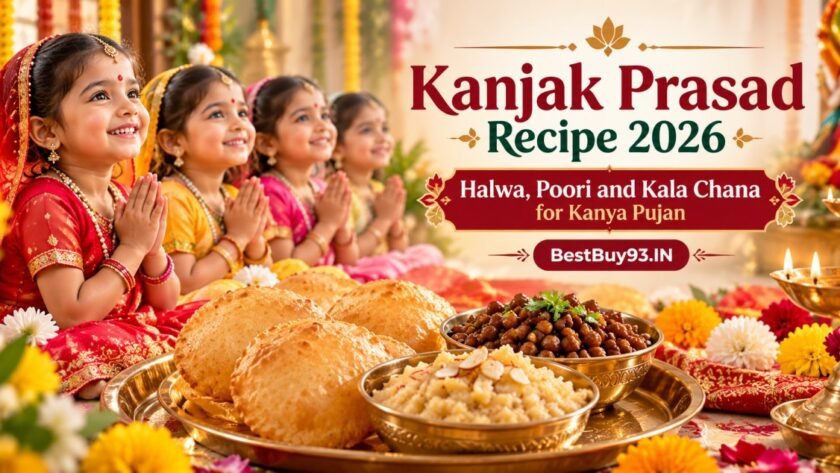

The aroma of freshly roasted sooji, warm pooris puffing up in hot oil and kala chana cooked with cumin and spices brings back the feeling of a traditional Navratri morning. For many Indian families, preparing Halwa, Poori and Kala Chana for Kanya Pujan is a cherished part of Durga Ashtami or Maha Navami celebrations.
Also known as Kanjak Prasad, this traditional meal is prepared as an offering to Maa Durga and served to young girls who are worshipped as manifestations of the Goddess in this ritual. Families may also follow their own customs for the puja, the number of children invited and the accompanying offerings.
If you are preparing Kanjak Prasad at home in 2026, this guide will help you make all three dishes with everyday ingredients. You will learn how to prepare soft, puffed pooris, rich and fragrant sooji halwa, and flavourful dry kala chana, along with a practical cooking schedule for the festive morning.
Quick Recipe Overview
- Preparation time: Approximately 8–12 hours for soaking the kala chana, plus 20–30 minutes of active preparation
- Cooking time: Approximately 60–75 minutes for all three dishes, depending on your equipment and batch size
- Difficulty: Easy to moderate
- Cuisine: North Indian
- Servings: Approximately 4–6 people
- Main dishes: Sooji halwa, wheat pooris and dry kala chana
- Best for: Kanya Pujan, Kanjak Puja, Durga Ashtami and Maha Navami
Timing is approximate and will vary with the number of pooris you fry and the capacity of your pressure cooker.
Why Are Halwa, Poori and Kala Chana Prepared for Kanya Pujan?
During Navratri, many families observe Kanya Pujan on Ashtami or Navami. In this tradition, young girls are honoured as forms of Goddess Durga, and food is offered as part of the ritual.
The combination of sooji halwa, poori and kala chana is a familiar Kanjak Prasad in many North Indian households. The sweet halwa, freshly fried pooris and savoury chickpeas create a simple, satisfying festive meal.
Practices vary between regions and families. Some households also prepare other sattvik dishes, offer fruits or coconut, or include additional rituals according to their traditions.
For 2026, check the panchang followed by your family and your location before finalising the puja date and timing. Festival tithi calculations and local observances can differ.
Buy Groceries – Click Here
Ingredients for Kanjak Prasad
The following quantities are suitable for a small family gathering. If you are inviting several children and serving additional family members, increase the quantities proportionately.
1. Ingredients for Sooji Halwa
| Ingredient | Quantity |
|---|---|
| Sooji (semolina/rava) | 1 cup |
| Ghee | ½ cup |
| Sugar | ¾–1 cup, to taste |
| Water | 2½–3 cups |
| Green cardamom powder | ¼ teaspoon, optional |
| Chopped almonds or cashews | 1–2 tablespoons, optional |
| Raisins | 1 tablespoon, optional |
Tip: Start with ¾ cup of sugar if you prefer moderately sweet halwa. You can adjust the quantity to your family’s preference.
2. Ingredients for Poori
| Ingredient | Quantity |
|---|---|
| Whole wheat flour (atta) | 2 cups |
| Water | Approximately ¾ cup, as needed |
| Salt | A small pinch, optional |
| Oil or ghee for frying | As required |
The amount of water depends on the flour. Add it gradually so the dough remains firm and smooth rather than soft and sticky.
3. Ingredients for Dry Kala Chana
| Ingredient | Quantity |
|---|---|
| Dry kala chana (black chickpeas) | 1 cup |
| Water for soaking and cooking | As required |
| Ghee or oil | 2 tablespoons |
| Cumin seeds | 1 teaspoon |
| Green chillies | 1–2, finely chopped |
| Ginger | 1 teaspoon, finely chopped, optional |
| Coriander powder | 1 teaspoon |
| Turmeric powder | ¼ teaspoon, optional |
| Red chilli powder | ¼ teaspoon, optional |
| Amchur (dry mango powder) | ½ teaspoon, optional |
| Salt | To taste |
| Fresh coriander | 1–2 tablespoons, chopped |
| Water from boiling the chana | A few tablespoons, as needed |
This version is prepared without onion or garlic to suit many traditional sattvik preparations. Follow your household’s customary recipe and ingredient rules.
Recipe 1: Traditional Sooji Halwa for Kanjak Prasad
Sooji halwa is loved for its rich aroma, soft texture and gentle sweetness. The key to a good result is roasting the semolina patiently and adding the hot liquid carefully.
Step 1: Prepare the ingredients
Measure the sooji, ghee, sugar and water before beginning. If using nuts and raisins, chop or measure them in advance.
Keep a heavy-bottomed kadhai or saucepan ready. A sturdy pan helps distribute heat more evenly and reduces the risk of the semolina scorching.
Step 2: Roast the sooji
Heat the ghee over low to medium-low heat. Add the sooji and stir continuously.
Roast for approximately 7–10 minutes, depending on the quantity and pan. The sooji should become fragrant and lightly golden, without turning dark brown or developing a burnt smell.
Do not rush this stage. Even roasting is essential for a pleasant, nutty flavour.
Step 3: Heat the water and sugar
In a separate saucepan, heat the water with the sugar until the sugar dissolves. Bring the mixture to a gentle simmer.
Keep the liquid warm so it can be incorporated more easily into the roasted sooji.
Step 4: Add the liquid carefully
Lower the heat. Slowly pour the hot water mixture into the roasted sooji while stirring continuously.
Be careful: the mixture may bubble and splutter when the liquid meets the hot ghee and semolina. Pour gradually and keep your hands and face away from the rising steam.
Step 5: Cook until thick
Continue stirring over low heat until the sooji absorbs the liquid and the halwa thickens. The grains should become soft, and the mixture should pull together rather than remain watery.
Add cardamom powder if desired.
Step 6: Add optional nuts
If your family uses nuts or raisins, fold them in at this stage. You can lightly roast them in a little ghee beforehand for extra flavour.
Step 7: Serve warm
Transfer the halwa to a clean serving bowl. Serve it warm as part of the Kanjak Prasad thali.
Tips for soft, flavourful halwa
- Roast the sooji slowly and evenly.
- Stir continuously when adding liquid.
- Use warm or hot water to help the mixture combine smoothly.
- Adjust sugar according to taste.
- Avoid adding too much liquid at once.
- If the halwa thickens while waiting, gently reheat it with a small splash of water, stirring until smooth.
Recipe 2: Soft, Puffy Poori for Kanya Pujan
Freshly fried pooris add a traditional touch to the Kanjak Prasad meal. For pooris that puff up well, the dough should be firm, the rolled discs should have an even thickness and the oil should be sufficiently hot.
Step 1: Knead the dough
Place the atta in a mixing bowl. Add a small pinch of salt if desired.
Add water gradually and knead until you have a firm, smooth dough. Poori dough is generally firmer than soft roti dough, so avoid adding too much water.
Cover and rest the dough for approximately 15–20 minutes.
Step 2: Divide into portions
Divide the dough into small, equal-sized balls. Keep them covered while working so the surface does not dry out.
Step 3: Roll the pooris
Lightly grease the rolling surface or use a small amount of flour if necessary.
Roll each ball into a small, evenly thick disc. Avoid making the centre too thick or the edges too thin, as uneven rolling can affect puffing.
Step 4: Heat the oil
Heat oil or ghee in a deep, heavy pan over medium heat.
To check the temperature, drop a tiny piece of dough into the oil. It should rise towards the surface and begin frying steadily. If it stays at the bottom, the oil may be too cool. If it darkens almost immediately, the oil is too hot.
Always handle hot oil carefully.
Step 5: Fry the pooris
Slide one poori gently into the hot oil. Using a slotted spoon, carefully press the surface with a little hot oil to encourage it to puff.
Turn it when needed and fry until lightly golden on both sides. Remove it with a slotted spoon and drain excess oil.
Repeat with the remaining pooris, adjusting the heat between batches if necessary.
Step 6: Keep them ready for serving
Place the pooris in a clean serving container lined with paper towels if desired. Avoid sealing them while they are still releasing a lot of steam, as trapped moisture can soften their texture.
Tips for puffed pooris
- Use firm dough rather than sticky dough.
- Roll the discs evenly.
- Maintain the oil at a suitable frying temperature.
- Fry in manageable batches.
- Keep the dough covered while rolling.
- Serve soon after frying for the best texture.
Recipe 3: Dry Kala Chana for Kanjak Prasad
Dry kala chana is the savoury component of this traditional meal. The chickpeas should be tender but retain their shape, with cumin, green chillies and ground spices providing flavour without making the dish too gravy-heavy.
Step 1: Wash and soak the kala chana
Rinse the dry kala chana thoroughly under running water. Place it in a large bowl and cover with plenty of water.
Soak for 8–12 hours or overnight. The chickpeas will expand as they absorb water, so use a sufficiently large bowl.
Discard the soaking water and rinse the chickpeas before cooking.
Step 2: Pressure-cook the chickpeas
Transfer the soaked chana to a pressure cooker and add fresh water.
Cook until tender according to your pressure cooker’s instructions and the age of the chickpeas. Cooking time can vary considerably, so check the manufacturer’s guidance and allow the pressure to release safely before opening.
The chickpeas should be cooked through and easy to bite, not hard in the centre. If they remain firm, cook them for longer with additional water as needed.
Reserve a little of the cooking liquid before draining.
Step 3: Prepare the tempering
Heat ghee or oil in a kadhai over medium heat. Add the cumin seeds and let them sizzle.
Add the chopped green chillies and optional ginger. Stir briefly until aromatic, taking care not to burn the spices.
Step 4: Add the powdered spices
Reduce the heat and add coriander powder, turmeric and red chilli powder if using.
Stir briefly. If the mixture begins to stick, add a tablespoon of the reserved cooking liquid rather than allowing the spices to burn.
Step 5: Add the cooked kala chana
Add the boiled chickpeas and salt to taste. Mix gently so the chickpeas are coated with the spices.
Cook for approximately 5–8 minutes, stirring occasionally. Add a small splash of cooking liquid if necessary to prevent sticking, but allow the excess moisture to evaporate.
Step 6: Finish with amchur and coriander
If desired, add amchur for a mild tangy flavour. Finish with chopped coriander and mix gently.
The final dish should be moist enough to remain flavourful but not watery. The chickpeas should hold their shape.
Step 7: Serve warm
Transfer the dry kala chana to a clean serving bowl. Offer and serve it according to your family’s Kanya Pujan customs.
Tips for flavourful kala chana
- Soak the chickpeas thoroughly.
- Cook until tender before adding them to the tempering.
- Avoid burning cumin or powdered spices.
- Add cooking liquid a little at a time.
- Adjust chillies to suit the people you are serving.
- Keep the finished dish covered until serving, and follow safe food-storage practices if it will not be eaten immediately.
How to Prepare All Three Dishes Without Rushing
Preparing the entire Kanjak Prasad meal on the same morning can feel demanding, especially when guests are expected. A simple schedule helps you organise the work.
The night before
- Wash and soak the kala chana in plenty of water.
- Measure the sooji, sugar, atta and spices.
- Chop any ingredients that can be safely prepared ahead and refrigerated.
- Set out clean serving bowls and utensils.
On the morning of Kanya Pujan
Step 1: Drain and pressure-cook the kala chana. Check that the chickpeas are fully tender.
Step 2: Prepare the dry kala chana tempering and finish the dish. Keep it covered while you prepare the other dishes.
Step 3: Roast the sooji and make the halwa. Keep it covered and warm; reheat gently if needed.
Step 4: Knead and roll the poori dough. Fry the pooris close to serving time so they are fresh.
Step 5: Arrange the dishes in clean serving bowls and prepare the thalis according to your family’s customs.
What should you cook first?
The kala chana requires the longest advance preparation because it needs soaking. It can be cooked before the halwa and pooris. Pooris are best fried near serving time, while halwa can be made earlier and gently reheated if necessary.
Serving Kanjak Prasad
Traditionally, the three dishes are served together as part of the Kanya Pujan meal. The exact order of worship, offerings and serving differs between households.
For a simple serving arrangement:
- Place a small portion of sooji halwa in a clean bowl or thali.
- Add fresh pooris.
- Serve a portion of dry kala chana.
- Include any additional items your family traditionally offers.
- Serve the food fresh and handle it hygienically.
Some families also prepare potato-based dishes or offer fruit and other prasad. These additions are optional and depend on personal and regional customs.
Common Mistakes to Avoid
1. Roasting the sooji too quickly: High heat can burn the semolina before it develops an even aroma. Use low to medium-low heat and stir continuously.
2. Adding too much water to poori dough: Soft, sticky dough can be difficult to roll and fry. Add water gradually.
3. Frying pooris in oil that is too cool: Pooris may absorb excess oil instead of puffing properly. Check the temperature before frying.
4. Undercooking kala chana: Chickpeas that remain hard in the centre need further cooking. Do not rely only on a fixed number of cooker whistles.
5. Burning the tempering: Cumin and powdered spices can turn bitter when overheated. Lower the heat before adding powdered spices.
6. Preparing every dish at the last minute: Soaking the chickpeas and measuring ingredients the night before can make the morning much easier.
7. Leaving cooked food at room temperature for too long: Keep food covered and serve promptly. Refrigerate perishable leftovers within two hours, or within one hour when the surrounding temperature is above 32°C, and reheat thoroughly before serving again.
In Case You Are Looking For –
- Best Homemade Snacks for Puja Gatherings
- Best Bengali Sweets to Prepare for Festive Guests
- What to Cook When Unexpected Festive Guests Arrive
- What to Serve with Hot Coffee on Cozy Mornings
Frequently Asked Questions
1. What is Kanjak Prasad?
Kanjak Prasad commonly refers to food offered during Kanya Pujan, a ritual observed by many families during Navratri. Halwa, poori and kala chana are a traditional combination in many North Indian households.
2. Can I prepare halwa, poori and kala chana on Ashtami or Navami?
Yes. Families commonly perform Kanya Pujan on Ashtami or Navami according to their regional, family and religious customs. Check the panchang you follow for the relevant date and puja timing.
3. Can I make kala chana the night before?
You can soak the dry chickpeas overnight. You may also cook the chickpeas ahead and refrigerate them promptly in a covered container. Finish the tempering and reheat the dish thoroughly before serving.
4. Why is my sooji halwa lumpy?
Lumps may form when liquid is added too quickly or the mixture is not stirred continuously. Add hot liquid gradually to the roasted sooji while stirring.
5. Why are my pooris not puffing?
Common reasons include dough that is too soft, uneven rolling or oil that is too cool. Knead firm dough, roll evenly and fry at a suitable temperature.
6. How do I know when kala chana is cooked?
The chickpeas should be tender throughout and easy to bite, without a hard centre. Cooking time depends on soaking, chickpea age and pressure-cooker performance.
7. Can I make this prasad without onion and garlic?
Yes. The recipes in this guide use no onion or garlic. Adjust the ingredients according to your household’s customary preparation. Halwa, Poori and Kala Chana
8. How much prasad should I prepare?
It depends on the number of children and family members being served, along with the number of pooris and portion sizes. Use the quantities in this guide as a small-batch starting point and scale up proportionately. Halwa, Poori and Kala Chana
9. Can I use oil instead of ghee?
Oil can be used for frying pooris, and some families use oil for the kala chana tempering. Ghee is commonly used for the halwa’s characteristic flavour, but ingredient choices may vary by household tradition. Halwa, Poori and Kala Chana
10. Can I prepare all three dishes in advance?
The kala chana can be cooked ahead and refrigerated safely. Halwa can be made earlier and gently reheated. Pooris are generally best fried close to serving time. Halwa, Poori and Kala Chana
Final Thoughts
Kanjak Prasad is more than a festive menu for many families: it is a familiar tradition associated with devotion, hospitality and sharing a meal during Navratri.
With carefully roasted sooji, freshly fried pooris and tender kala chana, you can prepare the classic combination at home without making the cooking process unnecessarily complicated. Soak the chickpeas the night before, measure the ingredients in advance and leave the pooris until close to serving time.
Whether your family observes Kanya Pujan on Ashtami or Navami, follow your customary rituals and prepare the food with care.
For more Indian recipes, festive food ideas and practical home guides, explore BestBuy93.IN.