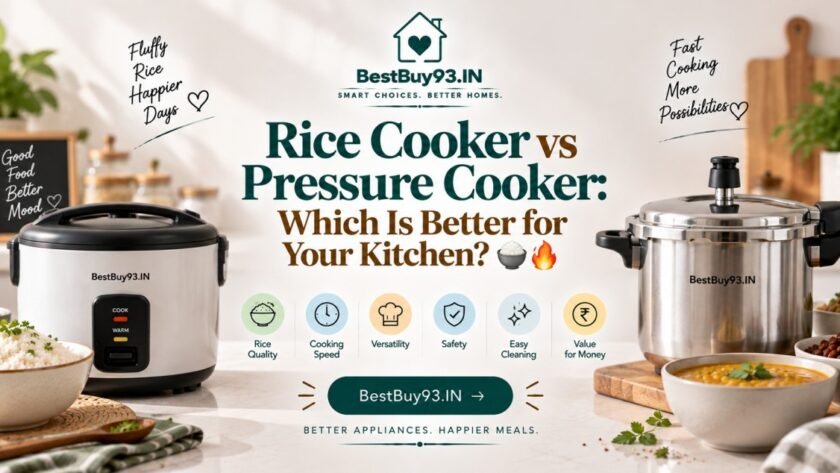

🍚🔥If you cook regularly, you’ve probably wondered:
“Rice cooker lena better hai ya pressure cooker?”
At first, the answer seems obvious.
A rice cooker cooks rice.
A pressure cooker also cooks rice.
So why would you need both? 🤔
The difference becomes much clearer once you look at how they cook, what foods they handle best, cooking speed, convenience, versatility, cleaning, safety and everyday Indian kitchen requirements.
A rice cooker is designed primarily around automated rice and grain cooking, while a pressure cooker uses trapped steam and pressure to cook food faster.
And honestly, neither appliance is universally “better.”
The better choice depends on what you cook most often.
Also Read | Best Rice Cookers for Home in India
Let’s break it down. 👇
🍚 Rice Cooker vs Pressure Cooker: Quick Comparison
| Feature | 🍚 Rice Cooker | 🔥 Pressure Cooker |
|---|---|---|
| Main purpose | Rice & grains | Fast multi-purpose cooking |
| Rice cooking | ⭐⭐⭐⭐⭐ | ⭐⭐⭐⭐ |
| Speed | Moderate | Faster |
| Dal | Limited/model dependent | ⭐⭐⭐⭐⭐ |
| Khichdi | Good on suitable models | ⭐⭐⭐⭐⭐ |
| Rajma/Chole | Not ideal | ⭐⭐⭐⭐⭐ |
| Basmati rice | Excellent for automated cooking | Very good |
| One-pot meals | Good | Excellent |
| Keep-warm | Usually available | Limited on traditional models |
| Hands-off cooking | Excellent | Requires more attention |
| Versatility | Moderate | High |
| Ease of use | Very easy | Requires pressure management |
| Best for | Rice-focused households | Multi-dish Indian cooking |
A rice cooker is generally better optimised for grains and hands-off cooking, while a pressure cooker is considerably more versatile for dal, legumes, curries, khichdi and other pressure-cooked foods.
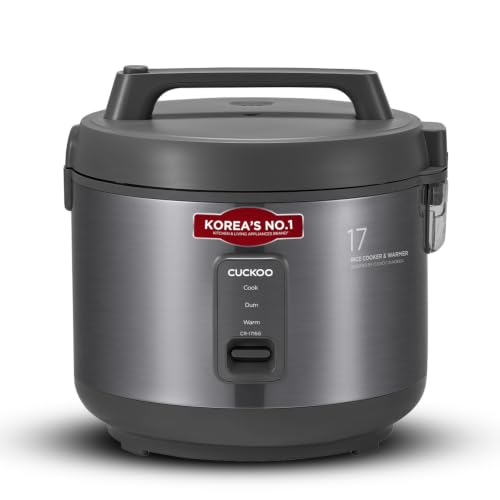
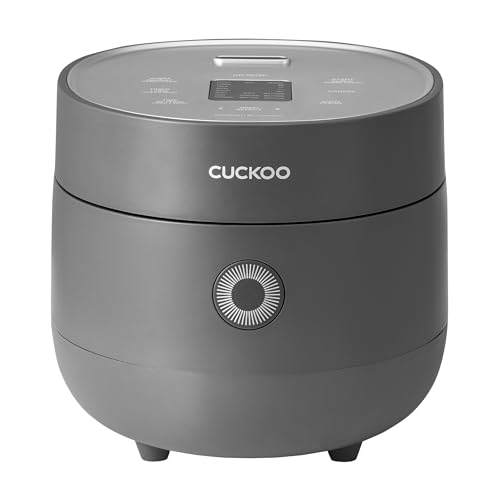
🍚 1. How Does a Rice Cooker Work?
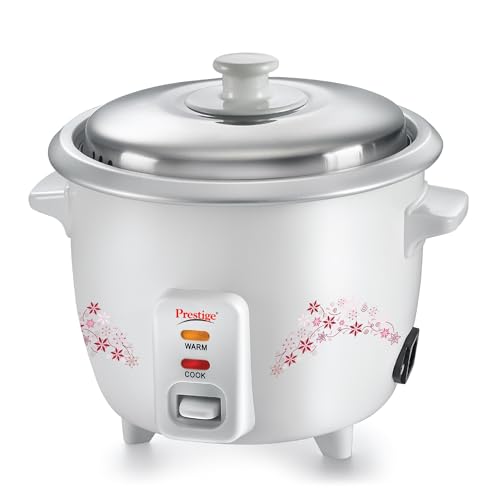
A rice cooker is an electric appliance built around controlled heating.
You generally:
- Add rice.
- Add water.
- Close the lid.
- Start the cooker.
- Let it cook automatically.
Many models automatically switch from cooking to keep-warm mode after the cooking cycle finishes. Some models also offer programs for foods such as congee or other grains.
This is the biggest advantage.
You don’t have to stand there watching the rice.
No:
❌ Flame adjustment
❌ Constant checking
❌ Guessing when to switch off
❌ Watching the water level every few minutes
For someone who cooks rice almost every day, this can be surprisingly convenient.



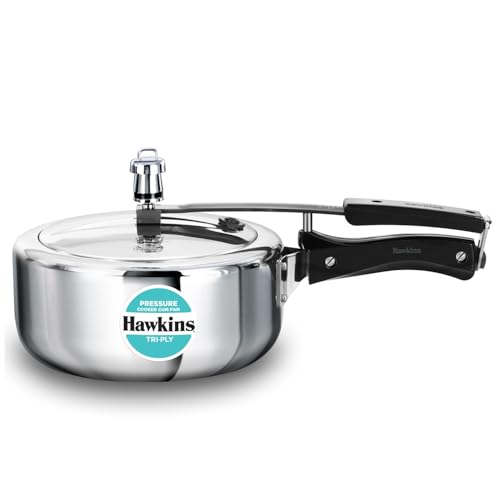
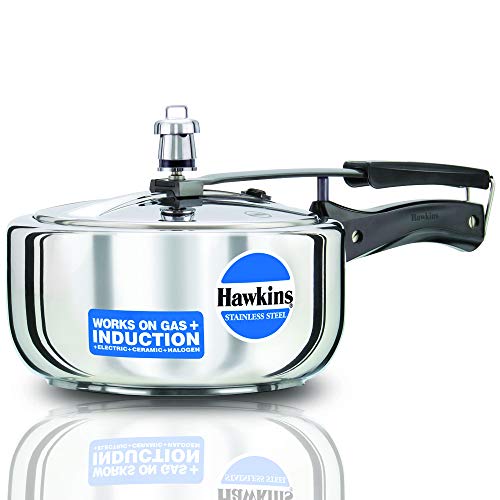
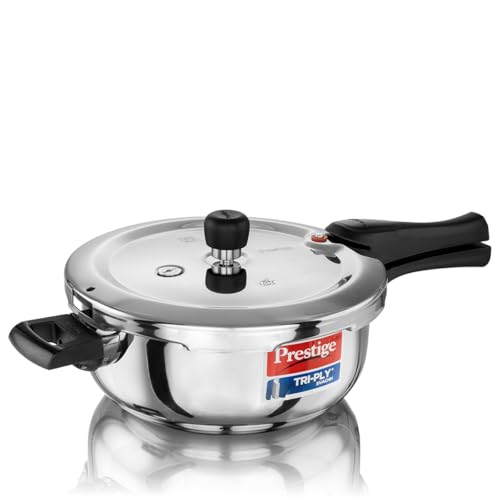
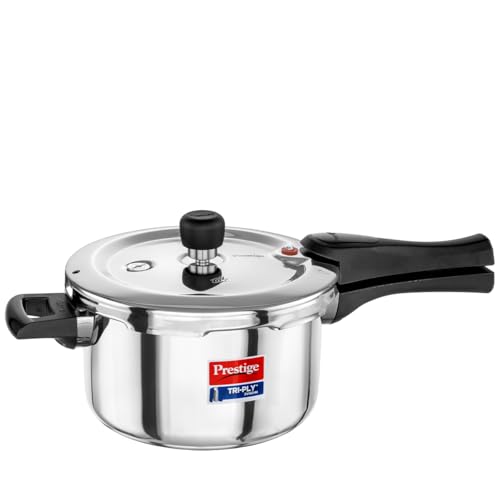
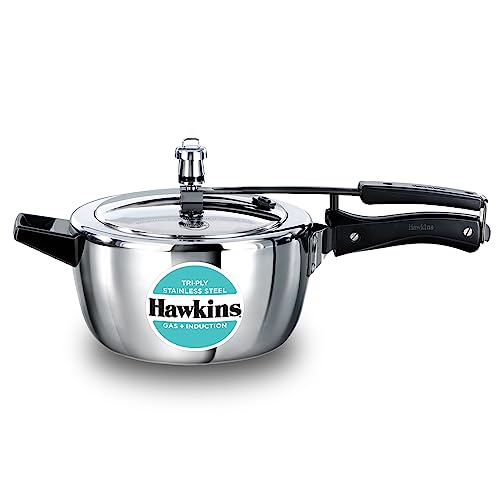
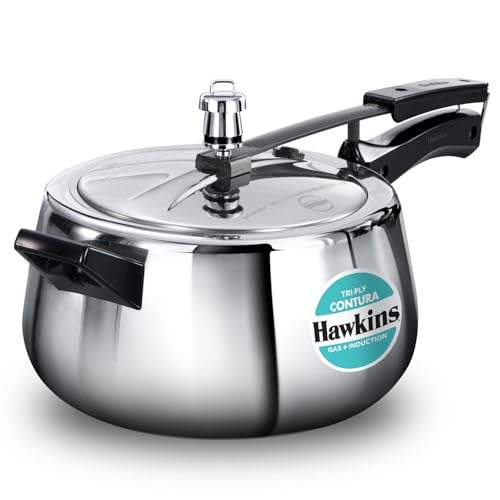
🔥 2. How Does a Pressure Cooker Work?
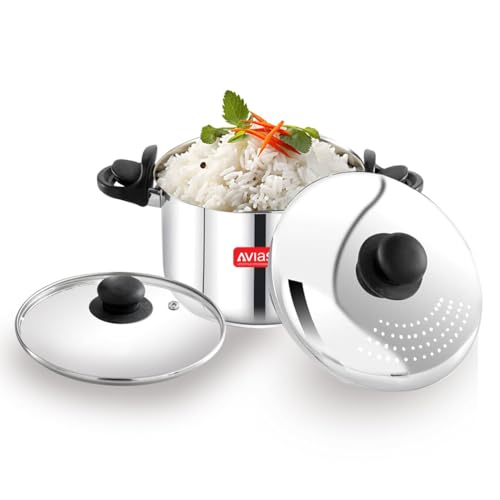
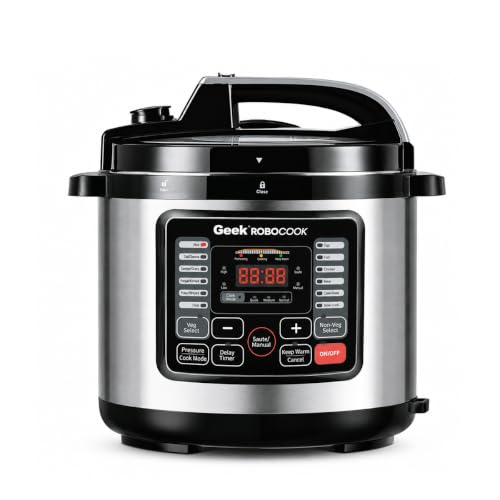
A traditional pressure cooker uses steam pressure inside a sealed cooking vessel.
As water heats, steam builds pressure inside the cooker.
That higher-pressure environment allows food to cook faster than conventional boiling or simmering.
This is why pressure cookers are so common in Indian kitchens.
They can handle foods such as:
🍚 Rice
🥣 Dal
🫘 Rajma
🫘 Chole
🥔 Potatoes
🍲 Khichdi
🥕 Vegetables
🍛 One-pot dishes
And that’s where the pressure cooker starts winning big.



⚡ 3. Which One Cooks Faster?
Winner: 🔥 Pressure Cooker
If speed is your priority, pressure cooking has a major advantage.
The pressure environment allows many foods to cook faster than conventional cooking methods.
This is especially useful for ingredients that take longer to soften, such as:
- Lentils
- Chickpeas
- Kidney beans
- Tough vegetables
- Certain meats
Rice cookers generally take longer because they’re designed around controlled cooking rather than pressure cooking.
So if your question is:
“Which one gets my food cooked faster?”
The answer will often be:
Pressure cooker.
🍚 4. Which Is Better for Plain Rice?
Winner: 🍚 Rice Cooker
This is where a dedicated rice cooker makes a lot of sense.
A rice cooker is specifically designed around rice and grains, so the entire experience is simpler.
You measure:
Rice + water → Start → Cook → Keep Warm
Some advanced rice cookers also use sensors and programmed cooking cycles to improve consistency across different rice types.
For people who eat rice regularly, that automation can be more valuable than the extra versatility of a pressure cooker.
🌾 5. What About Basmati Rice?
If your priority is fluffy, separate basmati rice, a rice cooker can be an excellent choice.
The controlled cooking process can make it easier to reproduce the same result once you’ve figured out the correct water ratio for your particular rice.
But remember:
Rice variety matters.
Basmati, Sona Masoori, brown rice and other varieties can require different water quantities and cooking approaches.
So don’t assume:
“One ratio works for every rice.”
It doesn’t.
🍲 6. Which Is Better for Khichdi?
Winner: 🔥 Pressure Cooker
Khichdi is one of those dishes where the pressure cooker shines.
Rice and dal need to become soft and blend together, and pressure cooking is particularly well suited to this kind of preparation.
Pressure-cooker khichdi recipes commonly rely on pressure cooking followed by natural pressure release to achieve a soft texture.
But can a rice cooker make khichdi?
Yes.
Khichdi can also be prepared in an electric rice cooker or regular pot, depending on the recipe and appliance.
The difference is that a pressure cooker is generally the more natural choice if khichdi, dal and legumes are regular parts of your cooking routine.
🥣 7. What About Dal?
Clear winner: 🔥 Pressure Cooker
This isn’t really a close competition.
Pressure cooking is extremely useful for lentils because it significantly speeds up the cooking process.
Different dals can require different cooking times and pressure settings, but the pressure cooker is designed for exactly this type of job.
If your everyday lunch is:
Dal + Rice + Sabzi
a pressure cooker remains one of the most useful appliances you can own.
🫘 8. Rajma and Chole?
Again:
🔥 Pressure Cooker wins.
Rajma and chole are classic examples of foods where pressure cooking is extremely useful.
They need significant cooking time to become tender.
A basic rice cooker isn’t designed to replace a pressure cooker for these jobs.
If you regularly prepare:
🫘 Rajma
🫘 Chole
🌾 Whole legumes
🥣 Dal
then a pressure cooker should remain high on your kitchen-appliance list.
🍛 9. What About Pulao?
This one is more interesting.
Rice Cooker:
Excellent for convenient rice-based cooking.
Pressure Cooker:
Can also make pulao quickly, but the cooking process is different.
If you prefer:
Separate grains + controlled rice cooking
a rice cooker can be appealing.
If you want:
Quick one-pot cooking
the pressure cooker can be more practical.
The choice depends on the texture and cooking method you prefer.
🍲 10. What About One-Pot Meals?
Winner: 🔥 Pressure Cooker
Pressure cookers are extremely useful for one-pot Indian meals.
You can combine:
🍚 Rice
🥣 Dal
🥕 Vegetables
🌶️ Spices
💧 Water
and cook them together.
This is especially useful when you’re trying to reduce the number of vessels used.
A rice cooker can also handle certain one-pot meals, but its suitability depends heavily on the model and manufacturer’s instructions.
♨️ 11. Which One Is More Hands-Off?
Winner: 🍚 Rice Cooker
This is probably the rice cooker’s biggest advantage.
You can start the rice and move on to something else.
For example:
7:00 PM
Start rice.
7:05 PM
Prepare dal.
7:15 PM
Cut vegetables.
7:25 PM
Rice finishes automatically.
7:30 PM
Dinner is ready.
The rice cooker is basically handling one part of your meal while you handle everything else.
That’s convenience.
⏰ 12. Keep-Warm: Rice Cooker’s Secret Weapon
Many electric rice cookers automatically switch to keep-warm mode after cooking.
Some models are specifically designed to maintain warm rice for extended periods; for example, Philips lists automatic keep-warm functionality on certain models.
This can be extremely useful when:
👨👩👧 Family members eat at different times
🍛 Rice is cooked before the rest of the meal
⏱️ You need a little flexibility around dinner time
Pressure cooker?
A traditional stovetop pressure cooker doesn’t generally provide the same automatic keep-warm function.
You would normally switch off the heat once cooking is complete.
🧑🍳 13. Which One Is Easier for Beginners?
🍚 Rice Cooker
Generally easier.
The basic process is:
Measure → Add water → Start.
That’s it.
A pressure cooker has a little more learning involved:
- Correct water quantity
- Heat management
- Pressure build-up
- Whistle/pressure indicator
- Pressure release
- Safe opening
Modern pressure cookers have safety mechanisms, but they still require proper operation.
🛡️ 14. Which One Is Safer?
This question needs a little nuance.
Rice Cooker
For basic rice cooking, it is relatively straightforward because you’re not intentionally building high pressure inside the cooking vessel.
Pressure Cooker
Modern pressure cookers are designed with safety mechanisms such as pressure regulation and locking systems, but they still require correct use.
You should:
✔ Inspect the gasket/sealing components
✔ Keep the pressure-release system clean
✔ Never force the lid open
✔ Follow the manufacturer’s instructions
✔ Avoid overfilling
✔ Allow pressure to release appropriately
Pressure cooking is very safe when the appliance is used correctly.
🧼 15. Which One Is Easier to Clean?
Winner: 🍚 Rice Cooker
For everyday rice, cleanup can be very simple.
Usually:
- Remove inner pot.
- Wash it.
- Clean the lid/steam components as instructed.
- Wipe the exterior.
- Dry everything.
A pressure cooker may require more attention to:
- Gasket
- Lid
- Pressure valve
- Safety components
- Inner pot
This doesn’t make pressure cookers difficult to clean.
It simply means there are more parts that need attention.
🏠 16. Which One Is Better for a Small Kitchen?
This depends on what you cook.
If you mostly eat rice:
🍚 Rice cooker
If you cook full Indian meals:
🔥 Pressure cooker
A pressure cooker can cover a much wider range of cooking tasks.
But a compact rice cooker may be more convenient if your main requirement is simply automated rice preparation.
🎓 17. What Should Students Buy?
For a student living alone, the decision is surprisingly easy.
Mostly rice + simple meals?
Rice cooker.
Dal + rice + vegetables + one-pot meals?
Pressure cooker.
Very limited cooking?
A compact rice cooker can provide a simple entry point.
But if you’re comfortable cooking on a gas or induction stove, a small pressure cooker can offer considerably more versatility.
👨👩👧👦 18. What Should Families Buy?
For a typical Indian family, the pressure cooker often remains the more versatile appliance.
Why?
Because family cooking usually involves:
🍚 Rice
🥣 Dal
🥔 Potatoes
🫘 Rajma
🫘 Chole
🍲 Khichdi
🍛 Curries
🥕 Vegetables
A rice cooker can’t necessarily replace all of that.
But…
If your family eats rice every day and you frequently need rice ready while preparing other dishes, adding a rice cooker can be a very useful convenience upgrade.
💰 19. Which One Gives Better Value?
This depends on what you expect from it.
Pressure Cooker
Better value for versatility.
One appliance can handle many different Indian dishes.
Rice Cooker
Better value for convenience.
You get automated rice preparation and, depending on the model, keep-warm and additional cooking functions.
So:
Pressure Cooker = More Jobs
Rice Cooker = Less Effort
That’s probably the simplest way to remember it. ❤️
🍚🔥 20. Can You Own Both?
Absolutely.
And for many households, this is actually the best solution.
Use the:
🍚 Rice Cooker for:
- Everyday rice
- Basmati
- Sona Masoori
- Porridge
- Certain steamed foods
- Automated cooking
- Keep-warm
🔥 Pressure Cooker for:
- Dal
- Rajma
- Chole
- Khichdi
- Potatoes
- Curries
- One-pot meals
- Faster cooking
Now you can cook two things simultaneously.
For example:
Rice cooker → Rice
Pressure cooker → Dal
Pan → Sabzi
Dinner gets done without making one appliance do everything.
🆚 21. Rice Cooker vs Pressure Cooker: Who Wins What?
| Category | Winner |
|---|---|
| Plain rice | 🍚 Rice Cooker |
| Fluffy rice | 🍚 Rice Cooker |
| Automation | 🍚 Rice Cooker |
| Keep-warm | 🍚 Rice Cooker |
| Ease of use | 🍚 Rice Cooker |
| Dal | 🔥 Pressure Cooker |
| Rajma | 🔥 Pressure Cooker |
| Chole | 🔥 Pressure Cooker |
| Khichdi | 🔥 Pressure Cooker |
| Speed | 🔥 Pressure Cooker |
| Versatility | 🔥 Pressure Cooker |
| One-pot meals | 🔥 Pressure Cooker |
| Multiple cooking tasks | 🔥 Pressure Cooker |
| Hands-off rice cooking | 🍚 Rice Cooker |
| Overall versatility | 🔥 Pressure Cooker |
🤔 22. So Which One Should You Buy?
Here’s the easiest decision tree.
🍚 Choose a Rice Cooker if:
✔ You eat rice frequently
✔ You want automated cooking
✔ You don’t want to monitor rice
✔ You like consistent rice preparation
✔ Keep-warm is useful to you
✔ You want a simple appliance
✔ You have limited cooking requirements
🔥 Choose a Pressure Cooker if:
✔ You cook dal frequently
✔ You make rajma/chole
✔ You prepare khichdi
✔ You cook Indian one-pot meals
✔ Speed matters
✔ You want one versatile appliance
✔ You cook for a family
❤️ Choose Both if:
✔ Rice is a daily staple
✔ You cook dal and other pressure-cooked foods regularly
✔ You want to cook multiple dishes simultaneously
✔ You have enough kitchen/storage space
This is where the combination becomes really powerful.
🍚🔥 The Simple Rule
Rice every day + convenience → Rice Cooker
Dal + legumes + Indian meals + speed → Pressure Cooker
Rice + full Indian cooking → Both
Simple. 😄
Performance, Cooking & Real-World Comparison 🍚🔥
In Part 1, we looked at the basic differences between a rice cooker and a pressure cooker.
The short version was:
🍚 Rice Cooker = convenience + automated rice cooking
🔥 Pressure Cooker = speed + versatility
But that doesn’t tell the whole story.
Because when you’re actually standing in your kitchen thinking:
“Should I buy a rice cooker or just use my pressure cooker?”
you need to know what happens with real food.
How does the rice texture compare?
Which one cooks faster?
What about dal?
Can you make khichdi?
What about pulao?
Which one uses more electricity?
And can a rice cooker really replace your pressure cooker?
Let’s compare them properly. 👇
🍚 1. Rice Texture: Which One Does Better?
For plain rice, a dedicated rice cooker has a natural advantage.
It’s designed around the cooking cycle of rice, and many electric models automatically transition from cooking to keep-warm after the rice is done.
Once you’ve figured out the correct water quantity for your rice variety and cooker, you can get a fairly repeatable result.
Rice cooker advantages:
✔ Consistent cooking
✔ Less monitoring
✔ Automatic cooking cycle
✔ Keep-warm on many models
✔ Easy repeatability
A pressure cooker can also produce excellent rice.
But the result depends more heavily on:
- Water quantity
- Rice variety
- Heat
- Cooking time
- Pressure release method
So if your priority is:
“I want to make rice with minimum involvement.”
🍚 Rice cooker wins.
💧 2. Water Requirements: Neither Cooker Is Magic
One common misconception is:
“Rice cooker automatically knows how much water to use.”
Not exactly.
The cooker automates the cooking process, but you still need to add an appropriate amount of water.
And that amount depends on:
🌾 Rice variety
🍚 Quantity
💦 Washing
⏱️ Soaking
🥣 Desired texture
⚙️ Cooker design
Basmati, Sona Masoori, brown rice and parboiled rice can all behave differently.
Best approach:
Start with the manufacturer’s recommended ratio or bowl markings.
Then adjust gradually.
If your rice is:
Too soft → reduce water slightly
Too firm → increase water slightly
Don’t change it dramatically after one cooking attempt.
⚡ 3. Cooking Speed: Pressure Cooker Wins
If speed is your number-one priority, the pressure cooker has a clear advantage.
Pressure cooking raises the boiling temperature of water and creates a high-pressure environment, allowing many foods to cook faster.
This is especially useful for:
🫘 Rajma
🫘 Chole
🥣 Dal
🥔 Potatoes
🍲 Khichdi
🥕 Certain vegetables
A rice cooker generally doesn’t rely on pressure cooking.
So its advantage isn’t raw speed.
Its advantage is:
Automation.
⏱️ 4. Faster Doesn’t Always Mean Better
Here’s where things get interesting.
Suppose you only want rice.
A pressure cooker may be capable of cooking it quickly.
But you’re still managing:
- Water
- Heat
- Pressure
- Cooking duration
- Pressure release
A rice cooker may take longer but require considerably less active involvement.
So you have two different types of efficiency:
🔥 Pressure Cooker
Time efficiency
🍚 Rice Cooker
Effort efficiency
And for busy people, effort efficiency can be surprisingly valuable.
🥣 5. Dal: Pressure Cooker Is the Clear Winner
If dal is a daily food in your home, the pressure cooker is extremely useful.
Pressure cooking is particularly suited to softening lentils efficiently.
You can prepare:
🌾 Toor dal
🌾 Moong dal
🌾 Masoor dal
🌾 Chana dal
with appropriate water and cooking settings.
A basic rice cooker isn’t designed to replace this function.
Some multifunction electric cookers may support dal-like preparations, but that doesn’t make a standard rice cooker equivalent to a pressure cooker.
Winner:
🔥 Pressure Cooker
🫘 6. Rajma & Chole: No Real Competition
Rajma and chole need significant cooking to become tender.
This is exactly where pressure cooking shines.
A pressure cooker can dramatically reduce the cooking time compared with conventional boiling.
A basic rice cooker?
Not the appliance I’d choose.
If your regular menu includes:
Rajma + Rice
or
Chole + Rice
the pressure cooker remains extremely useful.
🍲 7. Khichdi: Both Can Work
Khichdi is one of the few dishes where the comparison becomes more balanced.
Pressure Cooker
🔥 Faster
🔥 Excellent for soft texture
🔥 Good for one-pot preparation
Rice Cooker
🍚 Hands-off
🍚 Convenient
🍚 Useful for simple versions
If speed matters:
Pressure cooker.
If convenience matters:
Rice cooker.
Always check the appliance manufacturer’s permitted uses before preparing dishes beyond plain rice.
🍛 8. Pulao: It Depends on Your Cooking Style
Pulao can work in both appliances, but the workflow differs.
Rice Cooker
Great when you want:
Rice + ingredients + controlled cooking
Some models may also have additional cooking modes.
Pressure Cooker
Useful when you want:
Quick one-pot cooking
But pressure can affect texture, so timing and water quantity become particularly important.
If you love perfectly separate grains, you may prefer the control of a rice cooker.
If you want fast one-pot cooking, a pressure cooker can be more practical.
🍗 9. What About Biryani?
This is where you should be careful with expectations.
A rice cooker can be useful for simplified rice-based dishes, but a traditional biryani involves multiple stages:
🍗 Marination
🧅 Browning onions
🌿 Spices
🍚 Rice preparation
🔥 Layering
⏱️ Controlled finishing
A standard rice cooker isn’t designed to replicate every traditional biryani technique.
A pressure cooker also isn’t automatically a traditional biryani solution.
Bottom line:
For elaborate biryani:
Neither appliance completely replaces proper stovetop cooking.
♨️ 10. Keep-Warm: Rice Cooker Takes the Lead
This is one of the biggest practical differences.
Many electric rice cookers automatically switch to keep-warm mode after cooking.
That means you don’t have to coordinate rice cooking perfectly with the rest of dinner.
Example:
7:00 PM
Start rice.
7:10 PM
Start dal.
7:25 PM
Make sabzi.
7:35 PM
Rice is ready and has transitioned to keep-warm.
That’s convenient.
A traditional stovetop pressure cooker doesn’t normally provide this kind of automatic keep-warm function.
⚠️ 11. But Don’t Leave Rice Warm Forever
Keep-warm is a convenience feature.
It isn’t a replacement for proper food storage.
If you’re not going to eat the rice for an extended period, don’t assume that leaving it in warm mode indefinitely is the best option.
For longer storage:
Cool and refrigerate appropriately.
And follow sensible food-safety practices.
⚡ 12. Electricity: Which One Is Cheaper?
This question isn’t as simple as:
“Rice cooker is 700W, so it’s cheaper.”
Actual energy consumption depends on:
- Rated power
- Cooking time
- Heating cycle
- Quantity
- Keep-warm duration
- Appliance efficiency
For example, a 700W rice cooker running at full power for one hour would theoretically consume:
0.7 kWh
But real cooking isn’t necessarily one continuous hour at full rated power.
The same applies to electric pressure cookers.
For a traditional stovetop pressure cooker, you’re primarily consuming the energy source used by your stove rather than electricity.
Therefore:
Don’t choose between them purely on wattage.
🏠 13. Capacity: Which One Should Families Choose?
Capacity requirements depend on household size and portion sizes.
🍚 Rice Cooker
Common practical categories include:
1L-class → singles/couples
1.8L → many small families
2.8–3L+ → larger batches
But always check the manufacturer’s recommended maximum rice quantity.
The same principle applies to pressure cookers.
Important:
A cooker labelled 1.8L doesn’t mean you should fill it completely with dry rice.
Rice expands significantly during cooking.
👤 14. Best for a Single Person
Rice Cooker
Excellent if you mostly eat:
🍚 Rice
🥣 Oats
🍲 Simple one-pot meals
It’s compact and easy to operate.
Pressure Cooker
Better if you regularly prepare:
🥣 Dal
🥔 Potatoes
🫘 Beans
🍲 Curries
Verdict:
Rice-focused → Rice cooker
Full cooking → Pressure cooker
👫 15. Best for Couples
For couples, either can work.
Choose a rice cooker if:
You eat rice frequently and want hands-off cooking.
Choose a pressure cooker if:
You cook a wider variety of Indian dishes.
Own both if:
You cook frequently and want to prepare rice and dal simultaneously.
That combination is genuinely useful.
👨👩👧👦 16. Best for Families
For a family kitchen, the pressure cooker usually provides more overall versatility.
You can use it for:
🍚 Rice
🥣 Dal
🫘 Rajma
🫘 Chole
🍲 Khichdi
🥔 Potatoes
🥕 Vegetables
But a rice cooker becomes an excellent secondary appliance when rice is eaten daily.
Instead of:
Pressure cooker → rice
you can use:
Rice cooker → rice
Pressure cooker → dal
Now both dishes cook at the same time.
🔥 That’s where having both becomes really practical.
🧼 17. Cleaning Comparison
🍚 Rice Cooker
Usually straightforward:
- Remove inner bowl.
- Wash it.
- Clean the lid/steam components according to the instructions.
- Wipe the electrical base.
- Dry everything.
🔥 Pressure Cooker
You may need to clean:
- Inner pot
- Lid
- Gasket
- Pressure valve
- Safety components
So the pressure cooker isn’t necessarily difficult to clean.
It simply has more components that need attention.
🛡️ 18. Safety: Different Appliances, Different Considerations
A rice cooker doesn’t intentionally build cooking pressure in the same way as a pressure cooker.
That makes its operation relatively straightforward for basic rice cooking.
A pressure cooker, meanwhile, operates under pressure.
Therefore, correct handling matters.
With a pressure cooker:
✔ Check the gasket regularly
✔ Keep the pressure-release system clean
✔ Don’t overfill
✔ Don’t force the lid open
✔ Follow the manufacturer’s instructions
✔ Allow pressure to release correctly
With a rice cooker:
✔ Keep the electrical base dry
✔ Don’t block the steam vent
✔ Don’t exceed the recommended capacity
✔ Use the correct inner pot
✔ Unplug when not required
Both appliances can be safe when used correctly.
🔥 19. Which One Handles Indian Cooking Better?
Pressure Cooker:
⭐⭐⭐⭐⭐
Rice Cooker:
⭐⭐⭐
This isn’t because rice cookers are bad.
It’s because Indian cooking involves a huge variety of foods that benefit from pressure cooking.
Think:
Dal + Rice + Rajma + Chole + Khichdi + Potatoes
The pressure cooker can handle much more of that workload.
🍚 20. Which One Is Better for Rice-Focused Kitchens?
Now reverse the question.
If your kitchen revolves around:
🍚 Basmati
🍚 Sona Masoori
🍚 Everyday rice
🍚 Porridge
🍚 Simple steamed foods
then the rice cooker becomes much more attractive.
You get:
✔ Automation
✔ Repeatability
✔ Keep-warm
✔ Less supervision
That’s where it earns its countertop space.
🧠 21. Can a Rice Cooker Replace a Pressure Cooker?
Short answer:
Usually, no.
A standard rice cooker isn’t designed to replace the pressure cooker’s broader cooking capabilities.
It can potentially prepare certain foods that you’d normally make in a pressure cooker, but the cooking method and performance are different.
Think of them like this:
Rice cooker = specialist
Pressure cooker = all-rounder
A specialist can do one job extremely conveniently.
An all-rounder can handle many different jobs.
🆚 22. Real-World Scenario Comparison
| Situation | Better Choice |
|---|---|
| Daily plain rice | 🍚 Rice Cooker |
| Basmati rice | 🍚 Rice Cooker |
| Hands-off rice cooking | 🍚 Rice Cooker |
| Keep-warm | 🍚 Rice Cooker |
| Student’s simple meals | 🍚 Rice Cooker |
| Dal | 🔥 Pressure Cooker |
| Rajma | 🔥 Pressure Cooker |
| Chole | 🔥 Pressure Cooker |
| Fast cooking | 🔥 Pressure Cooker |
| Khichdi | 🔥 Pressure Cooker |
| One-pot Indian meals | 🔥 Pressure Cooker |
| Maximum versatility | 🔥 Pressure Cooker |
| Rice + dal simultaneously | 🏆 Both |
| Large variety of dishes | 🔥 Pressure Cooker |
🏆 23. The Best Combination for an Indian Kitchen
If your budget and kitchen space allow it, owning both can actually be smarter than trying to force one appliance to do everything.
🍚 Rice Cooker
Handles the rice.
🔥 Pressure Cooker
Handles the dal, legumes and other pressure-cooked foods.
🍳 Pan/Kadai
Handles the tadka and vegetables.
Suddenly your cooking workflow becomes much easier.
For example:
Rice cooker → Rice
Pressure cooker → Dal
Kadai → Sabzi
Three cooking tasks.
Three appliances.
Less waiting.
Less juggling.
More importantly, you’re using each appliance for the job it’s actually designed to do.
💰 24. Which One Should You Buy First?
If you can buy only one:
Choose a pressure cooker first if:
✔ You’re setting up a new kitchen
✔ You cook Indian meals regularly
✔ Dal is part of your routine
✔ You eat rajma/chole
✔ You want maximum versatility
✔ Speed matters
Choose a rice cooker first if:
✔ Rice is your primary staple
✔ You live alone
✔ You want minimal cooking effort
✔ You want automatic cooking
✔ Keep-warm is important
✔ You don’t cook many pressure-cooked foods
❤️ 25. Our Practical Verdict
The pressure cooker wins on versatility.
The rice cooker wins on convenience for rice.
Neither completely replaces the other.
And that’s the key point.
If you’re building a basic Indian kitchen from scratch:
🥇 Pressure Cooker
Start here for versatility.
Then add:
🥈 Rice Cooker
when you want more convenience and frequently cook rice.
But if you’re a rice-heavy household and hate monitoring rice every day, reverse that order.
Budget, Maintenance & Final Buying Guide 🍚🔥
We’ve already compared the rice cooker and pressure cooker on cooking performance, speed, convenience, rice quality, dal, khichdi, versatility, safety and everyday Indian kitchen use.
And the basic conclusion is pretty clear:
🍚 Rice Cooker → easier rice cooking
🔥 Pressure Cooker → greater versatility
But before you spend your money, there are still a few important questions.
Which one is more economical?
Which one is easier to maintain?
Which one lasts longer?
What should you buy if you’re on a budget?
And most importantly:
Do you actually need both?
Let’s settle it once and for all. 👇
💰 1. Which Is More Budget-Friendly?
If you’re comparing a basic stovetop pressure cooker with an electric rice cooker, the pressure cooker can often be the more economical single-appliance purchase because it performs many different cooking tasks.
A pressure cooker can handle:
🍚 Rice
🥣 Dal
🫘 Rajma
🫘 Chole
🍲 Khichdi
🥔 Potatoes
🥕 Vegetables
🍛 One-pot meals
A basic rice cooker is more specialised.
Its biggest advantage isn’t the number of dishes it can prepare.
It’s:
Convenience.
So don’t compare them purely by purchase price.
Compare:
Price + number of jobs + convenience + frequency of use.
🟢 2. When a Cheap Rice Cooker Makes Sense
A budget rice cooker can make sense if:
✔ You mostly eat rice
✔ You’re living alone
✔ You want simple cooking
✔ You don’t want to monitor rice
✔ You have limited cooking experience
✔ You want automatic cooking
✔ You don’t need pressure cooking
For these users, spending extra on a premium pressure cooker may not solve the actual problem.
🔥 3. When a Pressure Cooker Gives Better Value
A pressure cooker usually makes more sense if you cook complete Indian meals.
For example:
Lunch
Dal + Rice + Sabzi
Dinner
Khichdi
Weekend
Rajma/Chole
Meal prep
Boiled potatoes + dal + vegetables
One appliance can cover a huge portion of this workload.
That’s why the pressure cooker remains such a useful kitchen staple.
⚡ 4. What About Running Costs?
For a traditional pressure cooker, the energy source is your:
🔥 Gas stove
or
⚡ Induction cooktop.
An electric rice cooker uses electricity.
Its rated wattage might range from several hundred watts depending on the model and capacity.
But don’t assume:
Higher wattage = higher running cost.
Actual energy consumption depends on:
- Cooking time
- Heating cycles
- Quantity
- Rated power
- Keep-warm duration
A rice cooker may use its maximum rated power mainly during heating and then cycle differently as cooking progresses.
The important point:
Look at actual usage rather than just the wattage printed on the box.
♨️ 5. Keep-Warm Can Change the Equation
This is where the rice cooker has a convenience advantage.
Suppose dinner is at 8 PM.
You finish cooking rice at 7:30.
A rice cooker with keep-warm can maintain the rice warm according to its designed operating mode.
With a traditional pressure cooker, you’d normally switch off the heat after cooking.
If you later want hot rice, reheating may be necessary.
So:
Rice cooker = better scheduling flexibility
Pressure cooker = faster cooking versatility
🧼 6. Maintenance: Rice Cooker vs Pressure Cooker
Both appliances need maintenance.
But the type of maintenance is different.
🍚 Rice Cooker
Pay attention to:
- Inner pot
- Non-stick coating
- Lid
- Steam vent
- Heating plate
- Electrical cord
- Exterior
🔥 Pressure Cooker
Pay attention to:
- Gasket
- Pressure valve
- Lid
- Safety valve
- Inner pot
- Handles
- Sealing components
Neither appliance should simply be used and forgotten.
🥣 7. Rice Cooker Inner Pot Care
The inner pot is one of the most important components of an electric rice cooker.
If it has a non-stick coating:
Avoid:
❌ Metal spoons
❌ Steel scrubbers
❌ Sharp objects
❌ Aggressive scraping
Use:
✔ Wooden utensils
✔ Silicone utensils
✔ Plastic rice paddle
And don’t stack heavy metal cookware inside the rice cooker bowl while storing it.
That can scratch the coating unnecessarily.
🔧 8. Pressure Cooker Gasket Maintenance
For a pressure cooker, the gasket is particularly important.
Over time it can become:
- Hard
- Brittle
- Loose
- Cracked
- Less effective at sealing
Inspect it regularly and replace it according to the manufacturer’s guidance or when it shows signs of deterioration.
Also check:
✔ Pressure-release valve
✔ Safety valve
✔ Lid
✔ Sealing area
If something doesn’t look right, don’t continue using the cooker until you’ve addressed the problem.
🧼 9. Which One Is Easier to Clean?
Winner: 🍚 Rice Cooker
For basic rice cooking, cleanup is usually straightforward.
Remove the bowl.
Wash it.
Clean the lid and steam components as instructed.
Wipe the base.
Done.
A pressure cooker has more components that can accumulate food residue, especially around the lid and pressure-release system.
This doesn’t make it difficult.
It simply requires more attention.
🏠 10. Which One Is Better for Small Kitchens?
Here’s the interesting part.
If you only cook rice:
🍚 Rice cooker
A compact model can be convenient and easy to store.
If you cook complete meals:
🔥 Pressure cooker
You get significantly more cooking flexibility from one appliance.
If countertop space is extremely limited:
Think about what appliance you use more frequently, not which one has more features.
🎓 11. Best Choice for Students
Choose a rice cooker if:
🍚 Rice is your main food
🥣 You want simple meals
⏰ You don’t want to monitor cooking
🏠 You have limited kitchen experience
Choose a pressure cooker if:
🥣 You cook dal
🫘 You make beans
🍲 You prepare khichdi
🍛 You cook Indian meals regularly
Budget student?
Don’t overcomplicate it.
A small, reliable appliance that you actually use is better than an expensive multifunction machine sitting in your cupboard.
👨👩👧👦 12. Best Choice for Families
For most families, a pressure cooker remains the more versatile choice.
But a rice cooker can become a fantastic secondary appliance.
Imagine:
Rice Cooker
🍚 Rice
Pressure Cooker
🥣 Dal
Kadai
🥕 Sabzi
Now all three parts of the meal can be prepared around the same time.
That’s when the rice cooker stops being a luxury and becomes a genuine time-saving kitchen appliance.
💡 13. Should You Buy a Rice Cooker If You Already Own a Pressure Cooker?
This is probably the most important question in the entire comparison.
You don’t necessarily need one.
If you’re perfectly happy making rice in your pressure cooker, there’s no reason to buy another appliance just because it’s popular.
But a rice cooker can be worth buying if:
✔ You eat rice daily
✔ You want hands-off cooking
✔ You want automatic keep-warm
✔ You frequently cook rice while preparing other dishes
✔ You want someone in the household to easily prepare rice
✔ You dislike monitoring rice
In other words:
Buy the rice cooker to solve a problem.
Not simply because:
“Everyone has one.” 😂
🛒 14. What to Look for in a Rice Cooker
If you’ve decided that a rice cooker is useful for you, prioritise:
🍚 Capacity
Choose based on household size and actual rice consumption.
🥣 Inner pot
Look for a practical, easy-to-maintain bowl.
♨️ Keep-warm
Useful for families and flexible meal timing.
🛡️ Safety
Look for appropriate thermal and electrical protection.
🧼 Cleaning
Removable and washable components are useful.
🥦 Steaming
Worth considering if you’ll actually use it.
🧠 Cooking programs
Useful for people who cook different grains and dishes.
🛠️ Warranty
Important for long-term ownership.
🔄 Spare parts
Check whether replacement bowls and accessories are available where relevant.
🛒 15. What to Look for in a Pressure Cooker
For a pressure cooker, prioritise:
🛡️ Safety mechanisms
This should be your first consideration.
🥣 Correct capacity
Don’t buy unnecessarily large.
🔧 Quality gasket
Important for sealing.
💨 Pressure-release system
Check that it is well designed and easy to maintain.
🏗️ Construction
Look at the material and overall build.
🔥 Compatibility
Make sure it’s suitable for your cooking surface if you’re using induction.
🛠️ Spare parts
Check gasket, valve and other replacement availability.
📜 Warranty
Useful for long-term ownership.
❌ 16. Common Buying Mistakes
Mistake 1: Buying a rice cooker expecting it to replace everything
A standard rice cooker isn’t a pressure cooker.
Mistake 2: Buying a pressure cooker only for rice
If you hate monitoring rice and eat it every day, a rice cooker may offer considerably more convenience.
Mistake 3: Buying too large
Bigger isn’t always better.
Mistake 4: Ignoring spare parts
A replacement gasket or inner bowl can matter years after purchase.
Mistake 5: Looking only at price
Cheap isn’t automatically better value.
Mistake 6: Ignoring cleaning
The appliance you can clean easily is often the appliance you’ll maintain properly.
Mistake 7: Buying features you don’t need
You don’t need Wi-Fi to cook rice. 😂
Mistake 8: Ignoring manufacturer’s instructions
Especially for pressure cooking and appliances with specific cooking limitations.
🧠 17. The “One Appliance” Decision
If you have space and budget for only one:
Choose a Pressure Cooker if:
🔥 You cook a wide variety of Indian food.
🔥 Dal is a regular part of your meals.
🔥 You make rajma/chole.
🔥 You want fast cooking.
🔥 Versatility matters most.
Choose a Rice Cooker if:
🍚 Rice is the main staple.
🍚 You want automatic cooking.
🍚 You want keep-warm.
🍚 You want minimal supervision.
🍚 Convenience matters more than versatility.
🏆 18. The “Two Appliance” Decision
If you can have both:
This is arguably the most practical combination.
Rice Cooker → Rice
Pressure Cooker → Dal/beans/other pressure-cooked foods
You don’t need to choose between them.
You can simply give each appliance its own job.
Example:
🍚 Rice cooker → Basmati rice
🔥 Pressure cooker → Dal
🍳 Kadai → Sabzi
And your entire meal can come together faster.
📊 19. Final Comparison Matrix
| Category | Rice Cooker | Pressure Cooker |
|---|---|---|
| Rice | ⭐⭐⭐⭐⭐ | ⭐⭐⭐⭐ |
| Automation | ⭐⭐⭐⭐⭐ | ⭐⭐⭐ |
| Keep-warm | ⭐⭐⭐⭐⭐ | ⭐ |
| Speed | ⭐⭐⭐ | ⭐⭐⭐⭐⭐ |
| Dal | ⭐⭐ | ⭐⭐⭐⭐⭐ |
| Rajma/Chole | ⭐ | ⭐⭐⭐⭐⭐ |
| Khichdi | ⭐⭐⭐ | ⭐⭐⭐⭐⭐ |
| Versatility | ⭐⭐⭐ | ⭐⭐⭐⭐⭐ |
| Beginner-friendly | ⭐⭐⭐⭐⭐ | ⭐⭐⭐ |
| Cleaning | ⭐⭐⭐⭐⭐ | ⭐⭐⭐ |
| Convenience | ⭐⭐⭐⭐⭐ | ⭐⭐⭐⭐ |
| One-appliance value | ⭐⭐⭐⭐ | ⭐⭐⭐⭐⭐ |
| Rice-focused household | ⭐⭐⭐⭐⭐ | ⭐⭐⭐⭐ |
| Full Indian cooking | ⭐⭐⭐ | ⭐⭐⭐⭐⭐ |
❓ 20. Frequently Asked Questions
Is a rice cooker better than a pressure cooker for rice?
For convenience and automation, a rice cooker can be better.
A pressure cooker can also make excellent rice, often with faster cooking.
Can a rice cooker replace a pressure cooker?
A standard rice cooker generally cannot fully replace a pressure cooker because it isn’t designed for pressure cooking.
Some multifunction electric cookers combine different functions, but they should be evaluated separately from basic rice cookers.
Can I cook dal in a rice cooker?
Some models may support certain dal or one-pot preparations, but a standard rice cooker shouldn’t automatically be treated as a pressure cooker.
Always follow the manufacturer’s permitted-use instructions.
Which is faster?
For many foods, especially legumes and pressure-cooking recipes:
🔥 Pressure cooker.
Which is easier to use?
For plain rice:
🍚 Rice cooker.
Which is better for students?
It depends.
Rice-heavy diet → Rice cooker
Full Indian cooking → Pressure cooker
Which is better for a family?
For versatility:
🔥 Pressure cooker.
For daily rice convenience:
🍚 Rice cooker.
For maximum convenience:
❤️ Both.
Does a rice cooker save time?
It can save active cooking time because you don’t need to continuously monitor the rice.
The total cooking time isn’t necessarily shorter than pressure cooking.
Does a pressure cooker use electricity?
A traditional pressure cooker used on a gas stove doesn’t use electricity directly.
An electric pressure cooker, however, does.
Should I buy both?
If rice is a daily staple and you regularly cook dal, beans and other pressure-cooked foods, owning both can be very practical.
If your kitchen is small or your cooking needs are limited, one may be enough.
✅ 21. Final Buying Checklist
Before choosing, ask yourself:
Question 1
Do I eat rice almost every day?
Yes → Rice cooker becomes more attractive.
Question 2
Do I regularly cook dal, rajma or chole?
Yes → Pressure cooker is essential.
Question 3
Do I hate monitoring rice?
Yes → Rice cooker.
Question 4
Do I want one appliance to do many jobs?
Yes → Pressure cooker.
Question 5
Do I want rice ready while I cook other dishes?
Yes → Rice cooker + pressure cooker.
Question 6
Is kitchen space limited?
Yes → Prioritise the appliance that solves more of your everyday cooking needs.
Question 7
Am I buying features I won’t use?
If yes → Step back and choose a simpler model.
🏁 Final Verdict: Rice Cooker or Pressure Cooker?
After comparing them from almost every angle, here’s the simplest answer:
🍚 Rice Cooker
Best for:
Rice-focused cooking, automation, convenience and keep-warm.
🔥 Pressure Cooker
Best for:
Indian cooking, speed, dal, legumes, khichdi and versatility.
🏆 Both
Best for:
Households that eat rice frequently and also prepare a wide variety of Indian meals.
❤️ BestBuy93.IN Final Take
If you’re setting up your first kitchen and can only buy one appliance:
Start with a good pressure cooker.
It gives you more cooking flexibility for your money.
But if you already own a pressure cooker and find yourself making rice almost every day:
A rice cooker can be one of the most practical upgrades you make.
It won’t replace your pressure cooker.
It simply takes over one repetitive task and lets you focus on everything else.
And honestly, sometimes that’s exactly what a kitchen appliance should do.
Not cook everything.
Just make your everyday cooking easier. 🍚❤️
📌 The Simple Rule to Remember
🍚 Rice every day + less supervision → Rice Cooker
🔥 Dal + beans + Indian meals + speed → Pressure Cooker
🍚🔥 Rice + complete Indian cooking → Both
That’s it.
No complicated formula.
Just choose the appliance that matches how you actually cook.