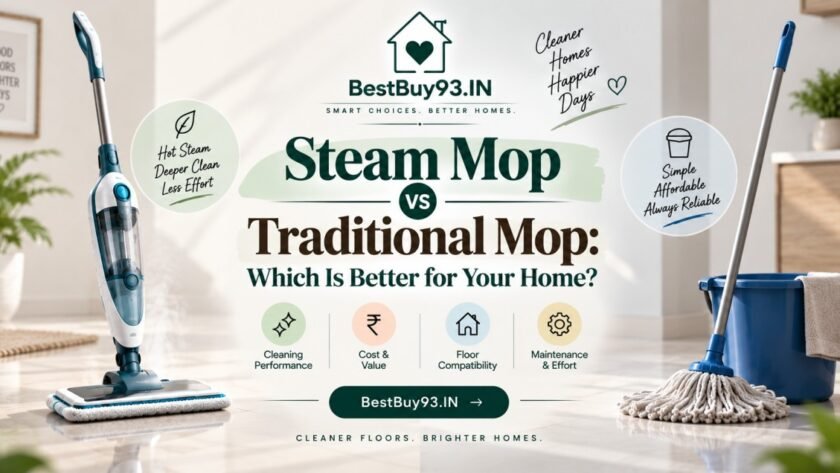

When it comes to cleaning floors, the humble traditional mop has been a household essential for generations.
But now there’s another option: the steam mop.
It promises easier cleaning using hot steam, less dependence on cleaning chemicals, and a more modern approach to floor care. Sounds like an obvious upgrade, right?
Well… not always. 😄
A traditional mop is inexpensive, simple and incredibly versatile, while a steam mop can offer extra convenience and deeper cleaning on the right types of flooring.
So, Steam Mop vs Traditional Mop which one is actually better?
The answer depends on your flooring, cleaning routine, budget, home size and how much effort you want to put into floor cleaning.
In this guide for BestBuy93.IN, we’ll compare both options across the things that actually matter, including cleaning performance, ease of use, water consumption, chemicals, floor compatibility, maintenance and everyday practicality.
Also Read | Best Steam Mops for a Cleaner Home from Amazon India
🆚 Steam Mop vs Traditional Mop: At a Glance
Before getting into the details, here’s the quick comparison:
| Feature | Steam Mop | Traditional Mop |
|---|---|---|
| Cleaning method | Hot steam + microfiber pad | Water + mop head |
| Electricity | Required | Not required |
| Bucket | Usually not required | Usually required |
| Cleaning chemicals | Often optional | Often used |
| Physical effort | Lower during mopping | Higher |
| Setup | Quick once heated | Very simple |
| Loose dust/debris | Not designed for it | Limited |
| Sticky grime | Generally effective on compatible floors | Depends on cleaning solution & scrubbing |
| Maintenance | Requires appliance care | Very easy |
| Purchase cost | Higher | Very low |
| Floor compatibility | Must check manufacturer guidance | Generally more flexible |
| Best for | Deep cleaning of compatible hard floors | Everyday cleaning |
The biggest difference is simple:
A traditional mop uses water and physical cleaning. A steam mop uses heat and steam to loosen dirt before the mop pad wipes it away.
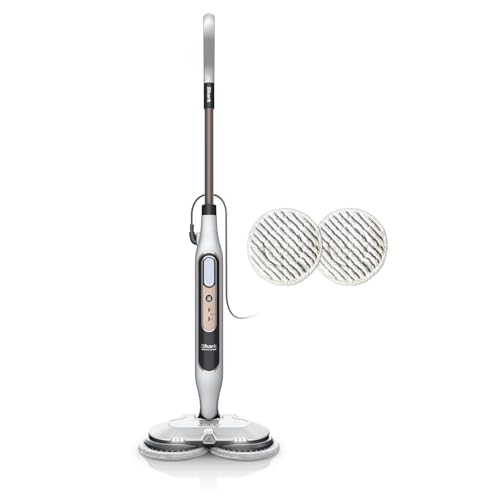
♨️ What Is a Steam Mop?
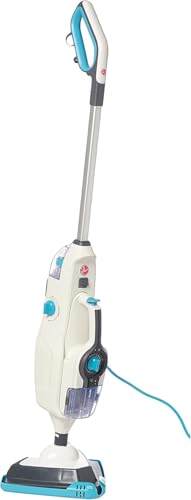
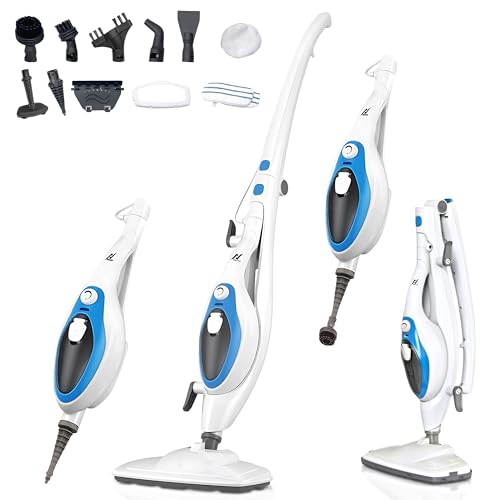
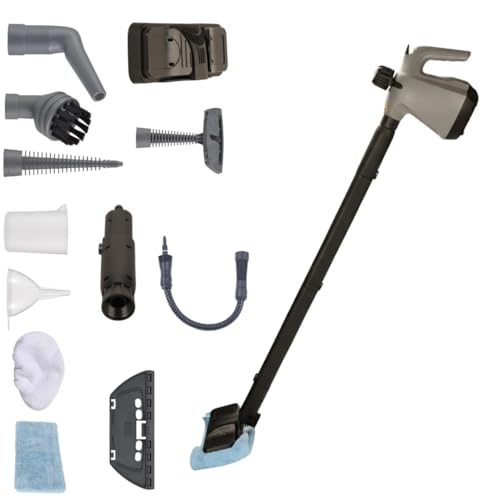
A steam mop is an electric floor-cleaning appliance that heats water to produce steam.
That steam is released through the mop head and works with a microfiber pad to loosen and remove dirt from compatible hard surfaces.
Unlike traditional mopping, you generally don’t need a bucket of water and floor cleaner.
A typical steam-mopping routine looks something like this:
Fill tank → heat water → generate steam → mop floor → wash the pad
That’s it.
Some models also include detachable handheld steam units and additional attachments, allowing them to be used for other compatible cleaning jobs around the home.
Why are steam mops becoming popular?
Because they can make floor cleaning feel less like a chore.
There’s:
- No bucket to carry around
- No repeated wringing
- Less water sitting on the floor
- No need for floor-cleaning chemicals in many situations
- Less bending and manual effort
- Faster setup once the appliance is heated
For people who dislike traditional mopping, that convenience can be a pretty big deal. 😅

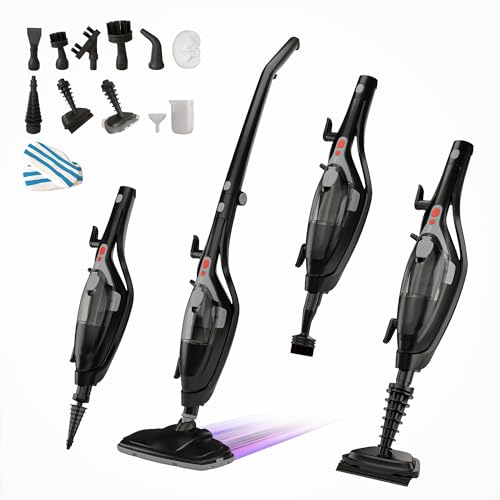
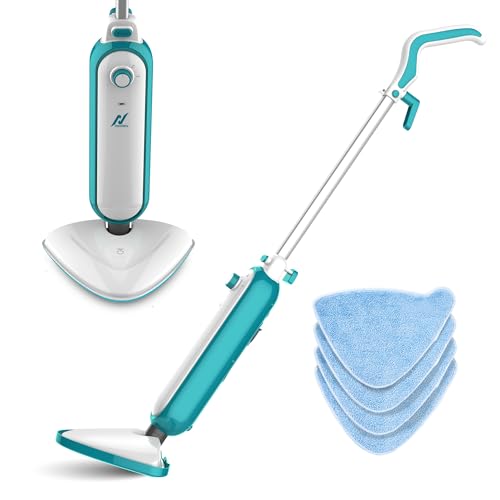
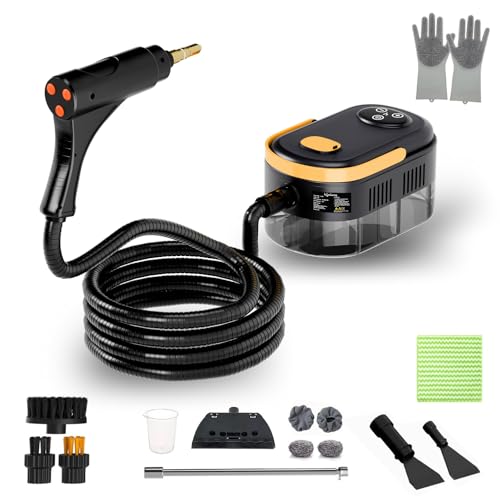
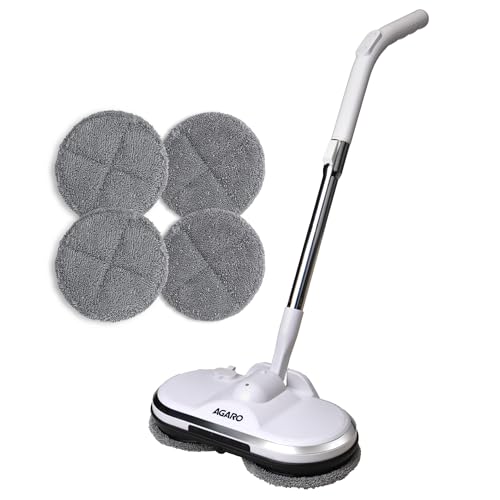


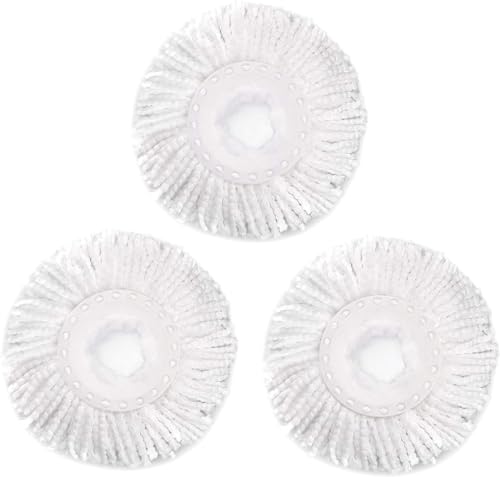
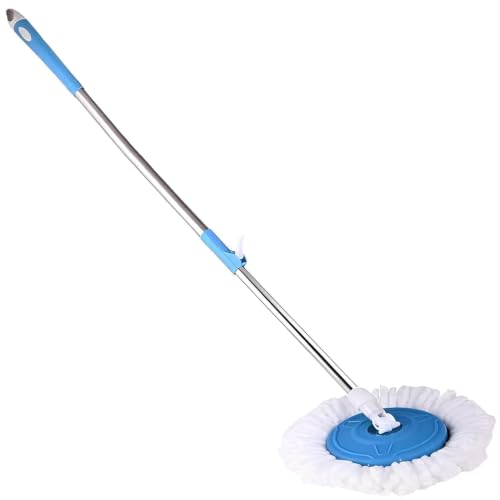
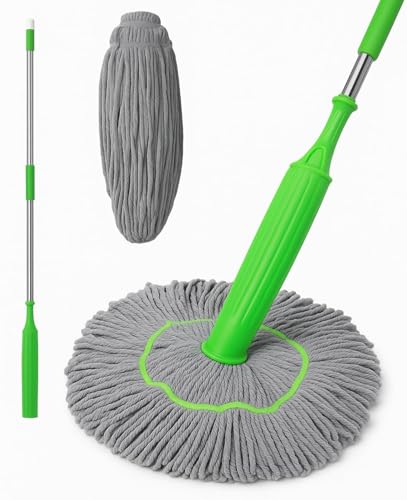
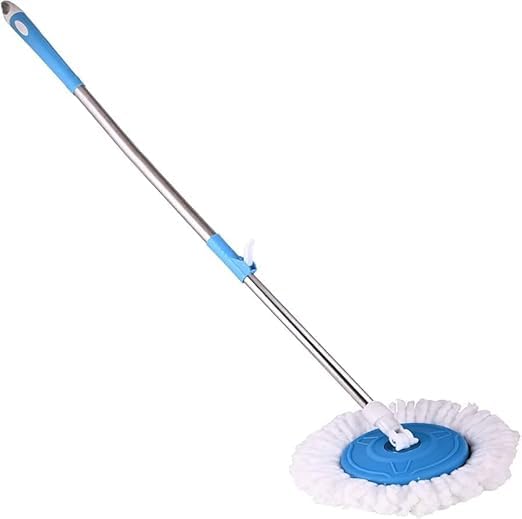
🪣 What Is a Traditional Mop?
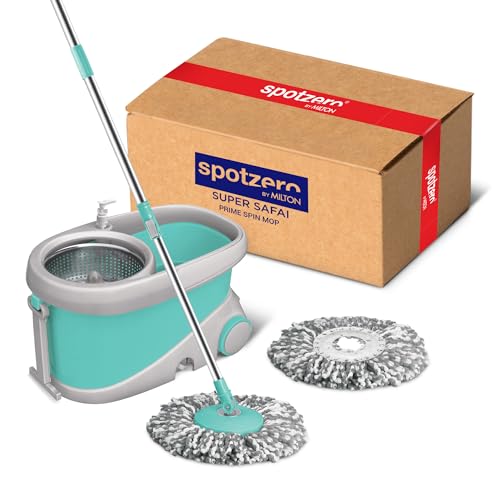
A traditional mop is about as straightforward as household cleaning gets.
You need:
Bucket + water + mop + optional cleaning solution
Depending on the mop design, you may manually:
- Dip the mop
- Wring it
- Scrub the floor
- Rinse it
- Wring it again
- Repeat
It’s not particularly high-tech.
And that’s exactly why it continues to work.
A traditional mop doesn’t need:
- Electricity
- Heating
- Electronics
- Descaling
- Replacement steam components
If you have water and a mop, you’re ready to clean.

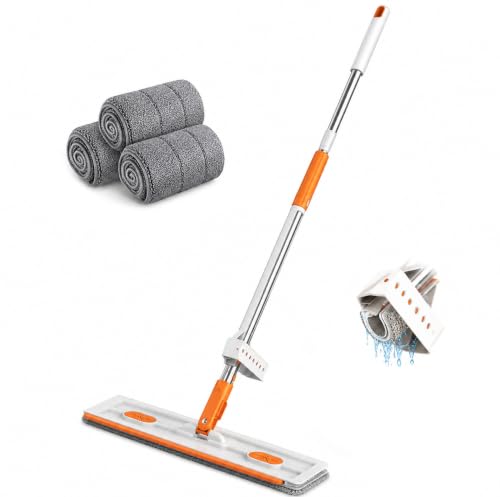
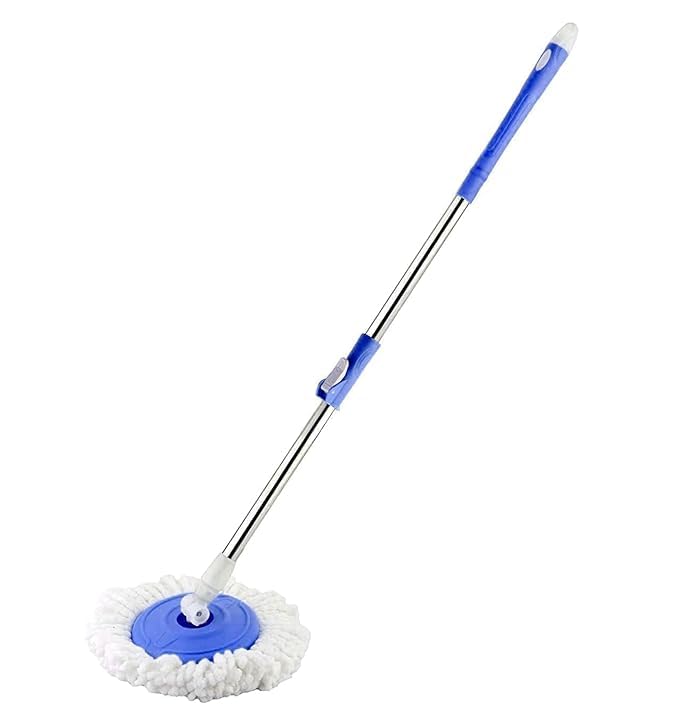
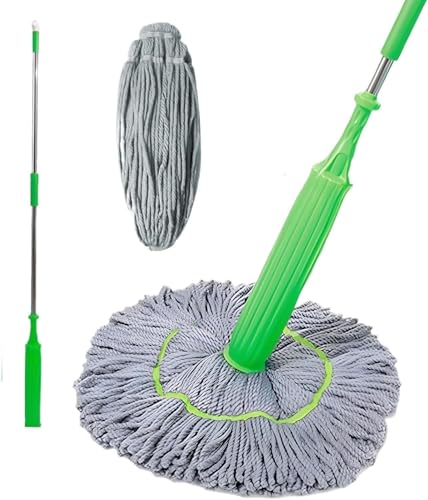
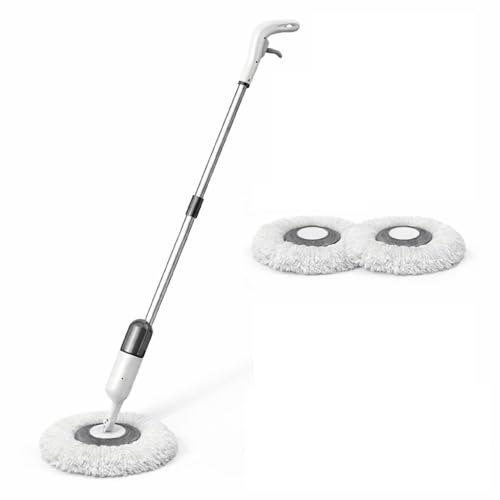
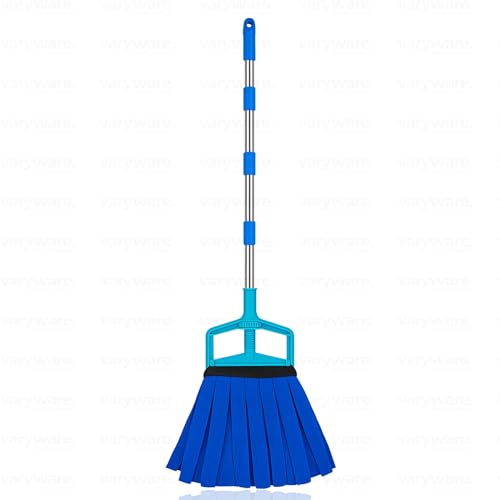
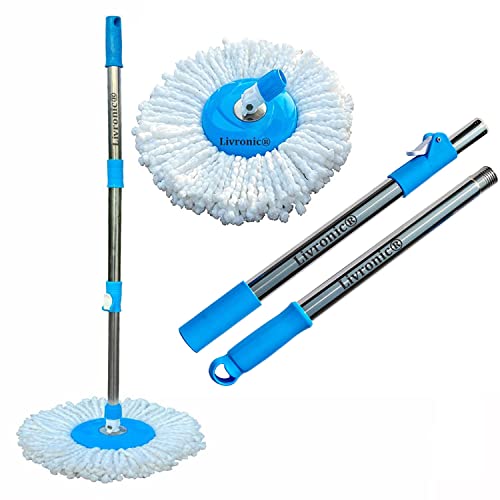
🧹 1. Which Cleans Better?
This is the question everyone wants answered.
Steam Mop
Steam can help loosen sticky dirt, grease and grime on compatible hard floors.
The heat can make certain types of stuck-on residue easier to remove, especially when combined with a good microfiber pad.
For deeper cleaning, a steam mop can therefore have an advantage over simply wiping the floor with water.
Traditional Mop
A traditional mop can also clean extremely well.
The difference is that you may need more:
- Scrubbing
- Cleaning solution
- Water
- Physical effort
- Repeated passes
A good-quality microfiber mop used regularly can keep everyday floors perfectly clean.
Winner?
For stubborn grime: Steam Mop 🏆
For routine everyday cleaning: Traditional Mop 🏆
It’s not really about one being universally superior.
💪 2. Which Requires Less Effort?
Here’s where steam mops have a clear advantage.
With a traditional mop, you’re constantly managing:
- Bucket
- Water
- Wringing
- Rinsing
- Moving dirty water around
- Repeating the process
And if you have a large home, that bucket can start feeling heavier with every room. 😂
With a steam mop, the process is generally:
Fill → heat → mop.
There’s no manual wringing because the microfiber pad is attached directly to the mop.
You still have to push the appliance around, of course, but the overall process can feel considerably easier.
Winner: 🥇 Steam Mop
Especially for people who find traditional mopping physically tiring.
💧 3. Which Uses Less Water?
This is another area where steam mops can be attractive.
Traditional mopping usually involves a bucket containing a relatively large amount of water.
Some of that water becomes dirty during cleaning and eventually goes down the drain.
A steam mop typically uses a relatively small water reservoir and converts the water into steam.
That means you’re not carrying a bucket of water around the house.
However, don’t interpret this as “steam mops use no water.”
They absolutely do.
They simply use water differently.
Winner: Steam Mop 🥇
Particularly if you want to avoid carrying and changing buckets of water during cleaning.
🧴 4. Do You Need Cleaning Chemicals?
This is one of the biggest differences between the two.
A traditional mop is often paired with:
- Floor cleaners
- Disinfectants
- Detergents
- Other cleaning solutions
Whether you use them depends on your cleaning routine and the flooring manufacturer’s recommendations.
Steam mops generally use water to create steam, so chemical floor cleaner isn’t normally required for the steam-generation process.
That can be appealing if you prefer a simpler cleaning routine.
But there’s an important point:
Don’t put floor cleaner into the steam mop tank unless the manufacturer explicitly allows it.
A steam mop’s water tank isn’t automatically designed for detergents or household chemicals.
Always follow the appliance manufacturer’s instructions.
Winner: Steam Mop 🥇
If your priority is reducing dependence on cleaning chemicals.
🏠 5. Which Is Better for Indian Homes?
This one is more complicated.
Indian homes can have a wide range of flooring:
- Vitrified tiles
- Ceramic tiles
- Marble
- Granite
- Natural stone
- Wooden flooring
- Laminate
- Vinyl
- Other engineered surfaces
A traditional mop is generally much easier to adapt to different cleaning situations.
You can change the amount of water, cleaning method and cleaning solution depending on the surface.
A steam mop requires more caution.
Why?
Because heat + moisture isn’t suitable for every floor.
Steam mops are generally intended for specific hard surfaces, often sealed ones, but the exact compatibility depends on the manufacturer and flooring.
So if your home has delicate flooring, don’t assume steam is automatically better.
Winner: Traditional Mop 🥇
If your home contains several different or uncertain flooring materials.
🧽 6. What About Kitchen Floors?
This is where things get interesting.
Indian kitchen floors can deal with:
- Oil splashes
- Masala stains
- Food residue
- Sticky spots
- Grease
- Everyday foot traffic
A steam mop can be useful for loosening sticky grime on compatible flooring.
But there’s one thing you need to remember:
Steam mops are not vacuum cleaners.
If there are:
- Rice grains
- Atta
- Hair
- Dust
- Food crumbs
- Dry debris
you should sweep or vacuum first.
Then steam mop the floor.
Traditional mop?
It can handle kitchen floors too, especially when paired with a suitable floor-cleaning solution.
Winner: Slight edge to Steam Mop 🏆
For sticky residue and deeper cleaning on compatible floors.
🚿 7. What About Bathroom Floors?
Bathrooms are another area where steam cleaning can be useful.
Steam can help loosen surface grime around:
- Tiles
- Tile joints
- Sink areas
- Bathroom corners
- Other compatible hard surfaces
Some steam cleaners also come with smaller brushes or handheld attachments that can make detailed cleaning easier.
A traditional mop, meanwhile, is excellent for simply wiping the bathroom floor after regular cleaning.
Winner:
Deep/detail cleaning: Steam Mop 🥇
Quick everyday floor wipe: Traditional Mop 🥇
🧼 8. Which Is Easier to Set Up?
This is where the traditional mop gets its revenge. 😂
Want to mop with a traditional mop?
Grab the bucket.
Add water.
Start cleaning.
Done.
A steam mop needs:
- Water
- Power socket
- Heating time
- Steam generation
Some modern steam mops heat up very quickly, but they still involve an appliance and electrical connection.
Winner: Traditional Mop 🥇
For absolute simplicity.
🔌 9. What Happens During a Power Cut?
Well… the traditional mop doesn’t care. 😄
No electricity?
No problem.
You can continue cleaning.
A corded steam mop?
Not happening.
This may sound like a small thing, but in a home where power interruptions are common, appliance dependency is worth considering.
Winner: Traditional Mop 🥇
💰 10. Which One Is Cheaper?
There isn’t much competition here.
A traditional mop can cost very little compared with an electric steam-cleaning appliance.
You don’t have to buy:
- Heating components
- Water tanks
- Steam systems
- Electrical controls
- Special accessories
You may eventually need a replacement mop head or microfiber pad, but the overall ownership cost is usually low.
A steam mop costs more upfront and may also require:
- Replacement microfiber pads
- Descaling/maintenance
- Manufacturer-specific accessories
- Possible replacement parts
Winner: Traditional Mop 🥇
If your main priority is keeping the cleaning budget as low as possible.
🔧 11. Which One Is Easier to Maintain?
Traditional mop:
Wash → dry → store.
That’s pretty much it.
Steam mop:
Cool down → clean pad → empty/maintain water system as instructed → descale when required → store.
If your household uses hard water, mineral buildup can also become a consideration for steam appliances.
This doesn’t mean steam mops are difficult to maintain.
It simply means they require more maintenance than a bucket and mop.
Winner: Traditional Mop 🥇
🪵 12. What About Wooden or Laminate Floors?
This is one area where you should not blindly follow a “steam cleans everything” mindset.
Some manufacturers specifically approve their steam cleaners for certain sealed wood or hard-floor applications.
Others may recommend avoiding steam altogether.
The same applies to laminate and engineered flooring.
The rule is simple:
Check the flooring manufacturer’s instructions first.
If steam cleaning isn’t approved, don’t use it just because your neighbour’s steam mop works on their floor.
Replacing damaged flooring will cost considerably more than buying the right cleaning tool. 😅
📊 Steam Mop vs Traditional Mop: Quick Scorecard
| Category | Winner |
|---|---|
| Everyday simplicity | 🪣 Traditional Mop |
| Initial cost | 🪣 Traditional Mop |
| No electricity | 🪣 Traditional Mop |
| Easy maintenance | 🪣 Traditional Mop |
| Deep cleaning of compatible floors | ♨️ Steam Mop |
| Less physical effort | ♨️ Steam Mop |
| Less bucket handling | ♨️ Steam Mop |
| Chemical-free steam cleaning | ♨️ Steam Mop |
| Sticky grime | ♨️ Steam Mop |
| Floor flexibility | 🪣 Traditional Mop |
| Multi-purpose steam cleaning | ♨️ Steam Mop |
And that’s exactly why there isn’t one universal winner.
🏆 Who Should Choose a Steam Mop?
A steam mop could make sense for you if:
✅ You have mostly compatible sealed hard floors
✅ You dislike carrying buckets
✅ You want less physical effort
✅ You frequently deal with sticky grime
✅ You want a chemical-free steam-cleaning option
✅ You regularly do deeper cleaning
✅ You don’t mind appliance maintenance
🪣 Who Should Stick With a Traditional Mop?
A traditional mop may be the better choice if:
✅ You want the cheapest cleaning solution
✅ You have multiple types of flooring
✅ You want something extremely simple
✅ You don’t want another electrical appliance
✅ You clean frequently and don’t need deep steam cleaning
✅ You want maximum flexibility
✅ You don’t want to deal with descaling or appliance maintenance
💡 The Smartest Option Might Be Both
Here’s something people often overlook:
You don’t necessarily have to choose one.
A traditional mop and steam mop can serve different purposes.
For example:
Daily cleaning
Use your regular microfiber mop.
Weekly/deep cleaning
Use your steam mop on compatible flooring.
Quick spills
Use a microfiber cloth or regular mop.
Kitchen/bathroom deep cleaning
Use steam where the surfaces are approved for it.
This approach can actually make more sense than expecting one appliance to handle every cleaning situation.
🧼 1. Everyday Cleaning Performance
For everyday dust and light dirt, both can do the job.
If you’re cleaning a floor that is already maintained regularly, you don’t necessarily need an advanced appliance.
Traditional Mop
A microfiber traditional mop can easily handle:
- Dust
- Light dirt
- Footprints
- Small spills
- Everyday surface grime
You can also change the cleaning solution depending on the floor and the type of dirt.
Steam Mop
A steam mop can handle many of the same everyday jobs on compatible hard floors, but it uses steam rather than a bucket of cleaning water.
The biggest advantage becomes noticeable when you’re dealing with sticky or dried-on residue.
Winner: 🤝 Depends
For ordinary daily dirt, there’s no dramatic difference.
For sticky grime, steam starts pulling ahead.
🔥 2. Sticky Dirt & Dried-On Grime
This is where a steam mop can genuinely earn its place in your cleaning cupboard.
Hot steam can help soften and loosen certain types of stuck-on residue, making it easier for the microfiber pad to wipe away.
Think:
- Dried food spots
- Sticky footprints
- Light grease residue
- Dried spills
- General grime buildup
A traditional mop can clean these too, but you may need to:
Apply cleaner → wait → scrub → mop → rinse → repeat.
With steam, the heat itself helps loosen the residue.
However, don’t expect steam to magically remove every stubborn stain.
Old grease, mineral deposits, paint, hardened adhesive and deeply embedded stains may still require a dedicated cleaning method.
Winner: 🥇 Steam Mop
For suitable hard floors and the right type of grime.
🍳 3. Greasy Kitchen Floors
Kitchen floors deserve their own category especially in Indian homes.
Oil droplets, masala residue and food spills can create a thin sticky layer that ordinary water alone may struggle with.
A steam mop can help loosen this type of surface grime.
But here’s the important part:
Steam doesn’t make grease disappear.
You still need the microfiber pad to pick up the loosened dirt.
If the pad becomes saturated or dirty, cleaning performance will drop.
Best method
Sweep/vacuum → Steam → Wipe with clean pad
For extremely greasy buildup, you may still need an appropriate degreasing product or manual cleaning.
Winner: 🥇 Steam Mop
For regular sticky kitchen-floor maintenance on steam-compatible surfaces.
💧 4. Water Usage: Which Is More Practical?
Traditional mopping can use a surprisingly large amount of water.
You fill a bucket, dip the mop, wring it out, clean a section, rinse the mop and repeat.
The water also gradually becomes dirty.
A steam mop uses a much smaller reservoir because it converts water into steam.
That means:
- Less water to carry
- No large bucket
- Less dirty water sitting around
- Less repeated wringing
However, water efficiency isn’t the same thing as cleaning efficiency.
A steam mop still needs enough water to complete your cleaning session, and larger homes may require a refill.
Winner: 🥇 Steam Mop
Particularly if you dislike carrying buckets around.
🧴 5. Cleaning Chemicals: Steam vs Floor Cleaner
Traditional mopping often involves some type of floor-cleaning solution.
That’s not necessarily bad.
Different cleaning products can be useful for specific cleaning requirements when they’re compatible with your flooring.
Steam mops offer another approach: using heated water/steam without adding a cleaning chemical to the tank.
This can appeal to people who prefer a simpler routine.
But there’s a very important rule:
Never add floor cleaner, disinfectant, perfume or other chemicals to a steam mop’s water tank unless the manufacturer specifically says you can.
The tank and internal steam system are designed around water and may not be compatible with household cleaning chemicals.
Winner: 🥇 Steam Mop
If reducing the use of cleaning chemicals is one of your priorities.
⏱️ 6. Which One Cleans Faster?
This depends heavily on the size of your home and your cleaning routine.
A traditional mop requires more preparation:
Fill bucket → add cleaner if needed → mop → rinse/wring → continue.
A steam mop usually involves:
Fill tank → heat → mop.
Once it’s ready, there is less water handling.
But steam mops aren’t necessarily faster in every situation.
If you’re cleaning a tiny spill in the kitchen, grabbing a traditional mop or cloth can actually be faster than plugging in a steam appliance and waiting for it to heat.
For a full cleaning session:
Steam Mop: Advantage 🥇
For a tiny spot clean:
Traditional Mop: Advantage 🥇
💪 7. Which Is Less Physically Demanding?
This is one of the strongest reasons to consider a steam mop.
Traditional mopping involves repeated:
- Bending
- Wringing
- Lifting the bucket
- Rinsing the mop
- Carrying water
For a large home, that can become tiring.
A steam mop eliminates most of that process.
You still have to push the mop around, and some models can feel heavy, particularly when the tank is full.
But overall, there’s significantly less manual water handling.
Winner: 🥇 Steam Mop
Especially for people who find bucket mopping tiring.
🪣 8. Where Traditional Mops Still Win: Flexibility
This is the traditional mop’s secret weapon.
You can use it almost anywhere.
Need to clean a floor?
Mop.
Need to wipe a slightly dirty wall?
Change the method.
Need to clean something where steam isn’t recommended?
No problem.
You can adjust:
- Water quantity
- Cleaning solution
- Mop pressure
- Mop head
- Cleaning technique
A steam mop is much more dependent on the manufacturer’s approved surfaces and operating instructions.
Winner: 🥇 Traditional Mop
For maximum flexibility.
🪵 9. Floor Safety: A Major Difference
This is where you should slow down before choosing steam.
Traditional mopping gives you much more control over the amount of water and the cleaning method.
Steam cleaning introduces high heat and moisture.
That can be excellent for some sealed hard floors, but inappropriate for others.
Always check before using steam on:
- Wood flooring
- Laminate
- Engineered wood
- Natural stone
- Waxed floors
- Unsealed surfaces
- Damaged flooring
Some manufacturers approve steam cleaning for specific sealed floors, while others recommend avoiding it.
So don’t assume:
“It’s a hard floor → steam is safe.”
That’s not a reliable rule.
Winner: 🥇 Traditional Mop
If you’re unsure about your floor’s steam compatibility.
💨 10. Which Floor Dries Faster?
This is an underrated advantage of steam mops.
Traditional mopping can leave a relatively wet floor, especially if too much water is used or the mop isn’t wrung properly.
That means:
- Longer drying time
- More footprints
- Higher chance of slipping while wet
- Furniture needing to be avoided
Steam mops generally use much less liquid water during the cleaning process.
That can mean less visible wetness on the floor.
But steam still introduces moisture, and drying depends on:
- Steam level
- Floor material
- Room ventilation
- Cleaning technique
- Mop pad condition
Winner: 🥇 Steam Mop
Generally better when you want to minimize excess water.
🦠 11. What About Germs and Hygiene?
This is probably the most misunderstood part of the steam-mop conversation.
You’ll often see steam-cleaning products marketed around germ reduction.
Steam can indeed help reduce certain microorganisms under appropriate conditions.
But there is a difference between:
“Steam can reduce microorganisms under controlled conditions”
and
“This mop kills every germ in your house.”
The second claim is far too broad.
Actual effectiveness depends on factors such as:
- Steam temperature
- Contact time
- Distance from surface
- Surface material
- Cleaning technique
- Amount of contamination
Some manufacturers publish high bacteria or virus reduction figures based on controlled laboratory testing.
Those results shouldn’t be treated as a guarantee for every real-world household situation.
Traditional mop
A traditional mop can also provide effective cleaning, particularly when used with an appropriate cleaning product.
Winner: 🥇 Steam Mop
For people specifically interested in heat-based cleaning but don’t treat steam as a magic sterilization button.
🧽 12. The Mop Pad Makes a Huge Difference
Here’s something that applies specifically to steam mops:
The steam isn’t doing all the cleaning.
The microfiber pad matters.
Steam loosens dirt.
The pad collects it.
If your pad is:
- Saturated
- Extremely dirty
- Worn out
- Poor quality
the results will suffer.
That’s why a good steam mop should ideally have:
✅ Washable pads
✅ Replaceable pads
✅ Easy attachment/removal
✅ Multiple pads available
A traditional microfiber mop has the same basic principle.
The cleaning head is still responsible for physically removing dirt.
Winner: 🤝 Tie
Both methods depend heavily on the quality and condition of the mop head.
🔄 13. What Happens When the Mop Pad Gets Dirty?
This is one of the biggest practical differences.
With a traditional mop, you can rinse the mop head in the bucket and continue.
With a steam mop, you generally don’t want to keep using the same heavily soiled microfiber pad across the entire house.
Imagine cleaning the bathroom first and then taking that same dirty pad into your bedroom.
Yeah… no. 😅
For whole-home cleaning, having multiple washable pads is useful.
A good workflow is:
Room → dirty pad → replace → next room
and then wash the used pads afterward according to the manufacturer’s care instructions.
🔧 14. Maintenance: Simple vs Mechanical
Traditional mop maintenance is almost laughably simple.
Wash the mop head.
Dry it.
Store it.
Done.
A steam mop contains:
- Heating components
- Water tank
- Steam pathways
- Electrical components
- Seals
- Sometimes filters or descaling systems
That means it needs more attention.
Steam mop maintenance may include:
- Washing microfiber pads
- Emptying the water tank when recommended
- Checking the mop head
- Descaling
- Cleaning accessories
- Following manufacturer-specific water instructions
The exact procedure varies between models.
Winner: 🥇 Traditional Mop
There’s simply less that can go wrong.
💧 15. Hard Water Can Change the Equation
This is particularly relevant in many Indian households.
If your water contains a high concentration of minerals, heating it repeatedly can contribute to mineral buildup inside a steam appliance.
That means descaling isn’t something to ignore.
Some manufacturers recommend specific descaling procedures, cartridges or water types.
Others provide different maintenance instructions.
Don’t blindly follow internet hacks.
Especially don’t assume that vinegar is universally safe.
If the manufacturer says to use a particular descaling method, follow that method.
Your steam mop is not the place to conduct a kitchen chemistry experiment. 😂
🧹 16. Steam Mop vs Traditional Mop for Dust
Here’s a category where neither should be mistaken for a vacuum cleaner.
A mop isn’t designed to efficiently collect large amounts of:
- Hair
- Dust
- Food crumbs
- Rice
- Atta
- Pet hair
- Loose debris
If your floor is dusty, sweep or vacuum first.
Then mop.
This applies whether you’re using a steam mop or traditional mop.
Best workflow:
Vacuum/Sweep → Mop
Not:
Steam Mop → discover half a kilo of hair → regret everything. 😂
🏃 17. What About Quick Daily Cleaning?
This is where traditional mops remain surprisingly hard to beat.
If someone spills tea:
Traditional mop?
Grab → wipe → done.
Steam mop?
Grab → plug in → fill if needed → heat → clean → unplug → store.
For small messes, the traditional option can actually be more convenient.
Winner: 🥇 Traditional Mop
For quick spot cleaning.
🏠 18. What About Whole-House Cleaning?
Now the equation changes.
If you’re cleaning several rooms, carrying a bucket around can become tedious.
A steam mop can make the workflow more streamlined.
You don’t need to:
- Carry a bucket
- Refill dirty water repeatedly
- Wring the mop every few minutes
You simply move the steam mop from room to room.
However, cord length and tank capacity become important.
Winner: 🥇 Steam Mop
For longer cleaning sessions on compatible flooring.
👨👩👧👦 19. Which Is Better for Homes With Children or Pets?
There’s no one-size-fits-all answer.
A steam mop can appeal to households that prefer hot-steam cleaning without adding floor-cleaning chemicals.
But remember:
Steam is extremely hot.
That means the appliance itself can create burn risks.
Never allow children to operate it unsupervised, and keep pets away from the hot mop head and steam outlet.
Also remember that “chemical-free” doesn’t automatically mean “risk-free.”
Traditional mop
A traditional mop doesn’t have a hot steam outlet, but cleaning chemicals may introduce their own handling considerations.
Winner: 🤝 Depends
Choose based on your household’s needs, supervision and floor type.
📊 Real-World Comparison
Here’s the more practical scorecard:
| Category | Better Choice |
|---|---|
| Sticky grime | ♨️ Steam Mop |
| Everyday light dirt | 🤝 Both |
| Quick spills | 🪣 Traditional Mop |
| Physical effort | ♨️ Steam Mop |
| Bucket handling | ♨️ Steam Mop |
| Water efficiency | ♨️ Steam Mop |
| Chemical-free cleaning | ♨️ Steam Mop |
| Floor flexibility | 🪣 Traditional Mop |
| Maintenance | 🪣 Traditional Mop |
| Initial cost | 🪣 Traditional Mop |
| Whole-house convenience | ♨️ Steam Mop |
| Power-cut friendly | 🪣 Traditional Mop |
| Deep cleaning of suitable floors | ♨️ Steam Mop |
| Simplicity | 🪣 Traditional Mop |
🧠 The Biggest Myth: “Steam Mop = Better Mop”
Not exactly.
A steam mop is a different cleaning method, not automatically a superior replacement.
Think about it like this:
Traditional Mop
Simple + flexible + affordable
Steam Mop
Convenient + low-water + heat-based cleaning
The right choice depends on what problem you’re trying to solve.
If your current mop works perfectly and you’re happy with it, there’s no reason to replace it just because steam mops are newer.
But if you hate bucket mopping, regularly deal with sticky grime and have steam-compatible flooring, a steam mop can be a worthwhile upgrade.
💰 Steam Mop vs Traditional Mop: What Are You Actually Paying For?
The biggest difference isn’t just the purchase price.
It’s the entire cleaning experience.
Traditional Mop
Your basic expenses are usually:
- Mop
- Bucket
- Replacement mop heads/pads
- Optional floor-cleaning solution
That’s about it.
There’s no motor, heating system or electrical component involved.
Steam Mop
With a steam mop, you’re paying for:
- Heating system
- Water tank
- Steam-generation mechanism
- Mop head
- Microfiber pads
- Electrical controls
- Sometimes handheld accessories
- Sometimes specialised maintenance components
So yes, the initial price is much higher.
But you’re also buying convenience and a different cleaning method.
The important question is whether you’ll actually use those advantages.
🧾 1. Initial Cost vs Long-Term Cost
Let’s look at the bigger picture.
| Cost Factor | Traditional Mop | Steam Mop |
|---|---|---|
| Initial purchase | Very low | Medium to high |
| Electricity | None | Required |
| Water | Higher volume | Lower volume generally |
| Cleaning chemicals | Optional/common | Usually unnecessary for steam function |
| Replacement pads | Low cost | Model-specific |
| Descaling | No | May be required |
| Repairs | Rare/simple | Possible appliance repair |
| Spare parts | Easy to find | Depends on brand |
| Overall ownership | Low | Higher |
A traditional mop wins easily on cost.
But cost isn’t the only measure of value.
If a steam mop saves you significant effort every week for several years, you may consider the additional cost worthwhile.
📆 2. How Often Do You Actually Mop?
This is a surprisingly useful way to decide.
If you mop once a week
You may not benefit enough from a steam mop to justify the extra expense.
A good microfiber mop can easily handle occasional cleaning.
If you mop several times a week
The convenience of a steam mop becomes more valuable.
You’re repeatedly avoiding:
- Carrying buckets
- Wringing mop heads
- Changing dirty water
- Mixing cleaning solutions
- Managing wet floors
If you clean every day
Now a steam mop can make considerably more sense provided your flooring is compatible.
The more frequently you clean, the more valuable convenience becomes.
🏠 3. Small Home vs Large Home
Your home size should also influence your decision.
🏢 Small 1BHK
For a small apartment, a traditional microfiber mop can be perfectly adequate.
You can clean the entire floor relatively quickly.
A compact steam mop can still be useful if you dislike traditional mopping, but it isn’t essential.
Best choice:
Traditional Mop for value
Steam Mop for convenience
🏠 2BHK
This is where a steam mop starts becoming more interesting.
There’s enough floor area for repeated bucket mopping to become annoying, but the home isn’t so large that tank capacity becomes a major issue.
Best choice:
Steam Mop if you clean frequently
🏡 3BHK or Larger
For larger homes, convenience matters much more.
Carrying a bucket from room to room can become tiring.
A steam mop can simplify the process, particularly if it has:
- Good tank capacity
- Long cord
- Comfortable handle
- Easy movement
- Efficient steam output
- Replaceable pads
Best choice:
Steam Mop for convenience
But if your home has several flooring types, a traditional mop may still be more practical.
🌀 4. What About an Electric Spin Mop?
This is an important alternative.
If you’re mainly looking for less physical effort, you don’t necessarily need steam.
An electric spin mop can provide powered scrubbing or spinning without introducing hot steam.
Choose an electric spin mop if:
✅ You want easier mopping
✅ You don’t need steam
✅ Your floors aren’t steam-compatible
✅ You want a cheaper powered option
✅ You mainly clean everyday dirt
Choose a steam mop if:
✅ You specifically want steam cleaning
✅ Your floors are steam-compatible
✅ You deal with sticky grime
✅ You want a low-water cleaning method
✅ You want the option of handheld steam cleaning on suitable surfaces
So if your only goal is:
“I hate manually mopping.”
An electric spin mop may solve your problem just as effectively.
🧹 5. What About a Vacuum Mop?
A vacuum mop is another completely different category.
It combines wet cleaning with some form of vacuum/debris pickup.
That means you may be able to:
Vacuum + mop in one workflow.
Sounds perfect, right?
Sometimes it is.
But these appliances are generally more complicated and can cost considerably more than a traditional mop or basic steam mop.
They also introduce additional maintenance such as:
- Dirty-water tank cleaning
- Brush-roll cleaning
- Filter maintenance
- Battery charging
- Self-cleaning system maintenance on some models
Choose a vacuum mop if:
You want to reduce the number of cleaning steps.
Choose a steam mop if:
Your main priority is steam-based cleaning of compatible hard floors.
🪣 6. What About a Regular Microfiber Mop?
Honestly?
Don’t underestimate it.
A good microfiber mop is one of the best-value cleaning tools you can own.
It’s:
- Cheap
- Lightweight
- Easy to store
- Easy to wash
- Easy to replace
- Electricity-free
- Suitable for many cleaning situations
If you already have one and it does the job well, buying a steam mop isn’t automatically an upgrade.
The steam mop should solve a specific problem.
For example:
“I don’t want to carry a bucket.”
or
“I want an easier way to deep-clean my sealed tile floors.”
That’s a stronger reason to buy one than simply wanting a newer gadget.
💸 7. Does a Steam Mop Save Money on Floor Cleaner?
Potentially, yes.
Steam cleaning generally uses water to produce steam rather than requiring a floor-cleaning chemical in the tank.
That means you may use less floor-cleaning solution.
But don’t calculate savings based on cleaning liquid alone.
The appliance itself costs more.
So even if you save money on cleaning products, it doesn’t necessarily mean the steam mop will become cheaper overall.
Think of it this way:
Traditional mop = lower purchase cost
Steam mop = higher purchase cost + potentially lower chemical dependence
The value comes mainly from convenience and cleaning method, not from expecting huge financial savings.
🔌 8. What About Electricity Costs?
Steam mops use electricity because they heat water.
For most households, electricity consumption is unlikely to be the main deciding factor compared with the purchase price and convenience.
But if you’re extremely cost-conscious, remember:
Traditional mop = zero electricity
Steam mop = electricity every time you use it
It’s another small advantage for the traditional option.
🧽 9. Replacement Pads: The Hidden Expense
This is something you should check before buying a steam mop.
A steam mop relies heavily on its microfiber pads.
Ideally, you want:
- Multiple washable pads
- Easily available replacements
- Reasonable replacement prices
Don’t buy a model only to discover six months later that replacement pads are difficult to find.
This is especially important with lesser-known brands.
Our rule:
If you can’t easily find replacement pads before buying the machine, think twice.
🔧 10. Maintenance Can Decide the Winner
Traditional mop maintenance:
Wash → dry → store.
Steam mop maintenance can involve:
Wash pad → cool appliance → manage water → descale when required → clean accessories → store.
If you live in an area with hard water, descaling becomes even more important.
Always follow the manufacturer’s maintenance instructions.
Don’t assume every steam mop can be treated the same way.
And definitely don’t pour random cleaning chemicals into the water tank.
⚠️ 11. When You Should NOT Buy a Steam Mop
This might be the most useful section for some readers.
You should probably skip a steam mop if:
❌ Your flooring isn’t approved for steam cleaning
❌ You only need occasional basic mopping
❌ You don’t want another electrical appliance
❌ You dislike appliance maintenance
❌ Your budget is extremely limited
❌ You mainly need quick spot cleaning
❌ You already have a mop that you’re perfectly happy with
❌ You’re buying one only because it looks “more advanced”
Sometimes the smartest purchase is not making a purchase.
Yep, we’re saying it. 😂
❤️ 12. When a Steam Mop Is Worth It
A steam mop becomes much easier to justify when:
✅ You have mostly sealed, steam-compatible hard floors
✅ You mop frequently
✅ You hate bucket mopping
✅ You want less physical effort
✅ You regularly deal with sticky floor grime
✅ You prefer a steam-based cleaning method
✅ You want one appliance for floor + certain detail-cleaning tasks
✅ You’re comfortable with basic appliance maintenance
In that situation, the additional cost can make sense.
📊 13. Final Decision Matrix
Still confused?
Use this:
| Your Situation | Best Choice |
|---|---|
| Cheapest possible option | Traditional Mop |
| Simple everyday cleaning | Traditional Mop |
| Quick spill | Traditional Mop |
| Multiple flooring types | Traditional Mop |
| No electricity available | Traditional Mop |
| Frequent deep cleaning | Steam Mop |
| Sticky grime | Steam Mop |
| Less physical effort | Steam Mop |
| Less bucket handling | Steam Mop |
| Steam-compatible tiled home | Steam Mop |
| Powered scrubbing without steam | Electric Spin Mop |
| Vacuum + wet cleaning | Vacuum Mop |
🏆 Our Final Verdict: Steam Mop vs Traditional Mop
After looking at cleaning performance, convenience, cost, maintenance and flexibility, here’s our final answer:
🥇 Traditional Mop Wins for Value
If your priority is low cost, simplicity and flexibility, stick with a traditional microfiber mop.
There’s absolutely nothing outdated about it.
A good mop used regularly can keep your floors looking great without electricity, complicated maintenance or a large upfront investment.
🥇 Steam Mop Wins for Convenience
If your priority is less effort and steam-based deep cleaning on compatible hard floors, a steam mop is the better choice.
It’s particularly useful for people who:
- Clean frequently
- Have lots of sealed tile/hard flooring
- Hate carrying buckets
- Deal with sticky grime
- Want a chemical-free steam-cleaning option
🏆 Best Overall Strategy: Use Both
For many homes, the smartest setup isn’t:
Steam Mop OR Traditional Mop
It’s:
Traditional Mop + Steam Mop
Use the traditional mop for quick everyday cleaning.
Use the steam mop for periodic deeper cleaning on approved surfaces.
This gives you flexibility without forcing one appliance to do everything.
🧠 Steam Mop vs Traditional Mop: The Bottom Line
There is no universal winner.
And that’s actually the answer we want you to take away from this guide.
Choose a Traditional Mop if you want:
💰 Low cost + 🪣 simplicity + 🏠 flexibility
Choose a Steam Mop if you want:
♨️ Steam cleaning + 💪 less effort + 🧼 convenient deep cleaning
Choose an Electric Spin Mop if you want:
🌀 powered mopping without steam
Choose a Vacuum Mop if you want:
🧹 debris pickup + 💧 wet cleaning in one appliance
The best cleaning tool is the one that fits your floor, your routine and your budget.
Not the one with the most features.
Not the one with the biggest number on the box.
And definitely not the one that looks coolest in an Instagram reel. 😂
❓ Frequently Asked Questions
Is a steam mop worth it compared with a traditional mop?
It can be worth it if you clean frequently, have compatible flooring and value convenience. If you’re happy with a regular mop and only clean occasionally, the additional cost may not be justified.
Is a steam mop better than a traditional mop?
For steam-based deep cleaning and reducing manual effort on suitable floors, it can be better. For affordability, simplicity and floor flexibility, a traditional mop is better.
Can I use floor cleaner in a steam mop?
Only if the manufacturer explicitly allows it. Most steam mops are designed to use water in the tank, so don’t add household cleaning chemicals unless the instructions specifically permit them.
Does a steam mop use less water?
Generally, a steam mop uses a relatively small water reservoir rather than a bucket of water. However, actual water consumption depends on the model, steam setting and cleaning routine.
Does a steam mop replace a normal mop?
Not necessarily.
A traditional mop can still be useful for quick spills, everyday cleaning and surfaces where steam isn’t recommended.
Can a steam mop replace a vacuum cleaner?
No.
Steam mops are not designed to replace vacuum cleaners for removing loose dust, hair, crumbs and debris.
Sweep or vacuum before steam mopping.
Can I use a steam mop every day?
That depends on the flooring and the manufacturer’s recommendations.
If the floor is approved for steam cleaning, frequent use may be possible, but you should still follow the manufacturer’s instructions and avoid excessive moisture or prolonged contact.
Are steam mops safe for wooden floors?
Only when the flooring manufacturer specifically allows steam cleaning.
Some sealed wood flooring systems may support steam cleaning, while others can be damaged by heat or moisture.
Always check the flooring manufacturer’s care instructions.
Which is better for Indian homes: steam mop or traditional mop?
For homes with mostly compatible sealed tile or hard flooring and frequent cleaning, a steam mop can be very convenient.
For homes with multiple flooring types, uncertain floor compatibility or a strong focus on affordability, a traditional microfiber mop may be the safer and more practical choice.
📋 Final Buying Checklist
Before buying either option, ask yourself:
☐ What type of flooring do I have?
☐ Is my flooring compatible with steam?
☐ How often do I clean?
☐ Do I hate carrying a bucket?
☐ Do I need deep cleaning or just routine cleaning?
☐ What’s my actual budget?
☐ Will I use a steam mop frequently enough to justify it?
☐ Are replacement pads easily available?
☐ Is maintenance manageable?
☐ Does the brand offer service support?
☐ Would an electric spin mop solve my problem more cheaply?
☐ Would a vacuum mop be more useful for my cleaning routine?
If you can answer these questions honestly, your decision becomes much easier.
🔬 How We Evaluated These Cleaning Methods
For this three-part Steam Mop vs Traditional Mop guide on BestBuy93.IN, we compared both cleaning methods based on practical household considerations including cleaning performance, physical effort, water usage, chemical dependence, floor compatibility, drying time, maintenance, purchase cost, replacement requirements and long-term convenience.
We also considered how different cleaning methods fit small apartments, larger homes, kitchens, bathrooms and different cleaning frequencies.
Because flooring manufacturers and appliance manufacturers can have different care requirements, readers should always check the relevant product and flooring instructions before using steam.
🏠 Final Word from BestBuy93.IN
The traditional mop has survived for so long for a very good reason:
It works. 🪣❤️
But that doesn’t mean steam mops don’t have a place in modern homes.
If you’re tired of buckets, repeated wringing and scrubbing sticky floors, a steam mop can make the cleaning routine much easier.
If you want something cheap, flexible and completely straightforward, your traditional microfiber mop is still hard to beat.
So before spending your money, ask yourself one simple question:
Do I need a better mop or do I just need an easier way to clean?
Once you know that, the right choice becomes pretty obvious.
Clean smarter. Choose what actually works for your home. 🧼✨