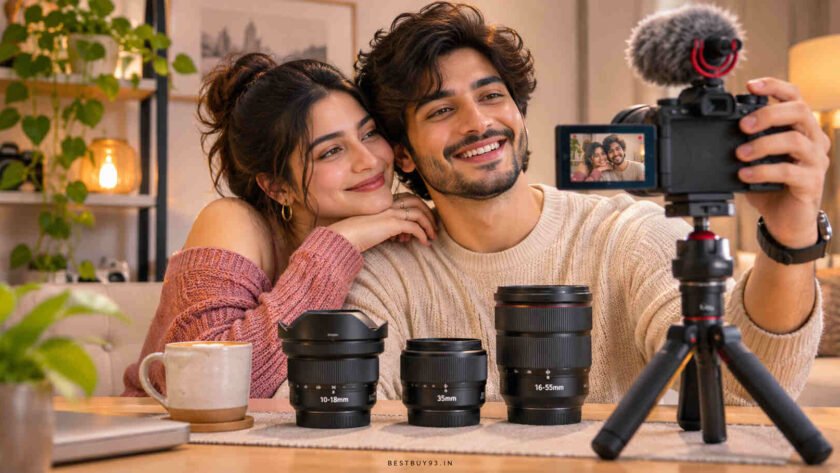

A camera body gets most of the attention when people build a vlogging setup.
But the lens?
That is the part quietly deciding whether your face actually fits in the frame. 😭🎥
You can buy an excellent mirrorless camera, switch on 4K, enable autofocus and hold it at arm’s length and still end up with footage showing approximately 70% forehead and one mysterious corner of the room because your lens simply is not wide enough.
For vlogging, the best lens is usually not the sharpest lens on a spec sheet.
It needs to balance:
- A wide field of view
- Fast and quiet autofocus
- Reasonable weight
- Good close-focusing ability
- Stabilisation where possible
- Low focus breathing
- Enough aperture for indoor and low-light filming
- Smooth zoom operation
- Compatibility with your exact camera mount
And this is where things get confusing.
A 16mm lens on a full-frame camera is extremely wide.
A 16mm lens on an APS-C camera looks much tighter.
A lens may have optical stabilisation while another relies entirely on the camera body.
And the lens everybody recommends online may not even fit your camera.
So for this guide, we compared current vlogging-friendly lenses from Sony, Sigma, Canon, Nikon and Tamron, looking specifically at real creator use rather than general photography performance.
Whether you shoot with a Sony ZV-E10 II, Sony a6700, Canon EOS R50 V, EOS R50, Nikon Z30, Nikon Z50 II, Fujifilm X-series camera or a full-frame Sony, these are some of the best camera lenses for vlogging in 2026.
Best Camera Lenses for Vlogging: Quick Comparison
| Lens | Best For | Format | Focal Length | Aperture | Weight |
|---|---|---|---|---|---|
| Sony E PZ 10-20mm F4 G | Best Overall Sony APS-C | APS-C | 10-20mm | F4 | 178g |
| Sigma 10-18mm F2.8 DC DN | Best Low-Light APS-C Zoom | APS-C | 10-18mm | F2.8 | 250-270g depending on mount |
| Canon RF-S 14-30mm IS STM PZ | Best Canon Video Lens | APS-C | 14-30mm | F4-6.3 | 181g |
| Canon RF-S 10-18mm IS STM | Best Canon Ultra-Wide Value | APS-C | 10-18mm | F4.5-6.3 | 150g |
| Nikon Z DX 12-28mm PZ VR | Best Nikon Vlogging Lens | APS-C | 12-28mm | F3.5-5.6 | 205g |
| Sony E 11mm F1.8 | Best Sony Low-Light Prime | APS-C | 11mm | F1.8 | 181g |
| Tamron 11-20mm F2.8 | Best Fast Wide Zoom Alternative | APS-C | 11-20mm | F2.8 | 335-340g |
| Sony FE PZ 16-35mm F4 G | Best Premium Full-Frame Pick | Full frame | 16-35mm | F4 | 353g |
1. Sony E PZ 10-20mm F4 G
Best Overall Lens for Sony APS-C Vlogging
If you use a Sony ZV-E10, ZV-E10 II, a6400, a6600 or a6700, the Sony E PZ 10-20mm F4 G is one of the most purpose-built vlogging lenses you can buy.
The focal range is equivalent to roughly 15-30mm on full frame, which is excellent for self-recording.
At 10mm, the field of view is wide enough for:
- Walking vlogs
- Selfie videos
- Travel content
- Small rooms
- Two-person framing
Zoom toward 20mm and you get a more natural perspective for talking-head shots and B-roll.
Sony keeps the lens extremely light at just 178g, and the internal power-zoom system means the lens does not change length while zooming. That helps keep balance stable on a gimbal or handheld grip.
Why Power Zoom Matters
Normal zoom lenses require you to physically rotate the zoom ring.
That can look jerky in video.
A power-zoom lens can produce smoother, repeatable zoom movements.
You can create that slow cinematic push-in without attempting microscopic wrist movements like you are defusing a bomb. 😂
Sony also uses quiet linear motors for autofocus, which is valuable when a microphone is mounted directly on the camera.
The Main Limitation
There is no optical stabilisation inside the lens.
Sony lists stabilisation as body-dependent.
That matters more on cameras without IBIS.
You can still use electronic stabilisation or a gimbal, but expect some crop when electronic stabilisation is enabled.
Reasons to Buy
| What We Like | What We Don’t Like |
|---|---|
| Excellent 15-30mm-equivalent range | No optical stabilisation |
| Extremely light at 178g | F4 is not ideal for very dark interiors |
| Power zoom | Premium price |
| Quiet autofocus | Sony E-mount only |
| Internal zoom | Limited background blur |
| Great for gimbals | APS-C only |
Best For
Sony APS-C creators who want one versatile lens for walking vlogs, travel, YouTube and handheld video.
There is an issue displaying Amazon products. Please contact the administrator to check that.2. Sigma 10-18mm F2.8 DC DN Contemporary
Best Vlogging Zoom for Low Light
Want the same ultra-wide flexibility but better low-light capability?
The Sigma 10-18mm F2.8 DC DN Contemporary is the one I would look at.
Sigma offers this lens for:
and the lens keeps a constant F2.8 maximum aperture throughout the zoom range.
That is a significant advantage indoors.
Compared with an F4 lens, F2.8 lets in roughly twice as much light.
That can mean:
lower ISO, less noise and cleaner-looking skin tones in dim rooms.
Excellent Vlogging Range
On Sony and Fujifilm APS-C cameras, you are roughly looking at a 15-27mm full-frame-equivalent range.
That gives you:
10mm for self-vlogging.
18mm for more natural-looking framing.
Sigma also keeps the lens impressively compact.
The Sony E version weighs about 255g, while other mount versions sit around 250-270g.
Close-Focus Performance
The lens can focus as close as roughly 11.6 cm at the wide end, with a maximum reproduction ratio of 1:4.
That is useful for vloggers who frequently switch between:
face → product → face.
For example:
You are reviewing a microphone.
Show yourself.
Bring microphone toward camera.
Focus grabs product.
Back to face.
That flexibility is genuinely useful.
Reasons to Buy
| What We Like | What We Don’t Like |
|---|---|
| Constant F2.8 | No optical stabilisation |
| Very wide | Costs more than kit lenses |
| Compact | No power zoom |
| Multiple mounts available | Slightly heavier than Sony 10-20 |
| Excellent close focusing | APS-C only |
| Strong low-light performance | Requires camera/body stabilisation for best walking footage |
Best For
Indoor creators, travel vloggers and anyone who values F2.8 more than power zoom.

- Ideal for landscapes, travel, video and online content creation
- Large-aperture, ultra-wide-angle zoom with expressive imaging capabilities
- Create expressive images on the go with the world's smallest and lightest ultra-wide-angle zoom lens for APS-C cameras*
3. Canon RF-S 14-30mm F4-6.3 IS STM PZ
Best Lens for Canon EOS R50 V
Canon clearly designed the RF-S 14-30mm around modern video creators.
It is particularly well matched with the EOS R50 V.
The lens gives an approximately 22-48mm full-frame-equivalent range, so it starts wide enough for many selfie-style videos and zooms toward a more conventional talking-head or detail perspective.
But its standout feature is:
Power Zoom.
This is Canon’s first RF lens with a built-in power-zoom mechanism.
It offers 15 selectable zoom-speed levels, and on the R50 V the camera’s own zoom lever can directly control the lens.
That is an extremely creator-focused combination.
Stabilisation
Canon lists up to 5 stops of optical stabilisation, increasing to as much as 7.5 stops with compatible coordinated stabilisation systems.
That makes it useful for:
walking videos, handheld B-roll and filming without constantly reaching for a tripod.
Non-Extending Design
The lens weighs only 181g, and its length does not change when zooming.
For gimbals, this is fantastic because the centre of gravity remains more consistent.
One Concern: 14mm Is Not Super-Wide on APS-C
The equivalent starting point is around 22mm.
That is wide.
But if you are holding the camera very close to your face, the Canon 10-18mm below gives you noticeably more room.
So:
R50 V video workflow → 14-30mm PZ
Maximum selfie width → 10-18mm
Reasons to Buy
| What We Like | What We Don’t Like |
|---|---|
| Built-in power zoom | 14mm may feel tight for very close selfies |
| Excellent with EOS R50 V | Variable aperture |
| Optical stabilisation | F6.3 at tele end |
| Quiet STM autofocus | APS-C focused |
| Non-extending design | Not a low-light specialist |
| 181g | More specialised than 10-18mm |
Best For
EOS R50 V users and Canon creators who value smooth zooming and video-oriented controls.
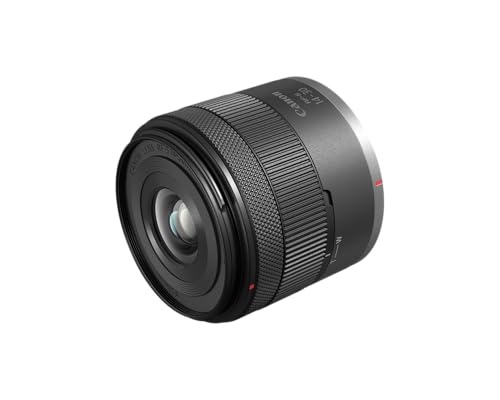
- Our latest RF-S lens was designed for creators and video.
- An ideal companion lens to the EOS R50 V in both features and style, and fully compatible with any RF mount body.
- Power zoom functionality lets you zoom smoothly at variable speeds.
4. Canon RF-S 10-18mm F4.5-6.3 IS STM
Best Canon Lens for Wide Self-Vlogging
If your priority is seeing more of the room and less of your nostrils, get the RF-S 10-18mm. 😂
The lens delivers approximately a 16-29mm full-frame-equivalent field of view, making it significantly wider than Canon’s 14-30mm at the wide end.
Canon explicitly positions it for self-recording and says the 10mm view can capture substantially more area than its standard RF-S 18-45mm kit lens.
Extremely Light
The lens weighs only 150g.
That makes a huge difference when you are holding:
camera + lens + microphone + mini tripod
at arm’s length for ten minutes.
Your shoulder will thank you.
Eventually.
Optical Stabilisation
Canon provides approximately 4 stops of optical image stabilisation, with up to 6 stops of coordinated stabilisation on compatible bodies.
Canon also supports Movie Digital IS and focus-breathing correction with compatible cameras.
Those are exactly the kinds of features that matter more for vlogging than laboratory sharpness charts.
Main Weakness
The F4.5-6.3 aperture is slow.
In daylight?
No issue.
Inside a dim café?
Your ISO may climb rapidly.
Pair it with good lighting for indoor studio use.
Reasons to Buy
| What We Like | What We Don’t Like |
|---|---|
| 16mm-equivalent wide view | Slow aperture |
| Only 150g | Limited low-light ability |
| Optical IS | No power zoom |
| Quiet STM AF | Mostly useful on APS-C |
| Focus breathing correction support | Less background blur |
| Great selfie framing | Lens hood may be separate depending on bundle |
Best For
Canon R50, R10, R7 and R50 V owners who want maximum wide-angle flexibility for handheld vlogging.

- Ultra-wide-angle zoom lens opens the door to creative wide-angle video and still imagery for Canon EOS APS-C camera user…
- Focal range of 10-18mm (16-29mm equivalent) is great for shooting in tight spaces so the subject and background can be c…
- Wide angle of view works beautifully for vlogging and selfies without the need of a long selfie stick.
5. Nikon NIKKOR Z DX 12-28mm F3.5-5.6 PZ VR
Best Nikon Lens for Vlogging
Nikon’s 12-28mm is probably the most obvious upgrade for a Nikon Z30, Z50, Z50 II or Z fc owner who wants to vlog.
This APS-C/DX lens weighs approximately 205g and includes both:
Power Zoom + Optical VR.
Nikon rates the vibration reduction at up to 4.5 stops.
That combination is particularly useful for the Z30 because the Z30 does not have traditional sensor-shift IBIS.
Wide Enough for Vlogging
The 12mm wide end gives you a very useful ultra-wide perspective for:
- Handheld selfie recording
- Travel
- Interiors
- Restaurants
- Walking videos
The 28mm end then provides a more normal perspective for B-roll and talking-head shots.
Nikon specifically markets the lens for selfies, vlogs and content creation.
Power Zoom
The lens uses a linear power-zoom system and can also be controlled remotely through supported methods.
Again, this makes smooth video zooming much easier.
Close Focusing
Minimum focus distance is around 0.19 m throughout the zoom range.
Useful for food vloggers and product creators.
Reasons to Buy
| What We Like | What We Don’t Like |
|---|---|
| Power zoom | Variable aperture |
| Lens VR | Not especially bright |
| Only 205g | F5.6 at long end |
| Very useful 12-28mm range | Nikon Z only |
| Great for Nikon Z30 | Not as wide as 10mm competitors |
| Good close focusing | Premium over kit zoom |
Best For
Nikon Z30, Z50, Z50 II or Z fc creators wanting one dedicated wide video zoom.

- NIKON
- Objectif
- Bouchon arrière LF-N1 Bouchon avant LC-67B
6. Sony E 11mm F1.8
Best Sony Prime Lens for Low-Light Vlogging
Zoom lenses are convenient.
Prime lenses are simple.
And this one is fast.
Sony’s 11mm F1.8 gives an approximately 16.5mm full-frame-equivalent field of view on an APS-C camera while weighing only 181g.
For Sony ZV-E10-style cameras, that is almost perfect selfie framing.
Why F1.8 Is a Big Deal
Compared with F4, F1.8 collects significantly more light.
That makes it excellent for:
- Evening street vlogs
- Restaurants
- Dim rooms
- Ambient-light videos
- Background separation
Sony also uses two linear motors for quiet, responsive autofocus.
Prime Lens Limitation
There is no zoom.
Want a tighter shot?
Move the camera.
Want a wider shot?
Move the camera.
Want to zoom dramatically while filming?
You are the zoom motor now. 😂
Stabilisation
Like Sony’s 10-20mm, the 11mm F1.8 does not include lens-based optical stabilisation.
So pair it with a stabilised body, electronic stabilisation or a gimbal when required.
Reasons to Buy
| What We Like | What We Don’t Like |
|---|---|
| F1.8 aperture | Fixed focal length |
| Ultra-wide | No optical stabilisation |
| Only 181g | Sony APS-C only |
| Quiet AF | Cannot reframe with zoom |
| Excellent indoors | Wider perspective may distort faces at very close range |
| Nice background separation | Premium for a prime |
Best For
Sony creators who vlog indoors or at night and want a compact ultra-wide prime.
7. Tamron 11-20mm F2.8 Di III-A RXD
Best Fast Wide Zoom Alternative
The Tamron 11-20mm F2.8 occupies a similar position to the Sigma 10-18mm.
It gives you a constant F2.8 aperture while maintaining a genuinely wide APS-C zoom range.
Tamron currently offers versions for Sony E, Fujifilm X and Canon RF.
The Sony and Fujifilm versions weigh approximately 335g, while the Canon RF version is around 340g.
So this is heavier than the Sigma.
But you gain slightly more reach at the long end.
Video-Focused Autofocus
Tamron uses its RXD stepping motor system.
The company specifically describes it as smooth and quiet enough for video recording.
Minimum focusing distance is about 0.15m at the wide end, and the maximum magnification reaches 1:4.
That makes it excellent for travel creators mixing:
wide landscapes + selfie video + food + product B-roll.
Reasons to Buy
| What We Like | What We Don’t Like |
|---|---|
| Constant F2.8 | Heavier than Sigma |
| Useful 11-20mm range | No power zoom |
| Quiet RXD autofocus | No optical stabilisation |
| Multiple mounts | More expensive than slower lenses |
| Excellent close focus | Large compared with Sony primes |
| Weather-oriented construction | APS-C only |
Best For
Travel and lifestyle vloggers who want F2.8 plus a slightly longer zoom range.

- Circular Aperture, Moisture-Resistant Construction, Fluorine Coating & BBAR Coating
- Fast Hybrid AF & Eye AF
- Direct Manual Focus (DMF)
8. Sony FE PZ 16-35mm F4 G
Best Premium Full-Frame Lens for Vlogging
Everything above is heavily APS-C focused.
What if you use a full-frame Sony camera such as:
Then the Sony FE PZ 16-35mm F4 G is one of the cleanest video-oriented options available.
It gives you a native 16-35mm full-frame range, constant F4 aperture and power zoom while weighing only 353g.
Sony specifically designed the lens around smooth movie operation, with powered zoom and quiet XD Linear Motor autofocus.
Why 16-35mm Is So Useful
At 16mm:
perfect for arm’s-length video.
At 24mm:
natural environmental talking-head shots.
At 35mm:
B-roll and more flattering medium framing.
That means one lens can cover nearly an entire vlog.
Gimbal-Friendly
The lens uses internal power zoom.
Its balance changes very little while zooming, which is exactly what you want after carefully balancing a gimbal.
Because there is nothing more fun than balancing a camera for five minutes and then discovering your zoom lens extends three inches and ruins everything. 😭
Stabilisation
The lens itself does not include optical SteadyShot.
It is intended to work with stabilised camera bodies and electronic video stabilisation.
Reasons to Buy
| What We Like | What We Don’t Like |
|---|---|
| Excellent 16-35mm range | Expensive |
| Full-frame | No optical stabilisation |
| Power zoom | F4 rather than F2.8 |
| Only 353g | Sony E-mount only |
| Great gimbal balance | Overkill for beginners |
| Professional video controls | Much pricier than APS-C options |
Best For
Sony full-frame vloggers, filmmakers and professional creators.

- Ultra-light & compact size
- Versatile wide-angle power zoom
- Fast, Precise, Quiet AF and tracking
Camera Lens Comparison for Vlogging
| Lens | Wide Enough for Selfies | Low Light | Stabilisation | Power Zoom | Portability |
|---|---|---|---|---|---|
| Sony 10-20 F4 G | ⭐⭐⭐⭐⭐ | ⭐⭐⭐ | Body dependent | ✅ | ⭐⭐⭐⭐⭐ |
| Sigma 10-18 F2.8 | ⭐⭐⭐⭐⭐ | ⭐⭐⭐⭐⭐ | Body dependent | ❌ | ⭐⭐⭐⭐ |
| Canon 14-30 PZ | ⭐⭐⭐⭐ | ⭐⭐⭐ | ✅ | ✅ | ⭐⭐⭐⭐⭐ |
| Canon 10-18 | ⭐⭐⭐⭐⭐ | ⭐⭐ | ✅ | ❌ | ⭐⭐⭐⭐⭐ |
| Nikon 12-28 PZ VR | ⭐⭐⭐⭐ | ⭐⭐⭐ | ✅ | ✅ | ⭐⭐⭐⭐⭐ |
| Sony 11 F1.8 | ⭐⭐⭐⭐⭐ | ⭐⭐⭐⭐⭐ | Body dependent | ❌ | ⭐⭐⭐⭐⭐ |
| Tamron 11-20 F2.8 | ⭐⭐⭐⭐ | ⭐⭐⭐⭐⭐ | Body dependent | ❌ | ⭐⭐⭐ |
| Sony FE 16-35 PZ | ⭐⭐⭐⭐⭐ | ⭐⭐⭐ | Body dependent | ✅ | ⭐⭐⭐⭐ |
How We Selected the Best Vlogging Lenses
This guide is based on current manufacturer specifications, compatibility information, Indian retailer availability and feature comparison, rather than claiming every lens was personally tested.
For vlogging, we prioritised:
- Wide-angle coverage
- Full-frame-equivalent field of view
- Lens weight
- Autofocus speed and noise
- Power zoom
- Optical stabilisation
- Aperture
- Close focusing
- Focus breathing behaviour
- Internal zoom design
- Gimbal suitability
- Camera-mount availability
- Current Indian pricing
- Overall creator value
We intentionally did not simply rank lenses by sharpness.
For vloggers, a perfectly sharp 50mm lens that cannot fit your face into an arm’s-length shot is not particularly useful.
What Focal Length Is Best for Vlogging?
This is probably the most important buying decision.
Around 15-18mm Full-Frame Equivalent
Excellent for:
- Walking vlogs
- Arm’s-length recording
- Small rooms
- Travel
This is where lenses such as the Sony 11mm APS-C prime land.
Around 20-24mm Equivalent
More natural-looking.
Still wide enough for many self-recording situations without exaggerating facial features too heavily.
Excellent for:
talking-head and lifestyle content.
Around 28-35mm Equivalent
Better for:
- Tripod talking-head videos
- Interviews
- B-roll
- Product demonstrations
Usually too tight for arm’s-length self-vlogging.
Why APS-C Crop Factor Matters
This is where many beginners accidentally buy the wrong lens.
A 16mm APS-C lens does not look like 16mm on full frame.
Sony, Nikon and Fujifilm APS-C cameras use approximately a 1.5x crop.
So:
16mm × 1.5 ≈ 24mm equivalent
Canon APS-C uses roughly 1.6x.
So:
16mm × 1.6 ≈ 25.6mm equivalent
That is why 10-12mm lenses are so common for APS-C vlogging.
Zoom Lens vs Prime Lens for Vlogging
Zoom Lens
Better if you frequently change framing.
Advantages:
- More flexible
- Better for travel
- One lens covers multiple shots
- Easier B-roll
Best examples:
Sony 10-20mm
Sigma 10-18mm
Nikon 12-28mm
Prime Lens
Better if you want:
- Larger aperture
- Better low light
- Smaller design
- More background blur
Best example:
Sony 11mm F1.8.
If you film mostly in one room?
A prime can be fantastic.
If you travel?
Zoom flexibility usually wins.
Does Aperture Matter for Vlogging?
Yes.
But not always as much as people think.
F1.8
Excellent for low light and blurred backgrounds.
F2.8
Great balance for video.
F4
Fine outdoors and in well-lit studios.
F4.5-6.3
Needs more light but keeps lenses compact and affordable.
If you already own good LED video lights, you may not need an F1.8 lens indoors.
Lighting solves many problems more cheaply than buying extremely fast glass.
Is Optical Stabilisation Important?
If your camera lacks IBIS?
Very.
Lens stabilisation becomes especially useful on cameras such as entry-level creator bodies.
Canon’s RF-S 10-18 and Nikon’s 12-28 include optical stabilisation.
Sony’s 10-20 and 11mm do not.
However, electronic stabilisation can compensate to some extent.
Just remember:
electronic stabilisation usually crops the image.
That makes starting with an ultra-wide lens even more useful.
Why Quiet Autofocus Matters
Your camera microphone is physically close to the lens.
If autofocus sounds like:
zzzzzz click rrrrrrrr
your viewers may hear it.
Modern STM and linear-motor lenses are much quieter.
That is why lenses from Sony, Canon, Nikon, Sigma and Tamron designed for modern mirrorless cameras are generally preferable to adapting old DSLR lenses for vlogging.
What Is Focus Breathing?
Focus breathing happens when the field of view changes slightly as focus shifts.
Example:
You hold a product near the camera.
Camera focuses on product.
You move it away.
Camera refocuses on your face.
If the entire image appears to zoom slightly during the transition, that is focus breathing.
For photography, this is rarely a major problem.
For video?
It can look distracting.
Canon explicitly supports breathing compensation with its RF-S 10-18 on compatible setups, while Sony also supports breathing-compensation workflows with selected cameras and lenses.
Best Lens for Sony ZV-E10 II
Best Overall
Best Low Light
Best F2.8 Zoom
If I were building a ZV-E10 II kit primarily for YouTube?
I would probably start with the Sony 10-20 F4 G.
Best Lens for Canon EOS R50 V
Best Video Features
Canon RF-S 14-30mm F4-6.3 IS STM PZ
The R50 V can control its power zoom directly from the camera.
Best for Wide Selfies
Canon RF-S 10-18mm F4.5-6.3 IS STM
Best Low-Light Upgrade
Best Lens for Nikon Z30
The NIKKOR Z DX 12-28mm F3.5-5.6 PZ VR is the obvious match.
It gives the Z30 two things that matter enormously:
wide-angle coverage + lens stabilisation.
Add power zoom and the combination becomes exceptionally creator-friendly.
Best Lens for Fujifilm Vlogging
Two particularly strong options are:
and
Sigma is lighter.
Tamron gives you a little more reach.
Both provide constant F2.8 apertures.
Do You Need a 50mm Lens for Vlogging?
Usually not for self-recording.
On APS-C, 50mm becomes approximately:
75-80mm equivalent.
Hold that at arm’s length and viewers will essentially receive a documentary about your left eyebrow.
But 50mm can still be useful for:
- B-roll
- Portraits
- Product shots
- Cinematic cutaways
Think of it as a secondary lens.
Not your main handheld vlogging lens.
Frequently Asked Questions
Which camera lens is best for vlogging?
For Sony APS-C creators, the Sony E PZ 10-20mm F4 G is one of the strongest all-round choices because of its ultra-wide range, power zoom, compact 178g design and video-focused autofocus.
Is 10mm too wide for vlogging?
Not on APS-C.
A 10mm APS-C lens provides roughly a 15-16mm full-frame-equivalent field of view, making it excellent for handheld self-recording.
Is 24mm good for vlogging?
Yes.
24mm full-frame equivalent gives a natural wide-angle look.
However, it can feel slightly tight when the camera is held very close to your face.
Is 16mm good for vlogging?
On full frame, yes very wide.
On APS-C, 16mm becomes closer to 24-26mm equivalent, so the result is noticeably tighter.
Is F2.8 enough for low-light vlogging?
Yes.
F2.8 is an excellent compromise between low-light performance, lens size and zoom flexibility.
Should I choose power zoom?
Power zoom is useful if you want smooth zoom transitions while recording.
It is particularly valuable for solo creators, gimbal users and cinematic B-roll.
Do I need lens stabilisation?
If your camera lacks IBIS and you walk while filming, optical lens stabilisation can be extremely helpful.
If you mostly film on a tripod, it matters far less.
What is the best Sony vlogging lens?
The Sony 10-20mm F4 G is the best all-round Sony APS-C pick, while the Sony 11mm F1.8 is better for low light.
For full-frame Sony bodies, the FE PZ 16-35mm F4 G is an excellent premium video zoom.
What is the best Canon vlogging lens?
For EOS R50 V, the RF-S 14-30mm PZ is especially well matched.
For maximum wide-angle coverage on Canon APS-C, the RF-S 10-18mm is better.
What is the best Nikon lens for vlogging?
The NIKKOR Z DX 12-28mm PZ VR is currently the obvious Nikon APS-C creator lens because it combines ultra-wide coverage, power zoom and up to 4.5 stops of lens VR.
Also Read | Best Cameras for Beginner YouTubers
Final Verdict: Which Vlogging Lens Should You Buy?
There is no universal winner because your camera mount decides the shortlist before anything else.
For Sony APS-C users, the Sony E PZ 10-20mm F4 G remains my top all-round recommendation.
It is extremely wide, absurdly light, gimbal-friendly and has smooth power zoom.
If low-light performance matters more, choose the Sigma 10-18mm F2.8 or Sony 11mm F1.8.
Canon EOS R50 V users should strongly consider the RF-S 14-30mm IS STM PZ, especially because the camera and lens are designed to work together for powered zoom operation.
If your priority is maximum Canon selfie width, get the RF-S 10-18mm instead.
For Nikon creators, the Z DX 12-28mm PZ VR is a beautifully logical pairing with the Z30 and Z50 II because you get both power zoom and optical stabilisation.
Fujifilm creators looking for an ultra-wide zoom should start with the Sigma 10-18mm F2.8, while the Tamron 11-20mm F2.8 offers a little more reach.
And for full-frame Sony vloggers?
The FE PZ 16-35mm F4 G is expensive but it gives you one of the most useful focal ranges for professional video in a remarkably compact 353g design.
The biggest mistake is buying a lens because someone says:
“This lens is very sharp.”
Great.
Sharp what?
If your camera crops the frame so aggressively that your face barely fits, sharpness is not rescuing the video.
For vlogging, prioritise:
field of view first, autofocus second, weight and stabilisation third and aperture according to how you actually shoot.
Get that right and your lens stops being something you think about.
Which is exactly what good creator gear should do.
You press record.
You talk.
And for once the entire head actually fits in the frame. 😭🎥✨